To reconstitute sermorelin peptide for research, follow the material-specific instructions for solvent, target concentration, mixing, and storage, using your laboratory’s approved handling procedure. Do not substitute a generic online mixing recipe for documented instructions: dissolving the powder does not establish identity, sterility, concentration, or suitability for your experiment.
- Reconstitute sermorelin peptide using material-specific laboratory instructions, not a universal solvent volume.
- Peptides777 markets research peptides for laboratory and scientific research, not personal administration.
- Calculate concentration from documented peptide content and final solution volume; purity alone does not establish either.
- Release the prepared solution for an experiment only after the required laboratory checks.
Why this matters
An error during reconstitution can carry into every subsequent dilution and assay result. A solution can look clear while containing the wrong concentration, an incompatible preservative, or material whose identity has not been confirmed.
Start with the documentation, not the liquid. The guide to reading a peptide certificate of analysis correctly explains how to examine analytical information before using it in a preparation record.
For a 2026 laboratory worksheet, separate three decisions: whether the material is acceptable, how to prepare the stock, and whether the prepared stock meets your experiment’s acceptance criteria. Approval at one stage does not automatically approve the next.
How do you reconstitute sermorelin peptide for research?
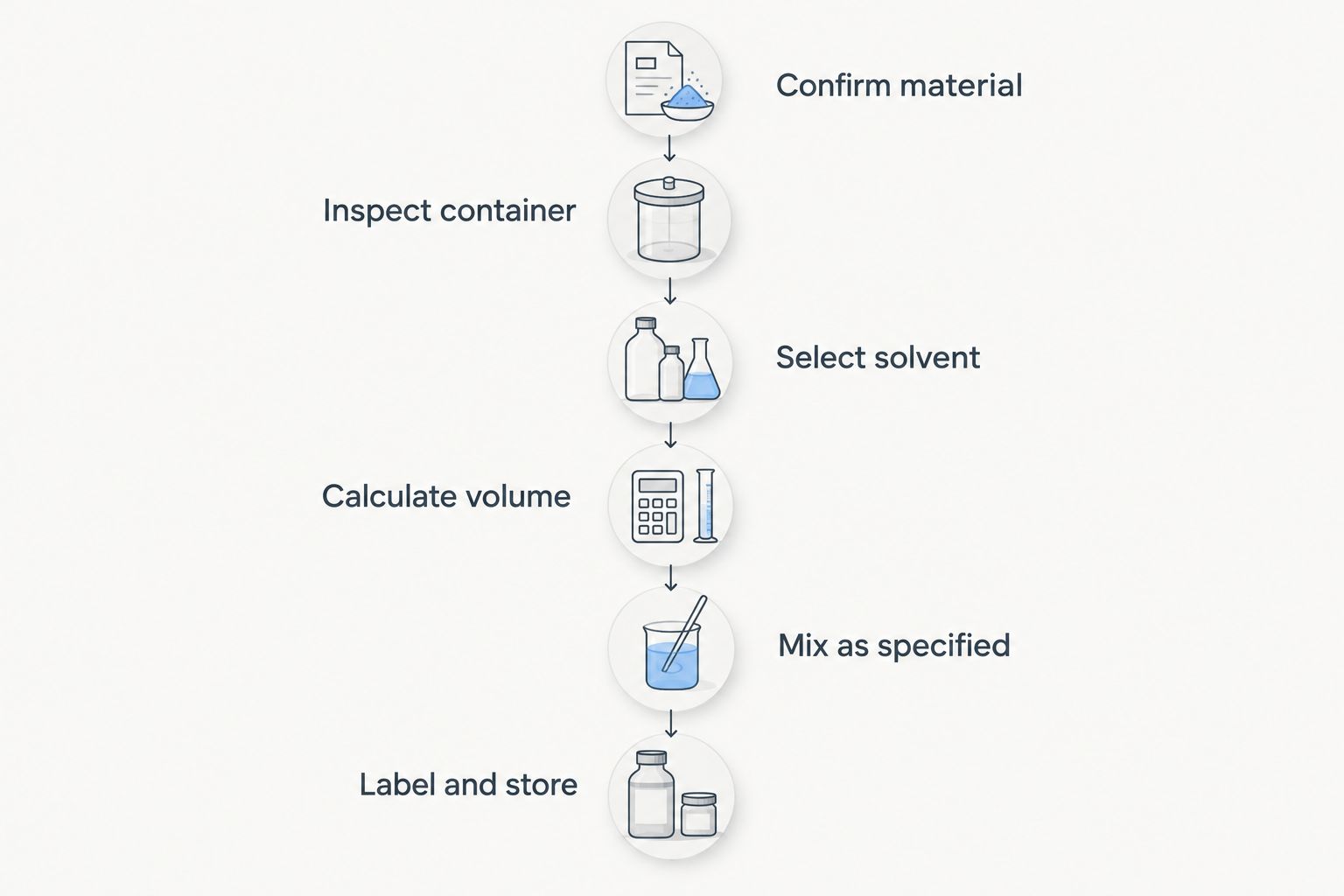
The correct procedure is the one supported by the specific material’s documentation and your validated experimental method. Use the sequence below to turn those requirements into a traceable preparation, without guessing a solvent volume or storage period.
1. Confirm the material and its documentation
Match the vial label to the purchase record, lot identifier, and available analytical documents. Check that the named material, chemical form, and reported content correspond to the material your protocol requires.
Distinguish chromatographic purity from peptide content. A purity result describes the measurement performed; it does not automatically establish the mass of peptide available for a concentration calculation, exclude every contaminant, or demonstrate biological activity.
2. Inspect the container before opening
Examine the vial, closure, and seal for damage or evidence of compromised integrity. Record any discrepancy before preparation rather than trying to explain it after an unexpected assay result.
Do not prepare a questionable vial simply because the powder looks normal. Isolate it under your laboratory’s procedure and obtain a documented disposition from the appropriate laboratory lead or supplier.
3. Select the solvent from written instructions
Use the solvent specified for the material and experimental method. Confirm its composition, grade, and compatibility with the downstream assay, including any preservatives, salts, buffers, or organic components.
Do not assume that water, saline, and bacteriostatic water are interchangeable. A solvent suitable for dissolving a material can still be unsuitable for the cells, enzymes, detection chemistry, or analytical instrument used later.
4. Calculate the required final volume
Calculate the final solution volume from the documented peptide content and the target stock concentration. Keep the mass and volume units consistent, and distinguish final solution volume from the amount of solvent added.
Use calibrated equipment appropriate to the required volume and your method’s accuracy requirements. Have the calculation checked according to your laboratory’s procedure before committing the material.
5. Add solvent and mix as specified
Prepare the workspace and handle the container according to your laboratory’s contamination-control procedure. Add the specified solvent using suitable laboratory equipment, then follow the documented mixing method.
Do not improvise vigorous shaking, heating, sonication, or chemical additions to force dissolution. If the material does not dissolve as expected, pause and investigate rather than changing several preparation conditions at once.
6. Check, label, and store the prepared stock
Inspect the preparation against the appearance criteria in your method, and perform any required analytical checks before experimental use. Visual inspection is a screening step, not a substitute for identity, concentration, or contamination testing.
Label the stock with its identity, lot, concentration basis, solvent, preparation date, preparer, and documented storage conditions. Assign a use period only when supporting instructions or stability evidence justify it.
Which solvent should you use for sermorelin research?
Use the documented solvent, not the solvent most often mentioned in a discussion thread. Solvent selection must address both dissolution and the experiment that follows.
The table compares solvent categories, not approved sermorelin recipes. Each category’s suitability depends on the material-specific instructions and the validated assay.
| Solvent category | Best for | Useful characteristic | Limitation to check |
|---|---|---|---|
| Water without added salts or preservatives | Methods explicitly specifying that water grade | Avoids deliberately introducing salts or preservatives | Does not provide buffering by itself; grade and contamination controls still matter |
| Saline | Methods explicitly requiring its salt composition | Introduces a defined salt-containing solvent when documented | Changes ionic composition and is not interchangeable with plain water |
| Bacteriostatic water | Methods explicitly accepting the stated preservative formulation | Provides a preservative-containing solvent when required | Preservatives can interfere with biological experiments; it does not sterilize the peptide |
| A specified laboratory buffer | Methods validated for that buffer | Establishes a defined chemical environment | Buffer components can affect assays and analytical measurements |
Check the actual solvent label and specification. A familiar category name is not enough to establish its composition, suitability, or handling requirements.
For your 2026 method record, identify the solvent precisely enough that another researcher can reproduce the preparation. Record the solvent lot and relevant composition rather than writing only “water” or “buffer.”
How do you calculate the final sermorelin concentration?
Mass concentration equals peptide mass divided by final solution volume. The calculation is straightforward; deciding which documented mass belongs in the numerator requires more care.
Use this relationship:
Concentration = documented peptide mass ÷ final solution volume
Keep these exact unit relationships separate from any experimental recipe:
- 1 mg = 1,000 micrograms. Convert the mass unit before comparing concentrations expressed differently.
- 1 mL = 1,000 microliters. Match the volume unit to the equipment and calculation.
- 1 L = 1,000 mL. Check this conversion when moving between laboratory stock records and instrument methods.
These are unit conversions, not recommended quantities for a sermorelin preparation. No particular vial mass, solvent volume, or working concentration follows from them.
The guide to calculating peptide concentration after mixing covers the calculation separately from solvent selection. Keep those decisions separate in your worksheet as well.
Why purity is not the same as concentration
Chromatographic area purity is not automatically a peptide mass fraction. Water, counterions, and other material characteristics can affect how a stated quantity relates to the peptide content needed for your calculation.
Record whether your concentration is nominal, corrected using a documented content value, or measured analytically. Do not describe a calculated concentration as experimentally verified unless an appropriate measurement supports that statement.
Why sermorelin reconstitution requirements vary
Different preparation instructions are not automatically contradictory. They can reflect different material specifications, experimental conditions, or measurement requirements.
- Chemical form: Salt form and counterion information affect how you interpret composition and prepare the calculation.
- Content basis: Gross material mass, stated peptide content, and an analytical assay result are different inputs.
- Solvent composition: Salts, preservatives, buffers, and other components change the solution’s chemical environment.
- Target concentration: Solubility and subsequent dilution requirements depend on the concentration your method specifies.
- Experimental system: A preparation for an analytical instrument is not automatically suitable for a cell-based experiment.
- Handling history: Time in solution, temperature exposure, light, and freeze–thaw history belong in the stability assessment.
Your 2026 protocol should connect each chosen condition to its supporting instruction or validation record. Copying a condition without its context makes the procedure harder to defend and reproduce.
What should you document before using the prepared stock?
A useful preparation record allows another researcher to reconstruct what happened without asking the original preparer to remember it. Separate observations from conclusions and retain the supporting documents.
Include the following in the record:
- Material identity, supplier, lot identifier, and relevant certificate references.
- The content value used and whether it represents nominal or measured content.
- Solvent identity, composition, lot, and relevant handling information.
- Calculation, final volume, concentration units, and equipment identification.
- Preparation date, preparer, mixing method, and observations.
- Storage instructions, aliquot identifiers if applicable, and the basis for the assigned use period.
- Required quality checks, results, deviations, and release authorization.
For Peptides777 research peptides, keep supplier information separate from laboratory acceptance. Peptides777 is for researchers sourcing laboratory materials, not people seeking a self-administration protocol. The store describes its materials as research-grade; your laboratory must still establish suitability for the intended experiment.
Can you use a clear solution immediately?
A clear solution is not proof that a sermorelin preparation is ready for an experiment. Clarity does not establish identity, peptide concentration, sterility, or retained activity.
Use the acceptance checks required by your method. If dissolution time or equilibration matters, follow the documented requirement rather than assigning a universal waiting period.
How long can you store reconstituted sermorelin?
Use a storage period supported by the specific preparation’s documentation or stability study. Do not transfer a storage claim from a different peptide, solvent, concentration, or container.
For a 2026 stability record, document the actual storage condition and handling history, including deviations. Refrigeration or freezing alone does not establish an acceptable use period, and a normal appearance does not prove retained activity.
Can you fix a preparation that does not dissolve?
Pause the preparation rather than repeatedly changing conditions. Check identity, solvent composition, calculation, and the written dissolution instructions before taking further action.
Adding acid, base, heat, or another solvent changes the preparation and can affect downstream compatibility. Treat any proposed adjustment as a controlled method change, not an informal rescue step.
FAQ
What's the safest starting point when I reconstitute sermorelin peptide for research?
Start with the material-specific preparation instructions and your laboratory’s approved procedure. Confirm identity, container integrity, solvent requirements, and the concentration calculation before opening the vial.
Can I use bacteriostatic water instead of another solvent?
Use bacteriostatic water only when the documented method accepts its formulation. A preservative-containing solvent is not interchangeable with plain water and does not sterilize the peptide material.
Does a high purity result prove my sermorelin solution is sterile?
No, a purity result does not prove sterility. Purity testing and microbiological testing address different questions, and neither result should be substituted for the other.
How much solvent should I add to a sermorelin vial?
Determine the final volume from the documented peptide content and the stock concentration required by your method. Do not select a universal volume without confirming those inputs and the material-specific instructions.
Can I shake the vial to dissolve the powder faster?
Use only the mixing method supported by the preparation instructions. Do not introduce vigorous shaking, heating, or sonication as an undocumented shortcut.
Does a clear solution mean the concentration is correct?
No, clarity does not verify concentration. A calculated concentration depends on the documented content and final volume; a measured concentration requires a suitable analytical method.
Can I use these laboratory instructions for personal injections?
No, this page addresses laboratory research preparation, not personal administration. Research-use materials and laboratory procedures are not substitutes for prescribed medicines or instructions from a licensed clinician.
One last thing
The final volume and the added solvent volume are not interchangeable terms. Write down which quantity your procedure controls and which quantity the concentration calculation requires; that distinction is easy to lose when a worksheet says only “add diluent.”
Before adopting a 2026 preparation worksheet, ask a second researcher to reproduce the calculation from the record alone. If they need an unwritten assumption, resolve it before using the stock in an experiment.