
Read a peptide certificate of analysis by matching its batch number to your material, checking identity and purity results separately, and confirming what each analytical method actually measures. A high purity percentage does not establish the amount of peptide in a vial, sterility, or suitability for human use. Accept the certificate only for the conclusions its methods and results support.
- Knowing how to read a peptide certificate of analysis starts with matching the batch, not checking the purity percentage.
- HPLC purity and mass spectrometry answer different questions; neither establishes sterility.
- Peptides777 research peptides are for laboratory research, not human treatment.
- Separate chromatographic purity, peptide content, and vial quantity before accepting material for an experiment.
How do you read a peptide certificate of analysis correctly?
Start with traceability, then assess identity, purity, quantity, and experiment-specific requirements. A certificate is useful only when you can connect its results to the material in front of you.
For a 2026 research purchase from Peptides777, evaluate the batch documentation independently of the product description. A general purity claim is not a substitute for a result tied to the supplied lot.
Use this reading order:
- Match the material. Compare the product identity, batch or lot number, and any relevant chemical form with the vial label and order documentation.
- Check document traceability. Look for a report identifier, testing dates, the issuing laboratory, and a clear connection between the tested sample and the supplied lot.
- Read identity evidence. Determine whether the analytical result supports the stated peptide, rather than merely showing a clean chromatographic peak.
- Interpret purity correctly. Identify the method, reported calculation, acceptance criterion, and actual result.
- Separate quantity from purity. Look for an appropriate content or assay result when your experiment depends on the amount of peptide present.
- Check additional requirements. Confirm that the tests address your protocol, including any relevant water, residual solvent, counterion, endotoxin, or microbiological requirements.
What the main tests can establish
| Test or result | Best for | What it supports | Main limitation |
|---|---|---|---|
| HPLC or UPLC purity | Assessing chromatographic purity | Relative separation of detected components under the stated method | Does not independently establish identity, peptide mass, or sterility |
| Mass spectrometry | Supporting molecular identity | Whether observed ions or interpreted mass agree with the expected peptide | Matching mass alone does not establish complete sequence or purity |
| Peptide content or assay | Assessing the amount of peptide | Quantity according to the stated analytical method and reporting basis | Requires clear units, method, and definition of what was measured |
| Water determination | Assessing water contribution | Water present in the tested material | Does not identify all other non-peptide components |
| Endotoxin testing | Assessing bacterial endotoxin | The reported endotoxin result under the test conditions | Does not establish sterility or absence of all contaminants |
| Sterility testing | Assessing growth under specified conditions | Whether growth was detected in the tested sample | Does not establish every attribute needed for human use |
Why this matters
A certificate can contain a valid result and still fail to answer your experimental question. Chromatographic purity, molecular identity, and peptide content are different attributes; treating them as interchangeable creates errors before an experiment begins.
Peptides777 markets its research materials with 99%+ purity. That claim does not, by itself, establish the peptide mass in a vial or suitability for a particular protocol. Read the corresponding batch evidence and the method behind any reported percentage.
For your 2026 laboratory records, preserve the certificate alongside the lot identifier and the experimental record. That connection makes later comparisons meaningful when batches or analytical methods differ.
How do you verify the batch and document?
Match the lot identifier character for character. A report for the same peptide name but a different batch does not establish the properties of your material.
Check the sample description for distinctions that affect interpretation, such as sequence, terminal modifications, or salt form. Similar names are not enough when the analytical target differs.
Look for a traceable report number and an identifiable issuer. If the supplier and testing laboratory differ, establish which organization supplied the sample and which organization performed the analysis; those roles are not interchangeable.
Dates also need context. A testing date is not automatically a manufacturing date, expiry date, or guarantee that storage conditions remained appropriate after testing.
Hold acceptance when the document cannot be tied to the supplied lot. An attractive report layout, signature, or laboratory logo cannot repair a batch mismatch.
What does HPLC purity actually mean?
HPLC separates sample components under a defined set of conditions. When purity is reported by peak-area normalization, the percentage describes the selected peak's share of the integrated detector response—not necessarily its share of the sample's total mass.
Read the chromatogram with the method information. The detector, wavelength, separation conditions, and integration approach affect which components appear and how their signals contribute to the reported result.
Look for:
- Peak assignment: Which peak is identified as the intended peptide?
- Integration: Which peaks are included or excluded from the calculation?
- Separation: Are nearby peaks resolved sufficiently to interpret the result?
- Method details: Are the conditions documented well enough to understand the reported percentage?
- Supporting data: Is a chromatogram available when the summary leaves an important question unanswered?
A single large peak does not prove that only one substance is present. Components can co-elute, and substances with weak detector response can be underrepresented.
Use chromatographic purity to assess chromatographic purity—not vial quantity. A clean trace is useful evidence within its analytical limits.
What should you check in mass spectrometry results?
Compare the expected mass with the reported observed result on the same basis. An ion's mass-to-charge ratio is not automatically the neutral molecular mass, especially when the peptide carries multiple charges.
Check whether the report provides raw ion assignments, a deconvoluted mass, or another interpretation. Also distinguish average mass from monoisotopic mass before treating a difference as an error.
The units matter: 1 kDa equals 1,000 Da. Converting units correctly prevents a reporting-format difference from looking like a molecular-identity problem.
A matching mass supports identity, but it does not independently establish the complete amino-acid sequence. Different structures can share a molecular mass, and identity conclusions depend on the evidence available.
For a 2026 acceptance checklist, record what was compared—not just whether the report says pass. If the mass assignment is unclear, request the interpretation rather than guessing from an unfamiliar spectrum.
Does purity tell you how much peptide is in the vial?
No. Chromatographic purity and peptide quantity answer different questions, even when both are expressed using percentages.
Dry material can include water, counterions, and other components that are not represented by the principal chromatographic peak. A stated fill quantity therefore needs its own interpretation; multiplying it by an HPLC area percentage does not automatically produce the peptide amount.
Keep these terms separate:
- Chromatographic purity: The reported purity under the separation and detection method.
- Peptide content: The amount or proportion of peptide measured on a stated basis.
- Fill quantity: The amount of material placed in the container, as defined by the supplier.
- Net peptide amount: The peptide quantity supported by an appropriate measurement and calculation basis.
1 mg equals 1,000 µg, but unit conversion cannot correct an unclear assay basis. Before calculating an experimental concentration, establish what the quantity describes and whether water or counterion contributions are accounted for.
If quantity is critical to your protocol, request the relevant assay evidence. Do not substitute an unrelated purity result simply because it is the only percentage available.
Why peptide certificate results vary
Differences between certificates do not automatically mean that one result is wrong. First establish whether the laboratories measured the same attribute using comparable methods.
The main drivers are:
- Detection conditions: Different detector settings change which components contribute to a chromatographic signal.
- Separation conditions: Different methods can resolve components differently, affecting peak interpretation.
- Integration rules: Peak inclusion, baseline placement, and integration choices affect area-based results.
- Reporting basis: Dry basis, as-received basis, and different assay definitions are not interchangeable.
- Sample handling: Preparation and storage conditions can affect the material submitted for analysis.
- Identity conventions: Ion assignments, charge states, and mass conventions affect how mass results are presented.
When comparing 2026 reports, compare methods and reporting bases before comparing headline percentages. An unexplained difference calls for clarification, not an assumption that the higher figure represents better material.
How should you decide whether a certificate is sufficient?
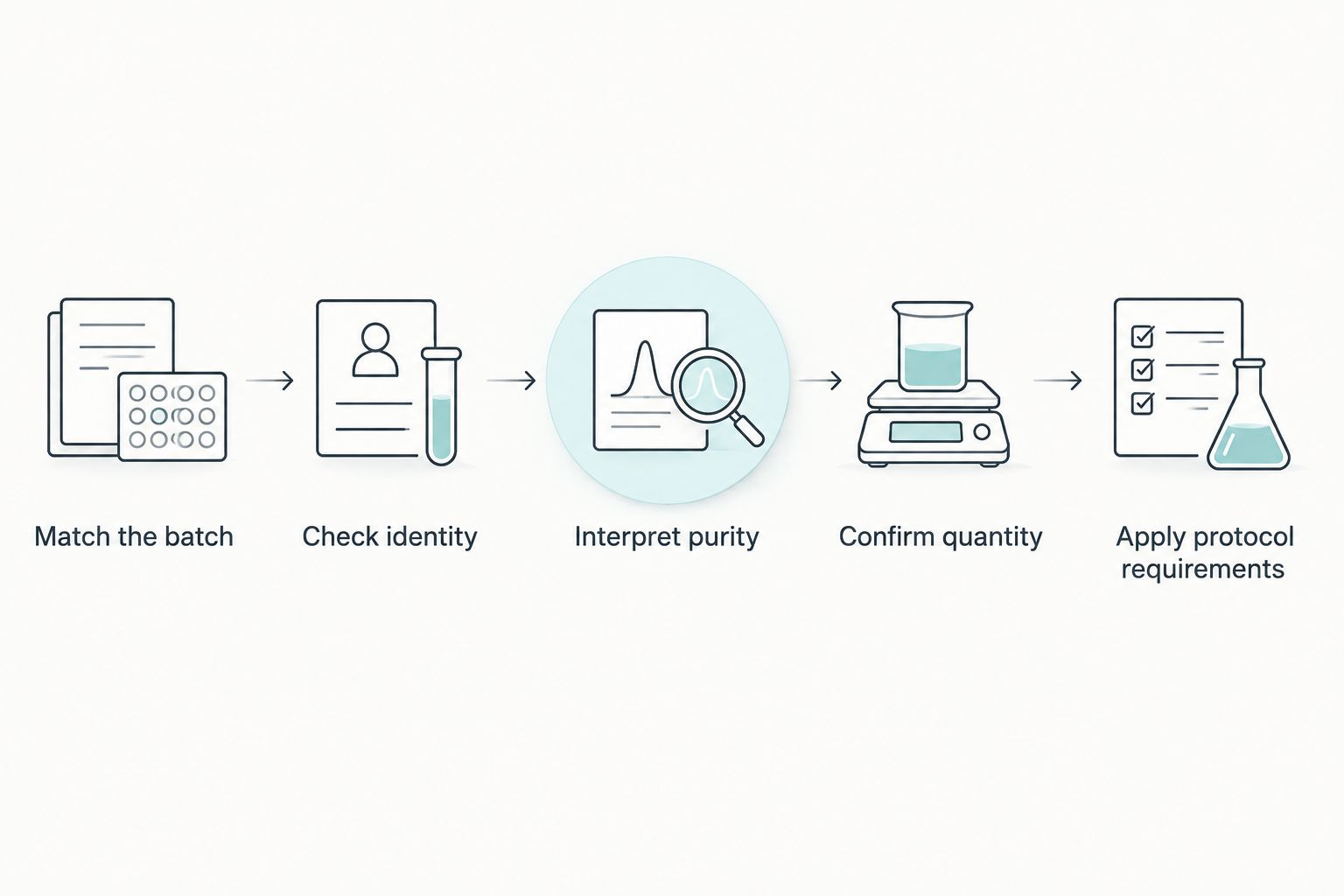
Use a document-review sequence that separates missing information from demonstrated nonconformance. An omitted test does not prove failure, but it cannot support a claim that the untested attribute passed.
- Match the batch: Stop if the report and material cannot be connected.
- Check identity: Resolve discrepancies between the stated peptide and analytical evidence.
- Interpret purity: Confirm what the percentage measures and whether the method suits your question.
- Confirm quantity: Establish the assay basis when your protocol depends on peptide amount.
- Apply protocol requirements: Accept only when the documented attributes meet your laboratory's criteria.
Keep the acceptance decision separate from the supplier's overall reputation. A supplier name does not replace evidence for a particular lot, and an unresolved document question is a reason to pause—not a basis for inventing a result.
Does a high-purity certificate establish sterility?
High chromatographic purity does not establish sterility. Sterility testing and chromatographic analysis assess different attributes, so a purity result cannot stand in for a microbiological result.
Endotoxin testing is separate again. A reported endotoxin result does not establish sterility, and a sterility result does not describe every possible contaminant.
Can a research certificate establish suitability for human use?
A research certificate does not establish suitability for human use. Identity and purity results do not supply the clinical, manufacturing, formulation, and regulatory evidence needed to make that conclusion.
Keep the boundary explicit in your 2026 purchasing and laboratory documentation: research material is assessed for the defined research application. Do not reinterpret a laboratory report as treatment guidance.
FAQ
What's the first thing I should check on a peptide certificate of analysis?
Check that the batch or lot number matches the material you received. Then confirm that the sample description and report identifier connect the analytical results to that lot.
Does 99% HPLC purity mean the vial contains 99% peptide by weight?
No. An HPLC peak-area percentage describes relative detector response under the stated method, not necessarily the peptide's proportion of total sample mass.
Is mass spectrometry better than HPLC for checking peptides?
Mass spectrometry is better suited to supporting molecular identity, while HPLC assesses chromatographic purity. Neither replaces the other, and matching mass alone does not establish a complete sequence.
Can I calculate peptide quantity from the vial label and HPLC purity?
Not reliably without an appropriate assay basis. Water, counterions, and the distinction between detector response and mass prevent a simple HPLC percentage calculation from establishing peptide quantity.
Does a certificate without a chromatogram mean the peptide failed?
No. A missing chromatogram limits your ability to inspect the separation and integration, but it does not demonstrate failure; request supporting data when your acceptance decision requires it.
Does an endotoxin test prove a peptide is sterile?
No. Endotoxin testing and sterility testing assess different attributes, and neither result substitutes for the other.
What should I verify before using Peptides777 research peptides in an experiment?
Verify the supplied lot's identity, interpret its purity evidence, and confirm any quantity or additional testing required by your protocol. A general product description does not replace batch-specific documentation.
One last thing
A pass result is meaningful only when you know what passed. Before accepting a certificate, write down the attribute tested, the method used, the reporting basis, and your acceptance criterion.
If you cannot complete that sentence for a result, ask for clarification before using it in a calculation or acceptance decision. The most useful certificate is not the one with the largest purity figure; it is the one that answers your laboratory's actual questions.