To calculate peptide concentration after mixing, divide the peptide mass by the final solution volume: concentration = mass ÷ volume. Using milligrams and milliliters gives mg/mL; the result is a nominal concentration, not independent confirmation of peptide content, complete dissolution, or stability.
- How to calculate peptide concentration after mixing: divide peptide mass by final solution volume, keeping units consistent.
- Use final solution volume, not automatically the volume of solvent added.
- Dilution calculations use C₁V₁ = C₂V₂ when peptide mass is conserved.
- Peptides777 is for laboratory research buyers, not personal-use peptide dosing.
Why this matters
A concentration error carries into every aliquot prepared from a stock solution. Correct division cannot fix an incorrect starting mass, an unrecorded dilution, or material that never entered solution.
For laboratory work in 2026, keep the calculation separate from the evidence supporting its inputs. Peptides777 sells research-grade peptides and research compounds for laboratory and scientific use; this guide covers solution calculations, not administration or personal use.
Calculate the concentration you prepared, then label what that calculation actually establishes. A value based on nominal vial content is not the same as an analytically measured concentration.
How to calculate peptide concentration after mixing
Use C = m ÷ V, where C is mass concentration, m is peptide mass, and V is final solution volume. The numerator and denominator determine the output units.
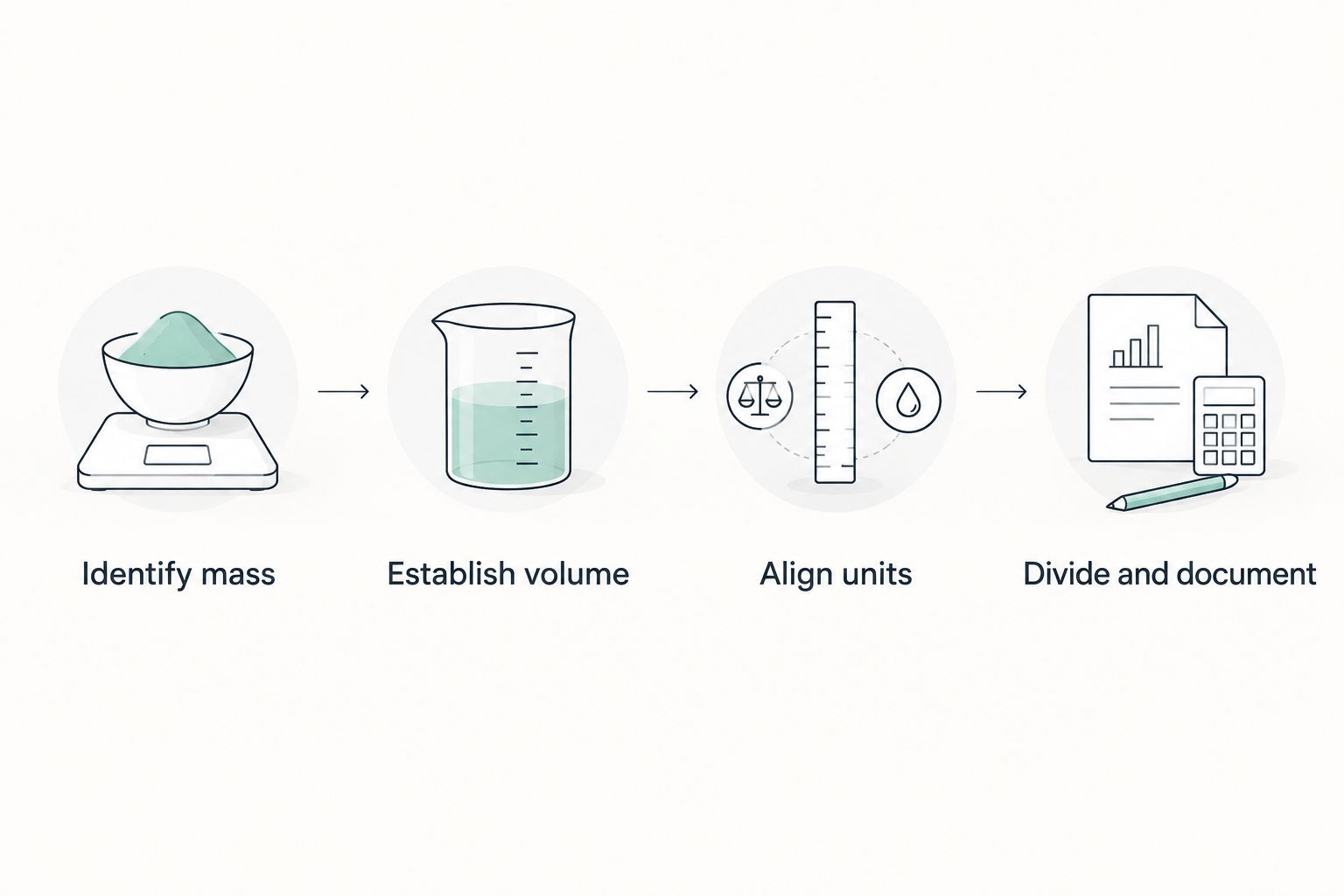
Step 1: Identify the peptide mass
Find the mass assigned to the material being prepared. Record whether it comes from a vial label, a weighing record, or a quantitative analytical result.
Do not substitute a purity percentage for a mass. Purity describes a different property, and its analytical meaning depends on the method used to report it.
Step 2: Establish the final solution volume
Use the volume of the completed solution. If a procedure specifies making a solution up to a final volume, that final volume is the denominator.
Adding a measured volume of solvent is not automatically equivalent to preparing that exact final volume. For quantitative work, follow the validated preparation procedure and record which volume basis you used.
Step 3: Align the units
Choose the units before dividing. Milligrams divided by milliliters produces mg/mL; micrograms divided by milliliters produces µg/mL.
These standard conversions help keep the arithmetic consistent:
- 1 mg = 1,000 µg.
- 1 mL = 1,000 µL.
- 1 L = 1,000 mL.
Convert the mass or volume before entering the calculation. Do not divide a mass in milligrams by a volume in microliters and label the answer mg/mL.
Step 4: Divide and document
Divide the mass by the final volume, then write the units beside the result. Keep the original inputs in the preparation record so another researcher can reproduce the calculation.
A useful record includes the material identifier, mass basis, solvent, final volume, concentration, and preparation date. Add any subsequent dilution as a separate entry rather than overwriting the original stock concentration.
Which concentration should you calculate?
Mass concentration and molar concentration answer different questions. Choose the quantity your experimental method requires rather than treating their units as interchangeable.
| Calculation | Best for | Required inputs | Advantage | Limitation |
|---|---|---|---|---|
| Mass concentration | Preparing a stock specified in mg/mL or µg/mL | Peptide mass and final volume | Direct calculation from mass and volume | Does not describe the number of molecules |
| Molar concentration | Experiments specified in mol/L or µM | Peptide mass, molecular weight, and final volume | Expresses amount of substance per volume | Requires the correct molecular-weight basis |
| Dilution calculation | Preparing a working solution from a known stock | Stock concentration and relevant volumes | Tracks a concentration change without reweighing | Inherits uncertainty in the stock concentration |
Use mass concentration when your protocol specifies mass per volume; use molarity when it specifies amount of substance per volume. Neither format proves that a preparation contains the expected amount of intact peptide.
Mass concentration: mass divided by final volume
For a stock expressed in mg/mL, use peptide mass in mg and final solution volume in mL. No molecular weight is needed for this calculation.
The benefit is simplicity. The limitation is that equal mass concentrations of different peptides do not necessarily represent equal molar concentrations, because their molecular weights differ.
Molar concentration: account for molecular weight
Use molar concentration = mass ÷ (molecular weight × final volume). With mass in grams, molecular weight in grams per mole, and volume in liters, the result is moles per liter.
Use the molecular weight appropriate to the material and calculation basis. Sequence changes, chemical modifications, and the distinction between peptide content and total supplied material matter when interpreting the numerator.
Do not select a molecular weight solely because a compound name looks similar. Match the identity and documentation to the actual research material before converting a mass concentration into molarity.
How do you calculate concentration after dilution?
Use C₁V₁ = C₂V₂ when a known stock is diluted and the amount of peptide is conserved. C₁ is the starting concentration, V₁ is the stock volume transferred, C₂ is the final concentration, and V₂ is the final solution volume.
Rearrange the equation according to the unknown:
- Final concentration: C₂ = C₁ × V₁ ÷ V₂.
- Stock volume needed: V₁ = C₂ × V₂ ÷ C₁.
- Final volume needed: V₂ = C₁ × V₁ ÷ C₂.
Keep both concentrations in matching units and both volumes in matching units. A dilution equation cannot resolve a unit mismatch or an incorrect stock concentration.
The equation also assumes the transferred peptide remains in the preparation. Loss through incomplete transfer, precipitation, or adsorption is not corrected merely by calculating a dilution factor.
Serial dilution requires a record of each transfer
For serial dilution, calculate each stage from the concentration entering that stage. Alternatively, combine the individual dilution factors and apply the total factor to the original stock.
Record the transferred volume and final volume at every stage. An unlabeled intermediate makes the final concentration difficult to reconstruct, even when the last transfer was performed correctly.
For a 2026 laboratory worksheet, separate stock preparation from working-solution preparation. That distinction makes it easier to locate whether an error entered during initial mixing or a later dilution.
Why calculated peptide concentration varies
The equation stays the same; its inputs and assumptions change. Check these factors before comparing concentration records:
- Mass basis. Nominal vial content, gross material mass, and quantified peptide content are not interchangeable descriptions.
- Final volume. Solvent added and completed solution volume are different measurements; identify which your procedure establishes.
- Dissolution. Visible undissolved material means the entire starting mass cannot simply be assumed to be in solution.
- Dilution history. Each transfer and volume adjustment changes the working concentration and needs a traceable calculation.
- Material identity. Molarity requires the molecular weight corresponding to the intended peptide and calculation basis.
- Loss or change. Adsorption, precipitation, evaporation, and chemical degradation can make the current preparation differ from its original calculated state.
These factors do not justify applying an arbitrary correction. Correct only for a quantity that has been established by an appropriate measurement or documented procedure.
For example, evaporation changes the volume basis, while degradation changes what chemical species remain. Neither problem is solved by relabeling the original calculation as a measured concentration.
Does peptide purity change the concentration calculation?
A purity result does not automatically provide the mass fraction needed to correct concentration. Chromatographic area purity, for example, describes relative detector response under the analytical method; it is not automatically a quantitative measurement of peptide mass in the supplied material.
Peptides777 markets its research materials with 99%+ purity. That statement alone does not establish the peptide content, water content, counterion contribution, or measured concentration of a particular prepared solution.
If a validated quantitative result provides an appropriate peptide mass fraction, the mass basis can be adjusted accordingly. Keep that calculation distinct from one based only on nominal vial content.
For 2026 preparation records, identify the basis explicitly: nominal content, documented quantitative content, or measured solution concentration. The label should not imply a stronger analytical claim than the supporting record provides.
How can you check your calculation before using a stock?
Check the equation, the units, and the physical preparation separately. Each check catches a different class of error.
Check the equation in reverse
Multiply the calculated mass concentration by the final volume. The result should recover the mass used in the original calculation, provided the units match.
For dilution, multiply concentration by volume on each side of C₁V₁ = C₂V₂. The amount represented should agree on both sides; disagreement signals an arithmetic or unit problem.
Check the direction of change
For a fixed peptide mass, increasing final volume decreases concentration. For a fixed final volume, increasing peptide mass increases concentration.
Diluting a stock with peptide-free solvent cannot increase its peptide concentration. If a worksheet shows the opposite, inspect the volume ratio before accepting the result.
Check the preparation, not just the spreadsheet
Confirm that the recorded mass and volumes correspond to what was actually prepared. A mathematically correct entry can still describe the wrong vial or an intended preparation that was not completed as recorded.
A clear solution does not independently establish identity, concentration, or stability. Appearance is one observation, not a substitute for an analytical method appropriate to the experiment.
What should a peptide concentration label include in 2026?
Write the material identifier, concentration with units, solvent, preparation date, and a reference to the preparation record. Include the concentration basis when it affects interpretation, such as nominal content versus analytically quantified content.
For a diluted working solution, preserve the connection to its source stock. Researchers should be able to trace the final label back through the dilution history without guessing which intermediate was used.
Follow material-specific documentation and your laboratory's procedures for storage and handling. The concentration equation does not establish a storage condition, expiration date, or suitable research application.
FAQ
How do I calculate peptide concentration after mixing?
Divide peptide mass by final solution volume. Mass in milligrams divided by volume in milliliters gives mg/mL; this is a nominal calculation unless the inputs establish actual peptide content.
Should I use the solvent volume or the final solution volume?
Use the final solution volume. If your preparation records only solvent added, do not silently describe that measurement as an independently established final volume.
How do I convert milligrams to micrograms?
1 mg = 1,000 µg. Multiply a mass in milligrams by 1,000 to express that same mass in micrograms, keeping the concentration denominator unchanged.
How do I calculate peptide concentration after another dilution?
Use C₁V₁ = C₂V₂ when the amount of peptide is conserved. Keep concentration units consistent with each other and volume units consistent with each other.
Does a high purity percentage prove my solution concentration?
No, a purity percentage alone does not prove solution concentration. The analytical method and mass basis determine whether the result supports a quantitative peptide-content correction.
Can I use these calculations for personal peptide dosing?
No, these calculations describe laboratory solution preparation, not personal dosing. Peptides777 markets its research-grade materials for laboratory and scientific research use.
Does a clear peptide solution confirm complete recovery?
No, clarity does not confirm complete peptide recovery or measured concentration. Identity, content, and stability require evidence appropriate to the research method.
One last thing
Write the units before entering the numbers. A calculator can divide any entries you give it; the units reveal whether the answer describes the quantity your experiment requires.
For your next 2026 preparation record, retain the original mass, final volume, and concentration basis beside the result. Those details make the concentration reproducible—and prevent a nominal calculation from being mistaken for a measurement.