To confirm a peptide vial’s concentration matches its label, measure peptide content with a validated quantitative assay and verify the solution’s final volume. A purity percentage, vial weight, or identity test alone cannot establish concentration. For a dry vial, confirm peptide content first; concentration exists only after that material is dissolved in a measured volume.
- How to confirm peptide vial concentration matches label: quantify peptide content, then verify final solution volume.
- Peptides777 markets research-grade peptides; its stated purity does not independently establish vial content or solution concentration.
- Use calibrated quantitative testing with a suitable reference standard, not an uncalibrated chromatographic peak.
- Compare results on the same chemical basis, including units, salt form, and measurement uncertainty.
How do you confirm a peptide vial’s concentration matches its label?
Confirm the amount of the specified peptide, confirm the final solution volume, and compare the calculated concentration with the label’s stated basis. Start by identifying whether the label describes dry peptide content or an already prepared solution.
For a 2026 laboratory purchasing or quality review, follow this sequence:
- Read the label. Record the peptide identity, lot identifier, stated amount or concentration, units, and any description of salt form or peptide-content basis.
- Match the documentation. Check that the certificate of analysis identifies the same lot and distinguishes identity, purity, and quantitative content results.
- Choose quantitative testing. Ask the laboratory for an assay suitable for the specific peptide and sample matrix, using a qualified reference standard.
- Verify final volume. For a reconstituted sample, document the final solution volume rather than assuming it equals the volume of solvent added.
- Compare like with like. Express the result in the label’s units and chemical basis, then assess it against an established specification with measurement uncertainty considered.
A result without the method, units, reference basis, or sample identity is not enough to resolve a label discrepancy. Ask for those details before interpreting a numerical match as confirmation.
Why this matters
A vial can contain the correct peptide and show a high chromatographic purity result while still containing a different peptide amount from its label. These tests answer different questions. Confusing them produces an apparently reassuring report that never measures the claim you need to verify.
The distinction matters in research because concentration affects how much material enters an experiment. If the starting concentration is wrong, subsequent dilutions preserve that error rather than correct it.
For your 2026 records, separate these findings:
- Identity: whether the detected material is consistent with the intended peptide.
- Purity: the proportion assigned to the peptide under the reported analytical method.
- Content: the amount of peptide present on a specified measurement basis.
- Concentration: the amount of peptide per unit volume of solution.
None of these findings establishes suitability for human use. This verification process concerns laboratory materials and analytical measurements, not dosing or treatment.
Dry vial: verify peptide content before concentration
A dry vial has an amount of material, not a solution concentration. A label expressed in milligrams therefore requires a content assessment before it can support a concentration calculation.
Do not treat the total powder mass as the mass of the target peptide. Water, counterions, residual solvents, and other components can contribute to the weighed material. The relevant question is how much of the specified peptide is present on the basis used by the label.
Ask whether the reported result represents peptide content excluding counterions or the mass of a defined salt form. These are not interchangeable descriptions. A laboratory must know which claim it is assessing before issuing a meaningful comparison.
Testing also needs to account for recovery. Incomplete dissolution or material left on the vial can affect the amount transferred into the analytical sample. Document preparation and transfer steps so that an apparent content shortfall is not confused with a sample-handling loss.
Prepared solution: verify amount and final volume
For mass concentration, the governing relationship is:
Concentration = peptide mass ÷ final solution volume.
Express peptide mass in milligrams and final volume in milliliters to obtain mg/mL. The unit conversion is exact: 1 mg/mL equals 1 g/L, and 1 mg equals 1,000 µg. These relationships convert units; they do not verify the amount inside a vial.
Keep the volume term tied to the actual preparation. Adding a stated volume of solvent does not, by itself, establish the same final solution volume after dissolution.
For a 2026 concentration check, record the preparation method, volumetric equipment, diluent, and any dilution performed before analysis. If a laboratory reports the diluted sample’s concentration, apply the documented dilution factor to recover the original solution concentration.
Molar concentration requires another defined input: the molecular mass corresponding to the reported peptide form. Do not substitute a mass for a different sequence, modification, or salt basis without resolving the difference.
Which analytical method can verify the label?
Use a method validated for quantitative measurement of the particular peptide and matrix. The instrument name alone does not tell you whether a report measures concentration.
| Analytical option | Best for | What makes it quantitative | Limitation |
|---|---|---|---|
| Calibrated HPLC assay | Peptides with suitable chromatographic separation and detection | A calibration relationship using a qualified reference standard | Peak-area purity alone does not establish vial content |
| Validated LC–MS assay | Samples needing selective peptide measurement | Appropriate calibration, sample preparation, and control of matrix effects | Detecting the expected mass alone confirms neither amount nor concentration |
| Amino acid analysis | Content assessment when the peptide composition and hydrolysis method are suitable | Quantified amino acids interpreted against the peptide’s composition | Hydrolysis behavior and amino acid recovery require method-specific assessment |
A calibrated HPLC assay can separate relevant components and quantify a target peak, but the result depends on the reference standard and method performance. Ask whether the report gives absolute content or only relative chromatographic purity.
A validated LC–MS assay adds selective detection. However, a mass spectrum showing the expected ion is an identity finding, not a concentration measurement. Matrix effects and the calibration approach remain important.
Amino acid analysis offers another route to peptide-content assessment. It requires suitable hydrolysis and interpretation because amino acids do not all behave identically during preparation.
Choose the method with the testing laboratory rather than selecting an instrument name from a supplier’s report. The best method is the one that can quantify the actual sample against the specific label claim.
Why can a peptide concentration result differ from the label?
A discrepancy does not identify its own cause. Investigate the measurement basis and preparation before attributing the difference to the vial’s contents.
- Different reporting basis. The label and assay can describe different quantities, such as salt-form mass versus peptide content excluding counterions.
- Water and counterions. Non-peptide components contribute to material mass without contributing the same amount of target peptide.
- Final-volume differences. Concentration changes when the actual solution volume differs from the volume assumed in the calculation.
- Incomplete recovery. Undissolved material, transfer losses, or adsorption can reduce the amount reaching the analytical sample.
- Analytical interference. Coeluting components or matrix effects can bias a result unless the method controls them.
- Degradation during handling. Chemical changes can alter the amount of intact target peptide measured by a selective assay.
Each explanation needs evidence. A visible residue, a different salt basis, or an unsuitable calibration procedure supports a specific investigation; a concentration difference alone does not.
What should you request from the testing laboratory?
Request a report that allows another qualified reader to reconstruct the comparison. A bare concentration value is insufficient when its preparation history and measurement basis are unclear.
Your 2026 testing request should identify the exact question: does the supplied sample meet its stated peptide-content or solution-concentration specification?
Include these requirements:
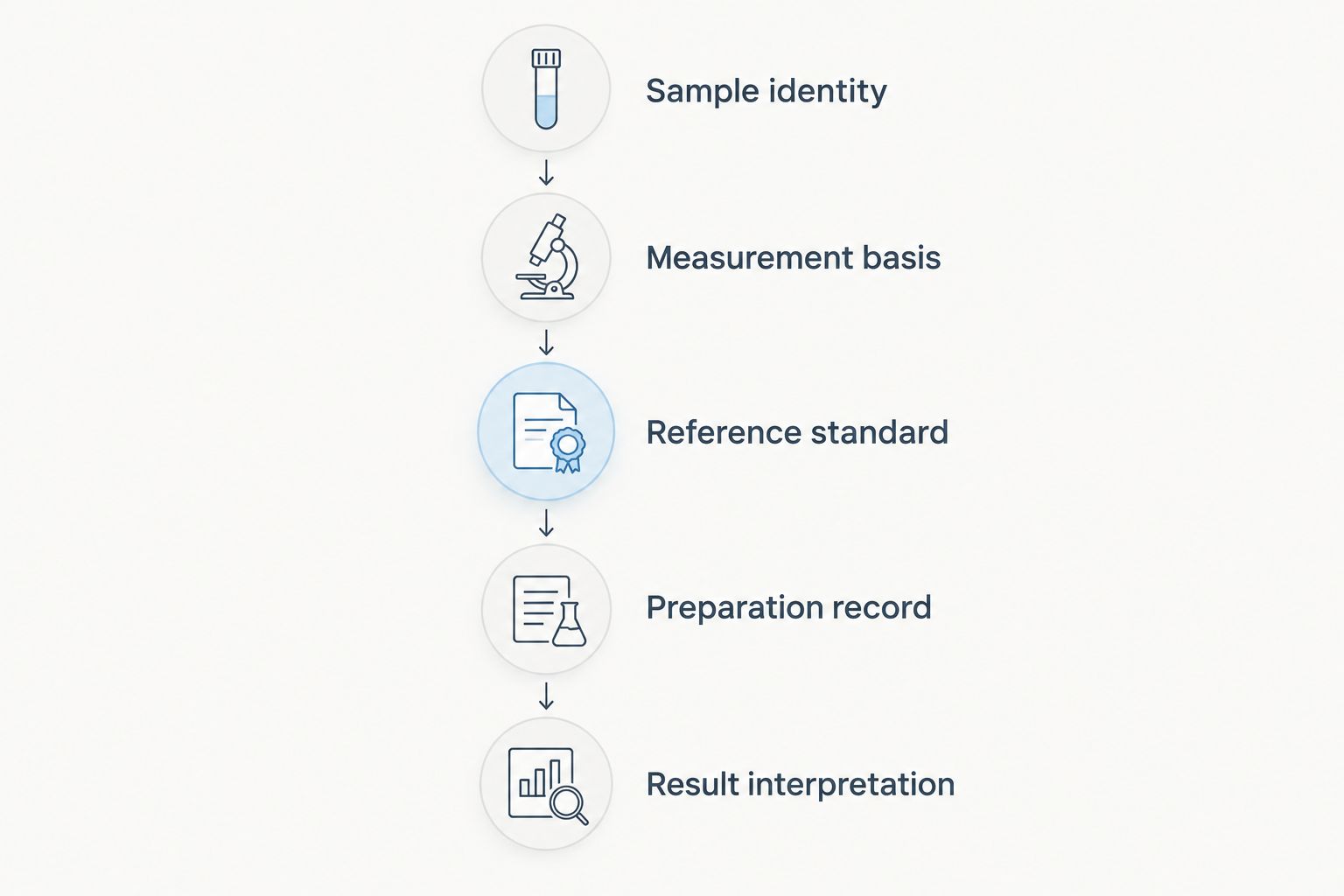
- Sample identity: lot identifier, label claim, sample condition, and preparation history.
- Measurement basis: target peptide form, units, and treatment of counterions or water.
- Method suitability: evidence that the assay measures the peptide selectively in the relevant matrix.
- Reference standard: identity, assigned content, and the basis used for calibration.
- Preparation record: dissolution, transfer, dilution, and final-volume details.
- Result interpretation: quantitative result, relevant uncertainty, and the specification used for assessment.
Ask how the laboratory will distinguish intact target peptide from related substances. A method that groups degradation products with the target can answer a different question from the one your label presents.
Agree on acceptance criteria before results arrive. Choosing a tolerance after seeing the measurement turns the decision into a moving target.
Does 99% purity mean the vial contains its labeled amount?
99% purity does not establish the labeled peptide amount. A chromatographic area percentage describes the relative detector response assigned to a peak under that method; it is not automatically a mass fraction of everything in the vial.
Peptides777 markets research-grade peptides with 99%+ purity. That statement concerns purity, not an independently demonstrated concentration for every prepared solution.
Peptides777 is for laboratory researchers seeking research-grade peptides, not products for human use. You can review the Peptides777 research-peptide offering, but supplier selection and analytical verification remain separate decisions.
The practical benefit of a purity statement is that it identifies a characteristic to investigate. Its limitation is equally important: without lot-matched quantitative evidence, it does not resolve peptide content or final solution concentration.
Can you confirm concentration by weighing the vial?
Weighing the vial does not selectively measure peptide content. Even a reliable net powder mass includes whatever components are present in that powder.
Subtracting an empty-vial mass addresses container mass, not chemical composition. It also requires an appropriate weighing procedure and equipment suited to the measurement.
Use weighing as part of a documented preparation or mass-balance investigation when appropriate. Do not use it as a substitute for a selective quantitative assay of the target peptide.
What should you do if the result does not match?
Keep a disputed sample out of experiments that require a verified concentration until the discrepancy is resolved. Preserve the original label, lot documentation, preparation record, and analytical report.
First check for transcription errors, incompatible units, an omitted dilution factor, and mismatched reporting bases. These checks address the comparison without assuming either the label or laboratory result is correct.
Next ask the laboratory to review sample preparation, calibration, recovery, and uncertainty. If repeat testing is justified, agree on the sampling plan and method before submitting another sample.
For a 2026 quality record, document the final disposition and its evidence. Do not average conflicting results merely to obtain a value closer to the label; establish whether the results are comparable and whether either measurement has an identified problem.
FAQ
Can a certificate of analysis prove my peptide concentration?
A certificate of analysis supports concentration only when it reports a relevant quantitative result on a defined basis for the applicable sample. Identity and purity results alone do not establish solution concentration.
Is HPLC purity the same as peptide concentration?
HPLC purity is not the same as peptide concentration. Relative peak-area results require a suitable quantitative calibration before they can establish an absolute amount or concentration.
Does mass spectrometry tell me how much peptide is present?
Mass spectrometry measures peptide amount only when it is part of an appropriate quantitative assay. An expected mass signal alone is an identity finding.
Can I calculate concentration from the amount printed on the vial?
You can calculate a nominal concentration from the labeled amount and final solution volume. That calculation assumes the labeled amount is correct; it does not independently confirm it.
Does Peptides777’s 99%+ purity claim confirm vial content?
Peptides777’s 99%+ purity claim does not independently confirm vial content. Quantitative content evidence and a documented final volume are needed to verify solution concentration.
Should I use solvent volume or final solution volume?
Use final solution volume when calculating concentration. Record the preparation method so the volume basis can be checked.
What tolerance should a peptide concentration result meet?
Use the applicable specification and a defined decision rule that considers measurement uncertainty. A universal tolerance cannot replace the requirements of the particular material and analytical method.
One last thing
Write down what would count as a match before submitting the sample. Specify the peptide form, concentration units, final-volume basis, acceptance criteria, and treatment of uncertainty.
That short specification prevents a common analytical mismatch: receiving a technically valid purity or identity report when the question was whether the vial contained its labeled peptide amount. Ask for the measurement you need, not simply a test with a familiar instrument name.