Some peptides can be reconstituted with saline, but saline is an acceptable substitute for water only when the peptide’s documentation or a validated laboratory method supports it. Sodium chloride changes the solution’s ionic strength, which can affect peptide solubility, aggregation, and experimental results. For laboratory work in 2026, use the specified diluent rather than treating saline, sterile water, and bacteriostatic water as interchangeable.
- Can peptides be reconstituted with saline? Only when peptide-specific documentation or a validated laboratory method supports that diluent.
- Normal saline contains 0.9% sodium chloride; it changes ionic strength and is not a buffer.
- Clear dissolution does not establish peptide stability, biological activity, or compatibility with your assay.
- Peptides777 markets research-grade peptides for laboratory and scientific research, not personal treatment.
Can peptides be reconstituted with saline instead of water?
Yes for a documented, compatible preparation; no as a blanket substitution. The deciding evidence is the formulation or laboratory method for the exact peptide, not advice about peptides as a single category. A method that specifies water has not automatically established compatibility with saline.
Normal saline contains 0.9% sodium chloride, equivalent to 9 mg/mL. It supplies sodium and chloride ions, but it does not provide a defined buffering system. Those distinctions matter when you prepare a stock solution or introduce that stock into an assay.
| Diluent | Best for | Useful property | Main limitation |
|---|---|---|---|
| Normal saline | Methods that explicitly specify sodium chloride solution | Provides a defined sodium chloride concentration | Changes ionic strength and does not control pH |
| Sterile water | Methods that specify water without added salt | Avoids adding sodium chloride | Does not provide buffering or an antimicrobial preservative |
| Bacteriostatic water | Methods that explicitly permit the labeled preservative | Contains an antimicrobial preservative | Preservative compatibility must be established |
| Defined buffer | Methods requiring controlled pH | Provides buffering within its useful range | Buffer components can interfere with downstream measurements |
Peptides777 is a research-peptide store for laboratory buyers. When reviewing a Peptides777 listing, distinguish its research-use description from the peptide-specific preparation instructions needed for your experiment.
Why this matters
Changing the diluent changes your experimental conditions. Even when the peptide concentration stays the same, added salt or preservative creates another variable that can complicate the interpretation of your results.
A powder that disappears into solution has passed a visual observation, not a stability test. Dissolved material can still undergo chemical changes or form assemblies that you cannot assess by eye.
For reproducible laboratory work in 2026, record both the peptide and its diluent. A preparation record that names only the peptide leaves out part of the formulation.
Normal saline: added salt without pH control
Normal saline is a 0.9% sodium chloride solution. Its sodium and chloride concentrations are each approximately 154 mmol/L, a consequence of its chemical composition rather than a peptide-specific recommendation.
The benefit is a defined salt concentration when your method calls for it. The limitation is equally important: normal saline is not a general-purpose peptide solvent and is not a pH buffer.
Salt changes electrostatic interactions in solution. Depending on the peptide and conditions, those changes affect interactions between peptide molecules and with other components in the preparation. There is no universal rule that adding sodium chloride improves peptide dissolution.
Also distinguish normal saline from buffered saline. A buffered saline preparation includes components intended to resist pH changes; plain sodium chloride solution does not. Substituting one for the other changes more than the label on the bottle.
Sterile water: no added sodium chloride
Sterile water avoids the sodium chloride introduced by saline. That makes it appropriate when the laboratory method specifies water and added salt would introduce an unwanted variable.
Its limitation is that water alone does not establish a controlled pH or guarantee peptide solubility. A peptide’s chemical properties and the complete formulation still determine whether the preparation works.
Sterility also describes a different property from chemical compatibility. A sterile diluent is not automatically the correct solvent, and using it does not establish that the final peptide preparation is sterile.
Use the water grade specified by the method. Do not replace a laboratory reagent requirement with a clinical-sounding label and assume the two satisfy the same analytical conditions.
Bacteriostatic water: a preservative is another variable
Bacteriostatic water contains an antimicrobial preservative. That distinguishes it from preservative-free sterile water, but it does not make it a universally better choice for research peptides.
The potential benefit is the preservative function described by the diluent’s labeling. The limitation is that the preservative becomes part of your experimental mixture and requires compatibility assessment.
Cell-based and biochemical experiments depend on their complete chemical environment. If a method specifies preservative-free water, bacteriostatic water is a formulation change rather than a direct equivalent.
Read the actual diluent label instead of assuming every product has the same composition. Neither the word bacteriostatic nor a clear-looking solution establishes peptide stability or suitability for a particular assay.
Why saline compatibility varies
Compatibility depends on the peptide and the experiment, not simply whether the powder dissolves. These factors explain why a saline substitution needs specific support:
- Peptide sequence: The arrangement of charged, polar, and hydrophobic residues influences how a peptide behaves in solution.
- Solution pH: pH changes the ionization of relevant chemical groups and can affect solubility and degradation pathways.
- Ionic strength: Sodium chloride changes charge screening and interactions among dissolved molecules.
- Peptide concentration: A successful dilute preparation does not establish that a more concentrated stock behaves identically.
- Other ingredients: Buffers, preservatives, and existing formulation components contribute to the final chemical environment.
- Experimental endpoint: A preparation suitable for one measurement is not automatically suitable for another, especially when the assay responds to salt or additives.
These are compatibility questions, not a recipe. They do not establish a universal salt concentration, storage period, or mixing procedure for an unspecified peptide.
For a 2026 laboratory protocol, define the acceptance criteria before comparing diluents. Otherwise, a convenient preparation can be mistaken for a validated one.
How do you check whether saline is acceptable?
Use a document-first process. Do not turn a solvent substitution into an undocumented experiment inside your main experiment.
- Identify the material. Match the peptide name, chemical form, formulation, and lot to the documentation you are using. Similar names do not establish identical preparation requirements.
- Check the method. Find the specified diluent, preparation conditions, and any compatibility information. A purity statement alone does not answer these questions.
- Review the assay. Determine whether added sodium chloride or preservative changes the final experimental mixture. Include the diluent contribution when preparing controls.
- Verify suitability. If substitution is necessary, assess it through the laboratory’s approved method-development process rather than assuming equivalent performance.
- Record the preparation. Document the actual diluent, relevant conditions, observations, and deviations so the experiment can be interpreted and repeated.
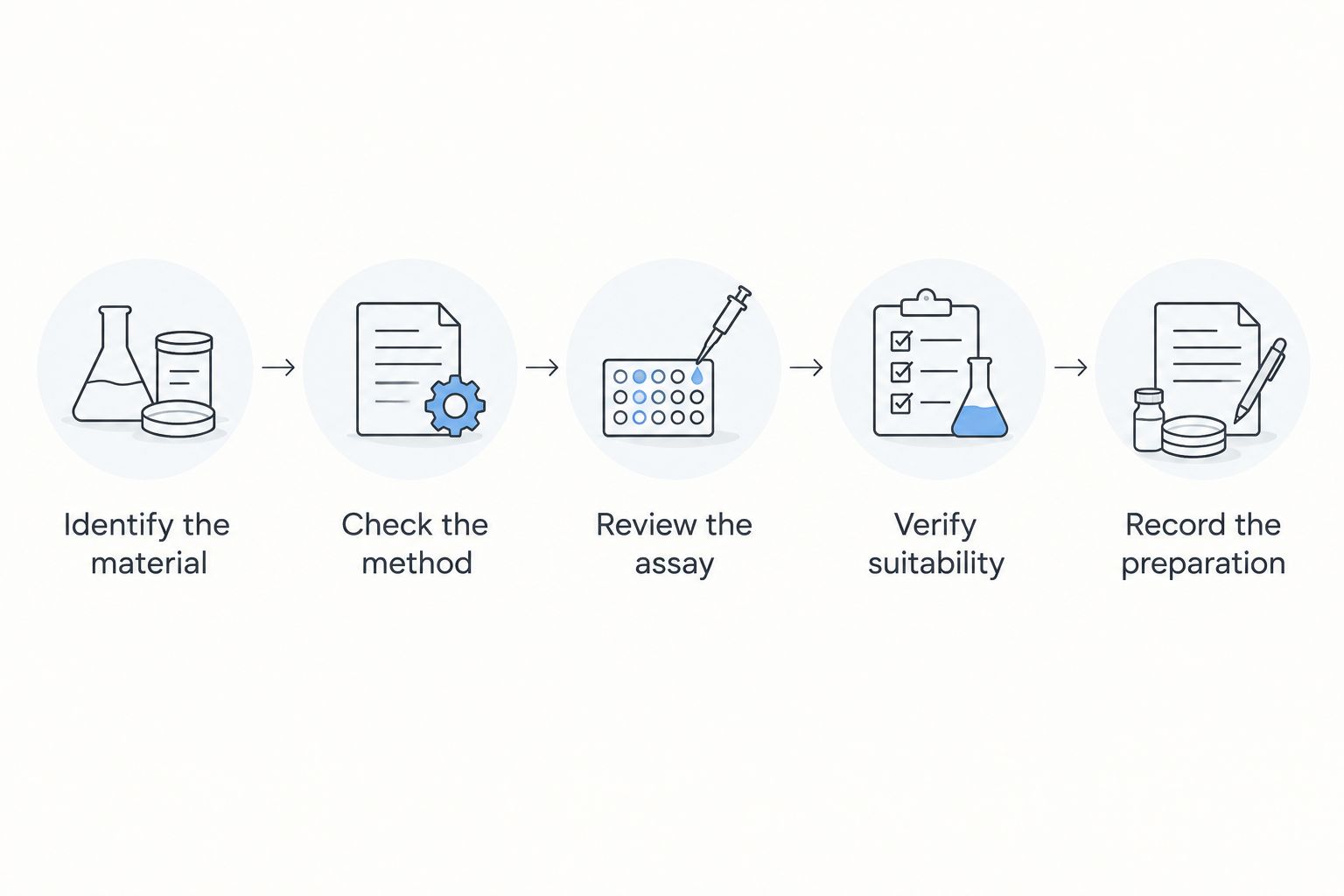
If the documentation does not address saline, ask a precise question: is this sodium chloride solution supported for this material under these experimental conditions? A general statement that peptides dissolve in water does not resolve that question.
For Peptides777 research compounds, request peptide-specific preparation information rather than inferring saline compatibility from the store’s research-grade positioning. If compatibility remains unestablished, retain the documented method or resolve the uncertainty through an approved laboratory process.
What should you record after reconstitution?
A useful preparation record identifies what actually entered the experiment. In 2026, a product name and preparation date alone still do not explain the solution’s composition.
Record the peptide identifier and lot, the diluent’s identity and composition, the preparation date, and the conditions required by your method. Include the intended stock concentration and the preparation calculation in the laboratory record, without treating a generic online guide as the source of that concentration.
Document observations such as visible particles, cloudiness, or unexpected color changes. Those observations support an investigation, but they do not identify the cause by themselves.
Storage instructions must come from the material’s documentation or a validated method. Neither saline nor bacteriostatic water creates a universal storage lifetime for reconstituted peptides.
Does 0.9% saline preserve reconstituted peptides?
0.9% saline is not, by itself, an antimicrobial preservative or a peptide-stability guarantee. Sodium chloride concentration does not establish how long a particular peptide remains chemically intact or biologically active.
Do not infer a storage period from the word saline. Use peptide-specific stability information and the storage conditions established for your laboratory method.
Is 0.9% saline the same as bacteriostatic water?
0.9% saline is a sodium chloride solution; bacteriostatic water is water containing an antimicrobial preservative. They differ in composition and experimental effects, so they are not interchangeable labels for the same diluent.
Some formulations combine salt with a preservative. Read the complete ingredient information instead of classifying the preparation from a shortened product name.
Can you use saline because a peptide solution looks clear?
A clear solution does not prove saline compatibility. Visual clarity tells you that you are not seeing obvious undissolved material or turbidity under those observation conditions; it does not establish identity, chemical stability, or assay performance.
If you need evidence of stability or activity, use the analytical or functional assessment specified by the method. Appearance alone cannot answer those questions.
FAQ
Can all peptides be reconstituted with saline?
No. Saline compatibility depends on the exact peptide, formulation, concentration, and experimental conditions. Use peptide-specific documentation or a validated laboratory method rather than a category-wide rule.
What does 0.9% saline mean?
0.9% saline contains 9 mg of sodium chloride per mL of solution. That composition does not make it a universal peptide solvent or a pH buffer.
Is saline better than sterile water for research peptides?
Neither saline nor sterile water is universally better for research peptides. The correct choice is the diluent specified by the peptide documentation and experimental method.
Can I use bacteriostatic water instead of saline?
Use bacteriostatic water instead of saline only when the method supports that substitution. Bacteriostatic water introduces a preservative, while saline introduces sodium chloride; those changes require separate compatibility assessment.
Does a 99% purity claim tell me which diluent to use?
No. A 99% purity claim does not establish solubility, saline compatibility, storage stability, or suitability for a particular assay. Those questions require separate preparation and method information.
How long do peptides last after reconstitution with saline?
There is no universal storage lifetime for peptides reconstituted with saline. Use stability information for the exact material, diluent, and storage conditions rather than assigning a generic expiration period.
Does sterile saline make a research peptide safe for injection?
No. A sterile diluent does not establish the final preparation’s sterility, endotoxin status, clinical suitability, or regulatory approval. Research-use peptides are not instructions or products for personal treatment.
One last thing
A purity percentage is not a formulation instruction. Peptides777 markets its research materials with 99%+ purity, but that claim does not establish that saline is an appropriate diluent for every material.
Before approving a saline substitution in 2026, finish this sentence in your laboratory record: the change is acceptable because the specified documentation or compatibility assessment supports it. If the only justification is that the solution looks clear, the compatibility question remains unanswered.