Do not use a peptide vial while a suspected broken seal remains unresolved. Separate it from usable research materials, document the damage, and have your laboratory’s responsible reviewer assess the closure; damage to an outer cap does not, by itself, establish whether the stopper or container seal has failed.
- Can a peptide be used if the vial seal looks broken? Not until a laboratory review resolves the concern.
- Peptides777 research peptides are intended for laboratory research, not personal use.
- A damaged outer cap and a compromised stopper are different findings; neither should be assessed by opening the vial.
- Photograph the condition, isolate the vial, and request a documented supplier review before deciding its disposition.
Can a peptide be used if the vial seal looks broken?
Hold the vial rather than using it to find out whether it is acceptable. The immediate question is whether the container closure remains intact, not whether the powder looks normal. A visual inspection can identify reasons to reject or investigate a vial, but it cannot establish sterility or rule out contamination.
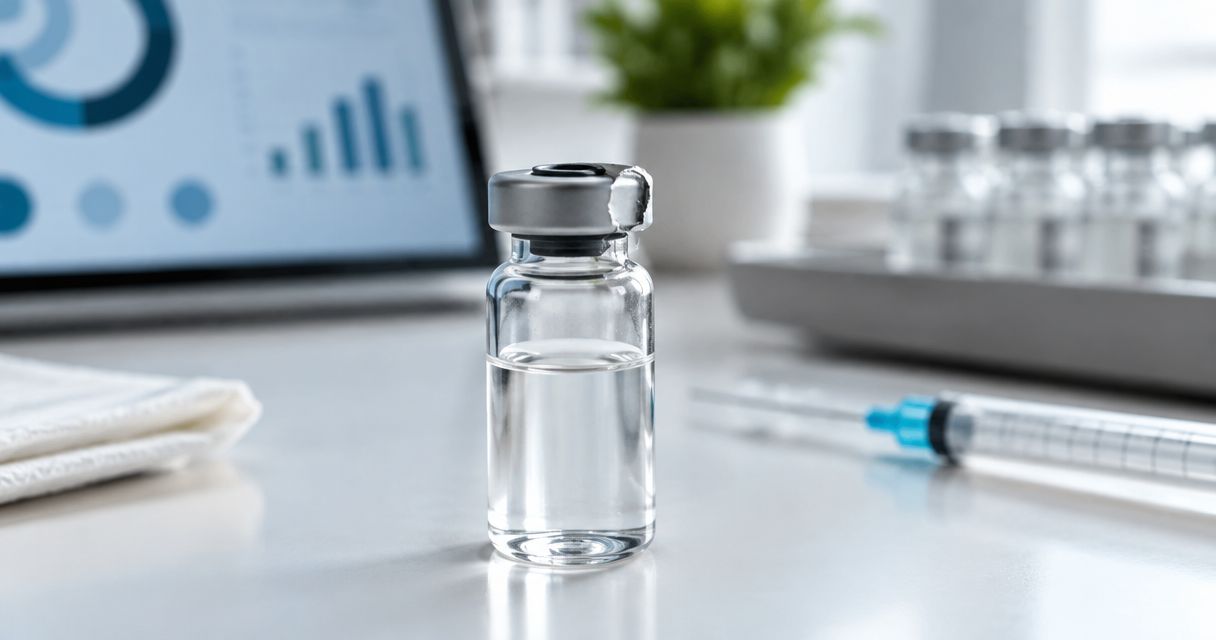
The word seal can refer to different parts of a vial. Some containers have a removable protective cap above a metal closure and an elastomeric stopper; others use different packaging. Assess the actual container rather than assuming every vial has the same construction.
| Observed condition | What it establishes | What to do next |
|---|---|---|
| Outer cap appears scratched or damaged | Visible damage to the protective component, not proof of stopper failure | Photograph it and request review without removing more packaging |
| Metal closure appears lifted, distorted, or loose | A concern about the assembly securing the stopper | Hold the vial and refer it for a closure assessment |
| Stopper appears displaced or punctured unexpectedly | The vial is not in its expected unopened condition | Exclude it from routine use and escalate the finding |
| Glass appears cracked or liquid is leaking | Visible container damage or loss of containment | Avoid unnecessary handling and follow laboratory safety procedures |
| Closure condition is unclear | The receiving inspection has not resolved acceptability | Keep the vial on hold until a documented decision is made |
Peptides777 sells research-grade peptides and research compounds for laboratory and scientific research. Peptides777 is for laboratory researchers, not people seeking peptides for personal use. A research-use designation is not permission to inject, ingest, or otherwise administer a questionable vial.
Why this matters
A suspect container introduces uncertainty before an experiment begins. If material has been exposed, lost, or altered, the experiment no longer starts with the same assumptions as work performed using an accepted vial.
That uncertainty affects interpretation as well as handling. An unexpected result from a questionable vial cannot establish whether the compound, the procedure, or the container condition caused the result. Using another sample to investigate the damage does not restore the original vial’s integrity.
For your 2026 receiving checklist, keep acceptance separate from experimentation. The receiving decision asks whether the material meets your laboratory’s requirements; the experiment asks a scientific question. Do not use the second process as a substitute for the first.
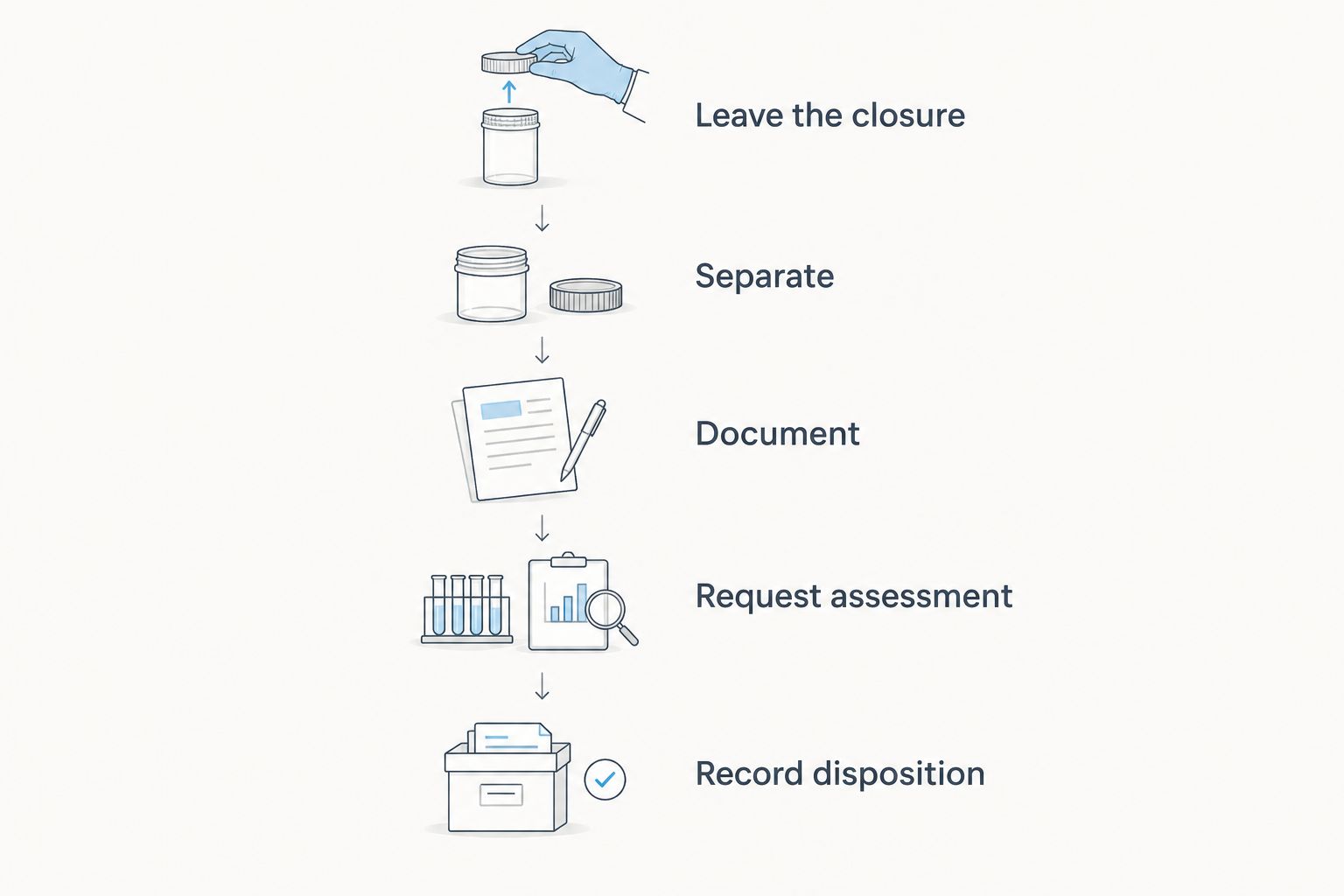
What should you do when the seal looks damaged?
Leave the closure as received
Do not remove the cap, lift the metal closure, press the stopper back into position, or puncture it to inspect the contents. Those actions change the condition you are trying to document and can introduce another route of exposure.
An unopened vial preserves more useful evidence than an opened one. If you have already manipulated it, stop and record exactly what happened rather than describing it as received unopened.
Separate it from accepted materials
Place the suspect vial in a designated hold area under your laboratory’s procedures. Make its status clear so another person does not mistake it for an accepted sample.
Continue to follow applicable storage instructions while the review is pending. A hold status is not a reason to leave a material under unsuitable conditions, and it does not justify improvising a new storage method.
Document the condition without testing it
Photograph the vial from angles that show the suspected damage, its identification, and the surrounding packaging. Record what you can actually see: a lifted edge, a displaced stopper, a crack, residue, or another specific feature.
Avoid conclusions your observations cannot support. Write that the closure appears uneven rather than declaring that contamination occurred. Keep the vial’s identity connected to the photographs so the reviewer can match the evidence to the correct material.
Ask for a documented assessment
Give the supplier and your laboratory reviewer the same factual account. Include the product identifier shown on the label, the lot identifier if present, the order reference, and whether the vial arrived in that condition or changed during handling.
For a Peptides777 research-peptide order, use the contact page to raise the concern. Request an assessment of the photographed condition and the appropriate next step; do not assume that a particular return, replacement, or refund policy applies.
Record the final disposition
The review should end with a clear status: accepted under your laboratory’s criteria, rejected, returned under agreed instructions, or disposed of under the applicable procedure. Retain the reason for that decision with the receiving record.
Your 2026 laboratory receiving record should also identify who authorized the disposition. An informal message that the vial seems fine is not a substitute for the acceptance process your work requires.
Why the response varies with the damage
The response depends on the condition observed, not the apparent value of the contents. A scratched protective component, a displaced stopper, and cracked glass present different evidence; treating them as interchangeable hides the actual problem.
Use these factors to organize the review:
- Affected component: Identify whether the concern involves the outer cap, securing closure, stopper, or glass. A description of the part is more useful than the single word broken.
- Evidence of exposure: Record visible openings, unexpected punctures, leakage, or residue without trying to create a better view by opening the vial.
- Handling history: Distinguish damage present on receipt from damage observed after storage or handling. Preserve that sequence in the record.
- Material condition: Note unexpected visible changes, but do not treat normal-looking powder or liquid as evidence that the closure is acceptable.
- Acceptance requirements: Apply the laboratory’s requirements for the intended research. Supplier feedback informs the assessment but does not replace local authorization.
The benefit of a documented hold is that it preserves evidence and prevents accidental use. Its limitation is equally clear: holding a vial does not repair it or prove that its contents remain suitable. The review still needs a defensible conclusion.
Does a damaged flip-off cap mean the peptide is contaminated?
A damaged flip-off cap does not, by itself, prove contamination. Where this type of cap is used, the protective cap and the stopper are separate components, so the assessment must identify which component is damaged.
The opposite conclusion is also unsupported: an apparently intact stopper does not prove that a suspect vial is uncontaminated. Photographs help explain the concern, but they cannot demonstrate everything about a container’s integrity or its contents.
For a 2026 quality review, document the component-level finding rather than assigning a pass based on appearance. If the supplier explains that a particular feature is normal for that packaging, retain that explanation and let the authorized reviewer decide whether it resolves the concern.
What if only the outer packaging is damaged?
Damage to a shipping carton is not the same finding as damage to the vial closure. Inspect the received condition according to your laboratory’s procedure and document any connection between the packaging damage and the vial.
Do not describe intact-looking packaging as proof that the vial is acceptable, either. The carton and the primary container require their own observations; one does not automatically establish the condition of the other.
Can you disinfect or reseal a peptide vial with a broken seal?
Do not treat surface disinfection or an improvised repair as restoration of container integrity. Cleaning an exterior surface does not establish what happened inside the vial, and reseating or covering a damaged closure does not reverse a possible exposure.
Do not apply glue, tape, or a replacement closure to make the vial appear unopened. That changes the evidence and leaves the underlying suitability question unresolved. A container that looks repaired is not equivalent to one accepted in its original condition.
Similarly, do not reconstitute the material to see whether it dissolves normally. Dissolution is not a test of sterility, identity, or closure integrity, and opening the vial creates an additional handling event to document.
Can a purity report clear a damaged vial for use?
A purity report does not resolve a broken-seal concern by itself. Analytical purity, sterility, and container integrity address different questions; evidence about one should not be substituted for evidence about another.
Peptides777 markets its research materials with 99%+ purity. That stated purity does not establish the condition of an individual vial after damage or suspected exposure, and it is not a claim that the material is suitable for human administration.
Keep any analytical documentation connected to the correct material and lot, but assess the damaged container separately. The useful question is not whether a report exists; it is whether the available evidence answers the specific reason the vial was placed on hold.
What should you tell the supplier?
Send a short factual report rather than a diagnosis. A useful report identifies the material, describes the observed damage, explains when it was noticed, and states whether the vial has been opened or otherwise manipulated.
Include the following in your 2026 supplier correspondence:
- The order reference and identifiers visible on the vial.
- Clear photographs of the closure, container, and relevant packaging.
- The condition observed at receipt and any later handling.
- Whether leakage, glass damage, or an unexpected puncture is visible.
- A request for written guidance on assessment and disposition.
Ask questions that produce an actionable answer. Does the photographed closure match the expected packaging? Does the visible condition require rejection? What instructions apply if the supplier requests a return?
Do not ship a leaking or damaged container back using improvised packaging. Get the applicable instructions and follow your laboratory’s handling and transport requirements. Keep the correspondence with the receiving record rather than relying on someone’s memory of a conversation.
FAQ
Can I use a peptide if the vial seal looks broken but the powder looks normal?
Do not use the vial while the seal concern remains unresolved. Normal-looking powder does not establish container integrity or rule out contamination; hold it for a documented laboratory review.
Is a missing protective cap the same as a broken vial seal?
A missing protective cap is not automatically the same as a failed stopper seal. It is still an unexpected packaging condition that requires assessment before the vial is accepted for research use.
Should I open the vial to check whether the stopper is damaged?
Do not open the vial to investigate suspected closure damage. Photograph the received condition and have the responsible reviewer assess it without adding another handling event.
Can alcohol make a vial with a broken seal safe to use?
Exterior alcohol disinfection does not restore a compromised container seal or establish that the contents are suitable. Do not use surface cleaning as a substitute for a closure assessment.
Does a purity certificate prove that a damaged vial is acceptable?
A purity certificate does not prove that a damaged vial is acceptable. Purity testing and container-integrity assessment answer different questions, and neither alone establishes suitability for human use.
What if I already reconstituted the peptide before noticing the damage?
Stop using the material and record that reconstitution occurred before the damage was noticed. Keep it identified and separated under laboratory procedures while the responsible reviewer determines its disposition.
Should every vial in the shipment be rejected if one looks damaged?
One damaged vial does not establish the condition of every other vial in the shipment. Document the affected material, inspect the remaining containers under the receiving procedure, and let the reviewer determine the scope of the hold.
One last thing
The most useful evidence can disappear when someone tries to fix the problem. A cap removed for a closer look or a stopper pressed back into place changes the condition the supplier and laboratory need to evaluate.
Make preservation of the received condition a standing instruction in your 2026 receiving procedure. When a seal looks wrong, the next move is documentation and review—not opening, repairing, or experimenting with the vial.