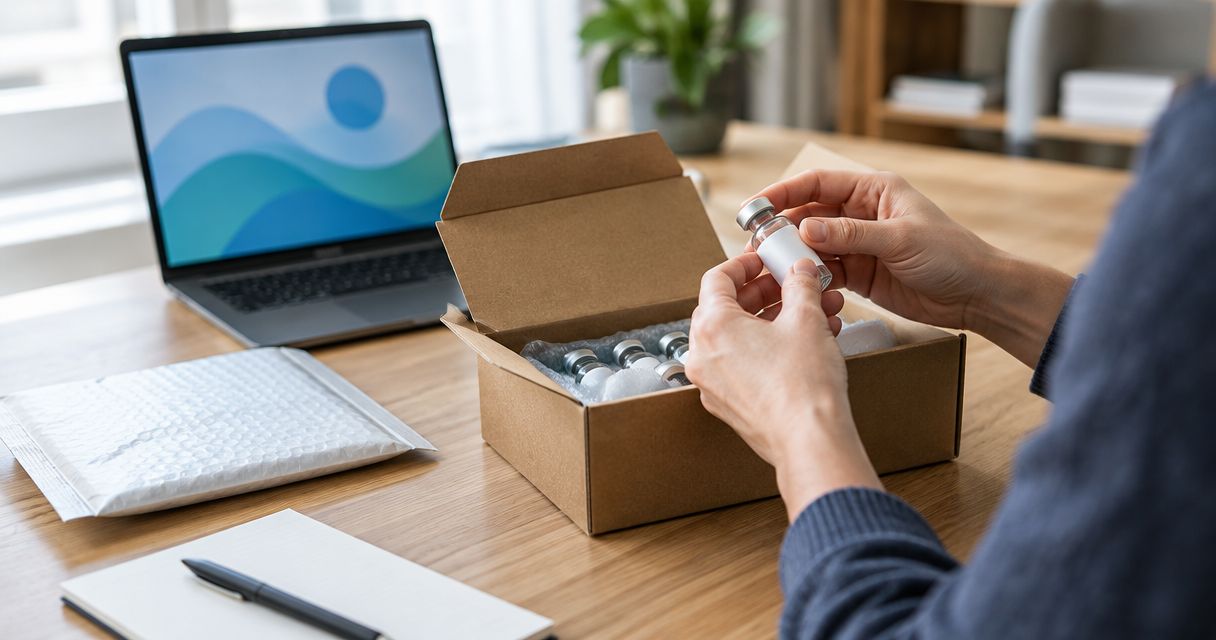
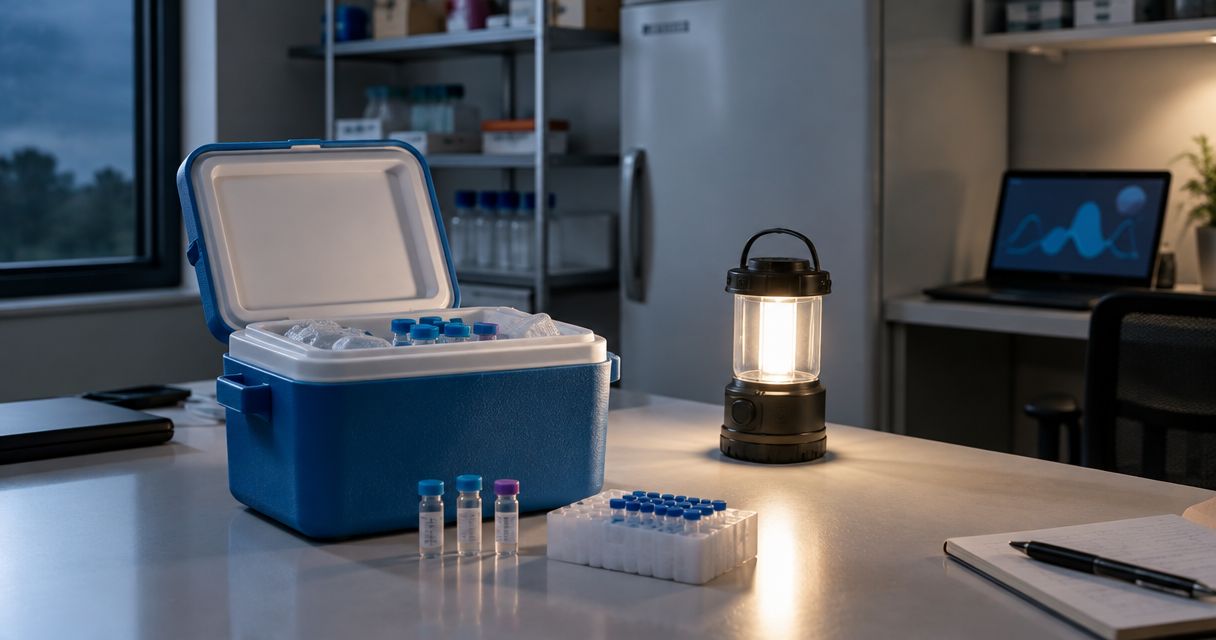
Store research peptides during a power outage by keeping the storage unit closed, monitoring temperature, and following each material’s documented storage limits. Transfer vials to qualified backup storage when the temperature record or your laboratory’s contingency procedure calls for it; extra cooling does not automatically mean better protection. Quarantine any material with an undocumented or out-of-limit exposure until its suitability for research has been assessed.
- How to store peptides during a power outage: follow material-specific storage limits and preserve temperature records.
- Keep lyophilized peptides sealed; assess reconstituted peptides against their solution-specific storage instructions.
- Use monitored backup storage, not unmeasured cooling or an assumed outage grace period.
- Peptides777 supplies research-grade peptides for laboratory research, not human treatment.
Why this matters
A power outage creates two separate problems: controlling exposure and proving what happened. Restoring refrigeration addresses the first problem, but it does not erase a temperature excursion or establish that a vial remains suitable for an experiment.
Your 2026 outage plan needs a material-specific decision rule, not a universal countdown. A refrigerator’s ability to stay cool is not the same as a peptide’s demonstrated stability under those conditions.
Peptides777 supplies research-grade peptides for laboratory and scientific research. Treat those materials as research reagents: their storage requirements and your laboratory’s acceptance criteria govern handling, not advice intended for food or household medicines.
How do you store research peptides during a power outage?
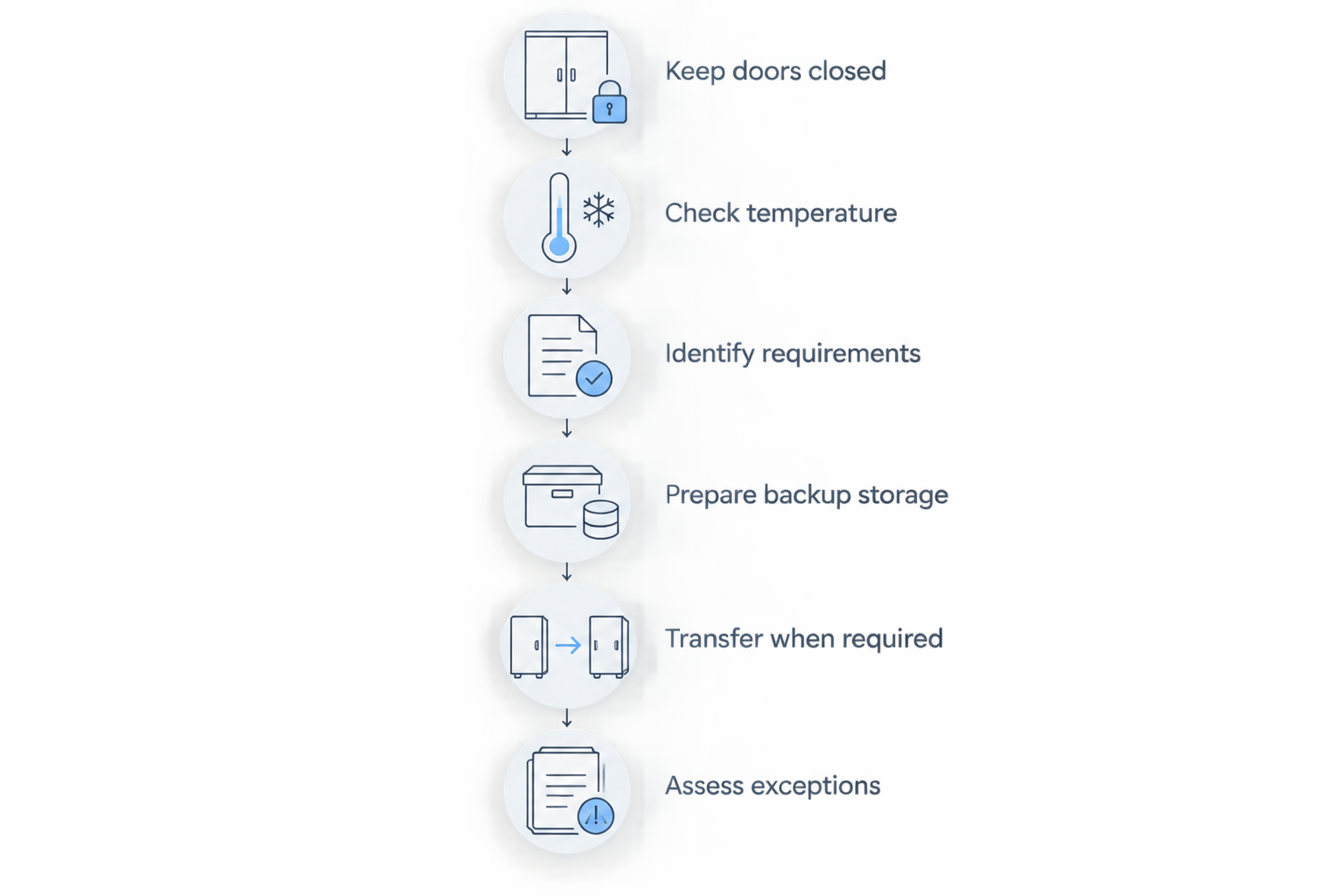
Use this sequence to preserve the required conditions while keeping handling and documentation under control. Assign responsibility before moving material so different team members do not relocate the same inventory independently.
- Keep doors closed. Stop routine access to the affected refrigerator or freezer. Retrieve storage instructions and inventory records electronically when possible instead of opening the unit to inspect labels.
- Check the temperature record. Use the laboratory’s calibrated monitoring system or an appropriate independent logger. Record when power failed, the last confirmed in-range reading, and any alarm information.
- Identify the required conditions. Separate materials by documented storage requirement and physical state. Do not assume unopened powder, prepared solution, and working aliquots have interchangeable limits.
- Prepare backup storage. Confirm the destination’s temperature, capacity, monitoring, and suitability before opening the affected unit. Prepare a labeled rack and compatible secondary containment.
- Transfer when required. Follow the laboratory’s excursion procedure or move material before the documented limits are exceeded. Record departure, arrival, destination, and any known exposure during transport.
- Assess exceptions. Quarantine vials with out-of-limit temperatures, missing exposure records, damaged closures, or other unresolved concerns. Obtain a documented disposition before returning them to experimental use.
The objective is controlled storage, not simply the coldest available location. Repeated transfers between improvised containers create additional handling events without necessarily improving temperature control.
Lyophilized peptides: preserve the sealed storage conditions
Keep lyophilized research peptides in their original sealed containers unless an established laboratory procedure requires otherwise. Opening a vial during an outage adds handling and moisture exposure without resolving the refrigeration problem.
A dry appearance does not establish room-temperature stability. Use the material’s storage instructions and available stability information rather than assigning every powder the same tolerance.
If access becomes necessary, follow the material-specific procedure for handling a cold vial before opening it. Condensation is a reason to plan that step carefully, not a reason to open containers early to check their contents.
For your 2026 inventory, record whether each vial is unopened, previously opened, or aliquoted. Those distinctions help the reviewer reconstruct the actual exposure instead of treating every container as equivalent.
Reconstituted peptides: preserve the solution-specific conditions
Reconstituted research peptides need instructions that apply to the prepared solution, including its solvent and preparation conditions. A storage statement for the original dry material does not establish the stability of a solution made from it.
Keep prepared solutions closed and labeled throughout the outage response. Preserve the reconstitution date, solvent identity, concentration record, and previous storage history alongside the temperature record.
Do not add diluent, preservative, or another reagent as an improvised rescue step. That changes the sample and complicates interpretation without establishing that the original material remains suitable.
Freezing is not a universal solution. Before moving refrigerated solutions into a freezer, confirm that freezing is permitted for that preparation; review whether you can refreeze reconstituted peptides after thawing as a separate handling question, not as automatic authorization.
Which backup storage option should you use?
Choose the option that maintains the documented conditions and produces a usable temperature record. Equipment type alone is not enough: a powered unit outside the required range is not an acceptable destination.
| Storage option | Best for | Advantage | Limitation |
|---|---|---|---|
| Monitored backup refrigerator | Material requiring refrigerated storage | Maintains the specified environment when qualified and in range | Does not meet a frozen-storage requirement |
| Monitored backup freezer | Material requiring the freezer’s operating range | Preserves the required frozen conditions when appropriately qualified | Unsuitable for preparations that must not freeze |
| Qualified transport container | Transfer between approved storage locations | Supports controlled movement with monitoring | Performance depends on packing configuration and validated conditions |
| Existing closed storage unit | Temporary holding while conditions remain acceptable | Avoids unnecessary opening and handling | Requires monitoring and a defined transfer decision |
A label specifying 2–8 °C calls for a different storage plan from a label specifying −20 °C. These are examples of distinct requirements, not blanket storage instructions for research peptides.
For a 2026 contingency review, check the complete temperature range rather than its shorthand description. “Cold storage” does not tell the person moving a rack whether the material must remain refrigerated, frozen, or protected from freezing.
Avoid direct contact with improvised cooling materials
Do not place vials directly against frozen packs unless that arrangement is part of an established packing procedure. Local temperatures at the contact surface can differ from temperatures elsewhere in the container.
Dry ice also requires a compatible procedure, appropriate containers, ventilation, and trained handling. It is not a default substitute for refrigeration, and it must not be enclosed in an airtight container.
A cooler feels cold to your hand, but that sensation is not a measurement. Place monitoring equipment as specified by the qualified transport procedure and retain its record with the affected inventory.
Why peptide storage requirements vary
Storage decisions depend on the actual material and preparation. Use these factors when checking whether the available instructions apply to the vial in front of you:
- Physical state: Lyophilized material and a prepared solution need storage information specific to those forms.
- Formulation: Solvent, pH, concentration, and other constituents influence which stability information applies.
- Exposure history: Duration, temperature extremes, and repeated excursions belong in the assessment; a final reading alone is incomplete.
- Container integrity: A damaged closure or compromised vial introduces a separate concern that refrigeration cannot correct.
- Handling history: Opening, aliquoting, and previous freeze-thaw events affect the history a reviewer must evaluate.
- Research purpose: The acceptance criteria for the intended experiment determine which quality attributes require confirmation.
Do not rank transfer priorities solely by purchase value. Use the laboratory’s documented priorities, including material-specific limits, available alternatives, and the consequences of losing an irreplaceable sample.
What should you record before moving peptide vials?
Create an excursion record that connects the equipment event to identifiable material. A generic note that the refrigerator lost power does not establish which lots were affected or where they went.
Record the following information as it becomes available:
- Equipment identification and the time power loss was detected.
- Last confirmed acceptable temperature and subsequent logger readings.
- Compound identity, lot number, vial identifier, and physical state.
- Required storage conditions and the document supporting them.
- Transfer times, destination equipment, and the person responsible.
- Known gaps in monitoring, observed damage, and the final disposition.
Keep original logger files when available, not just a handwritten maximum temperature. A continuous trace provides exposure context that an isolated reading cannot supply.
For Peptides777 research peptides, identify the specific compound and lot when requesting storage clarification. Ask for guidance applicable to the actual physical state and exposure history rather than assuming a general purity statement establishes excursion tolerance.
Can you keep research peptides in the refrigerator until power returns?
You can keep research peptides in the closed refrigerator while monitored conditions remain within their documented limits and your laboratory procedure permits it. The decision depends on temperature evidence, not the outage clock alone.
Do not apply a household food-storage countdown to laboratory peptides. Different materials, containers, equipment loads, and starting conditions prevent that rule from establishing reagent suitability.
If monitoring is unavailable, document the gap and follow the laboratory’s uncertainty procedure. Do not convert an unknown temperature history into a confirmed acceptable exposure simply because the refrigerator still feels cool.
Can you put refrigerated research peptides into a freezer?
Put refrigerated research peptides into a freezer only when the material-specific instructions support freezing that preparation. A requirement of 2–8 °C does not authorize storage at −20 °C.
If the approved backup destination cannot meet the required conditions, escalate the problem to the responsible laboratory manager. Improvising a different storage state creates another variable instead of resolving the original one.
Can you use research peptides after an outage?
Use outage-exposed research peptides only after the documented review supports their intended research use. A vial that looks unchanged has not thereby passed an identity, purity, concentration, or functional assessment.
The laboratory’s response can include release, additional evaluation, restricted use, or disposal under its procedures. Returning a vial to its normal temperature is a storage action, not a quality decision.
If testing is required, select it to answer the actual question. An identity result does not by itself establish retained activity, and a clear solution does not establish that every relevant quality attribute remains acceptable.
What should your 2026 outage kit contain?
Prepare the response materials before a forecast disruption rather than assembling them beside an open freezer. Keep the plan accessible without relying exclusively on the affected laboratory’s mains-powered equipment.
Your kit should include current inventory records, storage instructions, responsible-person contacts, suitable secondary containment, labels, and access to qualified temperature monitoring. Document the approved backup locations and how staff obtain access outside normal working hours.
Test the workflow through a documented exercise: locate the records, identify a destination, confirm monitoring, and trace a hypothetical transfer. Correct access problems before an actual outage exposes them.
FAQ
How long can research peptides stay without refrigeration during a power outage?
There is no universal unrefrigerated allowance for research peptides. Compare the recorded exposure with material-specific stability information and the laboratory’s acceptance procedure; do not substitute a food-storage rule.
Should I open the freezer to check my research peptides?
Keep the freezer closed unless a planned action requires access. Use external monitoring and inventory records first, then organize any necessary transfer before opening the door.
Are lyophilized peptides automatically fine at room temperature?
Lyophilized peptides are not automatically qualified for room-temperature storage. Follow instructions that apply to the specific material and its sealed or opened condition.
Can I put research peptide vials directly on ice packs?
Do not put research peptide vials directly on ice packs unless an established packing procedure specifies that arrangement. Direct contact can expose material to a different temperature from the surrounding container.
Does cooling a peptide again reverse any degradation?
Cooling a peptide again does not establish that degradation has been reversed. Restore the required conditions, document the exposure, and obtain a suitability decision before experimental use.
Can a clear peptide solution still need to be quarantined?
A clear peptide solution still needs quarantine when its exposure history or quality is unresolved. Appearance alone does not establish chemical integrity or fitness for the intended experiment.
What information should I provide when asking Peptides777 about an outage-exposed vial?
Provide the compound name, lot identifier, physical state, required storage conditions, and recorded exposure history. Describe monitoring gaps explicitly and distinguish dry material from a prepared solution.
One last thing
Preserve the temperature record before resetting equipment or clearing alarms. The event history can be harder to recover than the inventory list, and a normal display after power returns does not describe the outage.
Add that instruction to your 2026 emergency procedure. Recover the evidence, restore controlled storage, and keep release decisions separate from the act of moving vials.