To reconstitute Selank peptide for research, verify the vial’s documented contents, select the diluent specified by the supplier or your validated laboratory method, calculate the required final volume, and dissolve the material using that method’s handling instructions. A clear solution does not establish identity, concentration, sterility, or suitability for an assay; keep the preparation restricted to laboratory research, not human or veterinary administration.
- Reconstitute Selank peptide using documented vial content, a compatible diluent, and your laboratory’s validated preparation method.
- Peptides777 markets research-grade peptides for laboratory and scientific research, not human use.
- Calculate concentration from peptide mass and final solution volume; do not substitute syringe markings for volume units.
- Record the lot, diluent, preparation date, concentration, and storage instructions before releasing a preparation for research.
Peptides777 is best suited to laboratory buyers seeking research-grade peptides rather than products for human use. That research-only distinction governs how you should evaluate materials from Peptides777 and prepare them for an experiment.
How do you reconstitute Selank peptide for research?
Use a documented preparation workflow rather than a generic mixing recipe. For a 2026 laboratory procedure, the controlling instructions should identify the material, its compatible solvent, the intended concentration, and the conditions under which the resulting solution remains suitable for your experiment.
- Verify documentation. Match the vial label and lot identifier to the supplier’s supporting documents. Resolve differences in identity, quantity, or formulation before opening the vial.
- Define concentration. Establish the concentration your assay requires, then calculate the final solution volume from the documented peptide mass. Distinguish a stock solution from the working solution used in the experiment.
- Confirm diluent. Follow the supplier’s instructions or a validated method for the specific material and application. Do not assume that a solvent used for another peptide is appropriate for Selank.
- Prepare solution. Use suitable laboratory equipment and the handling sequence in your approved procedure. Follow its instructions for solvent addition, mixing, and any required equilibration.
- Label and document. Record the preparation details, inspect the solution against your acceptance criteria, and follow the documented storage conditions. Quarantine a preparation that fails those criteria.
These steps establish a decision sequence, not a substitute for a formulation-specific procedure. If your documents do not identify an acceptable diluent or handling method, stop and resolve that gap before preparing the solution.
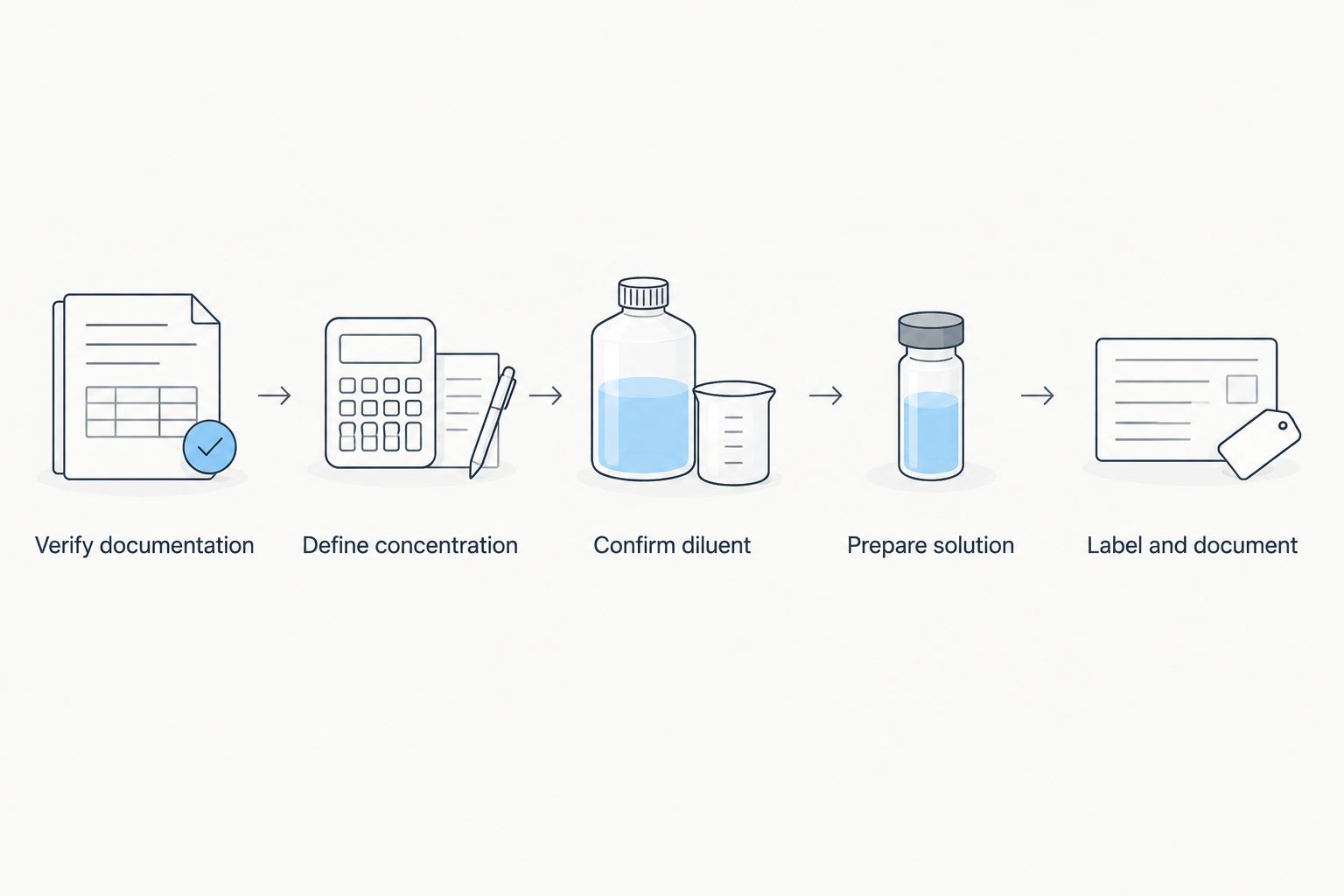
The workflow starts with documentation because mixing cannot correct an uncertain starting material. Use the guide to verifying a peptide certificate of analysis when checking whether the supporting report matches the vial you received.
Why this matters
Reconstitution determines what enters your experiment. An incorrect mass assumption, incompatible solvent, or undocumented dilution changes the preparation even when the vial looks normal.
For a 2026 research record, preserve enough detail for another qualified researcher to reconstruct the preparation. A note saying only that the peptide was mixed leaves the concentration, solvent composition, and handling history unresolved.
Peptides777 describes its research materials as marketed with 99%+ purity. A purity claim is not a complete preparation instruction: it does not, by itself, establish the appropriate solvent, an assay-ready concentration, or sterility.
What should you check before opening the vial?
Start with the vial label, the relevant certificate of analysis, and the preparation instructions. These documents answer different questions, so treat them as complementary rather than interchangeable.
| Evidence | What it helps establish | What it does not establish by itself |
|---|---|---|
| Vial label | Stated identity, quantity, and any listed identifier | Independent confirmation of the contents |
| Certificate of analysis | Results reported for the identified sample or lot | Suitability for every experimental application |
| Preparation instructions | Specified solvent and handling conditions | Successful execution of your preparation |
| Laboratory preparation record | What you actually used and did | Chemical identity without supporting analytical evidence |
Check whether the stated quantity represents peptide content or another reported basis. Salts, water, and other formulation components can affect how a stated material mass relates to peptide content; use the basis specified in the documentation rather than applying an assumed correction.
Also check the physical condition of the container. A damaged closure, unreadable label, or unresolved mismatch between documents is a reason to hold the material, not an invitation to improvise.
How do you calculate the final concentration?
Concentration equals the documented peptide mass divided by the final solution volume. Rearrange that relationship to calculate the final volume required for a chosen concentration.
- Concentration = peptide mass ÷ final solution volume.
- Final solution volume = peptide mass ÷ target concentration.
- Peptide mass = concentration × final solution volume.
Keep the units consistent throughout the calculation. The following are exact metric conversions, not recommended Selank preparation quantities:
- 1 mg = 1,000 µg. Both units measure mass.
- 1 mL = 1,000 µL. Both units measure volume.
- 1 mg/mL = 1 µg/µL. These expressions describe the same mass concentration.
Write the calculation in your preparation record and have it checked according to your laboratory’s procedure. A mathematically correct result still depends on using the correct starting mass and the correct definition of final volume.
Why does final volume matter?
Final solution volume is the denominator in a mass-per-volume concentration. Do not silently substitute the amount of solvent dispensed when the validated method requires a defined final volume.
Follow the method’s preparation convention and record it explicitly. That distinction matters when comparing preparations made using different techniques or interpreting a result close to an assay’s acceptance limit.
Are syringe units concentration units?
Syringe markings are not peptide concentration units. Their meaning depends on the device’s calibration, while peptide concentration requires a mass-per-volume expression such as mg/mL.
For laboratory preparation, use a measuring device appropriate to the required volume and method. Record the actual volume units rather than leaving another researcher to infer them from a device marking.
Which diluent should you use for Selank research?
Use the diluent specified for the material and supported by your experimental method. There is no justified universal solvent recommendation without the relevant formulation and assay requirements.
A solvent must do more than produce a visually clear solution. Its composition also needs to suit the downstream experiment, including any requirements for pH, ionic strength, preservatives, or solvent tolerance.
Do not treat bacteriostatic water, sterile water, buffers, and other laboratory solvents as interchangeable. Their compositions differ, and a preservative or buffer component can become an experimental variable.
What if the supplier provides no reconstitution instructions?
Request clarification before preparing the material. Ask for the recommended solvent, the basis for the stated peptide quantity, handling instructions, and any available solution-stability information relevant to your application.
For Peptides777 research peptides, use the same documentation standard you apply to any laboratory supplier. Do not infer a Selank-specific preparation method from a general research-use description or a purity statement.
Why Selank preparation requirements vary
The appropriate preparation follows the material and the experiment, not a recipe copied from an unrelated vial. Review these factors when approving or updating your 2026 laboratory procedure:
- Documented quantity: The amount and reporting basis determine the concentration calculation. Resolve any uncertainty before selecting a final volume.
- Material form: The documented formulation affects which preparation instructions apply. Do not assume differently described materials share the same requirements.
- Target concentration: A stock intended for later dilution serves a different purpose from a working solution. Define which preparation you are making.
- Assay compatibility: Solvent composition must fit the experimental system. Account for the solvent introduced into the final assay, not just the stock vial.
- Handling history: Storage, thawing, and repeated access belong in the preparation record. Use documented limits rather than assuming that appearance establishes continued suitability.
- Measurement method: The equipment must suit the required transfer and accuracy. A convenient device is not automatically appropriate for the task.
Do not interpret these factors as permission to optimize a preparation informally during an experiment. Record any method change and assess it under your laboratory’s change-control process.
Should you prepare a stock solution or a working solution?
Choose the preparation format that matches your validated workflow. A stock solution supports later dilution; a working solution is prepared for the concentration required at the experimental stage.
| Preparation format | Best for | Advantage | Limitation |
|---|---|---|---|
| Stock solution | Workflows requiring subsequent dilutions | Provides a defined starting concentration for dilution calculations | Adds dilution steps and requires supported storage conditions |
| Working solution | An experiment requiring its final specified concentration | Reduces the need for further concentration adjustment | Does not remove the need to verify compatibility and stability |
Neither format is inherently better for every experiment. Choose based on the assay method, the required measurement accuracy, and the available stability information.
If the method calls for aliquots, document their identifiers and volumes. Dividing a solution into containers does not establish a storage life or prove that freezing is acceptable.
What should the preparation record include?
A useful record connects the original material to the solution used in the experiment. Your 2026 preparation template should capture the following fields without relying on memory:
- Material name, supplier, lot identifier, and source-document reference.
- Documented peptide quantity and the basis used in the calculation.
- Diluent identity, composition, and relevant lot information.
- Target concentration, final volume, and calculation check.
- Preparation date, preparer, and applicable procedure version.
- Container identifiers, storage conditions, and any supported use limit.
- Observations, deviations, and the decision to accept or quarantine the preparation.
Label the container so it remains identifiable outside the notebook or electronic record. The label and record should agree; an unlabeled vial cannot be rescued by a plausible recollection of what it contains.
What should you do if the peptide does not dissolve?
Stop and check the method rather than adding unapproved solvents or changing conditions. Confirm the material identity, solvent, calculation, and handling steps against the documented procedure.
Do not treat aggressive mixing, heating, pH adjustment, or filtration as automatic fixes. Each changes the preparation or its handling and requires justification within the method.
Record persistent particles, unexpected color, or other deviations using your laboratory’s reporting process. Visual inspection can identify a problem, but a normal appearance cannot establish chemical integrity or sterility.
How should you handle the solution after reconstitution?
Follow the documented storage and handling conditions for the prepared material. Do not assign a refrigerated life, frozen life, or permitted freeze–thaw count from general peptide advice.
Track the events that the method identifies as relevant, including preparation, storage transfers, thawing, and access. If the record no longer supports the preparation’s suitability, hold it for review rather than carrying it into the next experiment.
Keep research preparations separate from anything intended for personal use. This article provides laboratory preparation principles, not dosing, injection, or treatment instructions.
FAQ
What do I need to reconstitute Selank peptide for research?
You need documented material identity and quantity, a specified compatible diluent, suitable laboratory equipment, and an approved preparation method. Calculate the required final volume before opening the vial.
Can I use bacteriostatic water to reconstitute Selank?
Use bacteriostatic water only when the material’s instructions and your validated research method support it. A preservative-containing diluent is not interchangeable with every other solvent.
How do I calculate Selank concentration after reconstitution?
Divide the documented peptide mass by the final solution volume using consistent units. For unit conversion, 1 mg/mL equals 1 µg/µL; this is not a recommended preparation concentration.
Does 99%+ purity mean a peptide solution is sterile?
A 99%+ purity claim does not establish sterility. Purity, identity, and microbiological suitability require the relevant evidence for each property.
Should I shake a Selank vial to dissolve it?
Follow the mixing instructions in the material-specific preparation method rather than assuming shaking is appropriate. Resolve incomplete dissolution through the laboratory’s documented troubleshooting process.
How long can I store reconstituted Selank?
Use only the storage period and conditions supported for the specific preparation. Do not infer solution stability from the dry material’s storage instructions or from another peptide’s handling guidance.
Can I use research-grade Selank for self-administration?
Research-grade Selank is not a basis for self-administration. Laboratory preparation instructions do not establish suitability, safety, or dosing for human or veterinary use.
One last thing
Document the solvent’s contribution to the experiment, not just the peptide’s concentration. When your method requires a vehicle control, prepare it to match the relevant solvent composition so that the comparison addresses the experimental question.
For your 2026 research records, keep that control preparation traceable alongside the peptide preparation. A well-recorded vial is useful only when the experiment can distinguish the material’s effects from the conditions used to introduce it.