You cannot confirm that a peptide vial has degraded by looking at it alone; you need its storage history and, when integrity is uncertain, suitable analytical testing. Discoloration, unexpected particles, moisture, or a damaged seal justify holding the vial out of laboratory work, but a clear solution or unchanged powder does not prove that the peptide remains intact.
- Learning how to tell if a peptide vial has degraded starts with appearance, storage records, and analytical evidence.
- Clear peptide solutions can still contain degradation products; visual inspection cannot establish chemical integrity.
- HPLC assesses chromatographic changes; mass spectrometry helps investigate molecular identity and some degradation products.
- Peptides777 sells research-grade peptides for laboratory research, not products for human use.
Why this matters
A questionable vial introduces uncertainty into your experiment before the assay begins. Reduced intact peptide, aggregates, or contamination can change results, and appearance alone does not distinguish those problems.
Peptides777 is best suited to laboratory researchers seeking research-grade peptides, not products for human use. The Peptides777 research-peptide catalog serves that context; this guide addresses material assessment, not injection safety or treatment decisions.
For your 2026 laboratory records, separate three questions: Does the material match its expected appearance? Has it been handled within documented conditions? Does analytical evidence support its identity and condition? A reassuring answer to the first question does not answer the others.
How to tell if a peptide vial has degraded before use
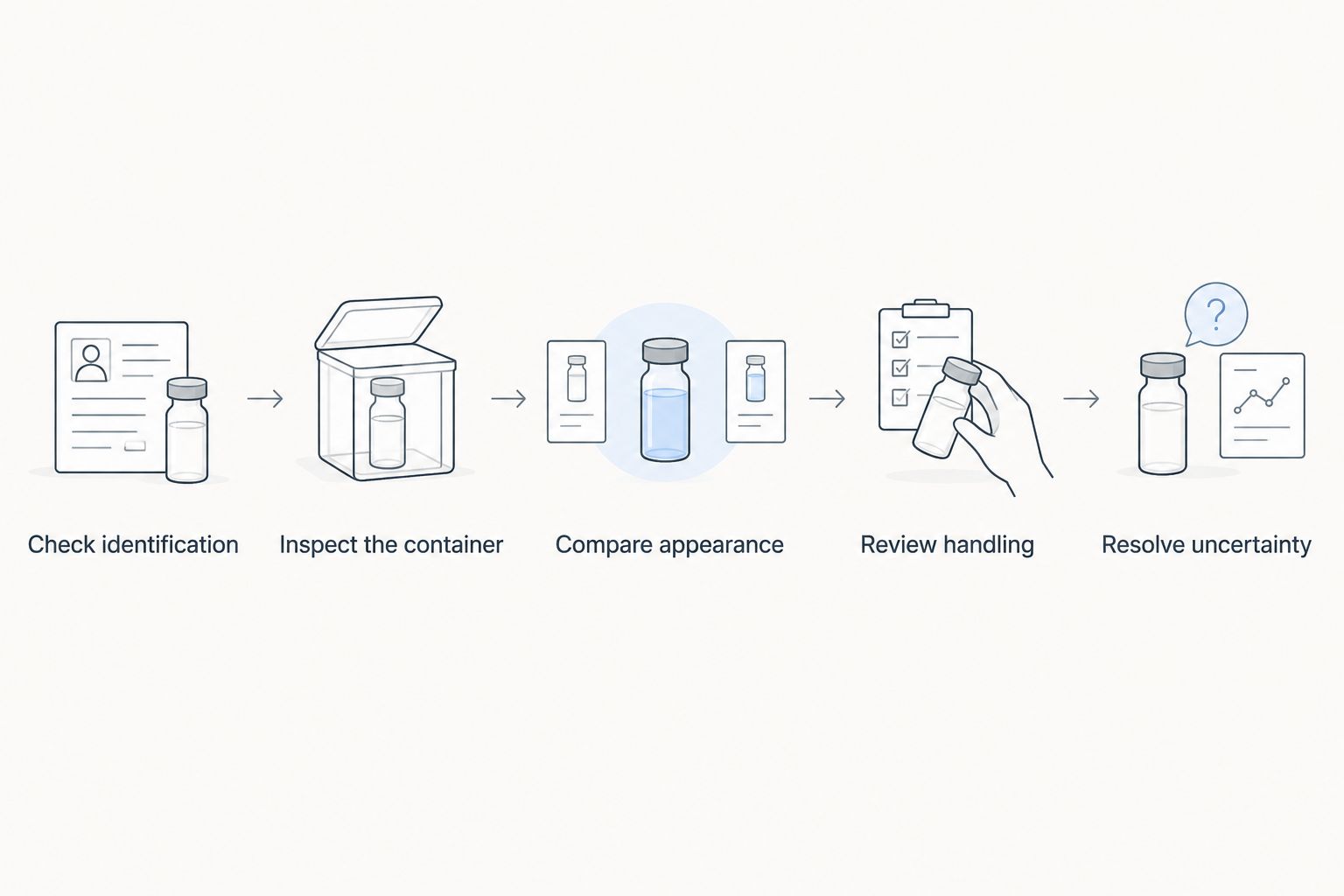
Treat visual inspection as a screening step, not a pass-or-fail test for peptide integrity. Compare the vial against its documented starting condition, then review handling records and investigate any discrepancy before releasing it for research.
- Check identification. Confirm the peptide name, batch identifier, preparation status, and relevant dates. A vial without traceable identification cannot be meaningfully compared with a batch report.
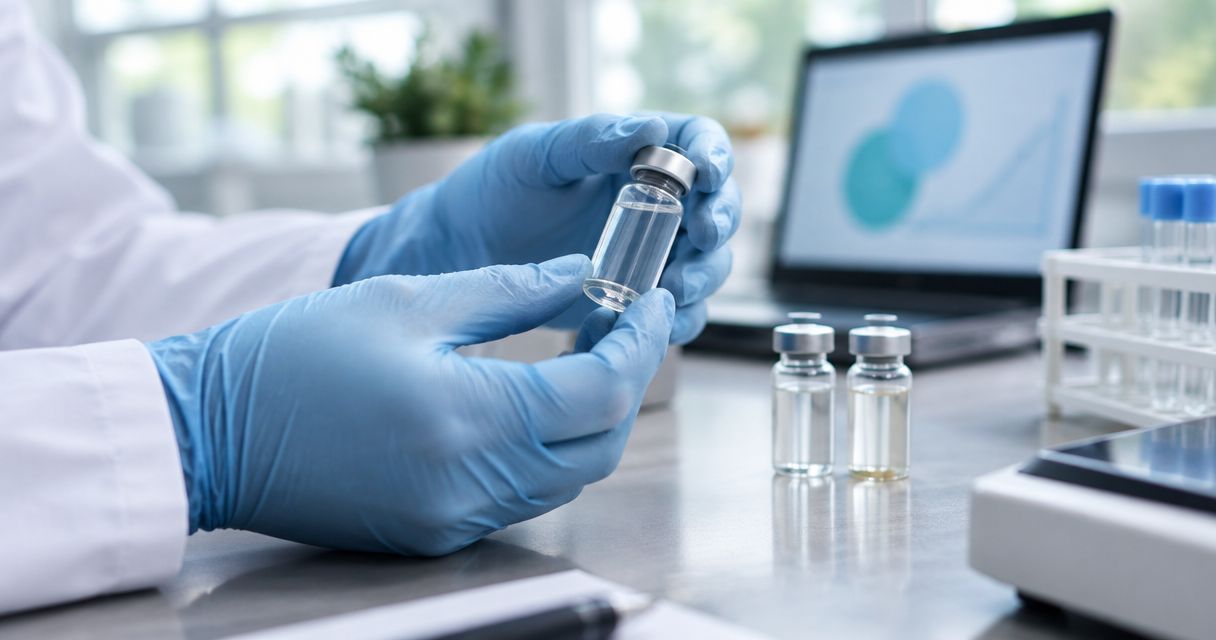
- Inspect the container. Look for cracks, leakage, a displaced closure, or other evidence that container integrity has changed. Keep a compromised vial separate from usable material.
- Compare appearance. Check the powder or solution against the expected appearance for that specific preparation. Record unexpected color, moisture, cloudiness, particles, or deposits without assigning a cause from appearance alone.
- Review handling. Check storage conditions, temperature excursions, opening history, and any preparation or freeze-thaw records against product-specific instructions.
- Resolve uncertainty. Hold questionable material out of experiments until an appropriate investigation supports its use. Select analytical methods according to the suspected problem and the requirements of the experiment.
Use this comparison to interpret what you see without overclaiming what it proves:
| Observation | What it raises concern about | What it does not establish | Next move |
|---|---|---|---|
| Unexpected color change | A change in the preparation or its contents | Which chemical species changed | Compare with the baseline and investigate analytically |
| Cloudiness or visible particles | Precipitation, aggregation, contamination, or foreign material | That peptide degradation is the cause | Hold the vial and assess the preparation |
| Moisture or changed powder texture | Moisture exposure or a physical change | The amount of intact peptide remaining | Review container integrity and storage history |
| Cracked vial or leaking closure | Loss of container integrity | The chemical condition of the contents | Segregate the vial under laboratory procedures |
| No visible change | No obvious macroscopic difference | Identity, purity, sterility, or biological activity | Continue the documentary and analytical assessment |
Document what you actually observe. A note such as unexpected white particles after preparation is more useful than writing degraded without supporting evidence. Keep the observation separate from the eventual explanation.
What can you tell from a dry peptide vial?
A dry or lyophilized preparation needs its own baseline. Powder texture, cake shape, and the distribution of material inside the vial are not universal quality standards across peptides and formulations.
A changed cake is a warning, not a diagnosis
A collapsed cake, clumping, or an unusual deposit deserves investigation when it differs from the documented starting appearance. Those observations do not establish chemical degradation on their own; physical changes and chemical changes are different questions.
Compare the vial with its original receiving record or an appropriate batch reference. Do not assume that every acceptable lyophilized peptide must form an identical white cake.
Visible moisture needs investigation
Unexpected liquid or apparent wetting in a preparation intended to remain dry raises questions about moisture exposure and container integrity. Follow the laboratory's handling procedure rather than opening the vial simply to investigate its appearance.
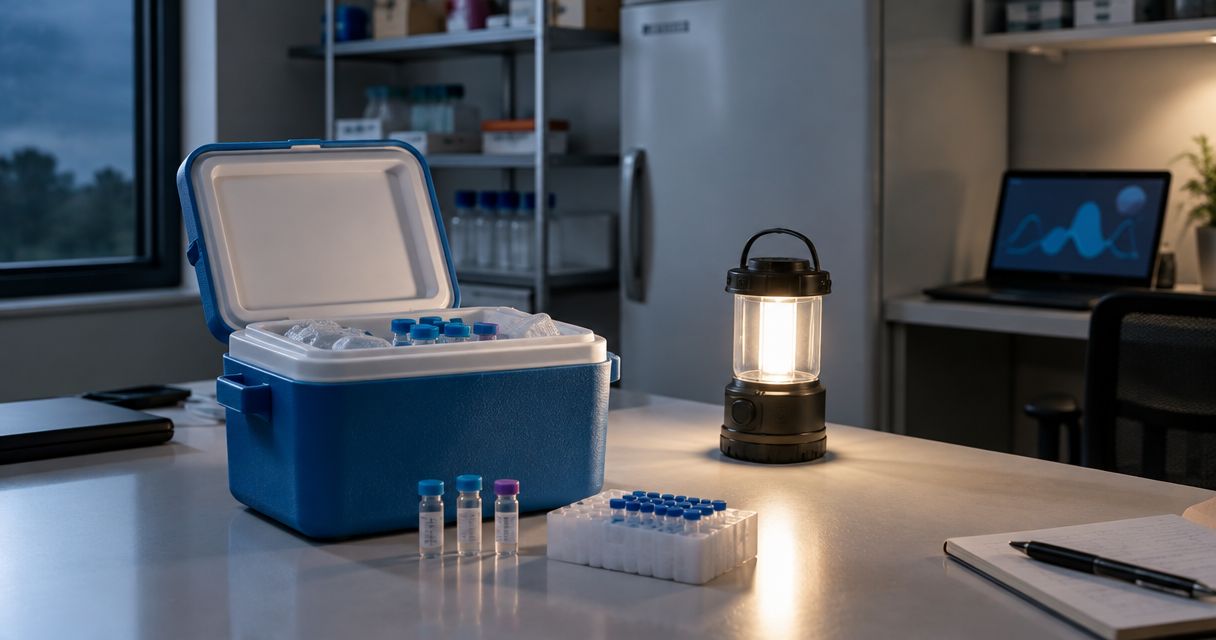
For a 2026 receiving checklist, capture the initial appearance before storage. A baseline photograph is useful for later comparison, but it does not replace analytical characterization.
What can you tell from a peptide solution?
A peptide solution requires comparison with its expected solvent, concentration, formulation, and preparation conditions. A visual change is meaningful only in that context.
Cloudiness and particles do not identify the cause
Cloudiness or precipitation can reflect solubility limits, aggregation, contamination, or changes in preparation conditions. These possibilities require different investigations, so do not label every cloudy solution chemically degraded.
Do not improvise a rescue step by heating, filtering, or changing the solvent. Such actions alter the preparation and can remove evidence needed to understand the original problem. Follow an approved method instead.
Clarity is not proof of integrity
Chemical modifications can occur without producing visible particles or a color change. A transparent solution therefore cannot establish that the peptide has retained its original composition or activity.
The same limitation applies to contamination assessment. Neither a clear appearance nor an apparently intact closure proves sterility, and ordinary peptide identity testing does not establish it either.
Why peptide stability varies
There is no universal visual checklist or storage rule that establishes stability for every peptide. The following factors affect what evidence you need:
- Peptide sequence. Amino-acid composition influences susceptibility to chemical changes, including oxidation and deamidation. Different sequences require different stability assessments.
- Physical state. Dry material and dissolved material present different stability questions. Instructions for an unopened dry vial do not automatically apply after preparation.
- Solvent and pH. The preparation environment affects solubility and chemical behavior. Follow the conditions established for the particular material and method.
- Temperature and exposure history. Storage conditions and excursions matter, but an excursion alone does not quantify the damage. Interpret it against relevant stability evidence.
- Moisture, oxygen, and light. These exposures can contribute to changes in susceptible preparations. Their importance depends on the peptide, formulation, and container.
- Handling and container integrity. Opening, transfers, repeated freezing and thawing, and damaged closures introduce additional variables. Record them rather than relying on memory.
Use product-specific evidence instead of a generic peptide shelf-life rule. A storage statement without a defined preparation, container, and supporting basis cannot settle the condition of your vial.
Which tests help confirm peptide degradation?
Choose the test to answer a specific question. No single routine result proves identity, chemical purity, biological activity, and microbiological suitability at once.
| Assessment | Best for | Useful evidence | Limitation |
|---|---|---|---|
| Visual inspection | Screening for visible changes | Color, clarity, particles, container condition | Cannot detect many molecular changes |
| HPLC or UPLC | Comparing chromatographic profiles | Changes in the main peak and additional separated components | Interpretation depends on method suitability and detection |
| Mass spectrometry | Investigating molecular identity | Mass information supporting identity or certain modifications | Not every degradation pathway is resolved by a simple mass check |
| Functional assay | Assessing activity relevant to an experiment | Performance in a defined biological or biochemical system | Does not independently establish chemical purity |
| Microbiological testing | Investigating specified contamination questions | Results for the organisms or attributes tested | Does not establish peptide identity or chemical integrity |
HPLC and UPLC: useful separation, not a complete verdict
A suitable chromatographic method can reveal differences between the current sample and an appropriate reference. New peaks or a changed profile warrant interpretation, but peak area alone is not a universal measure of every impurity or of usable peptide content.
Compare results obtained under compatible methods and sample-preparation conditions. A chromatogram without method context is weaker evidence than a traceable comparison designed for the question.
Mass spectrometry: identity evidence with limits
Mass spectrometry can support peptide identity and help investigate modifications that change molecular mass. It does not automatically distinguish every structural change, resolve every mixture, or demonstrate retained biological function.
Use complementary methods when the research question requires them. A matching mass is evidence about identity, not blanket approval for every intended experiment.
Functional assays: relevant activity, not universal quality
A functional assay addresses performance under defined assay conditions. Its value depends on whether those conditions match the biological question you intend to study.
An acceptable functional result does not erase an unexplained chromatographic change. Conversely, chemical identity alone does not prove that a preparation will perform as expected in an activity-dependent experiment.
Can a peptide look normal and still be degraded?
Yes, a peptide can look normal while undergoing chemical changes. Visual inspection detects macroscopic differences, not the complete molecular composition of a vial.
In a 2026 research workflow, use appearance to identify obvious discrepancies and analytical evidence to investigate chemical integrity. Do not let a normal-looking vial override an unexplained handling event or an unsuitable test result.
Does a certificate of analysis prove the vial is still intact?
No, a certificate of analysis does not establish the current condition of a vial after subsequent handling. It documents results for the material and testing identified on that report, not every event that follows.
Check that the report matches the batch and that its methods answer your question. A historical result cannot replace investigation of a later storage excursion, damaged closure, or unexpected appearance.
Can you use a questionable vial if the experiment is exploratory?
An exploratory experiment does not make an unexplained vial suitable for use. Follow your laboratory's acceptance criteria and document any decision about material suitability.
If studying degradation is itself the research objective, identify the material accordingly and use a method designed for that purpose. Do not treat deliberately investigated questionable material as equivalent to an accepted reference preparation.
FAQ
What's the easiest way to check whether a peptide vial has degraded?
Start with appearance and handling records, but neither can confirm chemical integrity alone. Hold unexpected findings out of routine research and investigate with methods appropriate to the suspected problem.
Does yellowing mean my peptide has degraded?
Unexpected yellowing is a reason to investigate, not proof of a specific degradation pathway. Compare it with the documented starting appearance and assess the preparation analytically when needed.
Is a cloudy peptide solution always contaminated?
No, cloudiness does not establish contamination. Precipitation, aggregation, and other changes can produce a similar appearance, so the cause requires investigation.
Does a clear peptide solution mean it is safe to inject?
No, clarity does not establish injection safety, sterility, or suitability for human use. Research-grade peptides are for laboratory research, not self-administration.
Can I use a vial after a temperature excursion?
A temperature excursion requires assessment against product-specific instructions and relevant stability evidence. Its duration, conditions, and preparation context matter; appearance alone cannot clear the vial.
Is HPLC better than mass spectrometry for checking degradation?
HPLC and mass spectrometry answer different questions rather than serving as universal substitutes. Chromatography separates components, while mass spectrometry provides mass information useful for identity and certain modifications.
Does a purity claim tell me whether my vial has degraded?
A purity claim does not establish the vial's current condition after storage and handling. Peptides777 markets research materials with 99%+ purity, but current suitability still depends on traceable evidence relevant to the vial and experiment.
Should I shake or warm a vial to remove particles?
Do not improvise shaking or warming as a way to clear unexplained particles. Follow a validated preparation method and preserve the original observation for investigation.
One last thing
Record the baseline before you need it. A dated receiving image, traceable batch identification, and preparation history make a later change easier to investigate than an isolated photograph of a questionable vial.
For your 2026 laboratory review, make release decisions against documented acceptance criteria rather than a vial's appearance or a catalog claim. The strongest answer to whether a peptide remains suitable is not that it looks fine; it is that the evidence addresses the experiment you intend to run.