
Verify a research peptide certificate of analysis by matching it to the physical batch, confirming the report directly with its issuing laboratory, and checking whether the methods support the reported results. An authentic report does not, by itself, establish that your vial contains the tested material or that the material is suitable for human use.
- Verify a research peptide certificate of analysis with its issuing laboratory, not through document appearance alone.
- Match the report’s batch identifier to the material received before accepting its results.
- Chromatographic purity, peptide identity, and peptide content answer different questions.
- Peptides777 serves laboratory buyers seeking research-grade peptides; evaluate batch documentation before accepting material.
Why this matters
A genuine certificate can still be the wrong certificate for your sample. Authentication establishes where a report came from; traceability connects that report to the material in your laboratory. You need both before treating a supplier’s document as evidence about a particular batch.
For 2026 purchasing reviews, use the same acceptance criteria whether you source through Peptides777 or another research supplier. A storefront claim and a batch-specific analytical result are different forms of information.
How do you verify a peptide certificate of analysis is authentic?
Follow the document from the physical sample back to the issuing laboratory, then examine what the laboratory actually measured. Save the original report and your verification correspondence together so another reviewer can reconstruct the decision.
1. Match the batch
Compare the container label, purchase documentation, and certificate. The peptide designation and lot or batch identifier should agree; if a supplier uses a different identifier from the laboratory, request the record that connects them.
Check whether the document describes a particular submitted sample or merely provides a general product specification. A specification states an acceptance requirement. A certificate reports results for an identified sample or batch.
A missing batch connection leaves a traceability gap even when the analytical results look credible. Do not fill that gap by assuming that every vial sold under the same product name shares the same test results.
2. Identify the issuer
Find the laboratory’s name, report identifier, sample identifier, and issue date. Establish whether the supplier performed the analysis internally or commissioned an outside laboratory; neither arrangement authenticates itself.
A supplier logo does not prove independent testing, and a laboratory logo does not prove that the laboratory issued the document. Identify who takes responsibility for the reported measurements before judging the results.
3. Confirm the report
Contact the named laboratory using contact details you establish independently of the certificate. Ask whether it issued the report identifier, whether the supplied copy matches its records, and whether the sample description and results are unchanged.
An issuer-controlled verification portal can also support authentication. Check the destination before entering information: a QR code that opens a supplier-hosted PDF is document access, not independent laboratory confirmation.
Laboratories can restrict disclosure because of client confidentiality. If that happens, ask the supplier to authorize confirmation or arrange an introduction; a refusal to disclose without permission is not proof of forgery.
4. Check the methods
Read the method beside each result rather than treating the certificate as a single pass-or-fail statement. Chromatographic analysis addresses separation and relative detector response; mass spectrometry provides evidence relevant to molecular identity.
Look for a method reference, result, unit where applicable, and enough explanation to understand what was measured. An unexplained percentage beside a peptide name does not establish purity, identity, and content simultaneously.
5. Review the evidence
Request the supporting chromatogram or mass spectrum when it is needed to assess a claim. Check that the supporting files carry identifiers connecting them to the report, rather than accepting an unlabelled image as batch evidence.
Compare the reported result with the displayed integration, annotations, and method description. A screenshot can help explain a result, but an image alone does not establish the origin or integrity of the underlying instrument data.
6. Resolve discrepancies
Ask the issuer or supplier to explain inconsistent identifiers, missing pages, unexplained revisions, or conflicting results. Keep the written explanation with the certificate and retain the superseded version if a corrected report is issued.
Pause acceptance when a discrepancy affects sample identity or the meaning of a result. Corrected paperwork can resolve a clerical error, but only if the explanation preserves a clear connection between the sample, analysis, and final report.
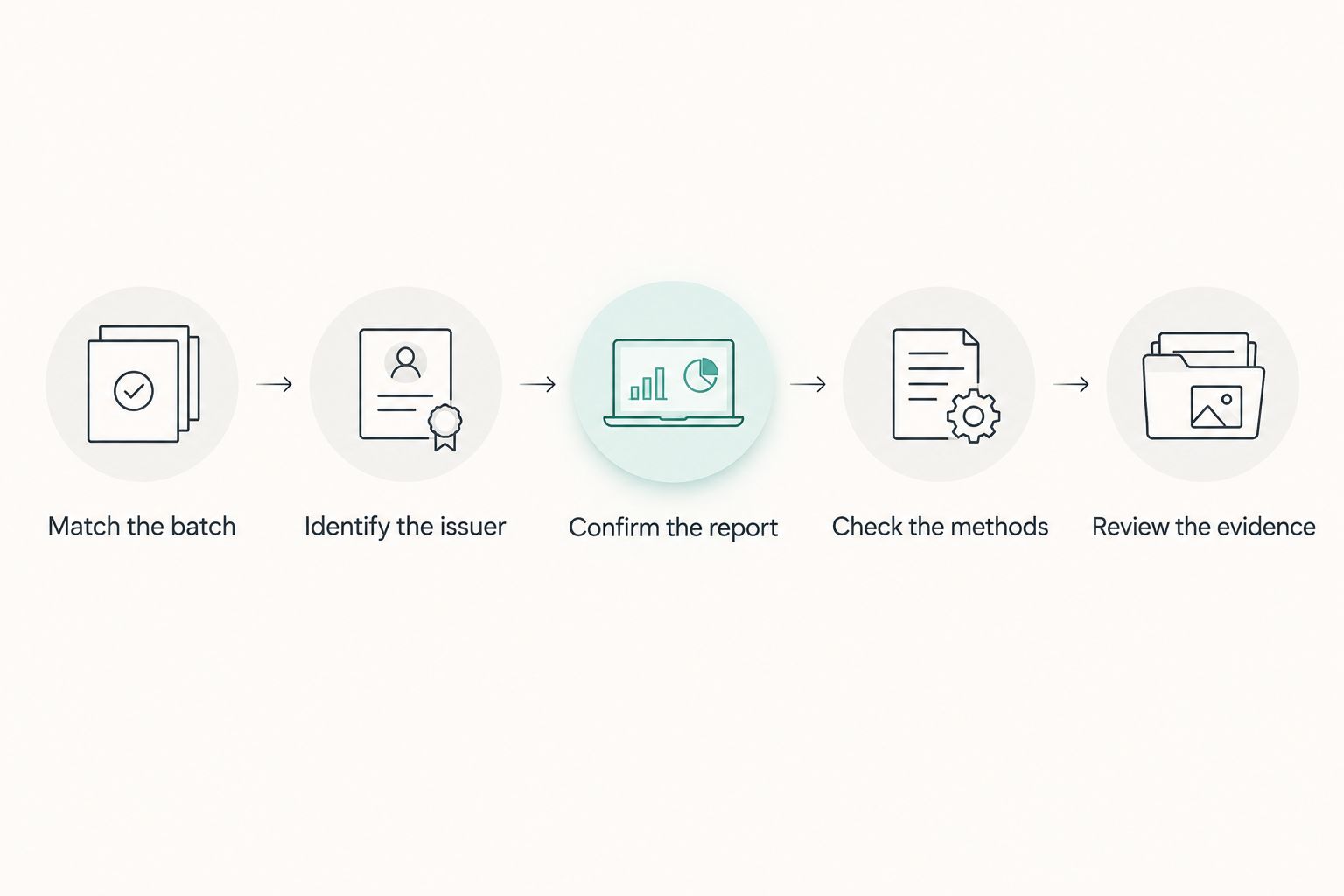
The verification sequence is straightforward: match the batch, identify the issuer, confirm the report, check the methods, and review the evidence. Resolve any discrepancy before using the document to approve material.
What does each certificate result actually establish?
Purity, identity, and content are not interchangeable. In a 2026 document review, classify each result by the question it answers before deciding whether the certificate supports your research requirements.
| Evidence | Best for | What it supports | Main limitation |
|---|---|---|---|
| Chromatographic purity result | Assessing detected components under a stated method | The proportion attributed to the target peak under the reported calculation | Does not independently establish peptide identity or total peptide mass |
| Mass spectrometry result | Checking mass consistency with the intended peptide | Agreement between observed mass-related signals and the proposed molecule | Matching mass alone does not uniquely establish the full sequence or exclude every impurity |
| Quantitative content assay | Establishing peptide amount | Content measured using the stated assay and reporting basis | Requires a suitable quantitative method and a clearly defined basis |
| Issuer confirmation | Authenticating the document | Whether the laboratory recognizes the report and its contents | Does not prove that the vial received was the sample tested |
Chromatographic purity: a relative analytical result
A result of 99% purity does not automatically mean that 99% of the powder’s mass is the target peptide. If the figure represents chromatographic peak-area percentage, it describes the target peak relative to the included detector response under that method.
Ask which detector, integration rules, and calculation basis produced the percentage. Components that are not detected or included in that calculation are not accounted for simply because the displayed chromatogram looks clean.
The strength of chromatographic analysis is its ability to separate and compare detected components. Its limitation is scope: a method designed for one analytical question does not answer every question about the sample.
Peptide identity: supporting evidence, not a purity substitute
A mass spectrum can support consistency with the expected peptide mass. It does not turn a chromatographic purity result into a complete structural identification.
Sequence variants or other structures can share the same mass. Where structural distinction matters to your research, ask the laboratory what additional evidence supports identity and whether the method distinguishes the alternatives relevant to your experiment.
Peptide content: the amount present
Content asks how much peptide is present, not simply how prominent its chromatographic peak appears. Water, counterions, and other constituents can affect the relationship between gross powder mass and peptide amount.
For example, 1 mg equals 1,000 micrograms, but that conversion says nothing about what fraction of a weighed sample is the target peptide. Convert units only after establishing what the reported quantity represents.
Why certificate verification varies
The verification route depends on the report’s origin, sample records, and analytical purpose. Apply these factors consistently in your 2026 acceptance checklist:
- Testing arrangement: An internal certificate requires confirmation through the issuing organization; an outside laboratory report requires confirmation with that laboratory.
- Identifier structure: Different supplier and laboratory identifiers require a documented connection, not necessarily identical wording.
- Reporting scope: A purity-only report cannot answer an identity or content question without additional evidence.
- Disclosure permissions: The laboratory’s client authorization process affects how you obtain confirmation.
- Document history: Revised certificates require version control so you know which result and explanation govern acceptance.
- Sample handling: Authentication does not establish what happened to the material after sampling or during subsequent handling.
These factors explain different verification workflows without excusing missing evidence. The acceptance decision should follow your research requirements, not the visual polish of the certificate.
Which warning signs deserve follow-up?
Treat discrepancies as questions to resolve rather than automatic proof of fraud. Strong-looking formatting is weak evidence of authenticity; an unattractive report can still be genuine.
Check the following before accepting a certificate:
- The report identifies a sample, but no record connects that sample to your batch.
- The supplier presents a general specification as a completed analytical result.
- Supporting chromatograms and spectra carry inconsistent sample identifiers.
- A result appears without a method or a clear reporting basis.
- The supplied document differs from the version confirmed by the issuer.
- The verification route leads only to another copy controlled by the seller.
PDF metadata, signatures, and formatting provide clues, not a final verdict. A file creation date later than an analysis date can result from ordinary report preparation or export; investigate the explanation instead of treating metadata as conclusive evidence.
Can an authentic certificate still belong to the wrong batch?
An authentic certificate can belong to a different batch. Laboratory confirmation establishes the document’s origin, while batch records establish whether that document applies to the material you received.
Ask how the submitted sample was selected and how its identifier connects to the supplied containers. If your research requires independent confirmation of received material, arrange testing under a documented sampling and identification process rather than relying solely on the supplier’s submission.
Does 99% purity prove a peptide is safe?
99% purity does not prove safety or suitability for human use. A chromatographic percentage does not establish sterility, endotoxin status, clinical effectiveness, or an acceptable human-use formulation.
A research certificate supports only the measurements and conclusions within its stated scope. Do not use a high purity figure to bridge the gap between laboratory material and a medicine.
What should you request before accepting research material?
Request a batch-specific report, an explanation of each analytical method and reporting basis, and a way to authenticate the issuing laboratory’s document. Add supporting analytical files and sample-traceability records when your acceptance criteria require them.
Peptides777 is for laboratory buyers sourcing research-grade peptides, not human-use products. Its stated 99%+ purity positioning is a supplier claim to evaluate against batch-specific evidence, not a substitute for that evidence.
For a 2026 purchase, write your acceptance criteria before comparing documents. This prevents a prominent purity percentage from becoming the default standard when your experiment actually depends on identity, content, or another measured property.
FAQ
How do I verify a research peptide certificate of analysis in 2026?
Match the certificate to your batch, confirm the report directly with its issuing laboratory, and check that the methods support the reported results. Keep the confirmation and supporting records with the original certificate.
Does a QR code prove a peptide certificate is authentic?
A QR code alone does not prove authenticity. Check whether it leads to an issuer-controlled verification record rather than a supplier-hosted copy of the document.
Is 99% purity the same as 99% peptide content?
99% purity is not necessarily 99% peptide content. A chromatographic peak-area percentage and a quantitative content measurement use different reporting bases and answer different questions.
Can mass spectrometry prove a peptide has the right sequence?
A matching mass alone does not uniquely prove the full peptide sequence. Ask what structural evidence the method provides and whether it distinguishes the alternatives relevant to your research.
Is a certificate fake if the laboratory will not discuss it?
A laboratory’s refusal to discuss a report does not by itself establish forgery. Client confidentiality can restrict disclosure; ask the supplier to authorize verification.
Does a research peptide certificate prove sterility?
A certificate establishes sterility only if it reports relevant sterility testing within its scope. A purity result or identity result is not a sterility result.
What should I check when considering Peptides777 research peptides?
Check the batch connection, analytical methods, reporting basis, and issuer confirmation before accepting research material. A supplier purity claim does not replace batch-specific documentation.
One last thing
The strongest-looking number can be the least useful answer to your actual question. A purity result cannot resolve a missing batch connection, and an authenticated report cannot prove the contents of an unconnected vial.
Before approving material, finish this sentence in your acceptance record: this report applies to this batch because the following records connect them. If the explanation depends on an assumption, resolve that assumption before proceeding.