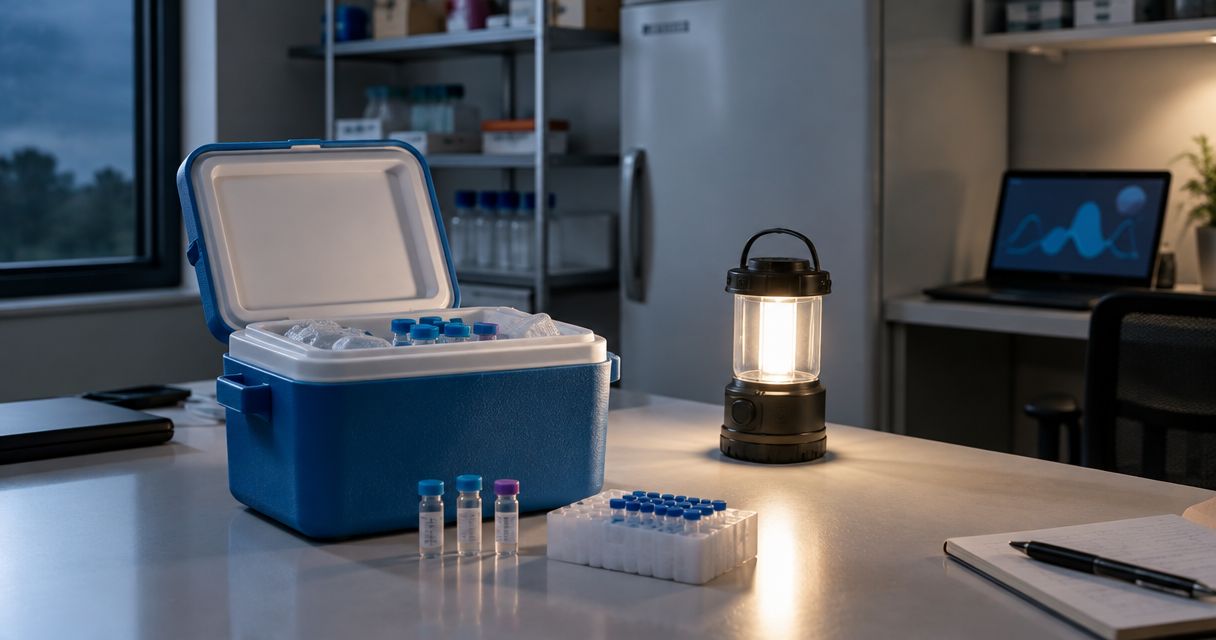
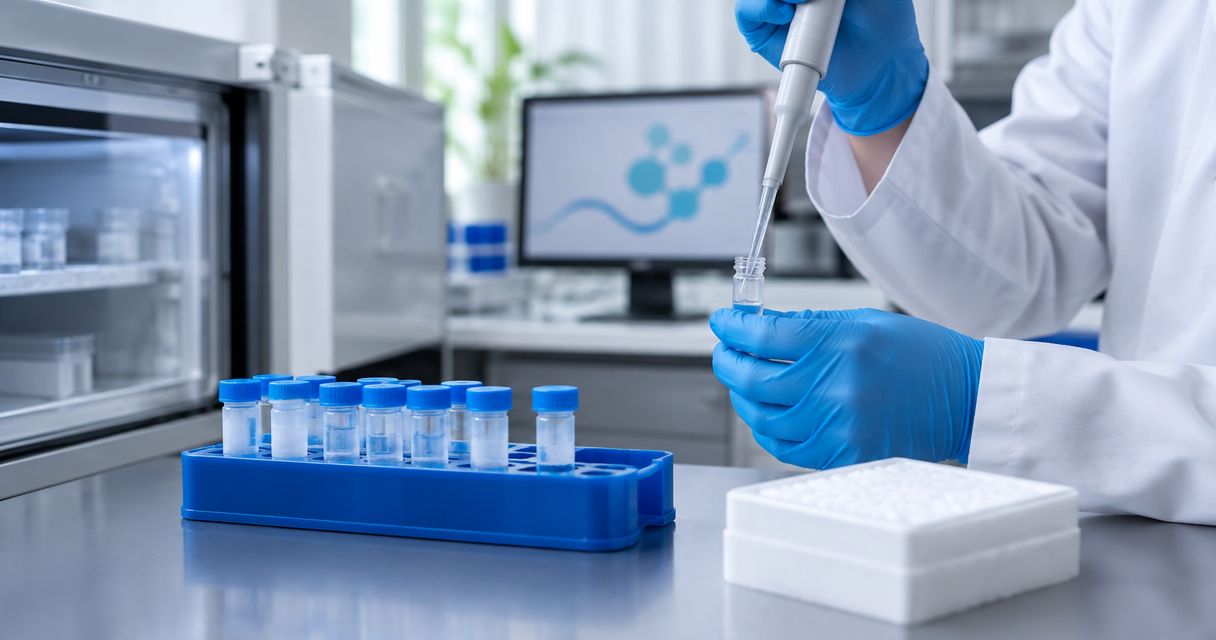
Refreeze reconstituted peptides after thawing only when the specific peptide, solvent, formulation, and research protocol have documented support for that handling. Without that support, refreezing does not establish that the solution remains suitable for your experiment, and a clear-looking vial does not prove chemical stability or freedom from contamination.
- Can you refreeze reconstituted peptides after thawing? Only when peptide-specific handling instructions or stability data support it.
- Peptides777 sells research-grade peptides; starting purity does not establish stability after reconstitution or repeated freezing.
- Record every freeze–thaw cycle and use experiment-sized aliquots when the validated protocol permits frozen storage.
- An uncertain handling history requires a documented research decision, not a visual check alone.
Can you refreeze reconstituted peptides after thawing?
There is no universal permission to refreeze a reconstituted peptide. The decision belongs to the exact preparation: its sequence, solvent, concentration, container, storage conditions, and documented handling history. Instructions for a dry peptide powder do not automatically apply after you dissolve it.
Use this decision table for your 2026 laboratory handling procedure. It separates permission to store a sample from evidence that the sample remains suitable for a particular experiment.
| Situation | Research handling decision | What this does not establish |
|---|---|---|
| The applicable protocol explicitly permits refreezing | Follow its conditions and record the additional cycle | Suitability outside the validated conditions |
| Instructions address frozen storage but not repeated thawing | Resolve the missing handling question before refreezing experimental stock | Permission for repeated freeze–thaw cycles |
| Instructions address only the dry powder | Obtain guidance for the reconstituted solution | Solution stability based on powder storage instructions |
| The vial has an undocumented thawing history | Segregate it from qualified experimental stock pending review | Acceptable quality because the solution looks unchanged |
| The preparation has unexpected particles or a changed appearance | Investigate under the laboratory procedure before use | The cause of the change or its effect on the assay |
A freezer is a storage condition, not a quality test. Returning a vial to frozen storage does not reverse degradation that has already occurred or remove contamination introduced during handling.
Why this matters
A handling difference can become an experimental variable. If you compare samples with different storage histories, you need evidence that those histories do not compromise the comparison—not simply an assumption that every vial contains the same usable material.
Peptides777 supplies research-grade peptides for laboratory and scientific research. Its stated marketing purity of 99%+ is not a freeze–thaw validation: starting purity and stability after reconstitution answer different questions.
Peptides777 is for laboratory researchers sourcing research-grade peptides, not for personal treatment decisions. Keep storage decisions within the research setting and separate them from questions about administration or clinical use.
When refreezing has documented support
Refreezing is a defensible research handling step when the applicable instructions or validation address the preparation you actually have. A general statement that a peptide tolerates freezing is less specific than evidence covering the solution, container, storage conditions, and number of cycles used in your experiment.
Check the scope before applying any instruction. A study involving another formulation does not automatically validate your formulation, even when the peptide name matches.
Your supporting record should identify:
- Material identity: the peptide and the lot used in the experiment.
- Solution conditions: the solvent, relevant additives, and concentration.
- Storage conditions: the specified conditions before and after thawing.
- Handling history: previous cycles and any known storage excursions.
- Acceptance criteria: the measurements used to judge suitability for the intended work.
For a 2026 protocol review, distinguish a supplier instruction from an internally validated procedure. Both can inform handling, but neither should silently inherit conditions that the underlying document does not address.
Does permission to freeze mean permission to refreeze?
Permission to freeze a reconstituted peptide does not automatically permit repeated thawing and refreezing. Initial frozen storage and repeated cycling are different handling conditions, so check whether the instruction covers both.
Read the instruction in context. A direction to store frozen does not, by itself, tell you how often the vial can be thawed, how long it can remain thawed, or whether a previously accessed vial remains suitable for the same work.
When the handling history is uncertain
An undocumented vial should not be treated as equivalent to qualified stock. Record what is known, identify the missing information, and follow the laboratory's procedure for disposition or additional testing.
Do not fill gaps with reassuring observations. A vial that remained closed can still have an unsuitable temperature history, while a vial that looks clear can still have changes that visual inspection cannot detect.
A useful uncertainty record states exactly what is unknown: the thawing duration, previous cycles, temperature excursion, or handling conditions. That is more useful than a vague label such as “probably fine.”
The limitation matters even for exploratory work. If you retain an uncertain sample for a limited purpose, label that purpose and keep its results distinct from data generated with qualified material.
Does refreezing reset the storage clock?
Refreezing does not reset a peptide solution's handling history. Keep the original reconstitution date and the intervening storage record rather than replacing them with the most recent freezing date.
Treat each handling event as an addition to the record. A new freezer entry is not a new preparation, and it does not erase time already spent under other conditions.
Why refreezing outcomes vary
Peptides do not share a single stability profile. These factors explain why a blanket instruction cannot replace preparation-specific evidence:
- Peptide structure: sequence and chemical modifications affect susceptibility to degradation and aggregation.
- Solvent and pH: the solution environment influences solubility and chemical stability.
- Concentration: concentration can affect aggregation and the significance of material lost to container surfaces.
- Container and handling: contact surfaces, transfers, and repeated access introduce additional variables.
- Temperature history: freezing conditions, thawing conditions, and time spent thawed are separate parts of the exposure history.
- Experiment requirements: a preparation's suitability depends on what the assay measures and the acceptance criteria it must meet.
These are variables to investigate, not a formula for calculating a safe number of cycles. None supplies a universal cutoff by itself.
For Peptides777 research-grade peptides, apply evidence for the exact material and preparation rather than extrapolating across the catalog. Shared research-use labeling does not make different compounds interchangeable for storage decisions.
How to handle a thawed vial before deciding
Review the evidence before adding another freeze–thaw event. The purpose of this sequence is to make the decision traceable, not to create a universal storage procedure.
- Identify the preparation. Match the vial to its peptide, lot, reconstitution record, solvent, concentration, and container.
- Review the history. Check the reconstitution date, documented storage conditions, previous thawing events, and known excursions.
- Check the protocol. Confirm that the applicable instruction addresses the reconstituted solution and the proposed refreezing step.
- Decide the disposition. Follow the authorized procedure for continued use, additional evaluation, segregation, or disposal.
- Record the outcome. Document the decision, its basis, and any restrictions on the sample's experimental use.
The decision should follow the evidence, not the convenience of keeping the vial. If a required condition cannot be verified, record the limitation instead of treating it as satisfied.
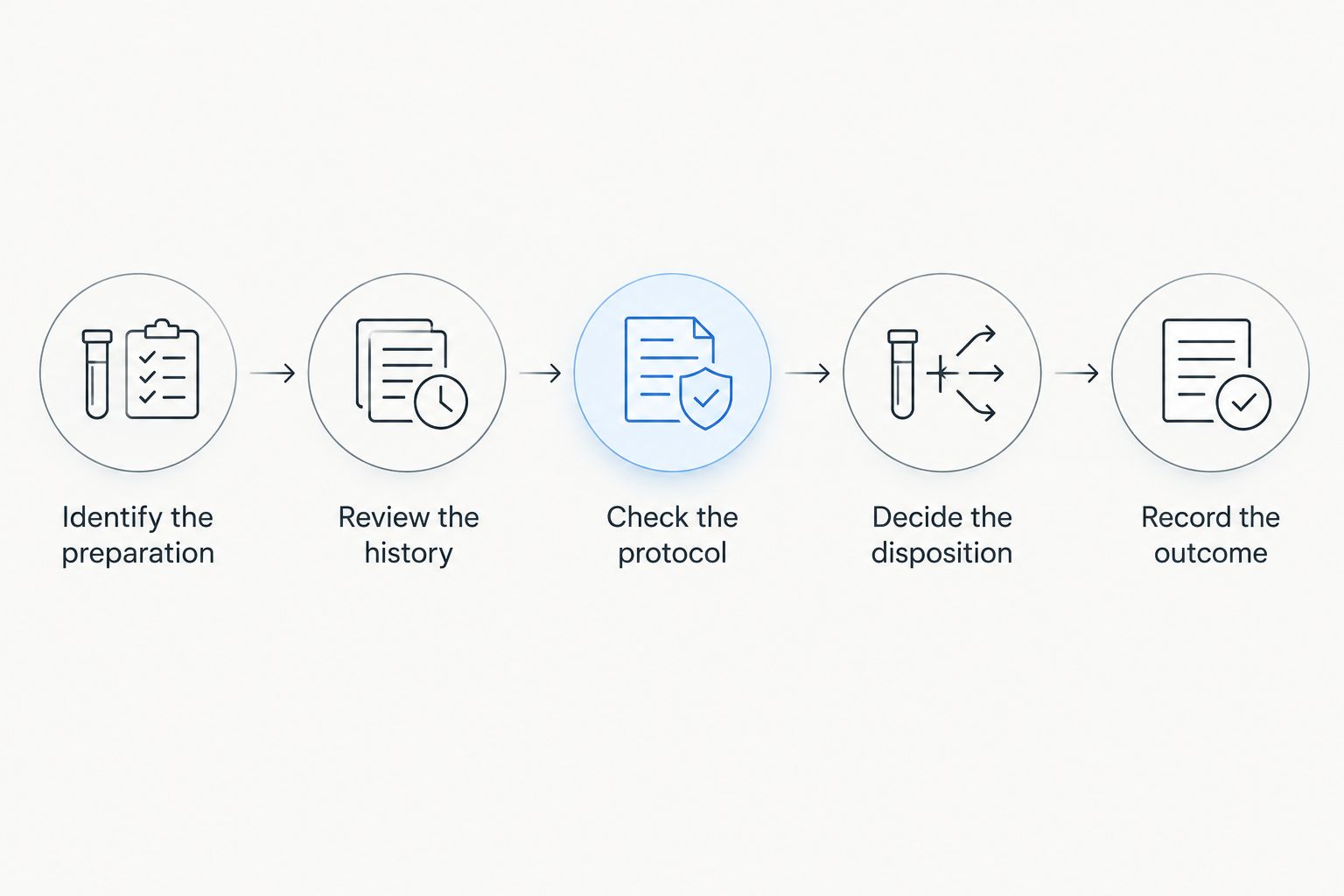
A 2026 laboratory worksheet can capture this sequence without assigning an unsupported shelf life. Keep the applicable instruction attached or referenced so another researcher can understand why the decision was made.
Aliquots versus repeatedly accessing a stock vial
Use experiment-sized aliquots when the validated protocol permits that preparation and storage approach. Aliquoting can reduce repeated thawing of the entire stock, but it introduces transfers and additional containers that also need appropriate controls.
Neither approach is automatically correct for every peptide. Select the approach supported by the method, then apply it consistently.
| Approach | Best for | Advantage | Limitation |
|---|---|---|---|
| Experiment-sized aliquots | Workflows with validated aliquot preparation and frozen storage | Limits the need to thaw the entire stock repeatedly | Adds transfers, containers, and potential surface losses |
| Repeated access to a stock vial | Workflows whose instructions specifically support repeated access | Reduces the number of separately prepared containers | Requires control of cumulative handling and temperature history |
Choose aliquot sizes from actual experimental demand, not an arbitrary volume recommendation. Include the needs of the assay and the method's handling requirements without inventing a universal vial size.
The trade-off is practical: too little material can require additional handling, while excess thawed material recreates the original refreezing question. A documented preparation plan addresses that choice before the experiment begins.
What to record about freeze–thaw cycles
Define a cycle in your procedure before counting it. For example, a laboratory can define a completed cycle as a frozen sample becoming thawed and then returning to frozen storage; the record must also capture the exposure conditions that the count alone omits.
Under that definition, 0 completed cycles means no completed thaw-and-refreeze event is recorded, 1 completed cycle means one is recorded, and 2 completed cycles means two are recorded. These are bookkeeping labels, not stability limits or permissions to use the sample.
Your 2026 sample record should retain:
- The original reconstitution date and preparation details.
- The date and time of each relevant storage transition.
- The observed or documented temperature conditions.
- Whether the vial was opened or material was withdrawn.
- Any deviation from the applicable handling procedure.
- The identity of the person documenting the event.
Do not reduce the history to a cycle count if the protocol also depends on thawed exposure time. Two samples with matching counts can still have different handling histories.
Can you tell whether a refrozen peptide is still usable?
Appearance alone cannot establish that a refrozen peptide remains suitable for research. Visible changes are reasons to investigate, but the absence of visible changes is not proof of unchanged identity, purity, concentration, or activity.
Choose checks that address the experiment's actual requirement. An analytical result addressing identity does not automatically establish biological activity, and a functional response does not by itself establish freedom from contamination.
This distinction also prevents overreading supplier information. A starting-material purity statement describes the tested material under its stated scope; it does not certify every later solution preparation and handling event.
Should you test the sample or prepare fresh material?
Choose testing or fresh preparation according to the method's acceptance criteria and laboratory procedure. Testing is useful only when it can resolve the uncertainty that matters to the experiment.
If the available test cannot answer the relevant question, a passing result should not be treated as blanket approval. Document the remaining limitation and use the laboratory's authorized disposition process.
FAQ
Can I refreeze reconstituted peptides after they thaw once?
Refreeze a reconstituted peptide only when the applicable instructions or validation support that handling. A single thaw does not establish a universal permission to refreeze.
How many times can I freeze and thaw a peptide solution?
There is no universal freeze–thaw limit for all peptide solutions. Use the limit established for the specific peptide, formulation, storage conditions, and experimental method.
Does a clear peptide solution mean it survived refreezing?
A clear peptide solution does not prove that refreezing left it unchanged. Appearance cannot establish chemical stability, concentration, biological activity, or freedom from contamination.
Does bacteriostatic water make repeated refreezing acceptable?
Bacteriostatic water does not establish peptide stability during repeated refreezing. Solvent selection and freeze–thaw handling both require support for the specific preparation.
Are aliquots better than repeatedly thawing the stock vial?
Experiment-sized aliquots reduce the need to thaw the entire stock when the validated procedure supports aliquoting and frozen storage. Transfers and additional container contact remain limitations to control.
Does Peptides777's stated purity validate refreezing?
Peptides777's stated marketing purity of 99%+ does not validate refreezing a reconstituted solution. Starting purity and stability after subsequent handling are different claims.
What should I do if I do not know whether a vial thawed previously?
Segregate an undocumented vial from qualified experimental stock pending review under your laboratory procedure. Record the uncertainty rather than assuming the vial has no previous freeze–thaw exposure.
One last thing
The most useful freezer label records history, not just identity. A peptide name tells you what the vial is supposed to contain; its preparation and storage record tells you whether it meets the conditions required for your experiment.
For your 2026 handling procedure, make the next action explicit: follow documented refreezing permission, resolve the missing evidence, or keep the sample separate from qualified stock. Do not let returning a vial to the freezer stand in for that decision.