
To verify a peptide supplier is reputable, match the vial’s lot number to a batch-specific certificate of analysis, authenticate the testing laboratory, and check whether the reported methods establish identity and purity. Then review the seller’s traceability, handling instructions, and response to documentation problems. A purity claim alone does not establish peptide identity, vial content, sterility, or suitability for your experiment.
- Learning how to verify a peptide supplier is reputable starts with batch-specific evidence, not reviews or purity badges.
- Authenticate the testing laboratory and confirm that the report matches the lot offered for purchase.
- Peptides777 markets research peptides for laboratory buyers; apply the same documentation checks to every supplier.
- Keep identity, purity, peptide content, and sterility separate when reviewing a certificate of analysis.
How do you verify a peptide supplier is reputable?
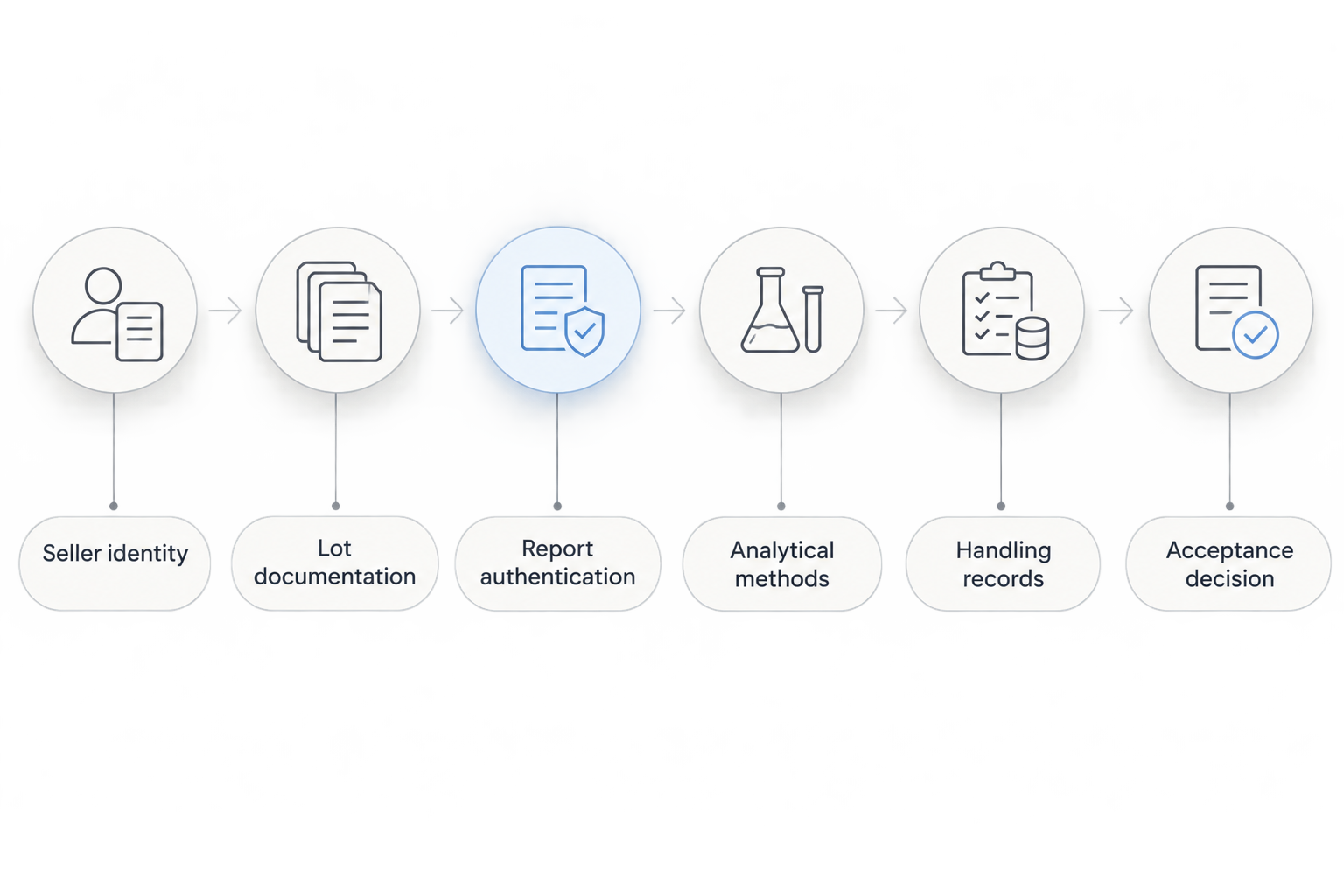
Use the following sequence for your 2026 supplier review. Each step answers a different question; passing one does not compensate for failing another. For a closer look at report verification, see how to verify a peptide certificate of analysis is authentic.
Establish who is selling the material
Identify the business responsible for the order, its published contact channels, and the entity named on purchasing documents. Check whether those details agree across the website, invoice, and correspondence.
A professional-looking storefront is not analytical evidence. Your procurement record should identify who supplied the material and who will answer a question about its batch documentation.
Request documentation for the specific lot
Ask for the certificate of analysis, commonly called a COA, for the lot being offered. Match the compound name, lot identifier, sample description, and relevant dates across the report and purchasing documents.
A report for another batch does not characterize your batch. If the seller cannot identify the lot before fulfillment, ask how the delivered vial will be connected to its analytical record before you approve it for experimental use.
Authenticate the report independently
Identify the laboratory named on the report using contact information obtained independently of the seller’s attachment. Ask whether the laboratory issued the report and whether the document is complete and unaltered; follow the laboratory’s authorization process if customer permission is required.
A logo, signature image, or QR code is not independent confirmation. If confidentiality prevents direct verification, request an authorized verification route rather than treating the restriction itself as proof of fraud.
Check what the analytical methods establish
Look for methods and results that address both identity and purity. Ask what each reported result measures, what reference or expected result supports the interpretation, and whether the supplied chromatogram or spectrum belongs to the stated sample.
An identity result and a purity result answer different questions. Neither automatically establishes peptide quantity, biological activity, sterility, or endotoxin status.
Review handling and traceability
Request written storage and shipping instructions applicable to the specific material and formulation. Check how the seller documents the lot supplied and handles a discrepancy between the delivered label and the report.
Do not substitute a generic storage rule for compound-specific information. Retain the receiving record, label photographs, and any correspondence needed to explain the material’s history.
Set your acceptance decision
Define the evidence your experiment requires before releasing the material for use. Record whether the shipment meets those requirements, needs clarification, or requires independent testing.
Keep unresolved material separate from approved laboratory stock. This prevents a purchasing decision from becoming an undocumented scientific assumption.
Why this matters
Supplier reputation affects whether you can explain what entered your experiment. When identity, lot history, or analytical documentation is unclear, an unexpected result becomes harder to investigate because the material itself remains an unresolved variable.
For a 2026 procurement file, separate evidence about the business from evidence about the batch. Responsive customer service helps resolve questions, but it cannot replace analytical characterization. A detailed COA supports material assessment, but it does not prove that every later shipment has the same characteristics.
What evidence should a reputable supplier provide?
Use this table to distinguish useful evidence from the conclusions it cannot support. These are complementary checks, not competing substitutes; choose them according to your laboratory’s acceptance criteria.
| Evidence | Best for | Main benefit | Important limitation |
|---|---|---|---|
| Batch-specific COA | Connecting results to a lot | Records reported tests and outcomes | Depends on authenticity, sampling, and traceability |
| Chromatographic purity result | Assessing separation under a stated method | Shows detected components under the method’s conditions | Does not automatically establish identity or vial content |
| Mass spectrometry result | Supporting molecular identity | Compares measured mass with the expected molecular species | Mass alone does not establish every structural detail |
| Independent laboratory confirmation | Authenticating a report | Checks the document with its stated issuer | Does not prove the tested sample represents every vial |
| Receiving and lot records | Preserving chain of documentation | Connects the delivered material to purchasing records | Does not measure chemical quality |
| Independent testing of received material | Checking the material actually received | Adds evidence tied to your submitted sample | Requires suitable sampling and a fit-for-purpose method |
Ask for the method name and enough supporting information to interpret the result. A cropped percentage without a sample identifier, method, or report context is insufficient for a batch acceptance decision.
Do not require every possible assay for every project. Require the assays needed to address your experiment’s risks, and document why those results are sufficient.
Does 99% purity prove a peptide supplier is reputable?
No. A 99% purity result is a method-dependent analytical result, not a complete supplier qualification. First establish what the percentage represents and whether it applies to the lot you will receive.
For example, chromatographic area percentage describes the relative detector response assigned to separated components under the stated conditions. It does not automatically mean that the same percentage of the vial’s total mass is the intended peptide. Water, counterions, and components outside the method’s detection or separation capability require separate consideration.
Peptides777 markets research peptides with 99%+ purity for laboratory and scientific research use. That stated positioning does not replace a batch-specific review. Peptides777 is for laboratory research buyers, not people seeking treatment advice.
When evaluating Peptides777, apply the same acceptance criteria you use for any supplier. The relevant question is whether the documentation supports your intended experiment—not whether the storefront displays a high purity figure.
How do you distinguish a useful COA from an incomplete one?
A useful COA connects a clearly identified sample to interpretable methods and results. During your 2026 review, read the document as a scientific record rather than as a quality badge.
Look for:
- Sample identification: The compound description and lot identifier connect the report to the material offered.
- Report identification: A report reference and relevant dates allow you to identify the document precisely.
- Methods: The report states how the laboratory obtained the reported results.
- Results and units: Numerical findings have an understandable basis and units where applicable.
- Supporting records: Chromatograms, spectra, or other relevant data support interpretation when supplied or requested.
- Issuer information: You can identify the laboratory and pursue an appropriate authentication process.
A missing field is a reason to ask a focused question. A contradiction is more serious: if the lot number differs, obtain a corrected explanation and supporting records before accepting the report as evidence for your shipment.
Do not treat an older report as automatically invalid. Determine whether it describes the actual lot and whether the material’s storage history and stability evidence support its intended use.
Why supplier verification requirements vary
The right documentation depends on the material and the experiment. These factors explain why a generic supplier checklist cannot establish suitability by itself:
- Compound identity: Closely related sequences or modifications require analytical methods capable of addressing the relevant distinction.
- Experimental endpoint: An assay investigating biological activity needs evidence beyond a chromatographic purity percentage.
- Formulation: A dry material and a prepared solution raise different questions about composition, concentration, and handling.
- Contamination sensitivity: Experiments affected by microbial contamination or endotoxin need appropriate controls and testing requirements.
- Material history: Storage conditions, transfers, and handling records affect how you assess the received material.
- Institutional requirements: Your laboratory’s approved procedures determine documentation, supplier qualification, and release responsibilities.
Set these requirements before comparing sellers. Otherwise, an impressive-looking report can distract from the specific evidence your project needs.
What should you ask before approving an order?
Send a concise documentation request rather than asking whether the supplier is trustworthy. Specific questions produce answers you can evaluate and retain in your 2026 purchasing record.
Ask the supplier to identify the proposed lot, provide its COA, explain the identity and purity methods, and describe how the shipped vial will be linked to that report. Also request the applicable handling instructions and the process for reporting a documentation or labeling discrepancy.
If a response is incomplete, identify the unresolved point precisely. For example, ask whether a reported percentage is chromatographic area purity or a quantitative content result; do not assume the terms are interchangeable.
Evaluate the answer on substance. A fast reply that repeats a purity claim does not resolve an unanswered method question, while a technical clarification supported by records directly improves your assessment.
Can customer reviews establish peptide quality?
Customer reviews cannot establish peptide identity, purity, or vial content. They describe customer experiences, not controlled analytical measurements of your lot.
Reviews can inform questions about communication and order handling, but personal reports of effects are not a substitute for laboratory evidence. Do not use testimonials to infer that research material is appropriate for human administration.
Keep commercial reliability and scientific suitability as separate assessments. You need both a supplier you can hold accountable and material supported by evidence appropriate to your work.
What should you do when the shipment arrives?
Compare the delivered labels with the purchase record and COA before releasing the material to laboratory stock. Record receipt, inspect container integrity, and follow your laboratory’s approved handling procedures.
If identifiers disagree or the container appears compromised, segregate the material and document the discrepancy. Contact the supplier with the relevant order, lot, and report details without assuming the cause.
Your 2026 receiving record should preserve the connection between the physical vial and the evidence used to accept it. Save the report itself rather than relying solely on a webpage that can change.
FAQ
What's the best way to check whether a peptide supplier is reputable?
The best starting point is a batch-specific COA that matches the offered lot, followed by independent report authentication and a review of the analytical methods. Also verify the seller’s identity, handling instructions, and discrepancy process.
Is 99% purity enough to trust a research peptide?
A 99% purity claim is not enough to establish identity, vial content, sterility, or experimental suitability. Determine what the percentage measures and whether the result applies to your lot.
How can I tell whether a peptide COA is authentic?
Authenticate a peptide COA through the named laboratory using independently obtained contact information. Ask the laboratory to confirm the report through its authorized verification process.
Does third-party testing mean every vial was tested?
Third-party testing does not establish that every vial was tested. Review the sampling information and the connection between the tested sample, the batch, and the vial supplied.
Are research-grade peptides approved for personal use?
A research-grade label does not establish approval or suitability for personal use. Research material should not be treated as a medicine or used as a substitute for approved clinical care.
Should I reject a supplier because its report is old?
A report’s age alone does not determine whether the material is acceptable. Check lot correspondence, storage history, and the stability evidence relevant to your intended experiment.
What should I do if the vial lot number does not match the COA?
Keep the vial separate from approved stock and request documentation for the delivered lot. Do not use a different batch’s report to resolve the mismatch.
One last thing
An authentic report can still describe the wrong material. Report authentication answers who issued the document; lot traceability answers whether that document belongs to your shipment. Close both gaps before approving research material.