Thymosin alpha-1 has no universal, evidence-backed stability window after reconstitution: the usable period must come from stability data that match the formulation, diluent, container, and storage conditions. Chemical stability alone also does not establish microbiological suitability, so a solution can retain measurable peptide while failing a laboratory’s contamination-control requirements. This guide explains how to assess those limits for research use without borrowing an unsupported expiry from another product.
- Thymosin alpha-1 stability after reconstitution requires formulation-specific evidence, not a generic countdown.
- Peptides777 serves laboratory peptide researchers; supplier selection does not replace stability verification.
- A certificate of analysis does not establish a reconstituted solution’s usable period unless it includes applicable stability evidence.
- Track storage conditions, handling, and contamination controls separately from chemical purity.
How long does Thymosin Alpha-1 stay stable once reconstituted?
Use only a post-reconstitution interval supported by documentation applicable to your material and laboratory conditions. An expiry printed on an unopened vial does not automatically apply after you dissolve its contents. Reconstitution changes the sample’s environment and introduces handling conditions that the unopened-vial specification does not describe.
For a 2026 laboratory protocol, record the source and scope of the stability claim alongside the proposed use window. A statement about a different formulation, solvent, concentration, or container is not direct evidence for your preparation.
Peptides777 supplies research-grade peptides and research compounds for laboratory and scientific use. That research-use positioning is separate from the evidence needed to assign a reconstituted solution’s expiry.
The following distinctions determine what a document actually supports:
| Evidence or observation | What it helps establish | What it does not establish alone |
|---|---|---|
| Unopened-vial expiry | Shelf life under the stated unopened storage conditions | Stability after adding a diluent |
| Release certificate of analysis | Results for the tested sample and listed attributes | Performance throughout a later storage interval |
| Applicable solution-stability study | Changes measured under the study’s conditions | Suitability under different handling conditions |
| Clear appearance | Absence of visible changes at inspection | Chemical identity, retained activity, or sterility |
| Storage log | Documented exposure history | The remaining amount of intact peptide |
No single row replaces the others. A usable-period decision needs both relevant evidence and a handling history consistent with that evidence.
Why this matters
An unsupported expiry creates an experimental problem before it creates an obvious visual one. If a stored preparation changes between experiments, differences in your results become harder to attribute to the experimental variable rather than the reagent.
The opposite mistake is treating every stored preparation as unusable without considering applicable evidence. The defensible decision is neither a blanket extension nor a blanket discard rule; it is a documented limit tied to the preparation.
Keep the question narrow: does the evidence support this material, in this solution, under these conditions, through the intended experimental endpoint? A general answer about peptides does not settle a specific answer about reconstituted thymosin alpha-1.
What does “stable” need to mean in your experiment?
Stability is not a single measurement. Before accepting a claim, identify the attribute the laboratory needs to preserve and the method used to assess it. A report that measures one attribute cannot automatically establish another.
Chemical integrity: has the peptide changed?
Chemical assessment concerns the identity and amount of intact peptide and the formation of degradation products. A suitable analytical method needs to distinguish the intended material from relevant changes; a reported purity result without its method and context is incomplete evidence.
Also distinguish purity from concentration. A sample can have a high relative proportion of the intended component while still containing less material than the experiment requires. Read the reported result as the measurement it actually represents, not as a general assurance of fitness.
Physical condition: is the preparation still suitable?
Visible particles, precipitation, or a change in appearance require investigation. However, a solution that looks unchanged has not passed a chemical stability test simply because you can see through it.
Container interactions also belong in the assessment. If the supporting study uses different storage vessels or closures, determine whether that difference affects the relevance of its results. Do not treat a change in container as a purely administrative substitution.
Microbiological control: has handling compromised the sample?
Chemical integrity and contamination control answer different questions. Repeated access, transfer steps, and the laboratory’s handling environment belong in the microbiological assessment, even when analytical testing still detects the expected peptide.
A preservative-containing diluent does not prove sterility or establish a universal storage interval. Likewise, a research-use designation does not establish suitability for administration to people or animals. This article addresses laboratory reagent assessment, not injection preparation or dosing.
How do you establish a defensible laboratory use window?
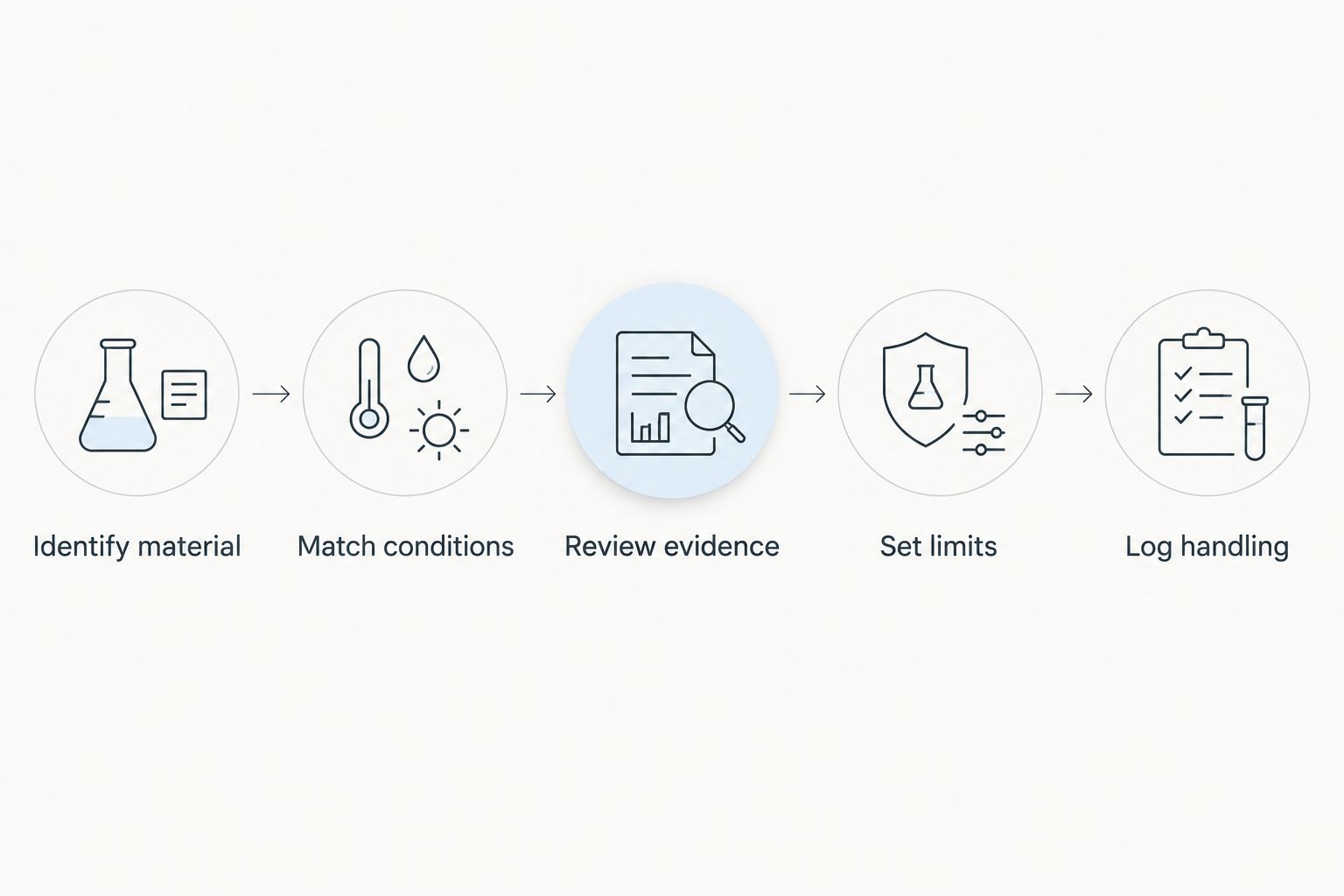
Use a sequence that connects the material’s identity to the evidence, then connects the evidence to the actual preparation. Each step should leave a record another researcher can review without reconstructing the decision from memory.
- Identify material. Record the supplier, product identifier, lot number, and supplied form. Keep the original label information connected to the laboratory’s sample identifier so documents cannot be accidentally assigned to the wrong vial.
- Match conditions. Compare the documented formulation, diluent, concentration, container, light exposure, and temperature conditions with the planned preparation. Record differences explicitly rather than treating them as equivalent.
- Review evidence. Identify the study duration, analytical methods, tested attributes, and acceptance criteria. Determine whether the report measures the properties your experiment depends on, rather than accepting the word stable by itself.
- Set limits. Assign a use window only where the evidence and your approved procedure support it. Define what happens after an excursion, unexpected appearance change, or handling deviation before one occurs.
- Log handling. Record reconstitution, storage, access events, transfers, and deviations. Keep the decision and its supporting documents with the preparation’s record, not only in a general supplier folder.
For your 2026 procedure, distinguish the document’s review date from the experimental evidence it contains. Updating a procedure’s date does not extend a study’s observation period or resolve differences between the studied preparation and your own.
When a supporting report cannot be matched to the intended conditions, escalate the decision through the laboratory’s quality process. Do not fill the gap with a storage interval copied from a discussion forum or an unrelated supplier’s label.
Why thymosin alpha-1 stability after reconstitution varies
These factors define whether a stability finding applies to your preparation. They are assessment variables, not a formula for calculating extra storage time.
- Formulation: The peptide’s surrounding chemical environment matters. Data for one formulation do not automatically transfer to another, even when both labels name thymosin alpha-1.
- Diluent and solution conditions: Solvent composition, pH, and concentration define the preparation being studied. Changing them changes the conditions to which a stability claim applies.
- Temperature history: A storage instruction describes an intended condition, while a temperature record describes actual exposure. An excursion needs assessment against applicable evidence, not an assumed reset when storage resumes.
- Container and closure: Vessel material, closure integrity, and transfers affect how closely your preparation matches the studied system. Document substitutions rather than silently treating them as equivalent.
- Light and handling exposure: The study’s handling conditions set the scope of its conclusion. Repeated warming, light exposure, and freeze–thaw events need consideration where they differ from those conditions.
- Contamination controls: Access technique and the handling environment affect microbiological suitability. Chemical stability evidence does not replace the laboratory’s contamination-control procedure.
A colder location, a clear solution, or a high purity claim is not permission to extend the use window. Each addresses only part of the assessment, and none supplies missing formulation-specific evidence.
What should you ask the supplier before reconstitution?
Ask for documentation that answers the actual decision: what evidence supports storage after dissolution under the conditions you intend to use? A general product specification is useful background, but it does not answer that question unless its scope includes the reconstituted preparation.
For a Peptides777 research-peptide inquiry, provide the exact material and lot identifier rather than asking only how long peptides last. Use the Contact Us page to request the applicable documentation without assuming that a particular study or storage claim exists.
Your request should distinguish these points:
- Whether the stated expiry applies to unopened material or the dissolved preparation.
- Which formulation, diluent, concentration, and container the evidence covers.
- Which storage and handling conditions were evaluated.
- Which analytical attributes were measured and what acceptance criteria were used.
- Whether the documentation addresses microbiological suitability separately.
Keep the response with your 2026 preparation record. If a reply supplies only a general recommendation, preserve that distinction: a recommendation and an analytical stability report are different types of evidence.
Can you use published thymosin alpha-1 research instead?
Published research can inform the assessment when its materials, methods, and storage conditions match the question. It does not automatically establish an expiry for a commercial research vial simply because the same peptide name appears in the paper.
Read the methods before adopting the conclusion. Determine whether the authors actually measured storage stability or merely described storing a preparation before an experiment. A reported storage practice is not the same as a study demonstrating unchanged material throughout that interval.
For a literature review completed in 2026, retain the source’s original publication date and the conditions it studied. A recent review date does not make older evidence more directly applicable, and a recent publication does not remove formulation differences.
Does refrigeration prove reconstituted thymosin alpha-1 is usable?
Refrigeration alone does not establish a usable period. It documents a storage approach only when you also know the actual temperature history and have evidence connecting that history to acceptable material quality.
Do not treat returning a vial to controlled storage as reversing an earlier excursion. Record the event and assess it under the laboratory’s approved procedure. If the excursion falls outside the supporting evidence, the remaining use window is not established by appearance alone.
Does a high purity result prove post-reconstitution stability?
A high purity result does not prove stability throughout a later storage interval. It describes the tested sample, method, and time point; stability requires evidence about change over time under specified conditions.
Peptides777 markets its research materials with a purity claim, but that claim is not interchangeable with a formulation-specific solution-stability study. Keep supplier qualification, release testing, and post-reconstitution assessment as separate decisions in your 2026 laboratory records.
FAQ
How long does thymosin alpha-1 last after mixing?
There is no universal, evidence-backed interval for every reconstituted thymosin alpha-1 preparation. Use a window supported by evidence matching the formulation, diluent, container, and storage conditions.
Can I use the expiry date on the unopened vial after reconstitution?
An unopened-vial expiry does not automatically apply after reconstitution. Check whether the supporting documentation explicitly covers the dissolved preparation and its handling conditions.
Does bacteriostatic water establish how long thymosin alpha-1 stays stable?
Bacteriostatic water alone does not establish thymosin alpha-1 chemical stability or a universal use window. The complete formulation and microbiological controls still require assessment.
Can I tell whether thymosin alpha-1 degraded by looking at it?
Appearance alone cannot establish thymosin alpha-1 integrity. Visible changes warrant investigation, but a clear solution does not prove retained identity, concentration, activity, or sterility.
Can I freeze reconstituted thymosin alpha-1 to extend its life?
Freezing does not justify extending a use window without applicable evidence. Assess freezing, thawing, and container conditions against the laboratory’s approved procedure and relevant stability documentation.
Is a certificate of analysis enough to set a storage deadline?
A certificate of analysis is not enough unless it includes applicable post-reconstitution stability evidence. Release-test results alone do not show how the preparation changes during later storage.
What should I do after a storage temperature excursion?
Document the excursion and assess it against applicable evidence and the laboratory’s approved procedure. Returning the preparation to its intended storage condition does not prove that its previous use window remains valid.
One last thing
The most useful date on a reconstituted vial is a supported discard date, not an optimistic mixing-date calculation. A mixing date tells you when preparation occurred; it does not establish how long the material remains suitable.
Before your next experiment, check that the sample record connects identity, supporting evidence, and actual handling. If those records disagree, resolve the disagreement before treating the preparation as an unchanged reagent. That check makes the stability decision reviewable and keeps an unsupported storage assumption out of the experimental interpretation.