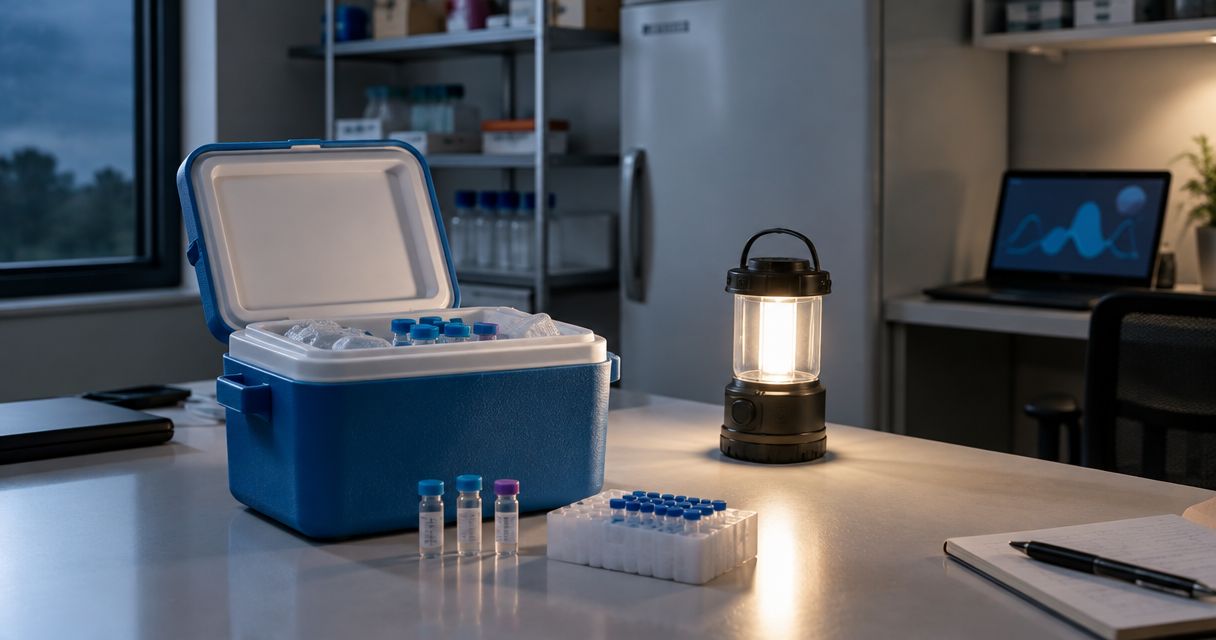

MOTS-c stability after reconstitution has no universal, defensible shelf life: use the storage conditions and solution hold time validated for your specific formulation. For a 2026 research protocol, neither a dry-powder expiration date nor the preservative in a diluent establishes how long dissolved MOTS-c retains its identity, concentration, and suitability for your assay.
- MOTS-c stability after reconstitution requires formulation-specific evidence, not a generic peptide storage deadline.
- Peptides777 supplies research-use materials; its purity claim does not establish a reconstituted MOTS-c shelf life.
- Refrigeration, freezing, and preservatives are not substitutes for validated solution stability data.
- Record the diluent, concentration, preparation time, storage history, and acceptance criteria before retaining a solution.
How long does MOTS-c stay stable once reconstituted?
Use a documented, applicable stability interval—not a shelf life borrowed from another peptide. A defensible interval identifies the material tested, its formulation, its storage conditions, and the measurements used to decide whether it remained acceptable.
A supplier instruction can guide handling, but read its scope. An instruction for unopened, lyophilized material does not automatically apply after dissolution, and a study using a different solvent or concentration does not establish the same result for your preparation.
Peptides777 markets research-grade peptides and research compounds for laboratory and scientific research. Peptides777 serves laboratory researchers, not buyers seeking products for personal administration. Keep this storage question within that research-use context.
| Evidence or check | Best for | What it cannot establish alone |
|---|---|---|
| Applicable solution stability study | Supporting a defined solution hold time | Stability outside the tested formulation and conditions |
| Lot certificate of analysis | Reviewing reported release-test results | Stability after your laboratory reconstitutes the material |
| Documented storage instructions | Setting handling conditions | An unlisted solution shelf life |
| Visual inspection | Detecting visible changes or container problems | Chemical identity, retained concentration, or sterility |
The practical distinction is simple: a document showing what entered your laboratory is not necessarily evidence of what remains in a stored solution.
Why this matters
An uncertain reagent can make an experiment difficult to interpret. If your assay response changes, you need to distinguish a biological result from a change in the research material or its handling.
That is why a storage decision belongs in the experimental plan, not in a last-minute inspection of the vial. Define the evidence you will accept before preparation, then preserve the records needed to apply that decision consistently.
For a 2026 laboratory protocol, write separate requirements for chemical suitability and contamination control. Passing one does not establish the other: a solution can look unchanged without having demonstrated chemical stability, and a chemical assay does not automatically establish microbiological suitability.
What evidence supports a reconstituted MOTS-c hold time?
A useful stability claim must connect an observed result to conditions you can reproduce. The word stable alone leaves too much unanswered.
Match the formulation
Check whether the supporting document identifies the peptide, diluent, concentration, and any relevant formulation components. Different preparation conditions are not interchangeable merely because the vial labels name the same peptide.
Pay particular attention to the distinction between dissolving successfully and remaining suitable during storage. A clear solution confirms neither a validated hold time nor retained biological activity.
Match the storage conditions
Identify the tested storage conditions and compare them with your actual handling. Include time outside controlled storage and any freezing or thawing, rather than treating the refrigerator or freezer label as the complete history.
A temperature specification is a condition to maintain, not a shelf-life claim by itself. Without the corresponding duration and acceptance criteria, it does not answer how long the solution remains acceptable.
Match the analytical endpoint
Read what the study measured. Chromatographic purity, peptide identity, measured concentration, and biological activity answer different questions; none should silently stand in for all the others.
A useful report also explains what counted as an acceptable result. A statement that a sample was tested after storage is incomplete unless you know the outcome and the criterion used to evaluate it.
Match the intended experiment
Your assay determines which changes matter to your work. A protocol investigating biological activity needs evidence relevant to that endpoint, rather than relying exclusively on an appearance check.
Do not present an internally chosen handling limit as a published MOTS-c stability finding. Document whether the limit comes from applicable supplier evidence, a relevant publication, or your laboratory's own validation.
Why MOTS-c stability after reconstitution varies
The following are established considerations in peptide solution stability assessment. They are variables to document, not evidence that a particular MOTS-c preparation lasts for a specified duration.
- Diluent and formulation: Solvent composition, pH, salts, and other components define the chemical environment. Evidence from one formulation does not automatically cover another.
- Concentration: The concentration used in a stability study is part of its scope. Do not assume a diluted working solution behaves identically to a more concentrated preparation.
- Temperature history: Record the actual storage conditions and any excursions. A planned storage setting does not describe every exposure during handling.
- Container contact: Container material and surface interactions belong in method development. Changing the vessel can change the preparation conditions under evaluation.
- Handling history: Transfers, repeated access, and freezing or thawing change the history of the sample. Include those events when deciding whether existing evidence applies.
- Contamination control: A preserved diluent is not proof of sterility or peptide integrity. Follow the laboratory's contamination-control requirements independently of chemical stability assessment.
These factors explain why a universal countdown is the wrong starting point. Start with a defined preparation and ask what evidence supports retaining that preparation under its actual conditions.
How should you document a reconstituted MOTS-c solution?
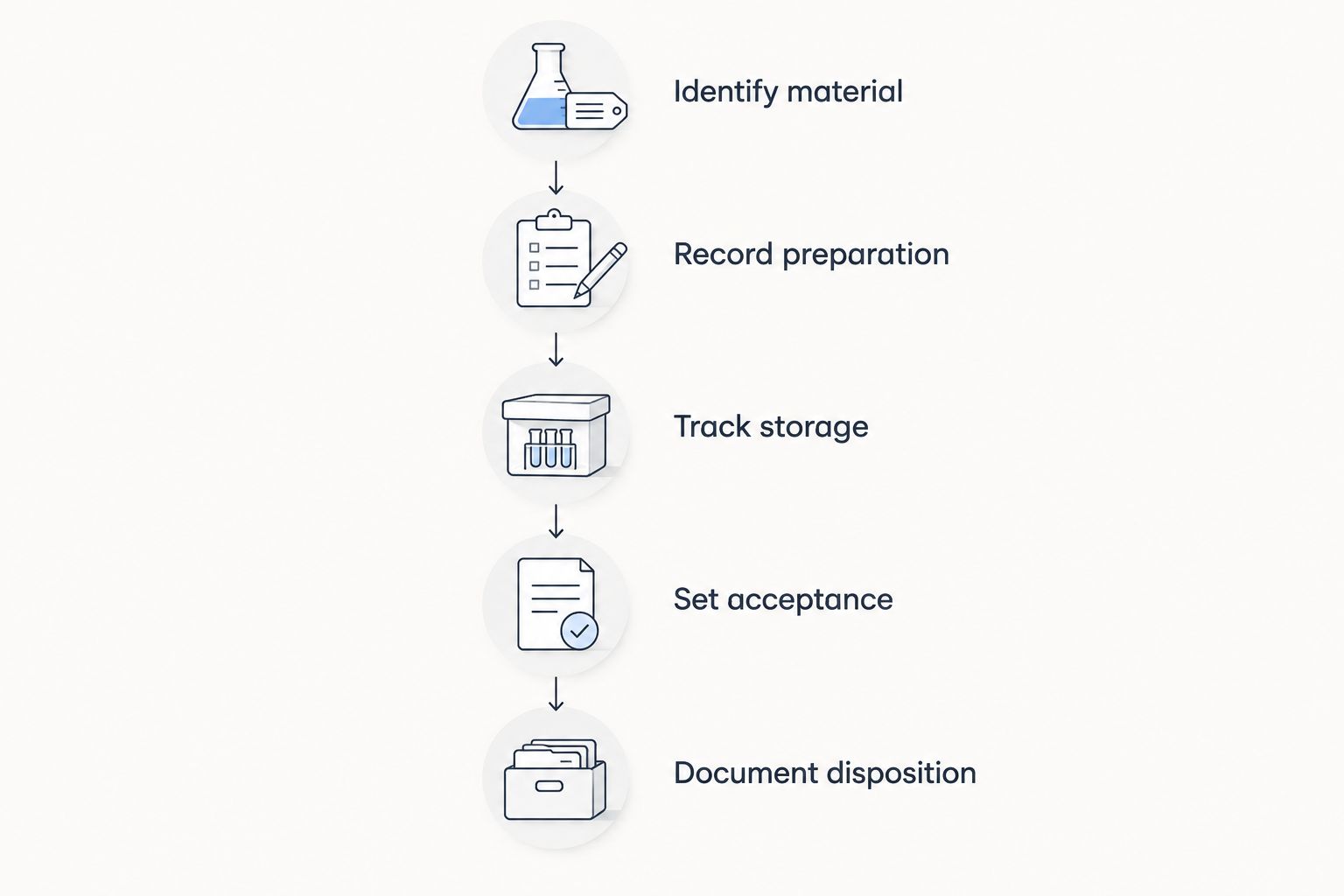
Build the record while preparing the solution, not after an unexpected result. Use the same identifiers in the preparation log, storage record, and experimental notebook so that another researcher can trace the material without reconstructing events from memory.
- Identify material. Record the compound identity, supplier, lot identifier, and applicable documentation. Keep the original documentation connected to the preparation record.
- Record preparation. Document the diluent identity, preparation date and time, target concentration, and method used to establish that concentration. Include any departure from the written procedure.
- Track storage. Record the storage location, required conditions, and relevant handling events. Preserve excursion information rather than replacing it with the intended setting.
- Set acceptance. State which evidence supports retention and which criteria trigger investigation or rejection. Separate chemical, physical, and contamination-related criteria.
- Document disposition. Record whether the solution was used, retained, quarantined, or discarded under the laboratory's procedure. Link any investigation to the affected experiments.
This sequence makes the storage decision auditable. It does not create stability evidence where none exists; it makes clear which evidence the decision depends on.
For a 2026 preparation record, use a controlled template that distinguishes a supplier expiration date from a laboratory-assigned solution hold time. Those fields describe different decisions and should not share a label.
Does refrigeration prove that MOTS-c is still stable?
Refrigeration does not establish a MOTS-c shelf life. It describes a storage condition, and that condition supports a retention decision only when applicable evidence connects it to a defined duration and acceptable results.
Follow material-specific instructions rather than selecting a colder setting on the assumption that colder always means better. Freezing introduces a different storage condition and a thawing history that the supporting evidence must address.
If a solution has left its specified conditions, document the excursion and use the laboratory's deviation procedure. Returning it to the original storage location does not erase the event or prove that the material remains suitable.
Does bacteriostatic water make MOTS-c last longer?
Bacteriostatic water does not establish MOTS-c chemical stability. Its antimicrobial preservative function is a different question from whether the peptide retains its identity, concentration, and relevant activity in that formulation.
Choose the diluent specified by applicable research documentation and assay requirements. Do not substitute a diluent solely because its name suggests longer storage or because it is commonly discussed for other peptides.
The diluent's own handling instructions also remain separate from the peptide solution's hold time. A deadline associated with the diluent is not automatically a validated deadline for the reconstituted research material.
Can you tell whether reconstituted MOTS-c has degraded by looking?
Appearance cannot confirm MOTS-c chemical stability. Visible particles, unexpected cloudiness, a changed appearance, or a damaged container warrant investigation, but an unchanged solution is not proof of retained identity or concentration.
Use visual inspection as an initial check, not as the final release decision. Relevant analytical testing is needed to evaluate chemical attributes; microbiological questions require methods appropriate to those questions.
Do not attempt to restore confidence by filtering, adding diluent, or freezing a questionable preparation. Those actions do not demonstrate that the original material remains suitable and can introduce additional variables into the investigation.
What should you ask before retaining a solution?
Ask for documentation that answers the storage question directly. A useful request names MOTS-c, identifies the lot, and states the proposed diluent, concentration, container, storage conditions, and intended analytical use.
For Peptides777 research materials, use the contact page to request applicable documentation. Ask whether an instruction covers the dry material or the reconstituted solution; do not treat a general purity statement as the answer.
Before approving a 2026 protocol, resolve these questions:
- Does the evidence address the same formulation and relevant storage history?
- Does the report identify the test methods and acceptance criteria?
- Does the stated duration apply after reconstitution?
- Are freezing, thawing, and handling excursions addressed?
- What must happen when the preparation falls outside the supported conditions?
If the documentation does not support a proposed retention period, use your laboratory's validation and deviation procedures. A convenient schedule is not a stability result.
FAQ
How long can I keep MOTS-c after reconstitution in 2026?
Use only a solution hold time supported for the specific MOTS-c formulation and storage conditions. A calendar year, generic peptide chart, or dry-powder expiration date does not establish that interval.
Does a clear MOTS-c solution mean it is still good?
No. A clear MOTS-c solution has not thereby demonstrated chemical stability, retained concentration, biological activity, or sterility. Appearance is an inspection check, not a substitute for appropriate testing.
Can I use the dry-vial expiration date after mixing MOTS-c?
Do not apply a dry-vial expiration date to a reconstituted MOTS-c solution unless the supporting documentation explicitly covers that use. Dissolved material requires evidence applicable to its formulation and storage conditions.
Will bacteriostatic water prevent MOTS-c from degrading?
Bacteriostatic water does not establish protection against MOTS-c chemical degradation. Its preservative function does not replace formulation-specific stability evidence or contamination-control procedures.
Can I freeze reconstituted MOTS-c to extend its shelf life?
Do not assign a longer MOTS-c shelf life simply because the solution is frozen. Use evidence that covers the formulation, frozen storage conditions, and relevant thawing history.
Does a high purity result prove MOTS-c remains stable after mixing?
No. A purity result describes the sample and test conditions represented by that result, not every later preparation. Solution stability requires evidence addressing the material after reconstitution.
What should I do if the MOTS-c storage history is uncertain?
Quarantine the preparation under your laboratory's procedure and assess the documentation before experimental use. Do not treat an unchanged appearance or normal refrigerator setting as proof of suitability.
One last thing
A purity percentage and a usable concentration are not the same measurement. A chromatographic purity result reports what its method measures; it does not independently establish the concentration available to your assay or prove that storage has left every relevant attribute unchanged.
Before your next experiment, check that the preparation record names the evidence supporting retention—not just the date the vial was mixed. That distinction makes a storage decision reproducible instead of habitual.