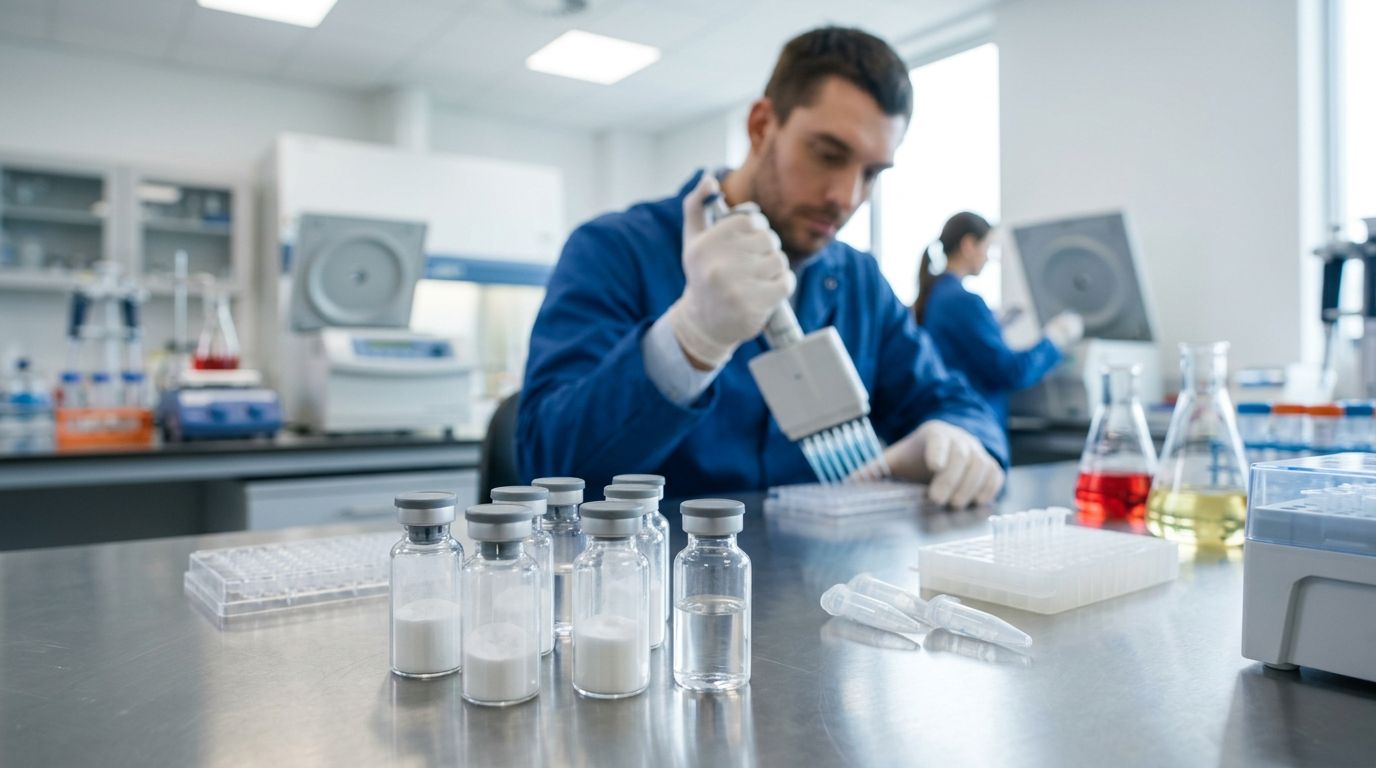
Research labs shopping for peptide blends in 2026 need purity data and sequence verification before anything else, not marketing copy. This guide ranks the six peptide categories that show up most often in lab protocols, with the compound to reach for depending on the research model you're running.
- BPC-157 tissue repair blends top the list of best peptide blends for research in 2026 for musculoskeletal and GI models.
- CJC-1295/Ipamorelin pairs suit growth hormone axis studies; Epitalon bioregulator panels suit longevity research.
- Lyophilized multi-peptide panels win on shelf stability for labs that can't reconstitute same-day.
- Every blend needs a matching certificate of analysis at 99%+ purity — a purity claim without one isn't verifiable.
Why this matters
Purity variance between research peptide suppliers is the single biggest reproducibility problem labs run into in 2026, and it's rarely disclosed until a study fails to replicate. A peptide sold as 98% purity with no HPLC or mass spec data attached is a guess dressed up as a spec sheet.
Peptides777 lists compounds at 99%+ purity with lot documentation, which is the baseline this ranking assumes for every blend below — all products referenced here are intended strictly for laboratory and scientific research use, not human consumption. For a broader catalog view before drilling into individual compounds, the top research peptides to buy online overview is worth a look.
Best overall: BPC-157 Tissue Repair Blend — the most-cited stable fragment for musculoskeletal and gut lining research models. Best for growth hormone axis research: CJC-1295/Ipamorelin Stack. Best for long-term storage: Lyophilized Multi-Peptide Panel, which extends usable shelf life regardless of which compound category you're stocking.
What makes the best peptide blend for research in 2026
- Certificate of analysis (COA) with HPLC and mass spec data attached to every lot, not just a generic spec sheet
- Sequence accuracy verified against the published amino acid chain for that peptide
- Purity threshold at 99%+, not vague "high purity" language with no number behind it
- Storage format — lyophilized powder holds integrity far longer than pre-reconstituted solution
- Cold-chain shipping with tracked handling from the point of manufacture to the lab bench
- Sourcing traceability — a batch number you can trace back to a specific manufacturing run
Best peptide blends for research at a glance
| Blend | Best For | Standout Feature | Key Limitation |
|---|---|---|---|
| BPC-157 Tissue Repair Blend | Musculoskeletal & GI research models | Largest published research base of any stable fragment here | Mechanism of action still under active study |
| CJC-1295/Ipamorelin Stack | Growth hormone axis research | GHRH analog paired with a GHRP for pulsatile GH modeling | Precise reconstitution required to avoid degradation |
| AOD-9604 Metabolic Panel | Lipid metabolism research | Fragment isolates a single fat-metabolism pathway | Narrower literature base than BPC-157 |
| Melanotan-2 Research Peptide | Melanocortin receptor studies | Broad receptor affinity supports multi-model programs | Batch-to-batch variability reported more often |
| Epitalon Bioregulator Panel | Longevity and telomere research | Deepest bioregulator research history on this list | Data concentrated in aging-model studies |
| Lyophilized Multi-Peptide Panel | Long-term storage studies | Freeze-dried format extends shelf stability | Needs correct reconstitution technique |
1. BPC-157 Tissue Repair Blend: best peptide blend for musculoskeletal research
BPC-157 is a synthetic peptide fragment studied heavily in tissue repair models, and it carries more published research volume than almost any other stable peptide fragment on this list. Labs running tendon, ligament, or gut lining recovery models tend to reach for it first.
BPC-157 pros:
- Largest published research base of the compounds ranked here
- Stable across a wide pH range in solution studies
- Available at 99%+ purity with lot-specific documentation via BPC-157 peptides for sale
BPC-157 cons:
- Mechanism of action in tissue repair models is still being characterized
- Sequence variability shows up in unverified suppliers — a COA is non-negotiable
Best for: musculoskeletal and gastrointestinal tissue repair research models. Verdict: Buy — the default starting point for a 2026 tissue-repair research protocol.
2. CJC-1295/Ipamorelin Stack: best peptide blend for growth hormone axis research
Pairing a GHRH analog (CJC-1295) with a GHRP (Ipamorelin) lets researchers model pulsatile growth hormone release without the broader receptor activity seen in older single-peptide secretagogues. It's the combination most commonly cited in endocrine research protocols examining GH axis regulation.
CJC-1295/Ipamorelin pros:
- Models a more selective GH release pathway than single-peptide GHRPs
- Two-peptide stack lets researchers isolate GHRH versus GHRP effects separately
- Well-documented reconstitution protocols across the existing literature
CJC-1295/Ipamorelin cons:
- Requires precise reconstitution and storage — degradation is common with mishandling
- Cost runs higher than single-peptide options since two compounds must be sourced
Best for: growth hormone axis and endocrine secretagogue research. Verdict: Buy — pick this stack when the protocol needs GHRH/GHRP separation.
3. AOD-9604 Metabolic Panel: best peptide blend for lipid metabolism research
AOD-9604 is a modified fragment of the human growth hormone molecule engineered to target fat metabolism pathways without the broader growth-hormone activity of the full-length peptide. Metabolic researchers use it in lipid oxidation and adipocyte models where isolating that one fragment matters.
AOD-9604 pros:
- Fragment design isolates a single metabolic pathway of interest
- Doesn't carry full-length growth hormone activity that could confound results
- Sourced with 99%+ purity documentation via AOD-9604 peptide suppliers
AOD-9604 cons:
- Narrower body of published literature than BPC-157 or Epitalon
- Fewer suppliers carry consistent batch quality compared to more common research peptides
Best for: lipid metabolism and adipocyte research models. Verdict: Hold — solid choice, but confirm the current literature fits your specific model before ordering.
4. Melanotan-2 Research Peptide: best peptide blend for melanocortin receptor studies
Melanotan-2 activates melanocortin receptors broadly, which makes it a flexible tool for labs studying pigmentation pathways, appetite regulation, and receptor binding behavior within the same research program. That same broad receptor affinity is also its main limitation for narrowly scoped studies.
Melanotan-2 pros:
- Broad melanocortin receptor affinity supports multi-model research programs
- Long track record in receptor-binding literature
- Sourcing documentation available through Melanotan-2 peptides for research
Melanotan-2 cons:
- Batch-to-batch purity variability reported more often than with single-target peptides
- Broad receptor activity makes isolating one pathway harder in mixed-model studies
Best for: melanocortin receptor and pigmentation pathway research. Verdict: Hold — verify receptor specificity needs before choosing this over a narrower peptide.
5. Epitalon Bioregulator Panel: best peptide blend for longevity and telomere research
Epitalon is a short-chain tetrapeptide bioregulator with one of the longest research histories in aging-model literature, tied largely to telomerase activity and pineal gland function studies. Labs building longevity research protocols in 2026 typically pair it with other bioregulator peptides rather than running it alone.
Epitalon pros:
- Deepest published history of any bioregulator peptide on this list
- Short four-amino-acid chain simplifies synthesis verification
- Fits naturally into a broader bioregulator research panel rather than standing alone
Epitalon cons:
- Effects documented mostly in aging-specific models, not general cell studies
- Bioregulator peptide literature overall is smaller than growth-hormone peptide literature
Best for: longevity, telomere, and pineal gland function research. Verdict: Buy — the standard entry point for a bioregulator research protocol.
6. Lyophilized Multi-Peptide Panel: best peptide blend for long-term storage studies
A freeze-dried, lyophilized format holds peptide integrity far longer than pre-reconstituted solution, which matters for labs ordering in batches or running studies spread across months rather than days. This isn't one compound — it's a storage format that applies across every peptide category above.
Lyophilized panel pros:
- Freeze-dried format extends usable shelf life versus liquid solution
- Applies across every compound category on this list, not locked to one peptide
- Reduces waste for labs that don't reconstitute daily
Lyophilized panel cons:
- Needs correct reconstitution technique — rushed prep degrades the peptide
- Requires proper storage temperature control even before reconstitution
Best for: labs running research protocols spread across weeks or months. Full storage options are covered in the lyophilized peptides for long-term storage guide. Verdict: Buy — default to lyophilized format unless the protocol specifically needs same-day solution.
How we ranked
Each blend was ranked against the six criteria above: COA availability, sequence accuracy, purity threshold, storage format performance, cold-chain shipping, and sourcing traceability. Published research volume for each compound category weighed heavily too — BPC-157 and Epitalon carry the deepest literature bases of the group, which pushed them to the top of their respective use-case slots.
Which peptide blend should you choose in 2026?
If your lab is only stocking one peptide blend for 2026 research work, start with the BPC-157 Tissue Repair Blend — it carries the most published data of anything on this list. If the program centers on GH axis modeling, order the CJC-1295/Ipamorelin Stack as a pair, not separately. For longevity protocols, pair Epitalon with a broader bioregulator panel rather than running it alone.
Regardless of which compound category fits your protocol, default to lyophilized format unless the study specifically requires same-day reconstituted solution. And whatever you order, don't accept a purity claim without a matching COA — that single document separates a research-grade peptide blend from a guess.
Shop 99%+ purity research peptides
Lot-specific documentation on every compound listed above.
FAQ
What's the best peptide blend for research in 2026?
BPC-157 leads for musculoskeletal and GI tissue repair models based on published research volume, while CJC-1295/Ipamorelin suits growth hormone axis studies and Epitalon suits longevity research. The right pick depends on the research model, not a single overall winner.
Is BPC-157 or AOD-9604 better for metabolic research?
AOD-9604 targets fat metabolism pathways specifically through a modified growth hormone fragment, while BPC-157's research base is centered on tissue repair, not metabolism. Pick AOD-9604 for lipid oxidation or adipocyte models.
How much purity should a research peptide blend carry?
Look for 99%+ purity backed by an HPLC and mass spec certificate of analysis for the specific lot you're buying. A purity percentage with no COA attached isn't verifiable.
Should I buy lyophilized or pre-mixed peptide solution?
Lyophilized (freeze-dried) format holds integrity longer and is the better choice for studies spread across weeks or months. Pre-mixed solution only makes sense when a protocol needs same-day use.
Can CJC-1295 and Ipamorelin be researched separately?
Yes, they model different parts of the GH pathway — CJC-1295 is a GHRH analog and Ipamorelin is a GHRP — and researchers sometimes isolate each to study its individual effect before combining them.
What documentation should come with a research peptide blend?
A certificate of analysis with HPLC and mass spec data, a specific batch number, and sequence verification against the published amino acid chain. Anything less makes the purity claim unverifiable.
Is Melanotan-2 suitable for narrow single-pathway research?
Not ideally — its broad melanocortin receptor affinity makes it better suited to multi-model programs than to studies isolating one specific pathway.
How should peptide blends be stored before reconstitution?
Frozen and protected from light in lyophilized form until use. Once reconstituted, peptides degrade faster and need refrigerated storage with a defined use window.
One last thing
The biggest purity failure point in most labs isn't the peptide itself — it's the reconstitution water. Bacteriostatic water past its use window introduces contamination that no certificate of analysis catches, because the COA was written for the peptide, not for what happens after you mix it. Check your water source before you check your peptide supplier in 2026.