Best overall lyophilized peptide for long-term storage: Epitalon. Best for extended multi-month research protocols: CJC-1295. Best for consistent benchtop stability across repeated freeze-thaw cycles: BPC-157. This guide ranks the lyophilized peptides available through Peptides777 by how each holds up in frozen storage, what limits its usable window, and which research setup it fits best in 2026.
- Epitalon ranks best overall for long-term storage thanks to its small tetrapeptide structure and low reactivity when frozen.
- CJC-1295 holds up well across multi-month research timelines but is more sensitive to temperature swings in transit.
- BPC-157 gives the most consistent benchtop stability across repeated freeze-thaw research cycles in 2026.
- Reconstituted lyophilized peptides always have a shorter usable window than the frozen powder itself, regardless of which compound you choose.
- AOD-9604 and Melanotan 2 fit shorter, cyclical research protocols better than long-term frozen storage.
Why this matters
A lyophilized peptide is only as good as the freezer it sits in. Freeze-drying removes water from a peptide solution to leave a stable powder, but "stable" is relative — amino acid chain length, side-chain chemistry, and how the vial was sealed all determine how long that powder holds its structure once frozen.
Most researchers don't lose potency from bad peptide chemistry. They lose it from poor handling: a freezer door left ajar, a vial cycled through room temperature repeatedly, or a peptide reconstituted weeks before it's actually used. Getting the ranking right in this guide means separating peptide-specific stability from handling mistakes that would degrade any compound.
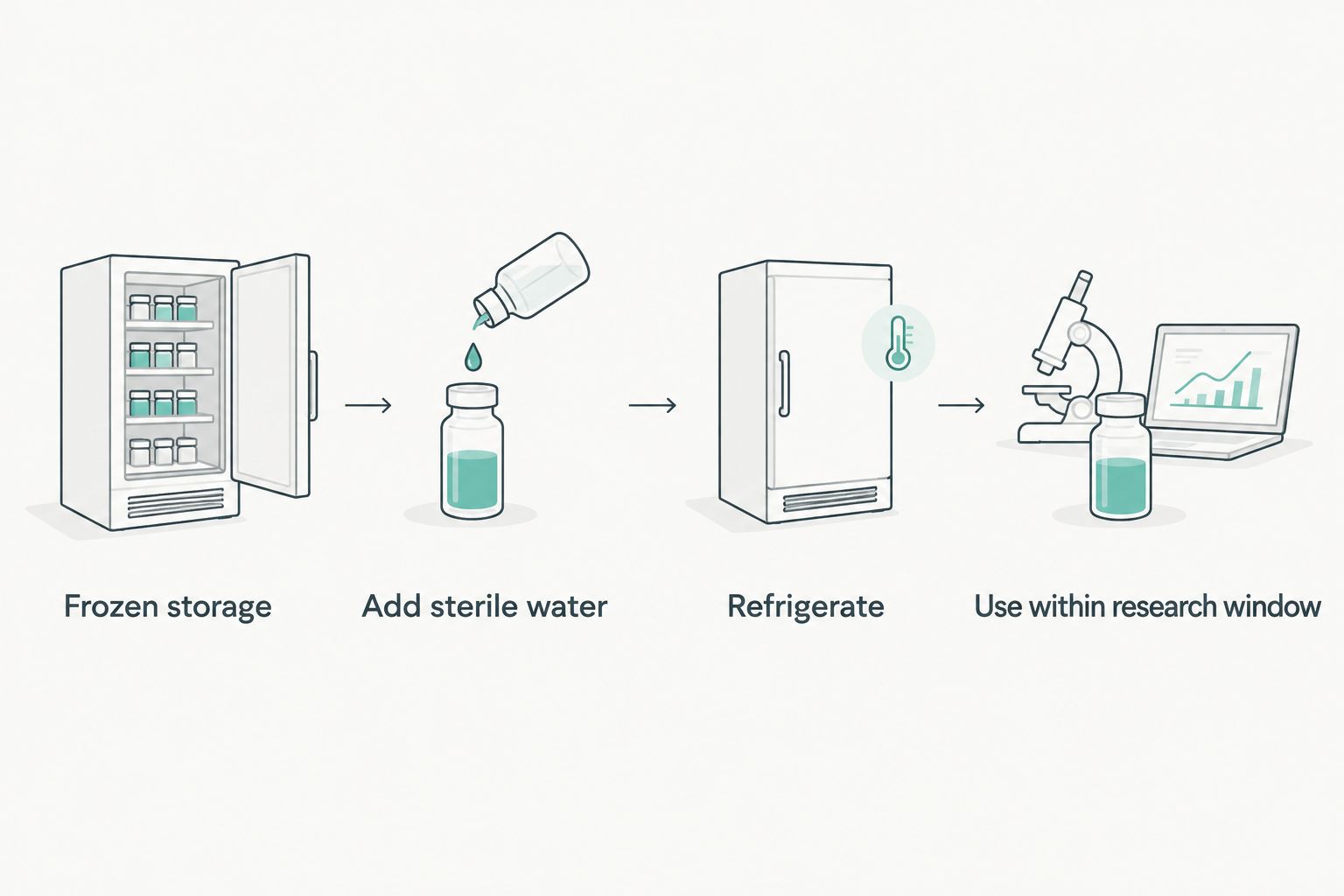
If a lyophilized peptide has been reconstituted, treat the clock as already running — refrigeration buys weeks, not months.
What makes the best lyophilized peptide for long-term storage
- Chain length and structure — shorter peptides with fewer reactive side chains generally resist oxidation better in frozen storage.
- Recommended storage temperature — lyophilized peptides are best kept at -20°C or colder, sealed against light and moisture.
- Reconstitution stability window — how long the peptide holds up once mixed with bacteriostatic or sterile water.
- Certificate of Analysis (COA) documentation — confirms purity at the time of lyophilization, which sets the baseline everything else degrades from.
- Cold-chain shipping and packaging — desiccant packs and insulated shipping reduce moisture exposure before the vial ever reaches a freezer.
At a glance: lyophilized peptide storage comparison for 2026
| Peptide | Best for | Standout feature | Key limitation |
|---|---|---|---|
| Epitalon | Long-term frozen storage | Small tetrapeptide structure resists degradation | Very short window once reconstituted |
| CJC-1295 | Extended multi-month studies | Holds structure well across long study timelines | Sensitive to temperature swings during transit |
| BPC-157 | General benchtop research stability | Holds up across repeated freeze-thaw cycles | Needs consistent -20°C storage to avoid potency loss |
| AOD-9604 | Predictable reconstitution schedules | Straightforward reconstitution behavior for routine protocols | Shorter published stability window than bioregulator peptides |
| Melanotan 2 | Cyclical, intermittent research windows | Well-documented reconstitution behavior in research literature | More sensitive to light exposure than the others on this list |
Browse research-grade peptides
Check current stock and COA documentation before you order.
1. Epitalon: best lyophilized peptide for long-term frozen storage
Epitalon is a synthetic tetrapeptide studied as a bioregulator, and its short four-amino-acid chain is exactly why it ranks first for storage. Fewer reactive sites mean less to degrade while the vial sits frozen.
Epitalon pros:
- Simple four-amino-acid structure with few degradation pathways
- Well suited to research protocols that don't need daily reconstitution
- Small molecular size simplifies handling and aliquoting
Epitalon cons:
- Very short stable window once reconstituted compared to the frozen powder
- Requires precise aliquoting since batches are typically small
Best for: research teams prioritizing shelf life over frequent access.
Verdict: Buy for any protocol built around infrequent, planned reconstitution.
2. CJC-1295: best lyophilized peptide for extended multi-month studies
CJC-1295 is used in growth-hormone axis research, and its lyophilized form holds up well across the kind of multi-month timelines longer studies require. The tradeoff shows up in transit rather than in the freezer.
CJC-1295 pros:
- Holds structural integrity across long study timelines when kept frozen
- Well documented in growth-hormone axis research literature
- Reasonable reconstituted stability for scheduled multi-week use
CJC-1295 cons:
- More sensitive to temperature swings during shipping than smaller peptides
- Requires disciplined cold-chain handling from delivery to freezer
Best for: studies running several months on a fixed reconstitution schedule.
Verdict: Buy if your protocol timeline is measured in months, not weeks.
3. BPC-157: best lyophilized peptide for general benchtop research stability
BPC-157 is a pentadecapeptide, and that longer 15-amino-acid chain gives it more structural resilience than the shorter bioregulators on this list. It's the peptide most research labs reach for across routine, repeated protocols.
BPC-157 pros:
- Holds up across repeated freeze-thaw cycles better than shorter compounds
- Extensively referenced in peptide research literature
- Broad availability makes it easy to source consistent COA-backed lots
BPC-157 cons:
- Needs consistent -20°C storage — inconsistent freezer temps erode the advantage
- Longer chain means more potential oxidation points than a tetrapeptide like Epitalon
Best for: labs running frequent, repeated research cycles that need dependable stability.
Verdict: Buy as the default choice for general-purpose research stability.
4. AOD-9604: best lyophilized peptide for predictable reconstitution schedules
AOD-9604 reconstitutes in a straightforward, repeatable way, which matters more than raw shelf life for labs running scheduled protocols rather than long-term storage.
AOD-9604 pros:
- Predictable, consistent reconstitution behavior
- Fits well into routine, scheduled research protocols
- Simple to standardize across a lab's testing cadence
AOD-9604 cons:
- Shorter published stability window than the bioregulator peptides on this list
- Less suited to open-ended, long-term frozen storage
Best for: labs that reconstitute on a fixed schedule rather than storing long-term.
Verdict: Hold for scheduled use; not the top pick for indefinite frozen storage.
5. Melanotan 2: best lyophilized peptide for cyclical research windows
Melanotan 2 is one of the more extensively documented peptides in research literature, with well-established reconstitution behavior. It ranks last here specifically because it's more light-sensitive than the rest of this list, which matters for long-term storage more than for short cyclical use.
Melanotan 2 pros:
- Well-documented reconstitution behavior across research literature
- Fits cyclical, intermittent protocols without long dead time in the freezer
- Widely available with consistent COA documentation
Melanotan 2 cons:
- More sensitive to light exposure than the other peptides on this list
- Not the strongest option if a protocol requires indefinite frozen storage
Best for: research protocols run in short, repeated cycles rather than continuous long-term storage.
Verdict: Hold for cyclical protocols; Skip if the goal is maximum shelf life.
How we ranked these lyophilized peptides
The ranking above weighs chain structure and known stability behavior first, then storage temperature sensitivity, then how much the compound loses once reconstituted, and finally how consistent COA documentation and cold-chain shipping are across current 2026 supply. Epitalon and BPC-157 lead because their structures resist degradation across the widest range of realistic lab conditions — not because they're the only viable options for research use.
Which lyophilized peptide should you choose?
If shelf life is the priority and reconstitution happens infrequently, Epitalon is the default pick for 2026. If a study runs several months on a fixed schedule, CJC-1295 handles that timeline better. For labs running frequent, repeated protocols where dependable freeze-thaw behavior matters more than absolute shelf life, BPC-157 is the safer everyday choice. AOD-9604 and Melanotan 2 both earn a place for cyclical, short-window research rather than long-term frozen storage.
FAQ
What are lyophilized peptides?
Lyophilized peptides are freeze-dried peptide compounds with the water removed from the original solution, leaving a stable powder for research use. Freeze-drying extends usable shelf life far beyond a liquid peptide solution.
How long do lyophilized peptides last in long-term storage?
Lyophilized peptides stored frozen at -20°C or colder, away from light and moisture, hold their structure far longer than reconstituted solutions. Actual shelf life varies by peptide structure, which is why chain length matters in the ranking above.
Is BPC-157 or Epitalon better for long-term storage?
Epitalon's shorter four-amino-acid structure gives it an edge for long-term frozen storage, while BPC-157's longer chain holds up better across repeated freeze-thaw cycles. Pick based on whether your protocol needs shelf life or repeated access.
What temperature should lyophilized peptides be stored at?
Lyophilized peptides should be kept at -20°C or colder in a sealed, light-protected container until they're ready for reconstitution. Warmer storage accelerates degradation regardless of which peptide you're working with.
How long does a peptide stay stable once reconstituted?
Reconstituted peptides have a much shorter usable window than the frozen lyophilized powder, and that window narrows further at room temperature. Refrigeration slows the clock but does not stop it.
Do lyophilized peptides need to be refrigerated before reconstitution?
No — lyophilized (freeze-dried) peptides should be kept frozen, not just refrigerated, until you're ready to reconstitute them. Refrigeration is for the reconstituted solution, not the dry powder.
What's the difference between lyophilized and reconstituted peptide storage?
Lyophilized peptides are dry powder stored frozen for extended periods, while reconstituted peptides are dissolved in solution and have a much shorter usable window. Treat the reconstitution step as the start of a countdown.
Does purity affect how long a lyophilized peptide stays stable?
Yes — a peptide with a lower starting purity has less margin before it falls below research-usable thresholds. Checking the COA for purity at the time of lyophilization is part of judging real shelf life.
One last thing
The biggest storage mistake in peptide research isn't temperature — it's repeated freeze-thaw cycling on a single vial. Every time a frozen vial warms up and refreezes, condensation gets a chance to work on the powder. Aliquot a lyophilized peptide into single-use portions before it goes back in the freezer, not after you've already cycled it once.