
Best overall method: divide the listed price by the total milligrams on the label, then compare only vials with the same purity documentation. Best for BPC-157 buyers: compare per-mg cost across vial sizes of the same compound. Best for multi-compound orders: build one comparison sheet for every compound in the cart. Rankings of research peptides by price per milligram only hold up when the inputs are matched, and this page shows how to do that in 2026.
Product prices change often, so this guide ships the method, not a frozen price list. Pull current prices from the Peptides777 catalog, run the formula below, and you get a ranking that is correct on the day you buy. All compounds discussed are sold for laboratory and scientific research use only, not for human consumption.
- Research peptides ranked by price per milligram means price divided by total labeled mg, nothing else.
- Compare only vials with matching purity documentation; Peptides777 markets its research peptides at 99%+ purity.
- A bigger vial is cheaper per mg only if the price rises slower than the mg count.
- BPC-157, CJC-1295, Ipamorelin and Epitalon each need their own comparison row in 2026.
- Skip any ranking that mixes purities, blends and single compounds in one column.
Why price per milligram matters in 2026
The sticker price of a vial tells you almost nothing. Two vials of the same compound can differ several-fold in content, so the cheaper-looking one is often the more expensive per milligram.
Price per milligram is the only number that makes vials comparable. It turns a shelf of different sizes into one column you can sort.
There is a second reason. Research budgets run in batches, and a lab ordering the same compound repeatedly saves or wastes real money on this one ratio. A 2x price gap on the same mg count is obvious. A vial priced 2x higher that holds 4x the content is a bargain that only the formula reveals.
What makes a fair price-per-mg ranking
A ranking is only as honest as its criteria. Use these five before you trust any list, including this one:
- Same compound. Never rank BPC-157 against Epitalon. Rank sizes and sources within each compound.
- Same form. Lyophilized vials compare to lyophilized vials, not to pre-mixed solutions.
- Labeled total content. Use total milligrams in the vial, not per-dose or per-mL figures.
- Matching purity documentation. A 99%+ claim only counts when documentation backs it up.
- Same-day prices. Record the price and date, because 2026 pricing can change between orders.
The formula
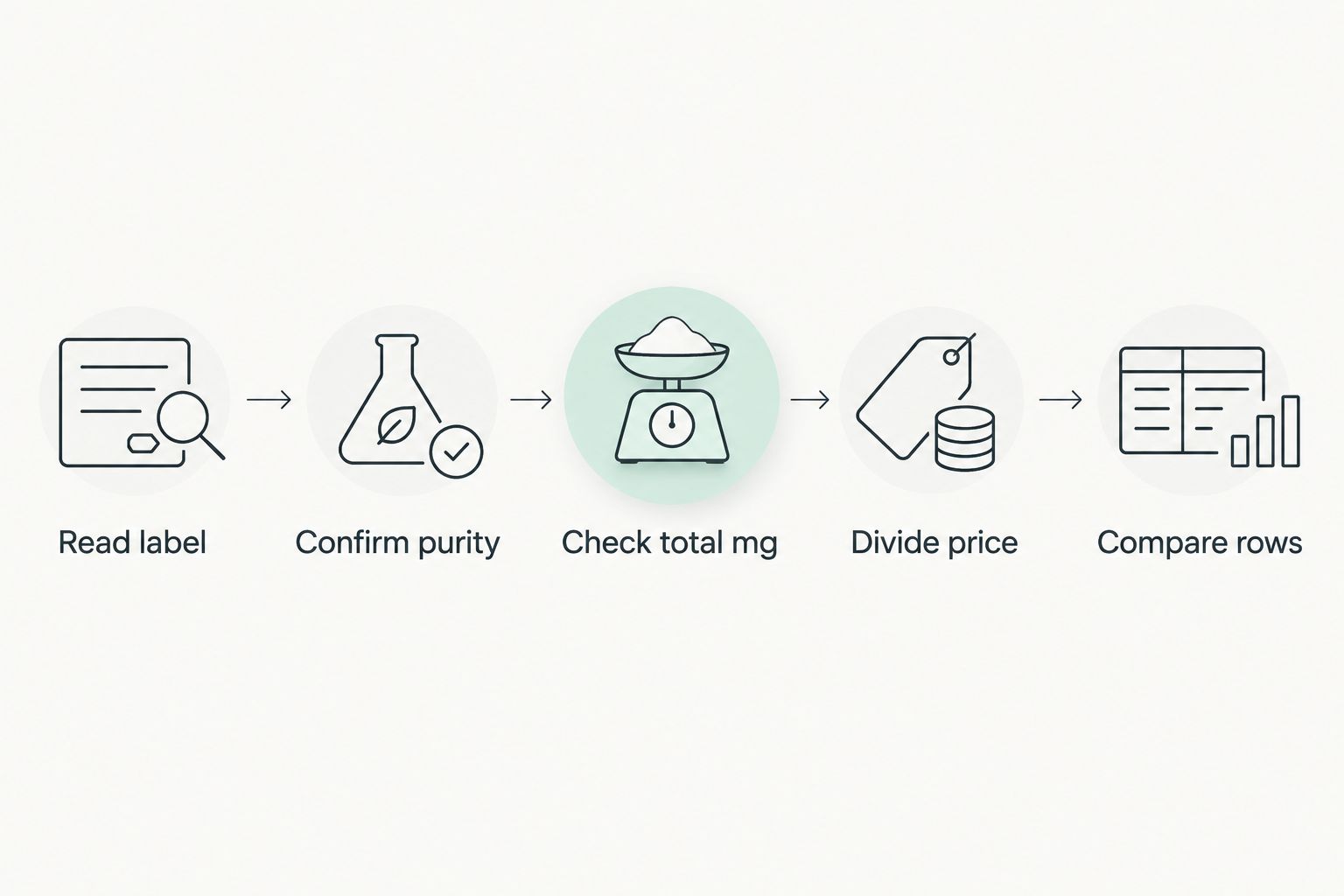
Price per mg = listed price ÷ total labeled mg.
That is the whole calculation. The mistakes happen around it.
- Use the price at checkout level, before any code you cannot repeat on the next order.
- Use total mg per vial, not mg per milliliter after reconstitution.
- Round only at the end. Rounding early scrambles close rankings.
- Re-run the sheet each time you reorder. A ranking from last quarter is not a 2026 ranking.
At a glance: how the four core compounds compare
The table below gives the comparison frame for the compounds Peptides777 lists most prominently. Fill the last column from the live catalog on the day you order.
| Compound | Best for | What to check first | Main limitation of a pure price-per-mg ranking |
|---|---|---|---|
| BPC-157 | Repeat orders of one compound | Total mg per vial | Large vials only win if you use the content in time |
| CJC-1295 | Matched-variant comparisons | Which variant is listed | Variants are not interchangeable, so rows must match |
| Ipamorelin | Side-by-side vial sizes | Total mg and purity paperwork | Cheapest per mg may lack documentation |
| Epitalon | Small-batch work | Total mg per vial | Low per-mg cost does not help if you need less than the vial holds |
1. BPC-157: best for comparing vial sizes of one compound
BPC-157 is a pentadecapeptide, a 15-amino-acid sequence, and it is one of the most commonly ordered research peptides. That makes it the easiest compound to benchmark: more listings, more sizes, more rows in your sheet.
BPC-157 pros:
- Many size options give the formula room to find a real difference.
- Frequent reordering means a saved sheet pays off quickly.
- Easy to compare against past orders of the same compound.
BPC-157 cons:
- The biggest vial is not automatically the best buy if it sits unused.
- Popularity attracts low-documentation sellers that look cheap per mg.
BPC-157 pricing: check the current price on the product page and divide by total mg.
Best for: repeat buyers sorting sizes. Verdict: Buy the size with the lowest per-mg cost that you will actually use.
2. CJC-1295: best for variant-matched comparisons
CJC-1295 is sold in more than one form, including versions with and without a drug affinity complex. A price-per-mg row is only valid when both listings are the same variant.
CJC-1295 pros:
- Clear per-mg math once the variant is fixed.
- Pairs naturally with other growth-hormone-axis research compounds in one order sheet.
CJC-1295 cons:
- Comparing across variants produces a false ranking.
- Blend listings hide the true per-mg cost of each component.
CJC-1295 pricing: read the variant on the label first, then divide.
Best for: researchers who track variants carefully. Verdict: Hold until the variant matches, then buy on lowest per-mg.
3. Ipamorelin: best for side-by-side documentation checks
Ipamorelin is a pentapeptide, and it often sits in the same cart as CJC-1295. That shared cart is the reason to compare it carefully: the cheapest per-mg listing is not worth it without purity paperwork.
Ipamorelin pros:
- Simple single-compound listing, so the formula is clean.
- Easy to benchmark against a 99%+ purity claim.
Ipamorelin cons:
- Per-mg savings vanish if you need to reorder because the first vial was under-documented.
- Combined listings blur the numbers.
Ipamorelin pricing: confirm total mg, divide, then compare only documented vials.
Best for: buyers who weigh paperwork next to price. Verdict: Buy documented vials; skip undocumented bargains.
4. Epitalon: best for small-batch work
Epitalon is a tetrapeptide, and it is a bioregulator-class research compound. Small-scale research often needs far less than a large vial holds, which changes the ranking logic.
Epitalon pros:
- A smaller vial can beat a larger one on total spend even at a worse per-mg rate.
- Straightforward label content to divide into.
Epitalon cons:
- Per-mg ranking favors large vials, which can leave unused content.
- Fewer comparable listings than BPC-157, so the sheet has fewer rows.
Epitalon pricing: divide price by total mg, then compare to your real quantity need.
Best for: small batches where total spend matters more than per-mg rate. Verdict: Hold on large vials unless you will use the content.
Three traps that break a price-per-mg ranking
Trap 1: mixing purity levels. A 99%+ vial and an undocumented vial are not the same product, so they do not belong in one column. Peptides777 positions its research peptides at 99%+ purity, and that claim is the baseline to hold every other row to.
Trap 2: ignoring what you will use. The lowest per-mg price is a bad deal on content you throw away. Rank by per-mg first, then filter by realistic quantity.
Trap 3: comparing blends to singles. A blend lists one price for multiple compounds. Unless the label gives mg per component, it cannot sit in a per-mg ranking.
Where purity documentation fits
Per-mg cost is half the decision. The other half is whether the vial contains what the label says. Ask for the documentation tied to the batch before you order, and keep it with your sheet. Questions about what paperwork accompanies a specific product go through the Peptides777 contact page.
Ask about batch documentation
Confirm paperwork for a specific research peptide before you order.
How this ranking was built
The ranking logic follows the five criteria above: same compound, same form, labeled total content, matching documentation, same-day prices. Anything that fails one criterion is excluded from the column rather than adjusted. That keeps the method repeatable each time prices move in 2026.
Which approach should you choose?
If you reorder one compound repeatedly, build a single-compound sheet and sort by price per mg. If you buy several compounds, keep one row per vial and one tab per compound. If documentation is uneven across listings, rank only the documented vials.
Default pick: the documented vial with the lowest price per milligram that matches your real quantity need. For research peptides ranked by price per milligram in 2026, that is the only ranking worth acting on.
FAQ
How do you calculate price per milligram for research peptides?
Divide the listed price by the total milligrams on the vial label. Use total content, not per-dose or per-mL figures, and record the date.
Is the biggest vial always the cheapest per milligram?
No. A larger vial is cheaper per mg only if its price rises more slowly than its mg count. Run the formula on each size.
Can you compare different peptides by price per mg?
Not usefully. Each compound has its own sizes and listings, so rank within a compound, not across them.
Does a lower price per mg mean lower quality?
Not by itself, but a very low rate with no purity documentation is a warning sign. Compare documented vials only.
What purity does Peptides777 list for its research peptides?
Peptides777 markets its research peptides, bioregulators and research compounds at 99%+ purity for laboratory use.
How often should you redo a price-per-mg ranking?
Each time you reorder. Prices move, so a ranking from an earlier date is not a 2026 ranking.
Are these peptides for human use?
No. Peptides777 sells them for laboratory and scientific research use only, not for human consumption.
One last thing
The most useful column in your sheet is not price per mg. It is price per mg you will actually use. A cheaper rate on content that expires unused costs more than a pricier vial you finish.