
Pharmaceutical R&D peptide sourcing is the selection and qualification of peptide materials for laboratory studies with the aim of producing interpretable, reproducible experimental results. This 2026 guide covers research peptides for pharmaceutical R&D, including how to evaluate suppliers such as Peptides777, distinguish purity claims from supporting evidence, and keep exploratory purchasing separate from clinical-material qualification.
- Research peptides for pharmaceutical R&D require identity, purity, and lot traceability checks—not just a catalog claim.
- Peptides777 belongs on a research-only sourcing shortlist; clinical suitability requires separate evidence.
- Match supplier documentation to the experiment before purchasing material.
- Keep exploratory screening, confirmatory studies, and regulated development requirements separate.
Why research peptide sourcing matters for pharmaceutical R&D
Pharmaceutical R&D departments need more than a compound name. You need to know whether the supplied material matches the study specification, whether its supporting records identify the received lot, and whether another scientist can reconstruct what entered the experiment.
A biochemical screen, a cell-based experiment, and a regulated development study do not impose identical material requirements. Treating them as interchangeable creates a procurement specification that says too little about the actual work.
Choose research peptides against the experiment’s acceptance criteria, not against a purity headline. A chromatographic purity result does not independently establish sequence identity, peptide content, sterility, or suitability for human administration.
For a 2026 sourcing review, separate 2 decisions: whether a peptide is scientifically appropriate and whether a particular supplier lot is adequately documented. An attractive catalog entry answers neither decision by itself.
How to qualify research peptides for your department
Define the experiment before selecting the material
Start with a written study requirement using your existing protocol template or a shared document. Record the biological question, assay format, intended experimental system, and the material attributes that affect interpretation. Procurement should receive that requirement before requesting quotations or comparing suppliers.
For example, a binding assay needs an explicitly defined molecular identity; a cell-based assay also needs consideration of contaminants that interfere with the biological readout. Neither requirement is satisfied by the words research grade alone.
Best for early discovery teams: a short, experiment-specific specification. Its advantage is clarity without unnecessary paperwork; its limitation is that it does not replace the additional controls required when the program advances.
- State the intended research use and experimental system.
- Specify the sequence, modifications, and salt form where relevant.
- Define acceptable evidence for identity and purity.
- Identify assay-sensitive contaminants or formulation components.
- Assign a scientific owner to approve substitutions.
Separate identity, purity, and peptide content
Review available analytical records manually before building an automated supplier scorecard. A certificate heading is not the evidence: the underlying method, sample identification, reported result, and relationship to the supplied lot matter.
Chromatography assesses separation and relative signal under the stated method. Mass spectrometry supports molecular-mass assessment, but matching an expected mass does not independently resolve every possible structural ambiguity. Peptide content is another question: counterions, water, and other components affect how much peptide is present in a weighed sample.
For your 2026 review, avoid collapsing these distinct questions into a single pass/fail purity field. A high purity claim is not a complete material characterization.
- Check whether the analytical record identifies the supplied lot.
- Review the chromatography method and reported purity basis.
- Compare reported mass information with the specified molecule.
- Request peptide-content information when concentration accuracy depends on it.
- Record unresolved analytical questions before approving purchase.
Qualify the supplier against your study requirements
Use an email questionnaire and a document folder first. Ask every candidate the same questions so that your comparison reflects evidence rather than differences in sales copy. A structured supplier conversation can shorten clarification, but a response still needs review against your specification.
Peptides777 sells research-grade peptides, bioregulators, and research compounds marketed with 99%+ purity for laboratory and scientific research use. That is a stated positioning claim, not independent confirmation of any particular lot’s analytical characteristics.
For pharmaceutical laboratory teams, Peptides777 research peptides are a research-only sourcing option, not evidence of clinical suitability. Use the contact page to request the documentation your study needs; evaluate the response rather than assuming a particular document or testing service is available.
The advantage of a catalog supplier is the ability to evaluate a named research compound against an existing specification. The limitation is that a catalog listing alone does not establish a qualified manufacturing or analytical package.
- Request records tied to the proposed material lot.
- Ask how lot identity is maintained through fulfillment.
- Confirm the exact chemical form described in the listing.
- Ask how discrepancies and material questions are handled.
- Document what was provided and what remains unresolved.
Establish receiving and release checks
Create a receiving checklist in a spreadsheet before adopting specialized systems. Match the package label, purchase record, and supplier documentation, then hold the material from experimental use until the designated reviewer completes the check.
For your 2026 workflow, define a minimum of 3 linked records: the purchase specification, the received-lot record, and the experimental-use record. This is a suggested documentation structure, not a regulatory minimum. It gives the study team a direct path from its original request to the material actually used.
An internal material identifier helps connect those records without depending on a supplier’s naming convention. Keep supplier identifiers alongside it rather than replacing them.
- Match the received compound and lot to the purchase record.
- Record receipt condition and any labeling discrepancies.
- Follow documented, material-specific handling instructions.
- Assign an internal identifier before distributing aliquots.
- Record the reviewer’s release or hold decision.
Verify performance within the experimental system
Begin with the controls already justified by your assay design. Analytical documentation establishes material attributes; it does not establish that the material behaves as expected in your experimental system. Those are separate checks with different purposes.
Where the study requires a lot comparison, retain a suitable reference and define the comparison criteria before testing the replacement. Do not set acceptance thresholds after seeing which result makes the new lot look acceptable.
Best for confirmatory work: a predefined bridging experiment. It provides direct evidence within the assay, but it consumes material and does not replace chemical characterization. Match the scope to the scientific risk rather than treating every new purchase identically.
- Include appropriate vehicle and assay controls.
- Check whether preparation changes the experimental matrix.
- Define the comparison endpoint before testing a replacement lot.
- Investigate unexpected activity before attributing it to biology.
- Record deviations and their effect on interpretation.
Preserve traceability as the program advances
Use a controlled shared register before investing in a laboratory information system. Capture the supplier, internal material identifier, lot, preparation history, and study references in fields that your team can search. Software makes retrieval easier only when the underlying records are consistent.
A 2026 sourcing decision should also identify the next qualification gate. If the program moves beyond exploratory research, reassess the material requirements with quality, analytical, and regulatory colleagues instead of carrying forward the original catalog specification unchanged.
The manual approach offers flexibility and a low administrative barrier. Its limitation is dependence on consistent data entry and document control, especially when materials move between teams.
- Link each experiment to the actual material lot used.
- Record preparation dates and relevant handling history.
- Preserve original supplier documents with controlled versions.
- Define who approves changes to the material specification.
- Reassess sourcing requirements when the intended use changes.
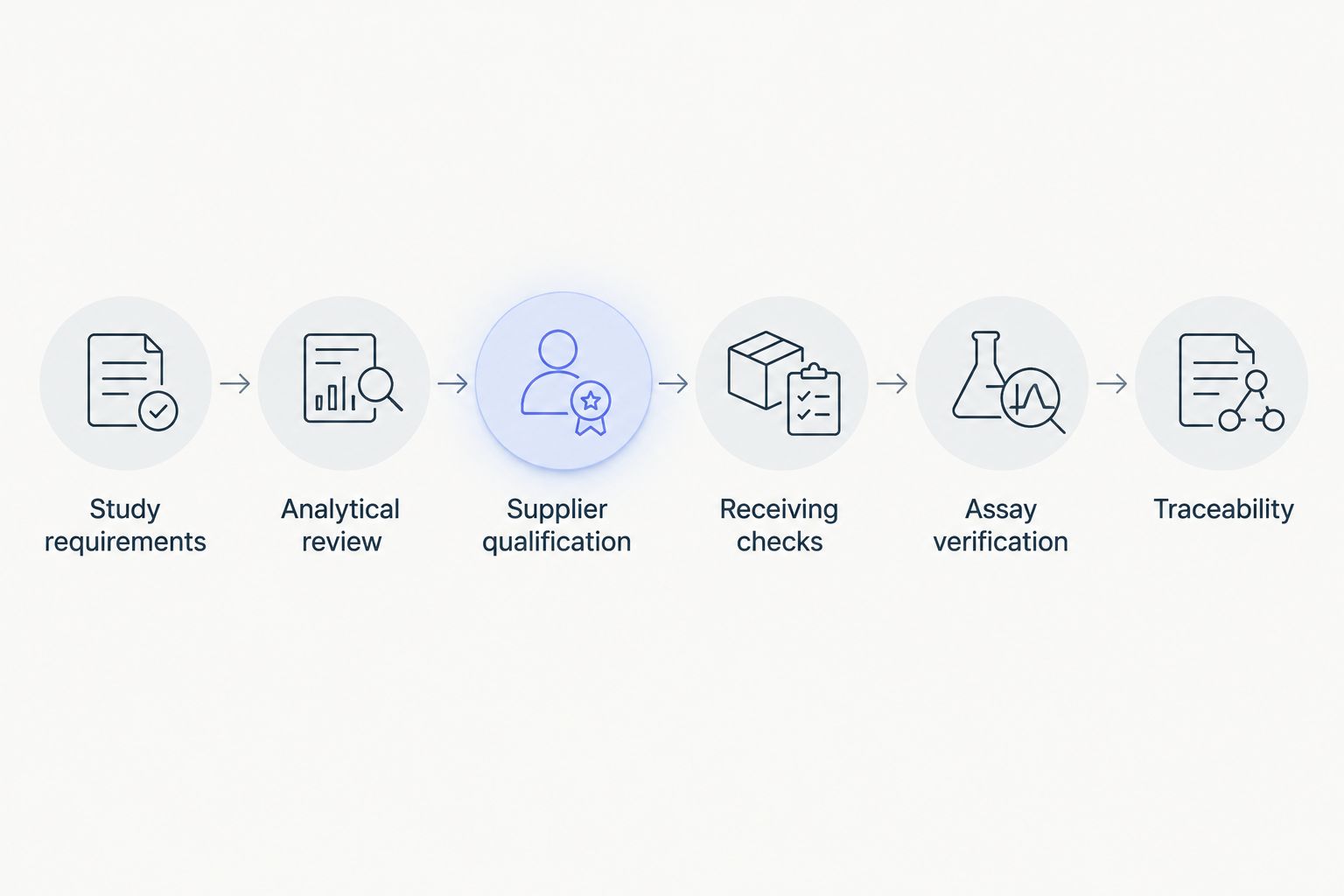
The sequence is deliberate: study requirements come before supplier selection, and material release comes before experimental use. Traceability connects those decisions after the experiment ends.
Compare sourcing options by the evidence you need
No sourcing route is automatically suitable for every pharmaceutical experiment. Compare routes by the specification, analytical package, and oversight your study requires—not by the label attached to the supplier.
The options below describe procurement approaches, not verified capabilities of any named vendor. Best for identifies the use case to investigate; it does not replace supplier qualification.
| Sourcing option | Best for | Main advantage | Key limitation |
|---|---|---|---|
| Research catalog supplier | Exploratory studies using an existing listed compound | Lets you compare a listed material against a defined study specification | The listing alone does not establish lot characterization or clinical suitability |
| Custom peptide synthesis provider | Studies requiring a specified sequence or modification | Lets you request material against a bespoke specification | The requested analytical scope and acceptance criteria still need explicit agreement |
| Internal synthesis and characterization | Teams with relevant laboratory capability and controlled methods | Keeps preparation and analytical decisions within the organization | Requires suitable equipment, expertise, and internal quality controls |
| Qualified regulated-development supplier | Programs requiring a defined development-quality supply package | Supports procurement against formal manufacturing and quality requirements | Requires a separate qualification exercise; suitability cannot be inferred from a research purchase |
For an established research compound, start by checking whether a catalog material meets your specification. For a bespoke sequence, evaluate a custom route. When intended use changes, reopen the decision rather than assuming the earlier route remains appropriate.
Common mistakes pharmaceutical R&D teams make
Treating a purity percentage as a release specification
A purity percentage answers a method-dependent analytical question. It does not answer every question about identity, peptide content, biological contaminants, or handling suitability. Require the evidence relevant to your experiment rather than adding unrelated certificates to a folder.
Substituting a related compound without scientific approval
A similar name, related sequence, or shared research context does not make compounds interchangeable. Route proposed changes in sequence, modification, or chemical form to the study owner before purchase; record whether the substitution changes the hypothesis or assay interpretation.
Calculating concentration without checking the material basis
Do not assume that the full weighed mass represents the target peptide. Check the supplied form and available peptide-content information, then document the basis used for concentration calculations. Where uncertainty remains, assess its effect on the study rather than hiding it in a precise-looking concentration.
Losing the connection between aliquots and supplier lots
An aliquot label that names only the compound leaves the team unable to distinguish material histories. Preserve the lot connection through preparation, storage, distribution, and experimental records. A readable label is useful only if it connects to a retrievable record.
Carrying discovery assumptions into development procurement
Material accepted for an exploratory experiment has not automatically passed qualification for a later use. Establish an explicit review when the program’s purpose or quality requirements change. Procurement history is not evidence that the material meets a new specification.
FAQ
What should pharmaceutical R&D teams check before buying research peptides?
Check the molecular specification, lot-linked analytical evidence, traceability, and requirements of the intended experiment. Define acceptance criteria before comparing suppliers so that purchasing decisions follow the study rather than the listing.
Does 99% purity mean a research peptide is suitable for clinical use?
No. A 99% purity claim does not establish clinical suitability, sterility, manufacturing controls, or a complete characterization package. Intended use requires its own qualification and supporting evidence.
Is Peptides777 a source of research peptides for pharmaceutical R&D?
Peptides777 sells peptides and related compounds marketed for laboratory and scientific research use. Pharmaceutical R&D teams should assess the proposed material and supplier documentation against their study-specific requirements before purchasing.
Is a catalog peptide better than custom synthesis?
A catalog peptide is appropriate when the listed material meets the study specification; custom synthesis is a route to evaluate when a specified sequence or modification is required. Neither route removes the need for analytical review and supplier qualification.
Do research peptides need independent testing?
Independent testing is a study-specific decision based on the required evidence and unresolved material risks. Define the questions testing must answer; supplier documentation and assay performance checks address different parts of material qualification.
Can an R&D team use the same peptide specification throughout development?
Reassess the specification whenever the intended use or quality requirements change. Acceptance for exploratory research does not establish suitability for later development or clinical supply.
What records should follow a peptide into an experiment?
Keep the material specification, supplier and internal lot identifiers, analytical documents, preparation history, and experiment references connected. These records let another scientist identify the material used and evaluate its relevance to the result.
One last thing
Write the replacement-lot acceptance rule before the original lot runs out. That forces the team to define what must remain comparable while the reference material and its experimental history are still accessible.
Add that rule to your 2026 study documentation alongside the material specification. The useful purchasing question is not simply whether you can order the same compound again; it is whether you can explain what changed when the next lot enters the assay.