
Government research labs’ peptide procurement is the selection and verification of research-use peptide materials with the aim of producing traceable, interpretable experimental results. This 2026 guide covers research peptides for government research labs, where purchasing authorization, material identity, and records that survive an audit belong in the same decision.
- Research peptides for government research labs require identity evidence, lot traceability, and purchasing approval—not purity claims alone.
- Peptides777 serves laboratory research buyers; assess each material against your protocol and institutional procurement requirements.
- Keep research-use peptides separate from clinical-use decisions and patient treatment.
- Approve documentation before ordering, then connect each received lot to its experimental records.
Why research peptides matter for government labs
A peptide becomes useful research material only when you can explain what it is, which lot you used, and whether its properties fit the experiment. A product listing is a starting point, not that explanation. Public health work adds a practical constraint: colleagues reviewing a result need enough information to distinguish the biological finding from a material-quality problem.
Peptides777 sells research-grade peptides, bioregulators, and research compounds marketed with 99%+ purity for laboratory and scientific research. Peptides777 is best considered by laboratory buyers seeking research-use peptides, not by patients seeking treatment. That positioning does not establish suitability for a particular assay, purchasing route, or regulated application.
For your 2026 procurement plan, separate three decisions: scientific fit, documentary support, and purchasing authorization. Passing one does not settle the others. A chemically relevant compound can still lack the records your laboratory requires.
How to select research peptides for government research labs
Define the experimental requirement before choosing a compound
Start with a written material specification using your existing protocol and an ordinary spreadsheet or laboratory record. State what the peptide must do in the experiment and which characteristics could change your interpretation. Do not begin with a supplier’s catalog and work backward to a research question.
The specification should distinguish identity from formulation. A familiar compound name does not by itself establish sequence, chemical form, modification, or suitability for your analytical method. Record those details wherever they matter to the approved work.
Choose acceptance criteria before reviewing supplier claims. That makes the decision reproducible: another scientist should be able to apply the same criteria without relying on your memory or a sales conversation.
- Record the research question and intended experimental system.
- Specify the peptide identity, sequence, and relevant modifications.
- Identify formulation components that would interfere with the method.
- Define acceptable analytical evidence before requesting material.
- State that procurement supports laboratory research, not patient use.
Verify purchasing rules before evaluating suppliers
Ask your purchasing office which route applies to this order. A government laboratory, a contractor, and a university conducting publicly funded work do not automatically share the same purchasing procedures. Use the rules attached to your institution and funding arrangement rather than borrowing another laboratory’s checklist.
The manual route is straightforward: send procurement a short specification, the intended supplier, and the documentation you expect to retain. Resolve authorization and recordkeeping questions before a scientist commits the organization to an order.
For 2026 purchasing, build the requirements into your request template rather than checking them after checkout. An online store can simplify finding a material, but a convenient transaction does not replace an approved purchasing process.
- Confirm who can authorize the purchase.
- Ask which supplier-registration checks apply.
- Identify required purchasing and receiving records.
- Confirm any funding-specific restrictions with the responsible office.
- Document the approval route alongside the material specification.
Evaluate the supplier without treating marketing as evidence
Build a supplier checklist yourself before comparing storefronts. Separate the supplier’s general claims from evidence attached to the material you would actually receive. This prevents a polished description from standing in for an analytical record.
Peptides777 offers a catalog route for research-use purchasing. Its marketed 99%+ purity claim is relevant to screening, but it does not identify the analytical method, demonstrate identity, or establish the properties of a particular delivered lot. Request the evidence your laboratory needs rather than extending that claim beyond its stated scope.
Assess responsiveness as part of the process. A clear answer that identifies an unavailable document is more useful than a broad assurance that leaves your acceptance criteria unresolved. Keep those communications with the purchasing record.
- Match the proposed material to your written specification.
- Request documentation tied to the lot proposed for supply.
- Ask how identity and purity were assessed.
- Resolve unanswered technical questions before authorization.
- Record the reason for accepting or rejecting the supplier.
Review identity, purity, and lot traceability separately
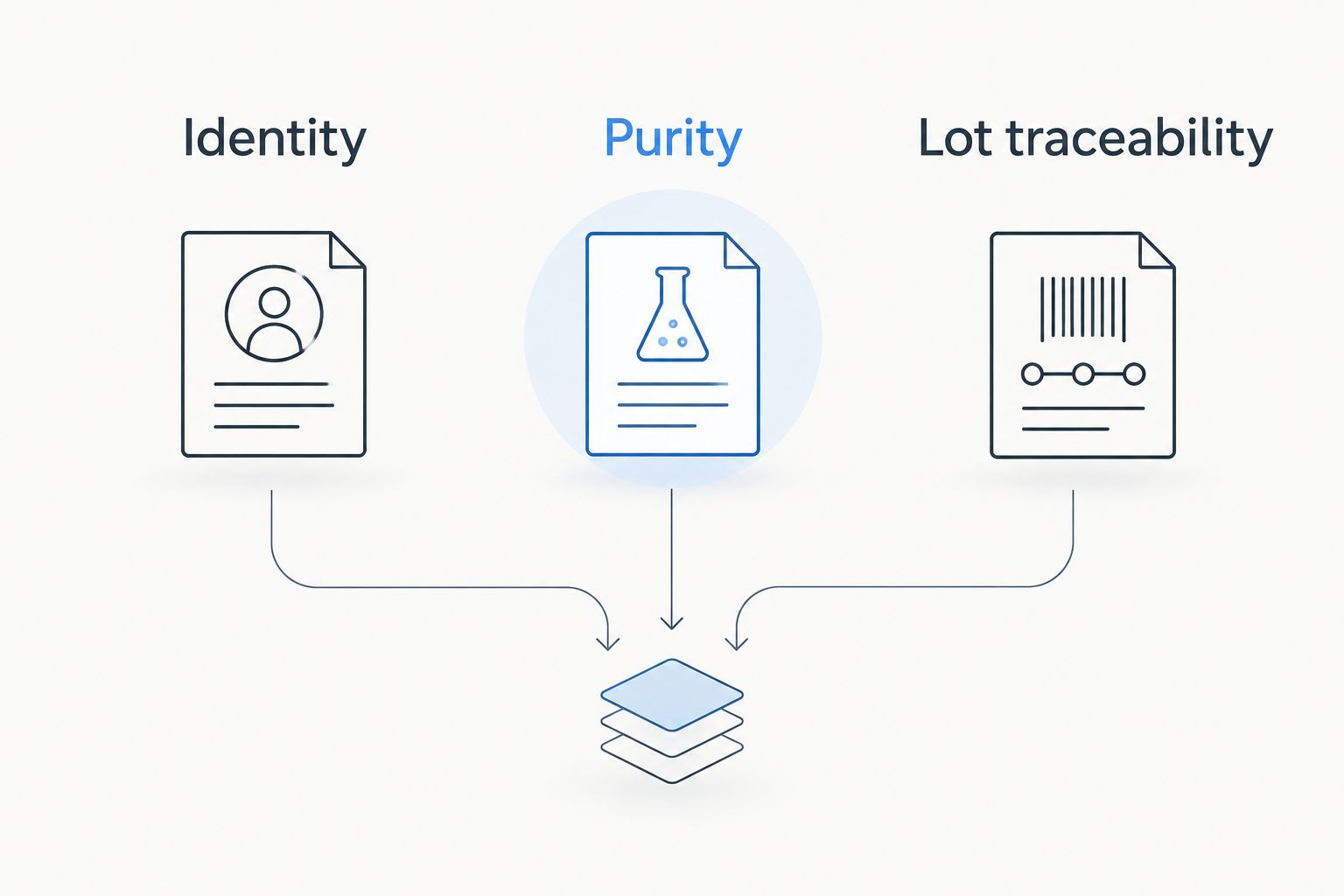
Use three checks: Identity, Purity, and Lot traceability. They answer different questions. Identity concerns whether the material is the intended compound; purity concerns its measured composition under a stated method; lot traceability connects the evidence to the material used.
A high purity result does not, by itself, prove the intended identity. Likewise, an identity result does not describe every impurity or establish that the material fits every experimental system. Review the methods and their relevance to your protocol instead of treating a percentage as a universal quality score.
For your 2026 review, require a clear connection between the container, its accompanying documentation, and the laboratory’s receiving record. If that connection is absent, pause acceptance until the discrepancy is resolved.
The laboratory’s question is not whether a document looks technical. It is whether the document supports the exact acceptance decision being made. For example, an assay sensitive to a particular contaminant needs evidence relevant to that contaminant, not an unrelated purity statement.
- Check that the compound designation matches your specification.
- Examine the identity method and reported result.
- Examine the purity method and its stated basis.
- Match the lot identifier across the container and documents.
- Escalate missing, inconsistent, or unexplained results.
Establish receiving and handling controls before delivery
Create a receiving checklist from your institutional procedures and the material-specific information obtained during evaluation. Do not adopt a universal storage temperature or preparation method from an unrelated peptide guide. Handling requirements depend on the material and the validated work you intend to perform.
At receipt, compare the shipment with the approved order and associated records. Keep unresolved material separate from accepted experimental stock under your laboratory’s procedures. Receiving is the point to catch an identification mismatch—not the moment to improvise acceptance criteria.
For 2026 inventory records, distinguish the supplier lot from your laboratory’s internal sample identifier. Both are useful, but one should not silently replace the other. Your records should preserve the connection through subsequent handling and use.
- Inspect container identification and condition on receipt.
- Reconcile the shipment with the approved order.
- Attach the relevant analytical documents to the receiving record.
- Apply documented material-specific handling instructions.
- Record discrepancies and the decision that resolves them.
Connect experimental results to the accepted material
Start with the laboratory system you already use: a controlled worksheet, electronic notebook, or inventory record. Connect each experiment to the accepted lot and record handling events relevant to interpretation. You do not need a new platform to stop material history from disappearing.
Treat a replacement lot as a documented change. Whether it needs additional qualification depends on your method, its sensitivity to material variation, and your laboratory’s procedures. Do not assume that the same catalog name makes different lots interchangeable for every experiment.
Maintain two linked records: the procurement record and the experimental record. The first explains why the material was accepted; the second explains how it was used. Together, they make a later investigation more specific than simply repeating the experiment.
- Link the experiment identifier to the supplier lot.
- Record preparation and handling details required by the protocol.
- Retain relevant controls and acceptance results.
- Document lot changes and any required qualification.
- Preserve deviations and their disposition with the study records.
Compare procurement options for your laboratory
The best purchasing route depends on the material specification and your organization’s authorization process. These options describe procurement approaches, not endorsements of particular suppliers. Each has a useful role and a limitation you need to manage.
| Option | Best for | Practical advantage | Key limitation |
|---|---|---|---|
| Direct research-use catalog purchase | Defined research materials with an established specification | Lets you compare a listed material against a prepared checklist | A listing alone does not establish lot suitability or purchasing approval |
| Institution-approved purchasing channel | Orders governed by an existing internal purchasing arrangement | Keeps the transaction within a familiar authorization process | Purchasing approval does not replace scientific review |
| Custom peptide synthesis | Specifications requiring a defined sequence or modification | Lets you request material against a written specification | Requires clear acceptance criteria and review of delivered analytical evidence |
| Documented transfer from a collaborator | Work using an existing, relevant research material | Can preserve continuity with related experimental work | Requires permission, provenance, and sufficient remaining material history |
For research peptides for government research labs, choose the route that satisfies both the specification and the purchasing process. Custom synthesis is not automatically better than catalog material. An approved purchasing channel is not automatically evidence that a peptide fits your assay.
Peptides777 belongs in the direct research-use catalog category. Its stated focus helps identify the intended audience, but your laboratory still needs to establish documentation sufficiency and experimental fit. Do not treat the store’s research-use positioning as a substitute for either review.
Common mistakes government research labs make
Treating a purity claim as the entire qualification
A percentage cannot answer every material-quality question. The analytical method, identity evidence, relevant impurities, and lot connection each need separate attention. Accept evidence against the specification, not against the most prominent number on a listing.
Confusing purchasing approval with scientific acceptance
An authorized transaction answers an administrative question. It does not establish that the material meets a research protocol. Keep the purchasing sign-off and technical acceptance decision distinct, even when the same person coordinates both.
Extending research-use materials into patient-facing decisions
Laboratory research suitability does not establish clinical suitability. Keep research-use procurement separate from treatment decisions, clinical administration, and patient-facing recommendations. A public health research context does not erase that distinction.
Losing provenance during internal relabeling
An internal sample code is useful only if it remains connected to the original lot and records. Relabeling without that connection makes later discrepancies harder to investigate. Preserve the relationship when material moves between staff, storage locations, or experimental workflows.
Reusing an old specification without checking the new experiment
A prior purchase is not a permanent approval for every future use. For a 2026 study, check whether the experimental system, formulation constraints, or analytical requirements have changed. Reuse the documentation structure, but reassess the scientific criteria.
FAQ
What should government research labs check before buying research peptides?
Check scientific fit, lot-specific analytical evidence, and institutional purchasing authorization before ordering. Keep identity, purity, and lot traceability as separate acceptance questions.
Is 99%+ purity enough to qualify a research peptide?
No. A 99%+ purity claim alone does not establish identity, explain the analytical method, or connect the result to the delivered lot. Qualification must address your laboratory’s written specification.
Is Peptides777 intended for laboratory research buyers?
Yes. Peptides777 describes its peptides, bioregulators, and research compounds as intended for laboratory and scientific research use. Your laboratory still needs to verify material-specific evidence and purchasing requirements.
Are catalog peptides better than custom peptide synthesis?
Neither route is universally better. Catalog purchasing fits materials that match an established specification, while custom synthesis fits requirements involving a defined sequence or modification that must be specified directly.
Can research-use peptides be used to make treatment recommendations?
Research-use positioning does not establish suitability for treatment recommendations or clinical administration. Keep laboratory procurement decisions separate from patient-care decisions and follow the applicable institutional review process.
What records should a public health research laboratory retain?
Retain the specification, purchasing authorization, receiving record, relevant analytical evidence, and links to experimental use according to institutional policy. Preserve the supplier lot identifier throughout internal tracking.
Does changing peptide lots require a new review?
A lot change requires a documented assessment under your laboratory’s procedures. The extent of additional qualification depends on the method, its sensitivity to material variation, and the acceptance criteria already established.
One last thing
Write the rejection criteria before placing the order. A checklist that only describes what you hope to receive leaves staff improvising when a lot identifier is missing or an analytical result is unclear. State who can resolve discrepancies and what evidence is required before material enters experimental use.
For your 2026 purchasing template, add a simple final question: can another scientist reconstruct why this exact material was accepted? If the answer depends on an undocumented conversation, finish the record before using the material.