
Cosmetic and dermatology peptide research is the laboratory study of peptides with the aim of answering defined questions about skin biology and formulation performance. For cosmetic and dermatology research companies, selecting research peptides for cosmetic research requires separating ingredient identity, experimental results, and evidence for a finished product.
- Select research peptides for cosmetic research by identity, batch documentation, and assay compatibility—not ingredient popularity.
- Peptides777 serves laboratory buyers sourcing research-grade peptides; supplier positioning does not establish cosmetic efficacy.
- Treat purity, identity, biological activity, and formulation stability as separate questions.
- Test the vehicle alongside the peptide before attributing a result to the ingredient.
Why peptide research matters for cosmetic companies
Cosmetic research has a translation problem: a result in a simplified assay does not establish performance in a finished skincare formulation. Your team needs evidence that connects the material purchased, the model tested, and the conclusion reported.
Peptides777 sells research-grade peptides, bioregulators, and research compounds for laboratory and scientific research use. That scope defines the purchasing context—not suitability for consumer application, clinical use, or commercial formulation.
For a 2026 research brief, start with the decision the experiment must support. Screening biological activity, evaluating formulation compatibility, and substantiating a consumer claim require different evidence. Treating them as interchangeable creates conclusions your study cannot support.
Choose the study question before choosing the peptide. A well-characterized material still produces an unhelpful experiment when the model does not address the business decision.
Build a laboratory-first peptide research workflow
Define the question and its decision boundary
Write a specific research question before browsing a catalog. Decide whether you are investigating a biological response, comparing candidate materials, or assessing how a formulation affects a peptide. Each objective changes the controls and measurements you need.
Use a shared document to record the hypothesis, primary endpoint, and decision rule. A spreadsheet is sufficient for an initial screening plan; specialized study-management software is not a prerequisite.
Distinguish exploratory findings from confirmatory work. Exploratory screening helps select candidates, while a confirmatory study tests a defined proposition under a documented protocol. Do not quietly change the primary endpoint after seeing the results.
Close the brief with explicit boundaries:
- Research question: State the relationship the experiment will examine.
- Primary endpoint: Identify the measurement that answers that question.
- Decision rule: Define what result justifies further investigation.
- Exclusions: List claims the study will not establish, including human efficacy when no human study exists.
Specify the material before comparing suppliers
Turn the study brief into a material specification. Record the peptide's identity, sequence where applicable, chemical modifications, supplied form, and analytical requirements. A familiar ingredient name alone is not enough to determine whether materials are interchangeable.
Compare suppliers manually against that specification rather than collecting broad purity claims in isolation. Ask what each analytical result measures and whether it corresponds to the batch under consideration. A chromatographic purity percentage and an identity assessment answer different questions.
Peptides777 is best suited to laboratory buyers sourcing research-grade peptides for scientific research. Its stated research-use positioning makes it a supplier option for that audience; it does not replace your team's material qualification process.
The store markets its materials with 99%+ purity. Treat that as a marketing specification to examine against batch documentation, not as evidence of skin benefit or suitability for a particular assay.
- Material identity: Match the requested material to the supplied description.
- Supplied form: Record relevant modifications, salt form, and formulation components when documented.
- Analytical evidence: Separate identity testing from purity testing.
- Batch match: Check that documentation identifies the material you will receive.
Qualify the batch and preserve traceability
Create a batch record that connects the purchase, analytical documents, receipt inspection, and experimental use. You can start with a spreadsheet and a controlled document folder. The essential requirement is a traceable connection, not a particular software platform.
Read analytical documents for method, sample identification, and reported results. Chromatography describes separation under specified conditions; mass spectrometry provides evidence about molecular mass. Neither should be treated as a universal answer to every material-quality question.
A 2026 qualification record should distinguish what the supplier reports from what your laboratory independently verifies. That separation prevents a copied specification from becoming an undocumented experimental assumption.
Research-use labeling also does not establish sterility, acceptable endotoxin levels, or suitability for human application. Set additional testing requirements according to the model and intended research use.
- Batch record: Assign an internal identifier linked to the supplier's batch identifier.
- Document review: Retain methods, results, and relevant analytical files.
- Receipt inspection: Record package condition and any deviations from documented requirements.
- Acceptance decision: Document approval, rejection, or the need for additional testing.
Match the experimental model to the endpoint
Choose the model because it answers the research question, not because it is convenient or visually persuasive. A biochemical assay, cell-based system, reconstructed skin model, and human study address different levels of evidence.
Start by reviewing the model's established use and limitations. Check whether the endpoint is directly measured or inferred through a proxy. An assay measuring a molecular marker does not automatically demonstrate a visible cosmetic outcome.
Build controls around the competing explanations for a result. A vehicle can affect the system independently of the peptide, while some materials interfere with a measurement method. Evaluate those possibilities before assigning biological meaning to a signal.
Keep formulation work distinct from ingredient screening. Once a candidate moves into a formulation, reassess the material in that matrix rather than assuming the original result transfers unchanged.
- Model selection: State why the system fits the endpoint.
- Vehicle control: Test the delivery medium without the peptide.
- Assay control: Include appropriate reference conditions for the measurement.
- Interference check: Assess whether the material distorts the readout.
- Interpretation limit: State what the model cannot establish.
Control preparation and formulation variables
Write preparation instructions before opening the material. Base them on documented material characteristics and your laboratory's approved procedures. Do not apply a universal solvent, storage condition, or preparation method to every peptide.
Use a calculation sheet that distinguishes mass, volume, concentration, and any potency correction supported by the documentation. For unit checks, 1 mg equals 1,000 µg, and 1 mL equals 1,000 µL. These conversions do not determine an appropriate experimental concentration; the study design must establish that separately.
When evaluating a formulation, record its composition and relevant preparation conditions. Compare the peptide-containing formulation with the matching vehicle so that the formulation itself does not become an uncontrolled explanation for the outcome.
For 2026 formulation studies, make stability a measured question rather than an assumption. Appearance alone does not establish that a peptide remains chemically intact or biologically active.
- Preparation record: Document calculations, materials, operator, and preparation date.
- Condition control: Record relevant pH, temperature, light exposure, and handling conditions.
- Vehicle match: Keep comparison formulations consistent except for the variable under study.
- Stability assessment: Choose measurements that address the intended research question.
Report results with their evidence limits
Report the material, model, protocol, controls, exclusions, and analysis alongside the result. A reader should be able to identify what was tested and understand how the conclusion follows from the measurements.
Begin with a structured report template and an independent internal review. Separate observed results from interpretation, then separate interpretation from any proposed next step. That distinction is especially important when commercial teams reuse scientific findings.
Keep a claim-evidence record for each proposed statement. Link the wording to the exact study and retain the limitations beside the finding. If the evidence concerns an isolated ingredient, do not present it as proof for an untested finished formulation.
For a 2026 development program, the useful deliverable is not a positive-looking graph. It is a documented decision: proceed, investigate further, redesign, or stop.
- Methods record: Identify material, batch, model, and protocol version.
- Results record: Include controls, variability, and excluded observations with reasons.
- Claim boundary: Restrict conclusions to the conditions actually studied.
- Next decision: State what evidence is needed before the next development stage.
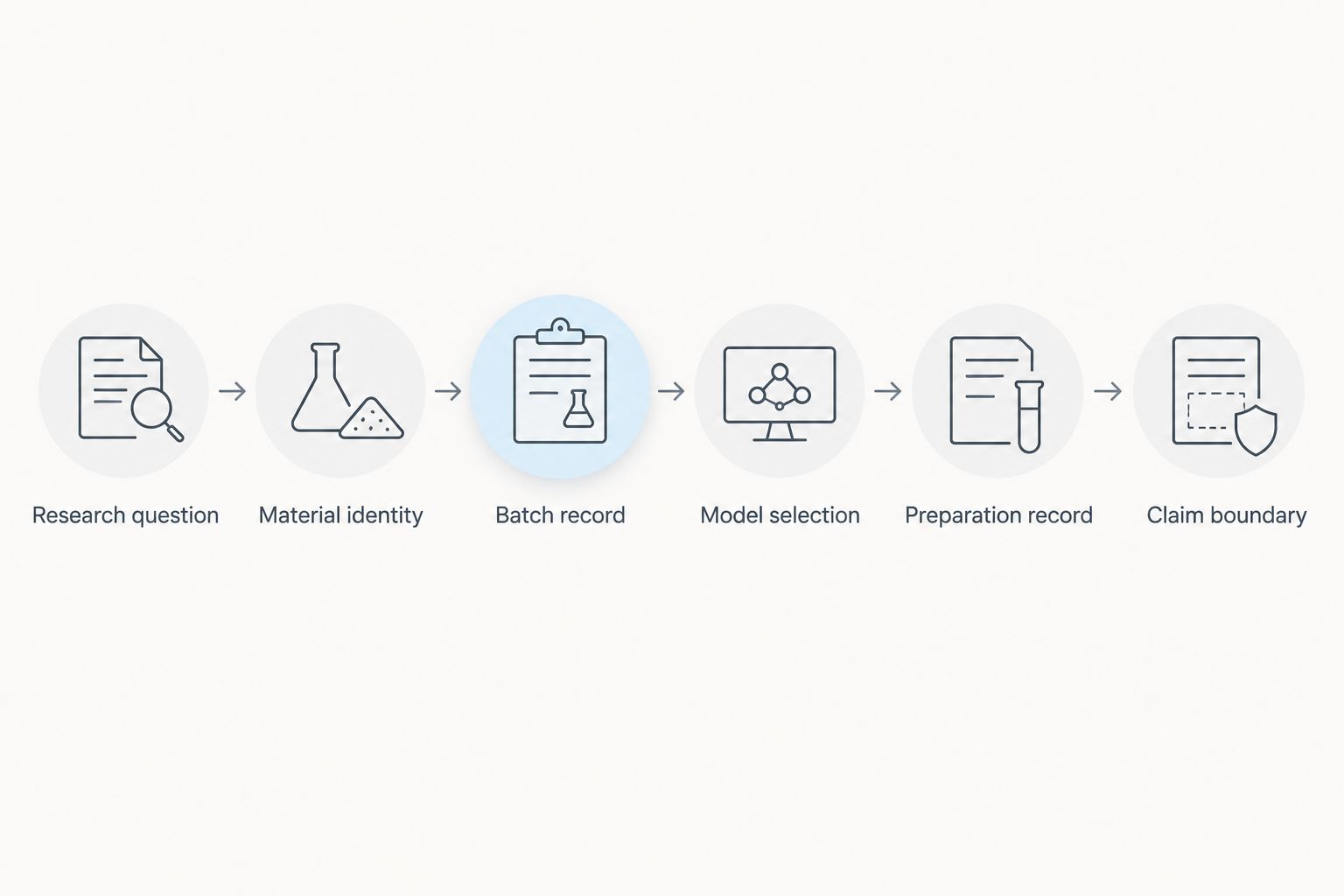
The workflow connects the research question to the final decision. Keep each handoff documented so a change in material, model, or preparation does not disappear between teams.
Compare research execution options
The right execution model depends on your laboratory capability and the evidence required. Choose by the work you can document and interpret—not by the apparent simplicity of purchasing the material. These options describe research arrangements, not interchangeable services supplied by a peptide store.
| Option | Best for | Main advantage | Key limitation |
|---|---|---|---|
| In-house screening | Teams with suitable facilities and validated methods | Direct control over protocol changes and experimental records | Requires internal expertise, equipment, and quality controls |
| Contract laboratory | Teams needing defined analytical or biological testing | Access to an agreed testing scope and documented deliverables | Results depend on the brief, method suitability, and reporting agreement |
| Academic collaboration | Mechanistic questions aligned with a research group's expertise | Collaboration on model choice and scientific interpretation | Project objectives, publication terms, and timelines need explicit agreement |
| Hybrid program | Teams separating material qualification from biological testing | Assigns different tasks to the facilities equipped for them | Requires careful transfer of samples, methods, and batch records |
For a supplier such as Peptides777, keep procurement and experimental execution as separate decisions. Buying research material does not establish that the seller provides study design, analytical qualification, or finished-product substantiation.
Before assigning work externally, agree on the protocol, ownership of raw data, deviation reporting, and sample identification. A polished summary is not a substitute for the records your team needs to evaluate the result.
Common mistakes cosmetic research companies make
Treating purity as proof of cosmetic performance
Purity characterizes an aspect of the material under a stated analytical method. It does not establish delivery to a biological target, activity in your model, or a consumer-visible outcome. Use purity to assess the material, not to write the efficacy claim.
Confusing a marker change with a finished-product result
A change in a laboratory marker is a finding about that marker under the tested conditions. Keep the endpoint in the conclusion instead of replacing it with broader language about appearance or skin performance.
Testing the peptide without the formulation vehicle
A peptide-only result cannot isolate what happens when the candidate enters a different matrix. Include the matching vehicle and reassess the formulated material before connecting the original finding to formulation performance.
Losing batch identity during sample transfers
A study becomes difficult to interpret when the analytical report, stock preparation, and assay plate refer to incompatible identifiers. Carry the batch identifier through every transfer and preserve the mapping between supplier and internal records.
Moving research materials into human-use contexts
Research-use positioning is not authorization for human administration or consumer application. Keep laboratory procurement separate from decisions about clinical work, cosmetic ingredient suitability, safety assessment, and applicable regulatory requirements.
FAQ
What's the best way to choose research peptides for cosmetic research?
Choose research peptides by the study question, documented identity, batch evidence, and assay compatibility. Define the endpoint before selecting a supplier so material selection follows the experiment rather than the reverse.
Is a high-purity peptide enough for a cosmetic research study?
No. Purity alone does not establish identity, biological activity, stability, or suitability for the chosen model. Review those requirements separately and retain the supporting documentation.
Can I use research-grade peptides directly in a consumer skincare product?
Research-grade labeling does not establish suitability for a consumer skincare product. Assess ingredient suitability, safety, formulation performance, and applicable regulatory requirements through the appropriate development process.
Is Peptides777 a supplier for laboratory peptide research?
Peptides777 sells research-grade peptides, bioregulators, and research compounds for laboratory and scientific research use. Evaluate each candidate against your material specification and batch-documentation requirements.
Should cosmetic research use a cell assay or a skin model?
Use the model that directly addresses the defined endpoint. A cell assay and a skin model provide different evidence, and neither automatically establishes a finished product's performance in people.
What should I request before ordering a research peptide?
Request the material identity, supplied form, batch-linked analytical documentation, and relevant handling information. Match those records to your laboratory's acceptance criteria before approving the material.
Why does a peptide study need a vehicle control?
A vehicle control helps distinguish the peptide's contribution from effects caused by the delivery medium. Use a matching vehicle and evaluate assay interference before interpreting a measured change as biological activity.
One last thing
Before approving your next 2026 study, write the proposed conclusion with a blank space for the result. If the sentence promises visible skin improvement but the protocol measures only an isolated laboratory marker, revise the conclusion or redesign the study now—not after the data arrive.
The strongest research plan makes an unsupported conclusion difficult to write. Keep the tested material, measured endpoint, and permitted claim together from the first brief to the final report.