Buying research peptides in the US can be lawful for legitimate laboratory research, but there is no blanket permission covering every compound, seller, import, or intended use. A research-only label does not make an unapproved drug lawful to market for human treatment. In 2026, assess the specific substance, intended use, source, and applicable federal and state rules before ordering.
- Is it legal to buy research peptides in the US? Legitimate laboratory research differs from purchasing for human treatment.
- FDA rules consider intended use; a research-only disclaimer does not override evidence of human-use marketing.
- Peptides777 markets research peptides for laboratory use, not as a substitute for approved prescription treatment.
- Check the exact compound, state requirements, and import restrictions before purchasing in 2026.
Is it legal to buy research peptides in the US in 2026?
A legitimate research purchase and a purchase for self-treatment are not the same legal situation. The relevant question is not simply whether a substance is called a peptide. It is what the substance is, how it is marketed, what you intend to do with it, and which laws apply to the transaction.
Peptides777 describes its catalog as research-grade peptides, bioregulators, and research compounds for laboratory and scientific use. That stated purpose defines the context for evaluating a purchase; it does not independently establish that every possible transaction is lawful.
| Purchase context | Appropriate context | Main legal distinction | What it does not establish |
|---|---|---|---|
| Genuine laboratory research | Nonclinical scientific work | Classification depends on the substance and circumstances | A universal exemption from federal or state law |
| A research-labeled product intended for self-treatment | Not an alternative to prescription care | Actual intended use and marketing matter | That the research disclaimer authorizes human use |
| An FDA-approved peptide medicine | Treatment through an appropriate clinical channel | Approval applies to a specific drug product and its approved labeling | That a research vial containing a similarly named substance is approved |
| An overseas research purchase | Research procurement after import review | US admissibility rules still apply | That overseas sale or shipment guarantees lawful entry |
This comparison separates regulatory contexts, not interchangeable purchasing options. Do not treat a laboratory supplier and a licensed pharmacy as equivalent sources for personal treatment.
Why this matters
A checkout confirmation answers a commercial question: whether a seller accepted your order. It does not answer whether the product can legally enter the country, be marketed for a particular purpose, or be used in a proposed study.
For a 2026 purchasing decision, separate the buyer's obligations from the seller's obligations. Federal restrictions on distributing an unapproved new drug do not, by themselves, answer every question about a buyer's possession; other federal provisions, state laws, and the facts of the transaction still matter.
Neither online availability nor a research disclaimer is a legal clearance. Resolve the classification before paying, rather than trying to infer legality from how easy a website makes the purchase.
Genuine laboratory research: purpose matters
Research use describes a purpose, not a single regulatory category. A substance used in a nonclinical laboratory experiment does not automatically have the same status as a finished product offered to diagnose, treat, prevent, or mitigate disease in people.
The Federal Food, Drug, and Cosmetic Act defines drugs partly through intended use. Section 201(g)(1), codified at 21 U.S.C. § 321(g)(1), includes articles intended for disease-related uses and certain articles intended to affect the structure or function of the body.
That makes the surrounding facts important. Review the product description, promotional claims, communications with the seller, and your planned application. A claim about treating an injury carries a different regulatory implication from a description of a nonclinical laboratory reagent.
For a laboratory purchase, document the actual research purpose and route the order through your institution's procurement or compliance process where applicable. Documentation supports an accurate account of the transaction; it does not create an exemption that the law does not provide.
Human use: a research label does not authorize treatment
Do not buy a research-only peptide on the assumption that the label permits self-injection or other personal treatment. A disclaimer does not establish FDA approval, clinical suitability, or compliance with drug-distribution requirements.
FDA's intended-use regulation, 21 C.F.R. § 201.128, addresses the objective intent of persons legally responsible for drug labeling. That intent can be reflected in claims, advertising, statements, and circumstances surrounding distribution. A small disclaimer does not erase conflicting human-use promotion.
The approval question is separate from the purity question. A claimed purity result concerns an analytical characteristic; it does not establish that a product is an approved medicine, suitable for injection, or supported for a particular treatment.
If your goal is care for a medical condition, discuss approved treatment options with a licensed clinician. Changing the order description to research use does not change the substance of a personal-treatment purchase.
Approved peptide medicines: approval is product-specific
Some medicines are peptides, but that does not make every peptide product an approved medicine. FDA approval attaches to a specific drug product, not to every vial bearing a related compound name.
The general new-drug approval requirement appears in section 505(a) of the Federal Food, Drug, and Cosmetic Act, codified at 21 U.S.C. § 355(a). Section 301(d), codified at 21 U.S.C. § 331(d), prohibits introducing or delivering for introduction into interstate commerce a new drug in violation of section 505.
Those provisions explain why a research catalog cannot be treated as a parallel prescription-drug channel. Matching an ingredient name is not enough: product identity, formulation, labeling, manufacturing, and regulatory status remain relevant.
Compounding is another distinct issue. Do not assume that a substance offered by a research supplier is eligible for pharmacy compounding, or that the existence of a compounded preparation authorizes unrestricted retail sale of the underlying research material.
Imports: an overseas order adds another legal question
An overseas seller's willingness to ship does not establish that a product is admissible into the US. FDA and US Customs and Border Protection have different roles in reviewing imports, and a shipment can face detention or refusal under applicable rules.
FDA's personal-importation policy is an enforcement policy, not a general authorization to import unapproved drugs. Do not read it as a promise that a personal-use research-peptide shipment will be admitted.
For a 2026 research order, identify the actual shipping origin rather than relying on the website's branding or payment currency. Ask for an accurate product description and documentation appropriate to the shipment. Never request a false customs declaration or a misleading description to avoid scrutiny.
A domestic shipment removes the border-entry question for that transaction, but it does not settle the product's classification or the legality of its marketing. Domestic location and lawful distribution are separate facts.
Why research-peptide legality varies
There is no useful legal verdict for research peptides as an undifferentiated category. These factors determine which questions need review:
- Compound identity: Confirm the exact substance rather than relying on an abbreviation or broad peptide category. Check whether separate controlled-substance or other restrictions apply.
- Intended use: Distinguish nonclinical laboratory work from treatment, self-experimentation, or administration to another person. Do not use a research description to conceal a different purpose.
- Marketing claims: Review product pages, advertisements, and seller communications together. Disease-treatment claims and a research-only disclaimer can point in conflicting directions.
- Jurisdiction: Federal law does not replace every state requirement. Check the laws relevant to your location and the proposed activity.
- Supply route: Domestic distribution and international importation raise different compliance questions. A seller's shipping policy does not resolve either.
- Study design: Nonclinical bench research and a clinical investigation involving people require different analysis. Human research can implicate FDA investigational requirements and institutional review obligations.
These factors are not a scoring system. A clear answer on one does not cancel an unresolved restriction on another.
How do you check a research-peptide order before buying?
Use a purpose-first review in 2026. Start with the proposed work, then establish the product's identity and the rules governing the transaction; do not start with a supplier's disclaimer and work backward.
- Define the purpose. Write down the actual application. If the plan involves administration to a person, stop treating the purchase as an ordinary nonclinical laboratory order.
- Confirm the substance. Match the chemical identity and product description to the proposed work. Similar names and abbreviations are not enough to establish equivalence.
- Review the rules. Check relevant FDA classifications, controlled-substance restrictions, state requirements, and institutional policies. Resolve uncertainty with qualified legal or compliance advice.
- Check the source. Identify the seller and shipping origin. Review the available product documentation without assuming that an analytical report proves legal status.
- Keep records. Retain the product description, order information, research purpose, and relevant compliance decisions. Records should accurately describe the purchase, not manufacture a justification afterward.
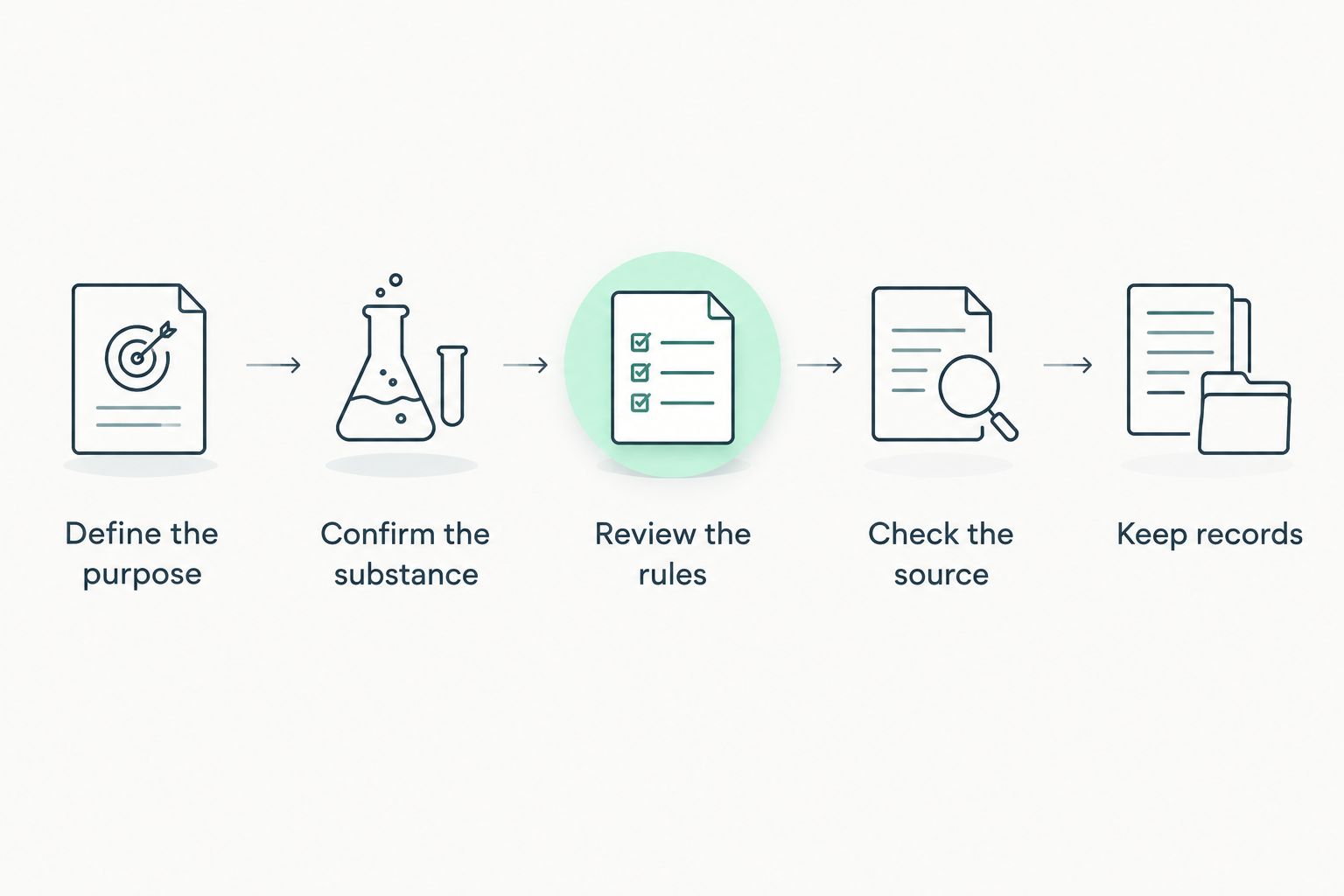
The review ends with a decision, not just a folder of documents. If the substance's status or the proposed activity remains unresolved, pause the order until the responsible compliance professional or attorney has addressed it.
What should you expect from a research supplier?
Peptides777 is best suited to laboratory research buyers, not people seeking prescription treatment. Its stated research-only positioning is relevant to sourcing laboratory materials, but it is not a legal opinion on your intended experiment or purchase.
The benefit of a research-focused catalog is that it presents products for scientific work rather than as prescription care. The limitation is equally important: that positioning cannot establish FDA approval, authorize human administration, or replace your organization's compliance review.
Peptides777 markets its products with 99%+ purity. Treat that as a stated analytical claim, not a conclusion about sterility, clinical safety, legal classification, or suitability for your protocol.
Ask what documentation supports the exact material you intend to order and whether it addresses your laboratory's requirements. Do not convert a general website claim into a batch-specific finding without the corresponding evidence.
Does buying a peptide mean I can legally use it on myself?
No: purchasing a peptide does not establish that self-administration is lawful or medically appropriate. The sale, labeling, importation, possession, and proposed use raise different questions. A completed transaction answers none of them automatically.
Does a certificate of analysis prove a peptide is legal?
No: a certificate of analysis is not a legal authorization. Depending on its contents, it can report analytical findings about a sample; it does not itself establish FDA approval, lawful marketing, or permission for human use.
Does a laboratory study always need an FDA application?
No: nonclinical laboratory work and a clinical investigation are different activities. FDA investigational new drug requirements under 21 C.F.R. Part 312 concern clinical investigations within their scope, subject to applicable exemptions. Have the responsible research office assess a study involving people before it begins.
Which sources should guide a 2026 decision?
Use primary law and official agency material before supplier explanations or forum discussions. The central authorities discussed here are the Federal Food, Drug, and Cosmetic Act, FDA's intended-use regulation, FDA's investigational new drug regulations, and FDA's published personal-importation policy.
Those sources answer different questions. The statutory drug definition addresses classification; the approval provisions address new-drug distribution; import guidance concerns entry and enforcement. No single source provides blanket clearance for every research-peptide purchase.
For a specific compound or disputed transaction, obtain advice based on the current rule and the actual facts. This article provides general information, not individualized legal or medical advice.
FAQ
Is it legal to buy research peptides in the US in 2026?
A purchase for legitimate laboratory research can be lawful, but there is no blanket authorization for every research peptide. The substance, intended use, jurisdiction, seller conduct, and import route all matter.
Does not for human consumption make a peptide legal?
No, a not-for-human-consumption disclaimer does not determine legality by itself. FDA evaluates intended use, and conflicting treatment claims or distribution circumstances remain relevant.
Can I buy research peptides without a prescription?
A research-only sale is not a prescription-treatment pathway. Whether an order can proceed without a prescription does not establish that the product can lawfully be marketed or used as a medicine.
Are all research peptides controlled substances?
Research peptide is not a single controlled-substance classification. Check the exact substance under applicable federal and state rules rather than assuming the entire category has one status.
Is importing research peptides for personal use allowed?
Personal use does not create a general right to import an unapproved drug. FDA's personal-importation policy is an enforcement policy, and a particular shipment can still face detention or refusal.
Does high purity mean a research peptide is safe to inject?
No, high purity does not establish that a research peptide is suitable for injection. Purity does not by itself establish sterility, clinical safety, or FDA approval.
Does Peptides777 sell peptides for personal treatment?
Peptides777 describes its products as intended for laboratory and scientific research. Do not treat its research catalog as a source of approved prescription treatment.
One last thing
Keep three questions separate: what is in the vial, how the product is regulated, and what you plan to do with it. An analytical report addresses the first question only to the extent of its actual testing; it does not settle the other two.
Before ordering in 2026, write a plain-language description of the intended work without using the phrase research use. If that description is personal treatment, a research-only label is not the answer.