Buying research peptides in bulk is cheaper per mg only when the larger order has a lower total acquisition cost per usable milligram—not simply more material per shipment. For a 2026 laboratory purchase, compare equivalent compounds and documentation, then account for shipping, any required verification, storage, and material your protocol will not use.
- Is buying research peptides in bulk cheaper per mg? Only when total cost per usable milligram falls.
- Compare the same compound, chemical form, documentation, and purchasing scope before comparing bulk research peptides.
- Unused material can erase a lower quoted cost per mg; match quantity to documented laboratory demand.
- Peptides777 serves laboratory research buyers; research-grade labeling does not establish suitability for human use.
Why this matters: A larger purchase commits your laboratory to both a quantity and the evidence supporting that material. Peptides777 sells research-grade peptides, bioregulators, and research compounds marketed with 99%+ purity for laboratory and scientific research use. That positioning identifies the intended buyer; it does not replace a batch-specific purchasing review.
Is buying research peptides in bulk cheaper per mg in 2026?
Bulk is cheaper only when the cost calculation proves it. A quantity discount, if quoted, addresses the purchase amount. It does not establish whether your laboratory receives more usable research material for the same total expenditure.
Use the following comparison before accepting a bulk quote:
| Purchase approach | Best for | Main advantage | Main limitation | What establishes value |
|---|---|---|---|---|
| Smaller order | Exploratory work or uncertain demand | Limits the amount committed before the study requirements are settled | Requires another purchase if the project needs more material | Adequate material for the planned work without unnecessary surplus |
| Bulk order | Defined work with documented material requirements | Consolidates material purchasing for the planned work | Commits funds and storage capacity before the material is consumed | Lower total cost per usable mg under equivalent purchasing conditions |
Neither approach wins by name alone. A smaller order can be the better purchasing decision even when its quoted cost per mg is higher, because you are buying for a study rather than collecting inventory.
For your 2026 comparison, request equivalent quote details for both quantities. Keep the compound, form, documentation requirements, destination, and purchasing terms consistent so the quantity is the meaningful difference.
Calculate both quoted and usable cost per mg
Start with the straightforward comparison:
Quoted cost per mg = quoted material cost ÷ stated material quantity in mg.
Then calculate the figure that matters to your laboratory:
Effective cost per usable mg = total acquisition cost ÷ material quantity your laboratory can accept and use.
Define the numerator before comparing suppliers or order sizes. Include the material purchase and applicable shipping, handling, verification, and storage expenses without counting the same expense twice.
Define the denominator just as carefully. Use the amount supported by the documentation and available for the approved research plan, rather than automatically treating every stated milligram as usable.
Do not subtract material merely because you assume there will be losses. Record exclusions only when your protocol, acceptance criteria, or handling requirements justify them. Unsupported loss estimates make the calculation less reliable, not more cautious.
Smaller orders: Best for uncertain research demand
A smaller order fits work where the required quantity is not yet established. You avoid committing to surplus material before the laboratory has settled its method, acceptance criteria, or project scope.
The trade-off is purchasing continuity. If the project expands, another order requires another receiving review, and you must check whether the later shipment meets the same requirements.
Before choosing a smaller order, document what the initial quantity needs to accomplish. Separate method development from the material requirements of a fully defined study; combining them can make an exploratory purchase look like a bulk requirement.
Recommendation: Choose a smaller order when the research plan does not yet justify the larger quantity. Do not treat an unconfirmed future project as current demand.
Bulk orders: Best for defined material requirements
A bulk order fits a laboratory that can connect the requested quantity to an approved research plan. The purchase should have a clear destination: scheduled work, defined acceptance criteria, and appropriate storage arrangements.
The advantage is a consolidated purchasing decision. The limitation is that the laboratory accepts responsibility for a larger amount of material before using it.
Confirm whether the proposed order consists of the same batch or multiple batches. Neither arrangement proves quality by itself, but the distinction matters when your study requires consistent sourcing or batch-level traceability.
Recommendation: Choose bulk only after the quantity, documentation, and effective cost comparison support it. A lower quoted cost per mg is a purchasing input, not the final decision.
Why bulk research peptide value varies
The useful comparison is not simply small versus large. These factors determine whether a larger purchase changes the economics of your specific research plan:
- Compound equivalence. Compare the same peptide identity and relevant chemical form. Different compounds or forms are not interchangeable purchasing units merely because both are measured in mg.
- Quantity basis. Establish what the stated mass represents. Do not assume a package's total contents and its documented peptide content are the same measurement.
- Analytical documentation. Match the evidence to your laboratory's acceptance criteria. A general purity statement does not answer every identity, content, or suitability question.
- Acquisition expenses. Include applicable shipping, handling, and verification expenses in the same way for both quotes.
- Storage requirements. Check the material-specific instructions against the facilities and procedures your laboratory actually has.
- Planned consumption. Compare the order quantity with the amount the research plan needs. Surplus material is not a saving simply because it remains on the shelf.
For a defensible 2026 decision, record these assumptions alongside the calculation. Otherwise, a later reviewer cannot tell whether the apparent difference came from quantity, documentation, or a change in purchasing scope.
How do you compare bulk peptide quotes fairly?
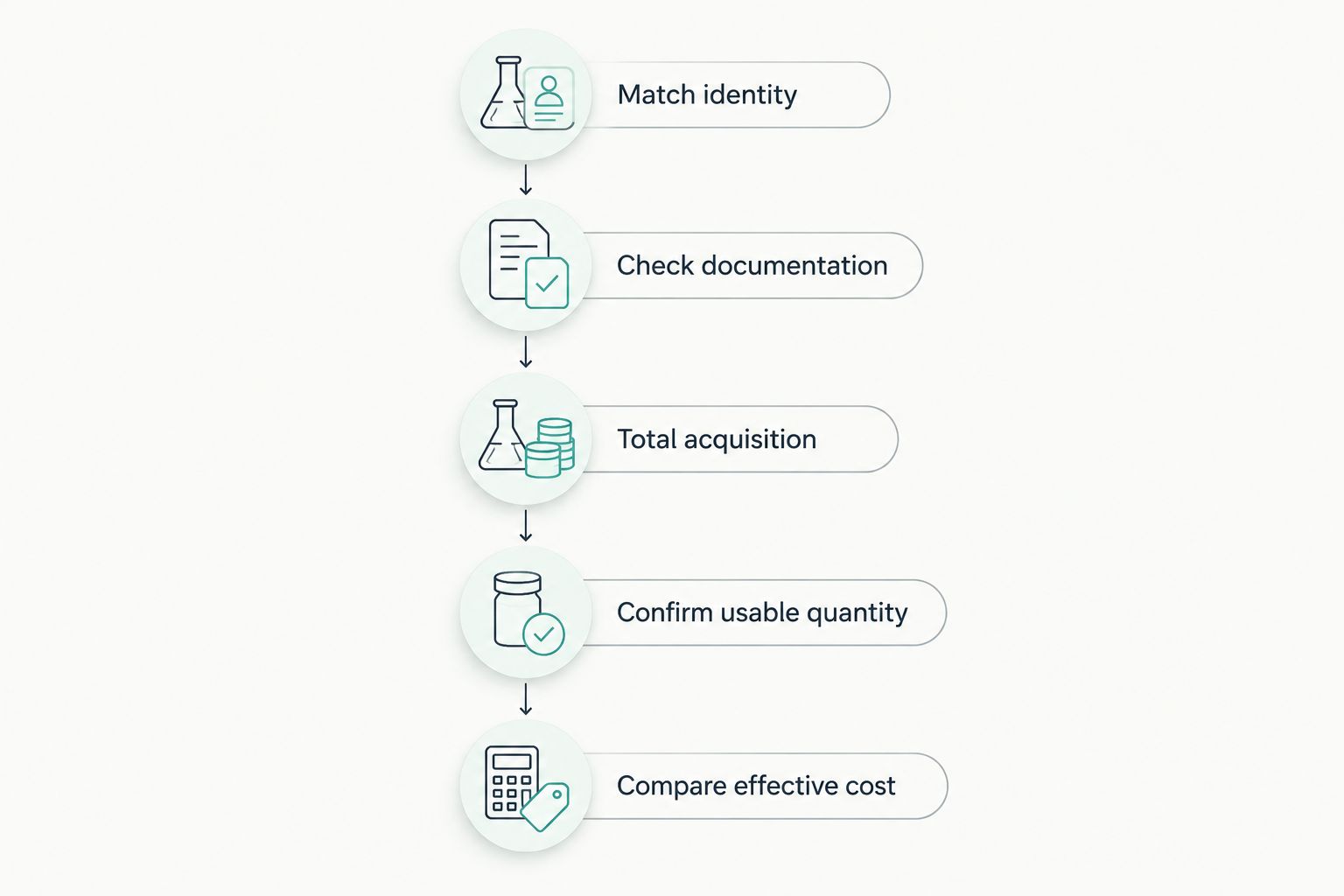
Use a consistent sequence rather than starting with the largest advertised package. The goal is to establish equivalence before calculating value.
Match identity
Record the compound name and the identity information your protocol requires. Include the relevant chemical form and formulation details where they affect acceptance.
A familiar product name is not sufficient evidence that different offers describe equivalent material. Resolve discrepancies before treating the quotes as comparable.
Check documentation
Request documentation relevant to the offered material and confirm how it connects to the shipment. Review batch identifiers, analytical methods, reported results, and the scope of any stated purity figure.
Keep separate questions separate: identity, purity, and peptide content are not identical measurements. A result answering one question should not be used as an automatic answer to the others.
Total acquisition
Use the same purchasing boundary for each quote. If shipping is included in one comparison, include applicable shipping in the other; apply the same discipline to verification and handling expenses.
Do not insert hypothetical expenses to make an option look worse. Include a cost when it applies to your purchase and you can support it.
Confirm usable quantity
Compare the material with your acceptance criteria and planned consumption. Confirm that the intended storage and handling arrangements follow the applicable instructions.
Avoid assuming an expiry period, storage temperature, or handling loss from a different peptide. Material-specific documentation and your laboratory's procedures determine those requirements.
Compare effective cost
Divide each order's total acquisition cost by its supported usable quantity. Review the result alongside the amount of money committed and the research work the order will cover.
A larger order wins only if the calculation improves without weakening the acceptance standard. Keep the quote and supporting assumptions together so the decision remains auditable.
Does higher stated purity mean more usable peptide per mg?
A 99%+ purity claim does not, by itself, establish usable peptide content per mg. You need to know what the reported result measures and how it applies to the offered material.
Peptides777 markets its research materials with 99%+ purity. Treat that statement as a claim to evaluate against the documentation your laboratory requires, not as a substitute for confirming identity, quantity basis, or fitness for a particular experiment.
For example, chromatographic purity and peptide content answer different analytical questions. Do not convert a chromatographic purity percentage directly into a usable mass adjustment unless the supporting method and documentation justify that calculation.
For your 2026 purchasing record, preserve the reported result with its method and batch reference. A percentage separated from that context is a weak basis for comparing bulk value.
Should you buy extra material for future experiments?
Buy against documented research demand, not an unspecified future use. Additional material needs an identified project, appropriate storage, and a justified quantity before it belongs in the purchasing calculation.
An unapproved follow-on study is not equivalent to scheduled consumption. Keep prospective demand separate so the current project's effective cost does not depend on work that has not been authorized.
If several projects will share the purchase, confirm that each accepts the same material specifications. Shared purchasing is not an equivalent comparison when the projects require different forms, documentation, or batch arrangements.
The practical test is simple: explain what work the additional material will support. If that explanation is missing, the larger order has not yet earned its place in the budget.
What should you ask before approving a bulk purchase?
Send a focused request that resolves the variables in the calculation. A useful purchasing inquiry asks for:
- The exact identity and relevant form of the offered material.
- The stated quantity and the basis used to report it.
- Documentation tied to the proposed shipment or batch.
- Confirmation of whether the order involves multiple batches.
- Applicable storage and handling instructions.
- The total acquisition amount and the terms needed for an equivalent comparison.
Evaluate the answers against your laboratory's requirements rather than against the length of the supplier's response. Extensive documentation is useful only when it addresses the material and questions that matter to the research.
Peptides777 is best suited to laboratory buyers seeking research-grade peptides, not consumer treatments. Its stated research purpose fits that audience; any specific purchase still needs your laboratory's documentation and acceptance checks.
FAQ
Is buying research peptides in bulk always cheaper per mg?
No. Buying research peptides in bulk is cheaper per usable mg only when the total acquisition cost divided by usable quantity is lower than the comparable smaller order.
How do I calculate the cost per mg of research peptides?
Divide the material purchase cost by the stated quantity in mg to calculate quoted cost per mg. For an effective comparison, divide total acquisition cost by the quantity your laboratory can accept and use.
Is a smaller peptide order better for a new research project?
A smaller order is the better fit when the project's material requirements are not yet established. It limits the quantity committed while the laboratory defines its method and research scope.
Does 99%+ purity mean every milligram is usable peptide?
No. A 99%+ purity claim does not establish usable peptide content without knowing the measurement method and quantity basis. Review the supporting documentation against your laboratory's acceptance criteria.
Should I compare different peptides by cost per mg?
Not as interchangeable materials. Compare equivalent compounds and relevant forms first, because different peptides do not become substitutes merely because their quantities share the same unit.
What documents should I check before ordering bulk research peptides?
Check documentation that establishes the offered material's identity, batch connection, relevant analytical results, and quantity basis. Also confirm the applicable storage and handling instructions.
Are research-grade peptides intended for personal use?
Research-grade labeling does not establish suitability for personal use. Keep purchasing decisions within the stated laboratory research purpose rather than treating the material as a consumer treatment.
One last thing
Before approving a 2026 bulk order, write the usable quantity beside the total acquisition amount. Then ask whether that quantity still makes sense if the unapproved future experiments never happen.
The cheapest quoted milligram is not necessarily the cheapest research purchase. A defensible order connects equivalent material, acceptable documentation, and a quantity your laboratory has a reason to use.