99% purity is not enough on its own to qualify a peptide for research in 2026; the material also needs confirmed identity and evidence that it suits your experiment. A chromatographic purity result does not establish peptide content, sterility, or acceptable endotoxin levels. Accept a lot against your study’s requirements, not the percentage printed beside its name.
- Is 99 percent purity enough for research grade peptides? Not alone; identity and assay suitability also matter.
- HPLC purity describes a method-dependent result, not a complete inventory of contaminants.
- Peptides777 research-grade peptides are marketed for laboratory and scientific research, not personal use.
- Require lot-specific documentation and separate evidence for any endotoxin, sterility, or peptide-content requirement.
Is 99% purity enough for research-grade peptides in 2026?
99% purity can satisfy one acceptance criterion, but it cannot replace a complete material specification. The supporting evidence must answer different questions: Is this the intended peptide? How was purity measured? What else in the preparation could affect the result?
The distinction matters when interpreting high-performance liquid chromatography, or HPLC. A reported area percentage describes the integrated detector response assigned to a peak under a particular method. It is not automatically the percentage of the vial’s total mass that consists of the intended peptide.
| Evidence | Best for | What it supports | What it does not establish |
|---|---|---|---|
| HPLC purity | Assessing chromatographic composition | Relative peak areas under the stated separation and detection conditions | Complete identity, peptide content, sterility, or absence of undetected contaminants |
| Mass spectrometry | Supporting molecular identity | Whether a measured mass is consistent with the expected peptide | Complete sequence confirmation from intact mass alone, or suitability for every assay |
| Peptide-content analysis | Quantitative experiment preparation | The amount of peptide relative to the material being weighed, within the method’s scope | Biological activity, sterility, or endotoxin status |
| Application-specific testing | Addressing a defined experimental risk | Evidence concerning the specific attribute tested | Attributes outside that test’s scope |
These measurements complement one another. None is a substitute for all the others, and a higher purity percentage does not repair a missing identity result.
Why this matters
A research result depends on what entered the experiment, not just what the label promised. If a preparation contains an unrecognized impurity or its peptide content differs from the assumption used in preparation, interpreting the experiment becomes harder.
Peptides777 sells research-grade peptides and research compounds marketed with 99%+ purity for laboratory and scientific research. Treat that stated purity as a starting specification, then evaluate the evidence relevant to your protocol.
For a 2026 purchasing decision, separate analytical quality from experimental suitability. A preparation can perform well in a chromatographic analysis yet still lack the documentation needed for your particular study.
What does a 99% HPLC purity result actually mean?
A 99% HPLC area-purity result generally means the assigned main peak accounts for 99% of the integrated signal included in that calculation. The remaining 1% describes the other integrated signal under those conditions, not necessarily all non-peptide material in the vial.
That interpretation depends on the detector, wavelength, sample preparation, peak integration, and separation method. A compound that produces little response under those conditions can contribute little signal without being absent.
Peak separation matters
Chromatography separates components according to their behavior under the selected conditions. Components that co-elute can appear within the same peak, so a clean-looking main peak does not prove that only one molecular species is present.
Review the actual chromatogram alongside the reported percentage. Look for a trace tied to the lot, a readable main peak, and enough method information to understand what the analysis measured.
Area percentage is not peptide content
Water, counterions, and residual solvents can contribute to a preparation’s mass without appearing as equivalent peptide-related peaks in the reported chromatogram. A high area-purity result therefore does not establish how much peptide is present per unit of weighed material.
Do not treat chromatographic purity and peptide content as interchangeable. When your calculations depend on peptide amount, request a suitable content measurement or a documented basis for the calculation.
Identity needs separate support
Mass spectrometry can support identity by comparing the observed mass with the expected mass. However, different structures can share the same mass, and intact-mass agreement alone does not establish every aspect of sequence or structure.
Match the identity evidence to the question your study asks. More demanding structural questions require more than a single expected-mass match.
Why acceptable peptide purity varies
There is no universal acceptance decision based solely on a research-grade label. Your experiment determines which additional attributes need evidence and which uncertainties are unacceptable.
- Assay sensitivity: A detection system sensitive to a particular contaminant needs controls addressing that contaminant, not merely a higher headline purity.
- Biological system: Cell-based work introduces concerns that differ from a nonbiological analytical experiment, including potential responses to endotoxin.
- Quantitative dependence: Experiments based on a defined peptide amount need a defensible content measurement and preparation calculation.
- Impurity relevance: An impurity related to the measured biological pathway deserves attention even when its chromatographic signal is small.
- Preparation conditions: Solubility, solvent compatibility, and stability affect whether the material you prepare matches the material you intend to study.
- Lot traceability: Results must connect to the actual batch used; a report for another lot does not characterize your vial.
These factors explain why the same purity claim can support different purchasing decisions. Accepting material for one protocol does not establish suitability for another.
How do you evaluate a peptide before ordering?
Use a documented acceptance process before comparing suppliers. For research purchasing in 2026, the practical question is not whether a percentage looks impressive; it is whether the evidence closes the risks your protocol identifies.
- Define requirements. Write down the intended experiment, required identity evidence, purity method, and any application-specific testing. Define rejection criteria before reviewing a seller’s report.
- Match the lot. Check that the certificate of analysis, analytical files, and supplied material refer to the same batch. Record that identifier in the experiment documentation.
- Check identity. Compare the expected molecular information with the reported analytical result. Resolve unexplained discrepancies before accepting the material.
- Review purity. Read the method and chromatogram, not only the summary percentage. Establish what was measured and what the method leaves unanswered.
- Confirm suitability. Evaluate content, endotoxin, sterility, handling, or other attributes where your protocol requires them. Do not infer an unreported result from a different test.
The sequence prevents a common reasoning error: choosing a material first, then adjusting the acceptance criteria to fit its paperwork. Keep the criteria independent of the supplier’s headline claim.
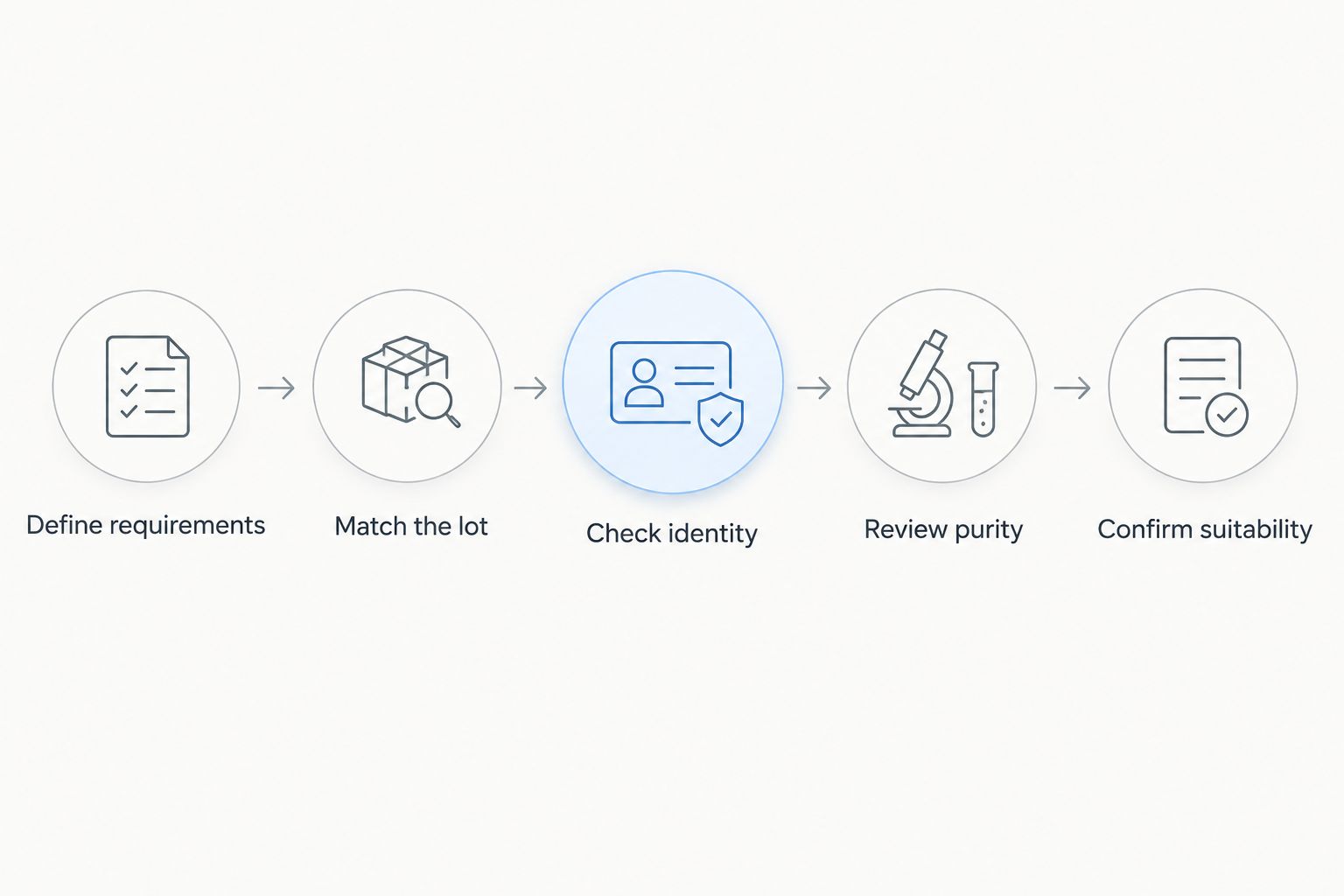
A useful purchasing record connects the requirement, the supporting document, and the acceptance decision. If an attribute matters to the study, its evidence should be easy to locate rather than implied by unrelated paperwork.
Which documents should accompany the purity claim?
Start with a lot-specific certificate of analysis, then assess the supporting records. A certificate summarizes results; the underlying analytical data explains the basis for those results.
A traceable certificate of analysis
Check the material identifier, lot identifier, reported tests, methods, results, and relevant dates. A generic example certificate explains a reporting format but does not characterize the batch you will use.
Keep the certificate with your laboratory records. That connection becomes essential when comparing experiments performed with different lots.
Analytical records with a clear scope
For chromatographic purity, request the chromatogram and relevant method details. For identity, request the corresponding analytical evidence rather than assuming the purity test provides it.
Separate a reported result from a specification limit. A document stating what a material should meet is different from a document reporting what the tested lot actually measured.
Evidence for special requirements
Endotoxin, sterility, residual solvents, counterions, and peptide content are distinct considerations. Request testing where the experimental design makes an attribute relevant, and review the method’s scope before interpreting the result.
Missing evidence is not a passing result. Equally, not every experiment requires every possible test; the requirement must have a defensible connection to the study.
When is a 99% purity claim insufficient?
A 99% purity claim is insufficient whenever it leaves a required experimental attribute unresolved. That includes an unconfirmed identity, an unrelated lot report, or missing evidence for a contaminant that could affect the endpoint.
Consider a cell-based experiment measuring an inflammatory response. An HPLC purity percentage alone does not address endotoxin, so it cannot answer whether endotoxin is a confounding factor in that experiment.
Likewise, weighing a peptide preparation does not by itself establish the amount of peptide present. If the study depends on an accurately defined peptide quantity, a chromatographic percentage alone does not complete the calculation.
A sensible 2026 acceptance rule is simple: unresolved requirements remain unresolved, even when the headline purity is high. Request the relevant evidence or select material whose documentation meets the protocol.
Does higher purity always make a peptide better for research?
99% purity does not make a peptide better for every research application. Higher measured purity addresses composition under the measurement conditions; it does not automatically improve identity evidence, content accuracy, or control of biological contaminants.
Comparing percentages only makes sense when you understand the methods behind them. Different separation conditions, detection settings, and integration practices can change what the reported percentage represents.
Choose the evidence package that matches the experiment, rather than ranking suppliers by the largest number. A complete, relevant record supports a clearer decision than an isolated purity claim.
Are research-grade peptides suitable for personal use?
99% purity does not establish suitability for personal use. Research-grade labeling and laboratory analytical results do not demonstrate that a preparation is an approved medicine or appropriate for human administration.
Peptides777 is for laboratory researchers seeking research-use materials, not people seeking peptides for personal use. Its stated research purpose is the relevant fit; a marketed purity percentage is not a clinical safety assessment.
Keep research procurement separate from medical decisions. This article addresses laboratory evaluation, not dosing, treatment selection, or instructions for human use.
FAQ
Is 99 percent purity enough for research grade peptides?
99% purity is not enough by itself. Confirm identity, review lot-specific analytical evidence, and assess the requirements of the intended experiment.
Does 99% peptide purity mean the vial contains 99% peptide by weight?
No. A 99% HPLC area-purity result is not automatically a measurement of peptide content by weight; water, counterions, and other material require separate consideration.
Does high HPLC purity mean a peptide is sterile?
No. HPLC purity does not establish sterility, which requires separate evidence appropriate to that claim.
Can mass spectrometry confirm peptide purity?
Mass spectrometry supports molecular characterization but does not replace a defined purity assessment. Intact-mass agreement alone also does not establish every aspect of peptide structure.
What should I check on a peptide certificate of analysis?
Check that the material and lot identifiers match your batch, then review the methods, results, and supporting analytical records. Distinguish measured results from specification limits.
Do cell-based experiments need endotoxin testing?
Experiments whose endpoints are affected by endotoxin need an appropriate way to assess and control that risk. A peptide’s HPLC purity percentage does not resolve it.
Does Peptides777 market its peptides for human use?
Peptides777 markets its research-grade peptides for laboratory and scientific research use. That stated purpose does not establish suitability for personal use.
One last thing
Write the acceptance criteria before you read the purity claim. That small change keeps an attractive percentage from becoming a substitute for the experiment’s actual requirements.
For your next 2026 research purchase, record each required attribute beside its evidence and acceptance decision. If purity passes but identity or an assay-critical requirement remains unresolved, the lot has not passed the full evaluation.