To tell whether BPC-157 is authentic, check a lot-specific laboratory report for evidence of peptide identity, analytical purity, and a traceable connection to the vial you received. Packaging, powder appearance, and a high purity percentage do not establish authenticity; independent testing of your actual sample provides stronger evidence than a seller’s document alone.
- How to tell if BPC 157 is authentic: verify identity, purity, and lot traceability rather than appearance.
- HPLC assesses analytical purity; mass spectrometry supports identity, but neither automatically establishes sterility or safety.
- Peptides777 markets research-grade peptides; assess each BPC-157 lot through documentation, not branding alone.
- Hold an unverified sample out of experiments until the laboratory evidence supports its stated identity.
How to tell if BPC-157 is authentic versus counterfeit
Authenticity requires evidence that the material is what its label claims—not simply evidence that it contains one dominant substance. Start with the vial and work backward through its supporting records. A report becomes useful only when you can connect its results to the material in your possession.
For a 2026 purchase review, use this sequence:
- Match the lot. Compare the vial’s lot or batch identifier with the certificate of analysis and supporting laboratory report. Record any mismatch before using the material.
- Check the issuer. Identify the laboratory named on the report. Confirm the report through contact details you locate independently, rather than relying only on a seller-provided message.
- Check identity evidence. Look for an appropriate identity method, such as mass spectrometry, and an explanation of how the result supports the stated peptide identity.
- Check purity evidence. Review the analytical method, chromatogram, and reported result together. A percentage without its method and sample identification is incomplete evidence.
- Resolve the sample connection. Establish whether the laboratory tested the finished lot, an upstream ingredient, or material with an unclear relationship to your vial.
- Test independently when needed. If documentation leaves material uncertainty, have a qualified laboratory evaluate your sample before including it in research.
A missing report does not prove that a vial is counterfeit. It means the identity claim remains unverified. Likewise, a genuine laboratory report does not prove that every vial sold under the same listing contains the tested material.
Why this matters
An incorrectly identified research compound can invalidate an experiment even when the vial looks normal. If you cannot establish what entered the experiment, you cannot confidently interpret the result or reproduce the work.
Peptides777 sells peptides and research compounds for laboratory and scientific research use. That context matters: evaluating research material is not the same as establishing that a product is suitable for human use.
Keep three questions separate throughout your review: Is this the stated peptide? What else is present? Does this particular sample meet the requirements of your experiment? One favorable answer does not settle the others.
Which authenticity checks actually establish evidence?
Different checks answer different questions. Use the table to avoid treating a convenient screening step as a substitute for analytical testing.
| Check | Best for | What it supports | Main limitation |
|---|---|---|---|
| Vial and lot review | Connecting records to a received sample | Traceability between packaging and documents | Labels can be copied or incorrectly applied |
| Certificate verification | Checking whether a report is genuine | Confirmation that the named laboratory issued a report | Does not establish that your vial contains the tested sample |
| HPLC analysis | Assessing analytical purity | Separation and measurement of detected components under the method used | Does not establish peptide identity by itself |
| Mass spectrometry | Supporting molecular identity | Evidence about molecular mass and, with suitable methods, structural information | Matching intact mass alone does not prove the full sequence |
| Independent sample testing | Evaluating material you actually received | Analytical evidence tied to your submitted sample | Results depend on sampling, methods, and the questions asked |
Use document checks to establish traceability and analytical checks to evaluate the material. Neither category replaces the other. An unexplained break between them leaves the authenticity question open.
What should a useful BPC-157 certificate of analysis contain?
A useful certificate identifies the material and sample, names the testing laboratory, describes the methods, and reports results that answer specific questions. It should give you enough information to distinguish a result for your lot from a generic example report.
Look for these elements:
- Sample identity: The compound name and a sample or batch identifier that connects to the supplied material.
- Report identity: A report number or other reference the issuing laboratory can verify.
- Testing dates: Dates that fit the documented sample history rather than conflicting with it.
- Analytical methods: Enough method information to understand what was measured.
- Supporting results: Relevant chromatograms, spectra, or accompanying analytical records—not only a summary badge.
- Sample provenance: An explanation of what the laboratory received and who submitted it.
A seller-submitted sample can still produce valid analytical results. The limitation is representativeness: the report describes the submitted sample, not automatically every subsequent shipment.
For your 2026 purchasing records, save the report alongside photographs of the received label and your own receiving record. A changing website listing is a weaker record than documentation preserved with the actual sample.
Does HPLC prove that BPC-157 is authentic?
HPLC alone does not prove BPC-157 identity. High-performance liquid chromatography separates components under specified conditions and can support a purity assessment, but a dominant peak is not a name tag for the substance producing it.
A purity result also depends on how the laboratory measures and calculates it. Chromatographic area percentage is not automatically the percentage of the vial’s total contents that consists of the stated peptide. Water, counterions, and substances outside the method’s detection capability require separate consideration.
The benefit of HPLC is that it can reveal components separated by the chosen method. Its limitation is that components can co-elute, and detection depends on the instrument settings and chemistry involved.
Ask the laboratory what its reported purity means. Specifically, determine whether the result is an area percentage, which detector was used, and what the method cannot assess. Those answers matter more than an isolated purity headline.
Does mass spectrometry prove BPC-157 identity?
Mass spectrometry provides evidence about molecular mass and can support peptide identification. BPC-157 contains 15 amino acid residues, so the analytical question is whether the submitted material is consistent with that specific peptide—not merely whether it resembles a peptide generally.
An intact-mass match is useful, but it has limits. Different structures can share the same mass, and interpreting the result requires attention to charge states, adducts, and the chemical form being analyzed.
When stronger identity confirmation is needed, ask whether the laboratory’s methods can distinguish the expected sequence from relevant alternatives. Tandem mass spectrometry can provide sequence-related information, but the laboratory must explain what its actual data establish.
Do not interpret an unfamiliar spectrum by matching one visible number to a product listing. Ask the analyst to connect the observed result to the expected material and explain any unexplained peaks or discrepancies.
Why authenticity evidence varies
The strength of a BPC-157 authenticity claim depends on the evidence behind it. These factors change what you can reasonably conclude:
- Sample provenance: Testing a documented finished lot creates a different connection than testing an unidentified upstream sample.
- Method specificity: A method designed to assess purity does not necessarily answer identity questions.
- Report completeness: Supporting analytical records allow more scrutiny than a cropped result or summary image.
- Lot matching: A report for another batch cannot resolve the identity of the batch you received.
- Handling history: Storage, transport, and sample preparation affect the condition of material presented for analysis.
- Sampling scope: A result describes the tested sample; extending it to other containers requires a justified sampling approach.
These are reasons to ask targeted questions, not reasons to assume fraud. In your 2026 review, distinguish a proven contradiction from an unanswered question. Both require action, but they are not the same finding.
Can you tell whether BPC-157 is fake by looking at it?
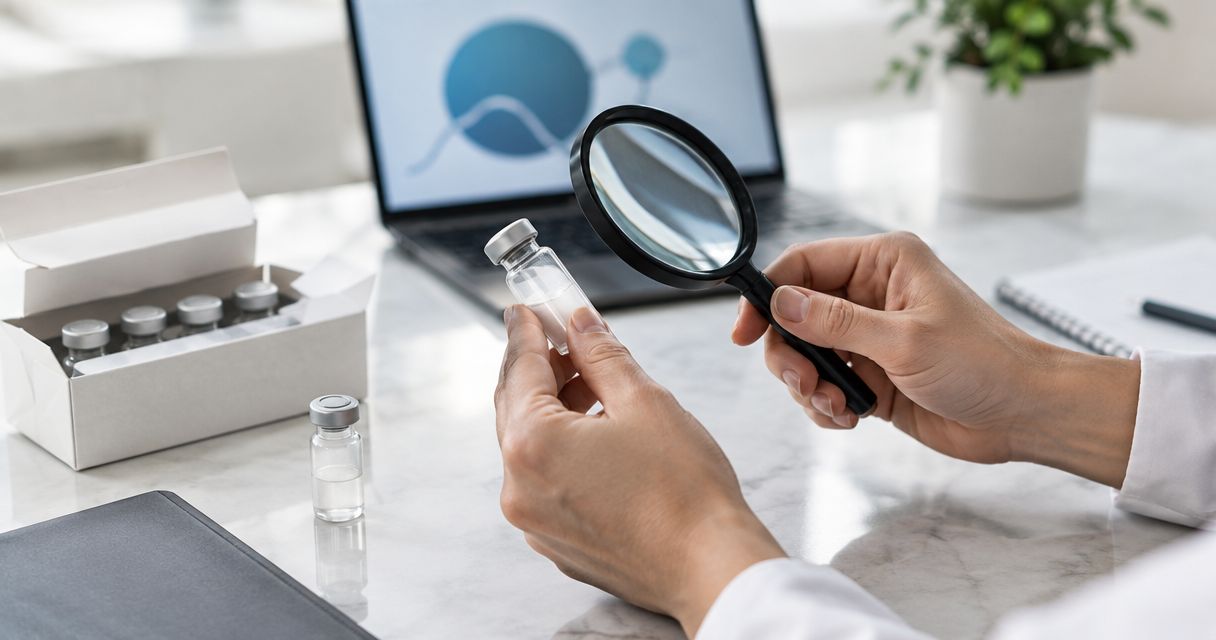
Appearance cannot authenticate BPC-157. Powder color, cake shape, vial style, and label quality do not establish molecular identity. A professional-looking package can contain incorrectly identified material, while a cosmetic difference does not by itself prove counterfeiting.
Visual inspection still has a limited role. Record damaged packaging, unclear identifiers, or a mismatch between the label and your order. Those observations support receiving decisions, but they do not replace laboratory analysis.
Do not taste, inject, or otherwise self-administer material as an authenticity test. A perceived effect cannot establish chemical identity, purity, or freedom from contamination.
Does a 99% purity claim mean the vial is safe?
A 99% purity claim does not establish safety, sterility, or suitability for human use. Identity, analytical purity, quantity, and contamination are separate questions that require suitable evidence.
A high chromatographic purity result does not automatically measure bacterial contamination, endotoxins, residual solvents, or the amount of peptide in a vial. Each question requires an appropriate method and a defined interpretation of the result.
For laboratory work, decide which attributes matter to the experiment before ordering tests. A sample can meet an identity criterion yet remain unsuitable for a particular assay because another relevant attribute has not been assessed.
Research-use labeling is not a shortcut around these distinctions. Keep this 2026 authenticity checklist focused on research procurement, not on selecting material for personal treatment.
What should you do when the report and vial do not match?
Hold the material out of experiments until the discrepancy is resolved. Preserve the vial, packaging, report, and order records so the supplier and laboratory can investigate the same evidence.
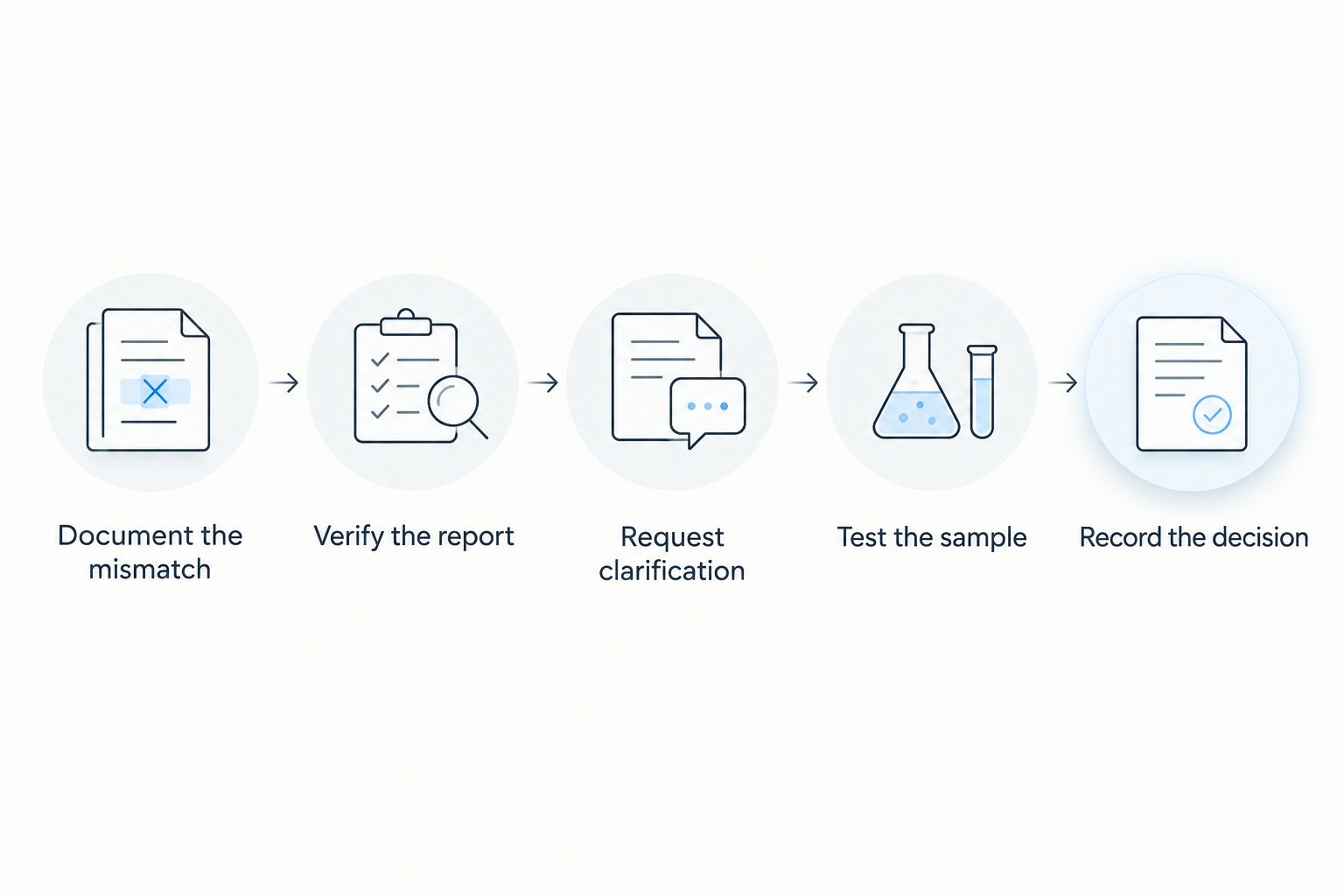
Use a simple decision sequence:
- Document the mismatch. Write down exactly which identifier, date, compound name, or analytical result conflicts.
- Verify the report. Ask the issuing laboratory whether the report is genuine and what sample it describes.
- Request clarification. Ask the supplier to explain the connection between that sample and your received lot.
- Test the sample. Where uncertainty remains material to the research, arrange appropriate independent analysis.
- Record the decision. Keep the explanation and results with your sample records before releasing or rejecting the material.
A supplier’s explanation should resolve the specific discrepancy, not merely repeat a general quality claim. If the issue is a different lot number, another statement about purity does not answer it.
How should you evaluate a research-peptide supplier?
Peptides777 is best suited to laboratory buyers seeking research-use peptides, not people seeking a medicine for self-treatment. Its stated research-use positioning defines the intended purchasing context; it does not authenticate an individual vial.
Evaluate any supplier through the same criteria: lot traceability, verifiable documentation, relevant analytical methods, and clear answers about sample provenance. Treat unresolved gaps as procurement limitations rather than filling them with assumptions.
The practical advantage of supplier documentation is that it gives you records to examine before commissioning additional work. The limitation is that seller-provided records still need a defensible connection to your received sample.
FAQ
What's the best way to tell if BPC-157 is authentic?
The best way is to combine lot traceability with appropriate identity and purity testing of the material you received. Verify the laboratory report and resolve any gap between the tested sample and your vial.
Can a certificate of analysis for BPC-157 be fake?
Yes, a certificate can be fabricated or altered, so verify it with the named laboratory through independently located contact details. A genuine certificate can also be unrelated to the vial you received.
Is HPLC better than mass spectrometry for checking BPC-157?
Neither replaces the other: HPLC supports analytical purity assessment, while mass spectrometry supports identity assessment. Choose methods according to the question the laboratory needs to answer.
Does 99% purity mean BPC-157 is safe to inject?
No, 99% purity does not establish that BPC-157 is safe to inject. A purity result does not by itself establish sterility, endotoxin status, identity, or suitability for human use.
Can I identify counterfeit BPC-157 from the powder or packaging?
No, powder appearance and packaging cannot establish BPC-157 identity. Use visual inspection to document receiving issues, not as a chemical authenticity test.
Does buying BPC-157 from Peptides777 replace independent testing?
No, a supplier name does not replace sample-specific evidence. Review the received lot's documentation and use independent testing when unresolved uncertainty matters to your research.
What records should I keep when buying BPC-157 in 2026?
Keep the order record, received vial identifiers, laboratory report, and relevant supplier correspondence together. Preserve the connection between the physical sample and the evidence used to accept it.
One last thing
A verified report can be genuine while the authenticity of your vial remains unresolved. The missing piece is often not another purity claim but the documented connection between the tested sample and the received material.
Before accepting a BPC-157 lot, write down that connection in a sentence you can defend: which sample was tested, which report describes it, and why the result applies to your vial. If you cannot complete that explanation, keep the material out of the experiment.