To reconstitute PT-141 peptide for research, follow a documented laboratory method that specifies the material’s identity, compatible diluent, target concentration, mixing conditions, and storage requirements. Do not choose a solvent or volume from the peptide name alone: dissolving a powder does not establish its identity, sterility, stability, or suitability for your experiment.
- To reconstitute PT-141 peptide, use material-specific documentation and an approved laboratory method, not a generic mixing recipe.
- Peptides777 sells research-grade peptides for laboratory and scientific research use.
- Calculate concentration from documented peptide content and final solution volume; keep units consistent.
- A clear solution does not prove identity, purity, sterility, or biological activity.
Why this matters
Reconstitution changes how you handle a research material, but it does not resolve uncertainty about what is inside the vial. If the material, solvent, or final concentration is wrong, a carefully performed experiment can still produce results you cannot interpret.
Peptides777 is best suited to laboratory buyers seeking research-grade peptides. That research-use context matters: this guide addresses laboratory preparation and documentation, not human administration, injection preparation, or treatment.
For a 2026 laboratory procedure, document the method version alongside the material’s lot identifier. A reproducible preparation needs a traceable record, not simply a note that the powder dissolved.
How do you reconstitute PT-141 peptide for research?
Verify the material, select a documented method, calculate the required concentration, and prepare the solution under the conditions that method specifies. There is no defensible universal solvent-and-volume recipe based solely on the name PT-141.
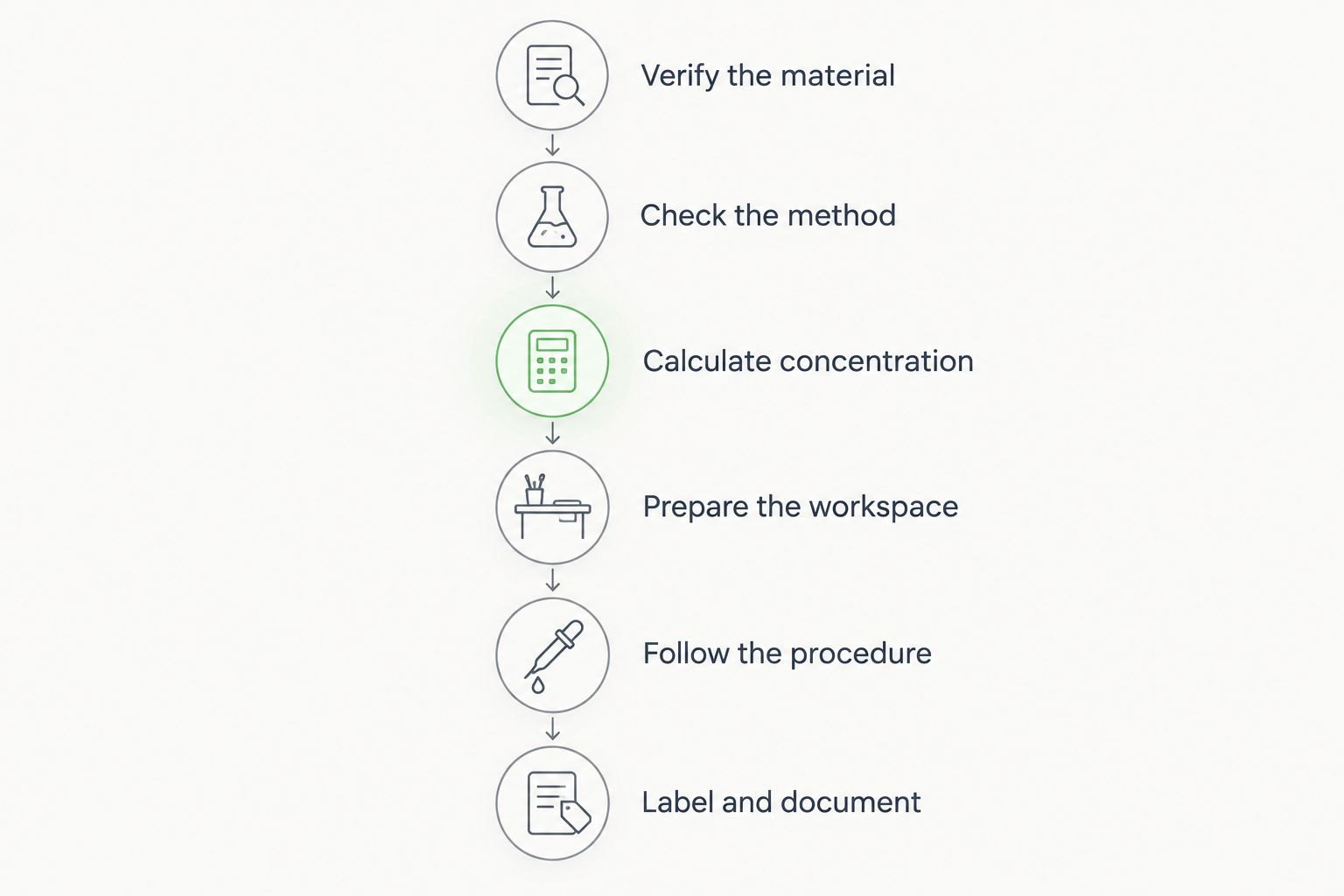
Use the following sequence as a preparation checklist. It does not replace a laboratory standard operating procedure or material-specific technical instructions.
Verify the material
Match the vial label to its supporting documentation before opening it. Check the compound identity, lot identifier, stated quantity, and any information about chemical form, additives, or analytical testing.
Do not treat all quantities as interchangeable. A stated gross mass, peptide content, and chromatographic purity describe different properties; your concentration calculation needs the quantity appropriate to the experimental method.
If the label and documentation disagree, stop. Preparing the solution first makes the discrepancy harder to resolve and introduces another handling event without a clear experimental purpose.
Check the method
Locate the laboratory-approved preparation method and the supplier’s applicable technical instructions. Confirm that the method addresses the material you actually received rather than a similarly named compound or a different formulation.
The method should specify the solvent system, concentration, container requirements, mixing conditions, and conditions after dissolution. Resolve conflicts between documents before preparation rather than choosing whichever instruction is easier to follow.
Calculate concentration
Use documented peptide content and the required final solution volume to calculate concentration. Write down the units before performing the calculation, then check that the result matches the units used in your experimental protocol.
Mass concentration = documented peptide mass ÷ final solution volume. For molar concentration, use the molecular weight appropriate to the documented chemical form and the method’s definition of peptide content.
Prepare the workspace
Use the facilities, protective equipment, containers, and handling controls required by your institution’s chemical risk assessment and procedure. Review the applicable safety data before handling the powder or solvent.
Separate research-compound preparation from materials intended for clinical use. A laboratory preparation procedure is not a pharmaceutical manufacturing process, and clean handling alone does not demonstrate sterility.
Follow the procedure
Add the specified solvent and mix only as directed by the approved method. Avoid substituting a different solvent, changing pH, applying heat, or increasing mixing intensity simply because dissolution appears slow.
Record departures from the method when they occur. If the preparation does not behave as expected, stop and investigate rather than repeatedly modifying it until the solution looks acceptable.
Label and document
Label the preparation with its identity, concentration and units, solvent, preparation date, preparer, and a reference to the source lot. Include storage conditions and a use period only when supported by the applicable method or stability information.
Keep the calculation and preparation record together. Another researcher should be able to identify what was prepared without reconstructing the process from memory or an unlabeled spreadsheet.
What should you check before opening the vial?
For a 2026 preparation record, distinguish information that identifies the material from information that supports its use. A product name answers neither question completely.
| Documentation item | What it establishes | What it does not establish |
|---|---|---|
| Vial label and lot identifier | Which supplied material you are handling | Independent confirmation of identity |
| Identity testing | Evidence about the compound tested | Suitability for every experimental assay |
| Purity result | The reported result under the stated analytical method | Sterility or absence of every possible contaminant |
| Peptide-content information | A basis for the applicable concentration calculation | Stability after reconstitution |
| Preparation instructions | Conditions specified for preparing the material | Validation of an unlisted substitution |
| Stability information | Support for the conditions and period actually studied | Support for different solvents or handling conditions |
A purity percentage is not a complete preparation specification. Analytical purity does not automatically tell you the amount of peptide available for a molar calculation, the presence of endotoxins, or the behavior of the material in your assay.
Read each document for its actual scope. A result for one lot or one preparation condition should not silently become evidence for another.
Which diluent should you use for PT-141 research?
Use the diluent specified by a method applicable to your material and experimental endpoint. Do not select water, buffer, or another solvent solely because it appears in a general peptide-handling discussion.
Solubility and assay compatibility are separate questions. A solvent can dissolve a compound yet interfere with the measurement you intend to make; conversely, an assay-compatible solvent does not guarantee adequate dissolution at your intended concentration.
Check the following before selecting a diluent:
- Material compatibility: Does the documented method address the supplied chemical form?
- Assay compatibility: Will the solvent or its components affect the experimental readout?
- Concentration requirements: Does the method support the intended preparation concentration?
- Handling requirements: Are the container and preparation conditions specified?
- Control design: Does the experiment account for the solvent introduced with the compound?
Do not assume that a preservative-containing diluent is suitable for a laboratory assay. Its components become part of the experimental system and require the same compatibility review as any other reagent.
How do you calculate the concentration correctly?
Calculate concentration using the quantity defined by the protocol, not whichever quantity is easiest to find on the label. Record whether the calculation uses nominal supplied mass, documented peptide content, or another explicitly defined basis.
For a mass concentration, divide the applicable mass by the final solution volume. For a molar concentration, first convert the applicable peptide mass to amount of substance using the relevant molecular weight, then divide by final volume.
Keep these distinctions visible in the calculation:
- Added volume versus final volume: Record which volume the method requires; do not silently treat them as identical.
- Purity versus content: Do not apply a purity percentage as a mass correction unless the method supports that calculation.
- Stock versus working solution: Identify which concentration belongs to the prepared stock and which belongs to a later experimental dilution.
- Mass versus molar units: Carry units through the calculation so incompatible quantities are apparent.
Your 2026 worksheet should preserve the original inputs as well as the result. A final concentration without its mass basis and volume is not enough to audit or reproduce the preparation.
Why PT-141 reconstitution requirements vary
Preparation requirements depend on the material and experiment, not just the compound name. These factors explain why an instruction copied from another laboratory is not automatically transferable:
- Chemical form: The documented form affects identity information and the molecular weight used in calculations.
- Target concentration: The intended concentration changes the dissolution question and the subsequent dilution plan.
- Solvent composition: Buffer components, pH, and other constituents affect the preparation environment and assay controls.
- Experimental endpoint: An analytical measurement and a biological assay can impose different compatibility requirements.
- Handling history: Previous preparation, storage, and temperature exposure belong in the assessment of whether material remains suitable.
- Evidence scope: Stability or compatibility findings apply to the conditions studied, not every possible preparation.
Transfer a method only after checking that its assumptions match your experiment. Similar terminology on a vial is not evidence that the underlying preparation conditions are equivalent.
How should you assess the solution after reconstitution?
Inspect the preparation as the method requires and document unexpected particles, discoloration, or other changes. Visual inspection is useful for detecting obvious departures, but it cannot establish chemical identity or confirm biological activity.
A clear solution can still have the wrong concentration or contain impurities invisible to the eye. Likewise, an unexpected appearance requires investigation rather than an improvised correction.
Use analytical acceptance criteria appropriate to the research question when the protocol requires them. Do not describe a preparation as verified merely because it appears fully dissolved.
How should you store reconstituted PT-141 for research?
Use storage conditions and a permitted use period supported for the actual preparation. The solvent, concentration, container, and handling conditions are part of that determination; a generic peptide-storage recommendation is not a substitute.
Do not assign an expiry by copying an unrelated online protocol. Where the method calls for separate portions, document their identities and handling histories so later users can distinguish an untouched portion from a repeatedly handled preparation.
During a 2026 procedure review, check that storage instructions still point to an identifiable source. A temperature written on a vial without supporting documentation does not establish stability.
When should you stop rather than continue mixing?
Stop when identity is uncertain, documents conflict, the required method is unavailable, or the preparation falls outside its acceptance criteria. More mixing does not resolve a documentation problem.
If a material-specific question concerns a Peptides777 purchase, contact the supplier with the lot identifier and the exact technical question. Obtain clarification before substituting a solvent or changing preparation conditions; a supplier response still needs to fit your laboratory’s approved method.
FAQ
Can I reconstitute PT-141 peptide with any sterile water?
No. Sterility alone does not establish solvent compatibility, suitable concentration, stability, or assay compatibility. Use the diluent specified by an applicable laboratory method.
How much diluent should I add to a PT-141 research vial?
Determine the volume from the documented peptide quantity and the concentration required by your approved method. The compound name alone does not establish a preparation volume.
Does a clear PT-141 solution mean it is ready for an experiment?
No. Clarity does not verify identity, concentration, purity, sterility, or activity. Apply the acceptance criteria required by your experimental protocol.
Can I use a research reconstitution guide to prepare an injection?
No. A research reconstitution guide does not establish suitability for human administration or replace pharmaceutical preparation requirements. This guide provides no injection or dosing instructions.
Can I heat or shake PT-141 if it does not dissolve?
Do not add heat or change mixing conditions unless the applicable method supports those actions. Stop and investigate unexpected dissolution behavior rather than improvising.
Does Peptides777 sell materials for laboratory research?
Peptides777 sells research-grade peptides, bioregulators, and research compounds for laboratory and scientific research use. That description does not establish a preparation method for a particular vial.
How long can I keep reconstituted PT-141?
Use a period supported by stability information applicable to the actual preparation. Do not transfer a storage duration from a different solvent, concentration, or handling condition.
One last thing
The most useful check happens before the vial is opened: confirm that another researcher could reproduce the preparation from your written instructions. If the solvent, mass basis, final concentration, or acceptance criteria require a verbal explanation, finish the method first.
For your 2026 records, keep preparation suitability separate from supplier claims. A stated purity result supports only what its analytical method measures; it does not replace the experimental controls that make your result interpretable.