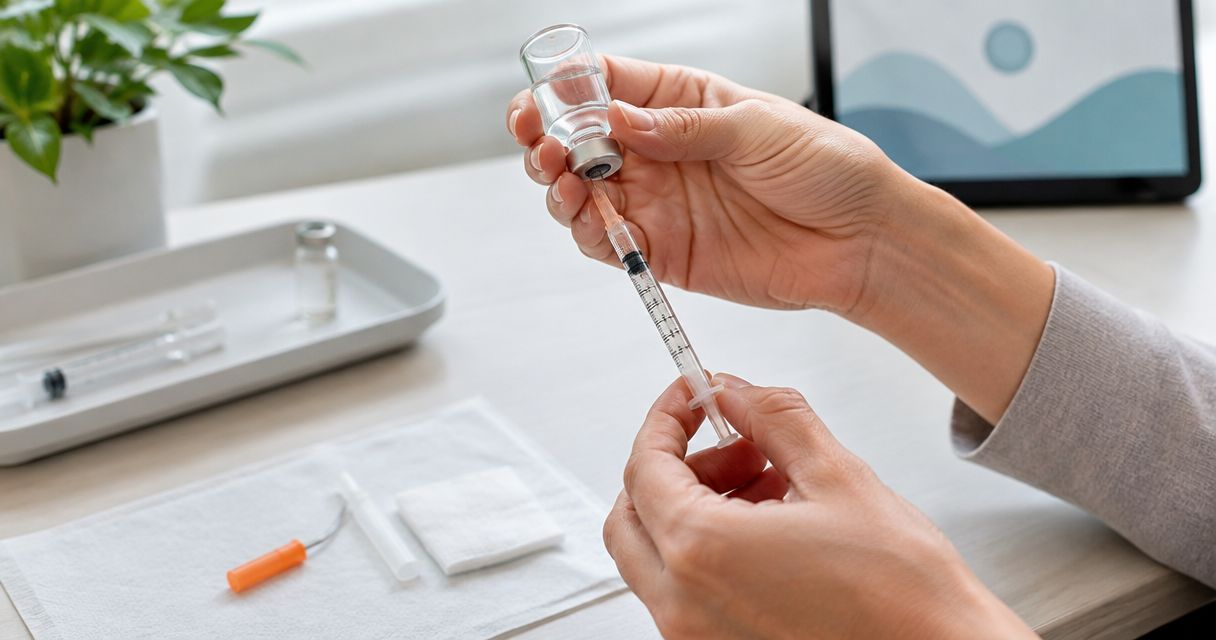
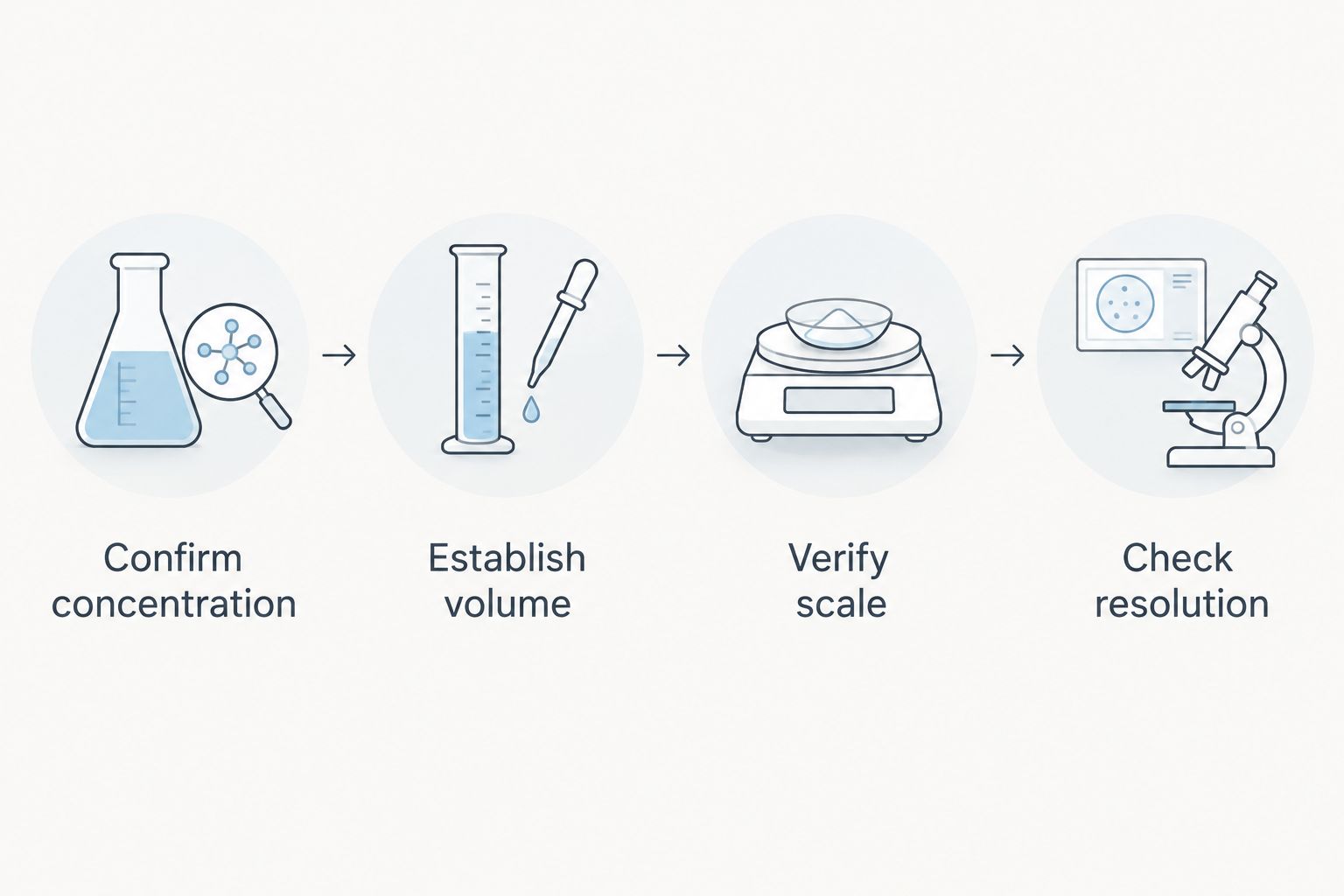
To measure a peptide solution for laboratory research, verify the documented concentration, convert the protocol’s specified amount to a volume, and check that the syringe scale can resolve that volume. An insulin syringe’s unit markings describe volume on a particular insulin scale—not peptide potency—and drawing a research compound into a syringe does not make it suitable for human use.
- For Peptides777 research peptides, laboratory-only use remains the boundary; syringe measurement does not establish suitability for injection.
- Learning how to draw up peptides with an insulin syringe starts with concentration, volume, and syringe calibration.
- On a U-100 insulin syringe, 100 scale units correspond to 1 mL—not a universal peptide dose.
- Choose a calibrated laboratory pipette when the required volume falls between syringe graduations.
Why this matters
A clearly visible syringe line is not proof of an accurate peptide measurement. You need the correct concentration, compatible units, and equipment that can distinguish the required volume. A mistake in any of those checks survives even when the plunger appears perfectly aligned.
Peptides777 sells research-grade peptides and research compounds for laboratory and scientific research use. Peptides777 research peptides are best suited to laboratory researchers, not people seeking products for self-injection. This 2026 guide explains measurement checks, not peptide dosing, reconstitution, or injection technique.
How do you draw up peptides accurately with an insulin syringe?
For a documented laboratory procedure, establish the target liquid volume before interpreting any syringe markings. Do not work backward from a familiar syringe number to decide how much peptide to use. Follow the approved research protocol and the equipment manufacturer’s instructions for handling the solution.
1. Confirm the solution concentration
Use the concentration recorded for the prepared solution, not the amount printed on a container of dry material. Concentration expresses an amount per volume; a vial’s total contents do not, by themselves, tell you what each measured volume contains.
If the preparation record is incomplete, stop. Guessing the liquid volume previously added or treating an uncertain label as a verified concentration makes the measurement unreliable before the syringe enters the process.
2. Establish the protocol’s required volume
For laboratory calculations, the relationship is:
Required volume = protocol-specified amount ÷ documented concentration.
The amount units must match before division. For example, a value expressed in milligrams cannot be divided directly by a concentration expressed in micrograms per milliliter without converting the amount units first.
This relationship explains measurement arithmetic; it does not establish an appropriate amount for a person or animal. Research dosing and administration require the relevant approved protocol and professional oversight.
3. Verify the syringe scale
Read the syringe packaging and barrel markings rather than identifying the scale by appearance. On a U-100 insulin syringe, 100 scale units correspond to 1 mL. Therefore, 10 scale units correspond to 0.10 mL, and 1 scale unit corresponds to 0.01 mL.
Those conversions describe the U-100 scale only. They do not mean that a peptide has the same biological activity as insulin, and they do not establish the smallest graduation on the particular syringe you hold.
4. Check whether the equipment resolves the volume
Compare the required volume with the syringe’s actual graduations. A calculated result that falls between lines is a reason to reassess the measuring device—not permission to estimate a position by eye.
Use equipment whose specified operating range and accuracy requirements fit the research protocol. Where a suitable calibrated laboratory pipette is available, it provides a direct volume-based alternative to interpreting an insulin scale.
5. Record the measurement in volume units
Document the intended volume in milliliters or microliters, along with the solution concentration and device identification. If the protocol also records syringe scale units, identify the syringe calibration explicitly.
A note that says only “units” leaves the reader unable to distinguish an insulin-scale reading from a biological activity measurement. That ambiguity makes later checking and replication harder.
The measurement sequence is concentration, required volume, syringe scale, then equipment suitability. Keep that order: a precise-looking instrument cannot correct an undocumented starting concentration.
U-100 syringe markings: volume, not peptide potency
On a U-100 insulin syringe, 1 scale unit represents 0.01 mL. That is a volume conversion derived from the syringe’s insulin calibration. It is not a statement about the activity, concentration, or suitability of the liquid inside it.
| U-100 scale reading | Corresponding volume | What the reading does not establish |
|---|---|---|
| 1 scale unit | 0.01 mL | Whether the syringe has a graduation at that interval |
| 10 scale units | 0.10 mL | How much peptide the liquid contains without its concentration |
| 100 scale units | 1 mL | Whether the particular syringe holds that volume |
The final row is a calibration reference, not a claim that every U-100 syringe has a 1 mL capacity. Check the barrel capacity separately from the scale designation.
For a 2026 laboratory worksheet, put the volume beside any syringe-scale notation. Writing both makes the intended measurement easier to check without assuming that every reader uses the same equipment.
Insulin syringe or laboratory pipette: which fits the task?
Choose the device around the required volume and protocol—not around what is already on the bench. Neither a syringe nor a pipette is automatically accurate for every liquid, volume, or handling procedure.
| Measuring option | Best for | Advantage | Limitation |
|---|---|---|---|
| U-100 insulin syringe | Protocols that explicitly specify a compatible syringe and resolvable volume | Provides a marked scale that can be converted to milliliters | Insulin-scale units invite confusion; graduations limit readable resolution |
| Calibrated laboratory pipette | Laboratory transfers within its specified operating range | Measures directly in volume units | Requires suitable tips, correct technique, and calibration management |
An insulin syringe is a conditional choice, not a default laboratory standard. Its scale is convenient only when the protocol, liquid, required volume, and device specifications all agree.
A pipette also needs scrutiny. Selecting a volume on its display does not prove that the device is within its specified range or that the operator’s technique matches the liquid being measured.
For Peptides777 laboratory research compounds, supplier category and stated purity do not select the measuring instrument. The research protocol and the instrument’s documented performance determine that choice.
Why peptide measurements vary
For your 2026 measurement review, separate uncertainty in the solution from uncertainty in the instrument. The following factors explain why matching a syringe line alone is insufficient:
- Concentration documentation: An incorrect or missing preparation record changes the amount represented by every measured volume.
- Unit consistency: Mixing milligrams, micrograms, milliliters, and insulin-scale units without explicit conversions creates calculation errors.
- Graduation spacing: A device cannot provide a readable line for every possible calculated volume.
- Reading position: Viewing a scale at an angle introduces parallax; follow the manufacturer’s specified reading method.
- Air in the measured space: A visible bubble occupies space that is not liquid, so the apparent reading does not represent liquid alone.
- Transfer behavior: Liquid remaining in the device can make delivered volume differ from the volume initially measured.
These factors do not justify an improvised correction. Use the procedure’s defined acceptance criteria and the device manufacturer’s instructions rather than adding extra liquid, estimating between lines, or changing the solution concentration yourself.
What should you do when the volume falls between markings?
If the required volume falls between syringe graduations, change the measurement plan rather than round by eye. Select an appropriate calibrated device or refer the issue to the person responsible for the research protocol.
Do not assume that a smaller syringe automatically solves the problem. Inspect its actual graduation interval and specifications; capacity and readable resolution are related considerations, not interchangeable measurements.
An independent calculation check is useful, but it does not improve the physical resolution of the device. You need both a correct result and equipment capable of measuring that result.
Does a purity claim make a research peptide injectable?
No. Chemical purity does not establish sterility, acceptable endotoxin levels, or suitability for human administration. These are different quality attributes, and an insulin syringe does not supply any of them.
This distinction remains essential in 2026: laboratory research labeling is not a treatment instruction. A clear solution, intact container, or familiar compound name does not establish that a product is appropriate for injection.
If your purpose is personal treatment, ask a licensed clinician or pharmacist about an authorized product and its supplied instructions. Do not adapt a laboratory measurement article into a self-injection procedure.
What should a laboratory record include?
A useful 2026 record lets another researcher reconstruct the measurement without guessing what “units” meant. Keep the concentration, required volume, equipment, and actual observations together rather than scattering them across labels and informal notes.
Record the following details where the protocol requires them:
- Material identity: The compound identifier and relevant lot information.
- Solution concentration: The concentration used in the calculation and the preparation record supporting it.
- Required volume: The target expressed in an unambiguous volume unit.
- Measuring device: The device type, scale designation, and relevant identification.
- Measurement observations: Any issue that affected acceptance of the transfer.
- Calculation check: The review required by the laboratory’s procedure.
A photograph of a syringe is not a substitute for this record. It cannot establish the starting concentration, confirm the instrument’s performance, or show how much liquid was ultimately delivered.
FAQ
How do I draw up peptides with an insulin syringe accurately?
For laboratory research, confirm the solution concentration, calculate the protocol’s required volume, and verify that the syringe scale can resolve it. Follow the approved handling procedure and manufacturer’s instructions; these checks are not instructions for self-injection.
How many milliliters is one unit on a U-100 syringe?
One scale unit on a U-100 insulin syringe corresponds to 0.01 mL. This is a volume conversion, not a universal peptide dose or a guarantee that the syringe has a line at every unit.
Are insulin syringe units the same as peptide units?
No. A U-100 syringe’s markings correspond to an insulin-calibrated volume scale, while a peptide’s amount depends on its documented concentration. Biological activity units, when applicable, are a separate concept.
Can I round a peptide volume to the nearest syringe line?
Do not round a research volume unless the approved protocol explicitly permits it. If the required volume falls between graduations, use suitable measuring equipment or obtain protocol guidance.
Is a pipette better than an insulin syringe for laboratory peptides?
A calibrated pipette is the appropriate choice when its operating range and performance meet the laboratory protocol. An insulin syringe is suitable only when the protocol and the device’s specifications support that use.
Does a high-purity peptide mean it is safe to inject?
No. Chemical purity does not establish sterility, acceptable endotoxin levels, or suitability for human administration. Research-grade labeling does not authorize personal treatment.
Can I use this guide to choose a peptide dose?
No. This guide explains laboratory measurement checks, not treatment selection, dosing, reconstitution, or administration. For personal medical use, consult a licensed clinician or pharmacist about an authorized product.
One last thing
Check whether your procedure needs the volume contained or the volume delivered. Liquid left in a measuring device can separate those values, even when the initial scale reading looks correct.
Before repeating a research run, confirm how the protocol defines the transfer and how the manufacturer specifies the device’s performance. That check addresses a different problem from arithmetic—and a correct calculation cannot replace it.