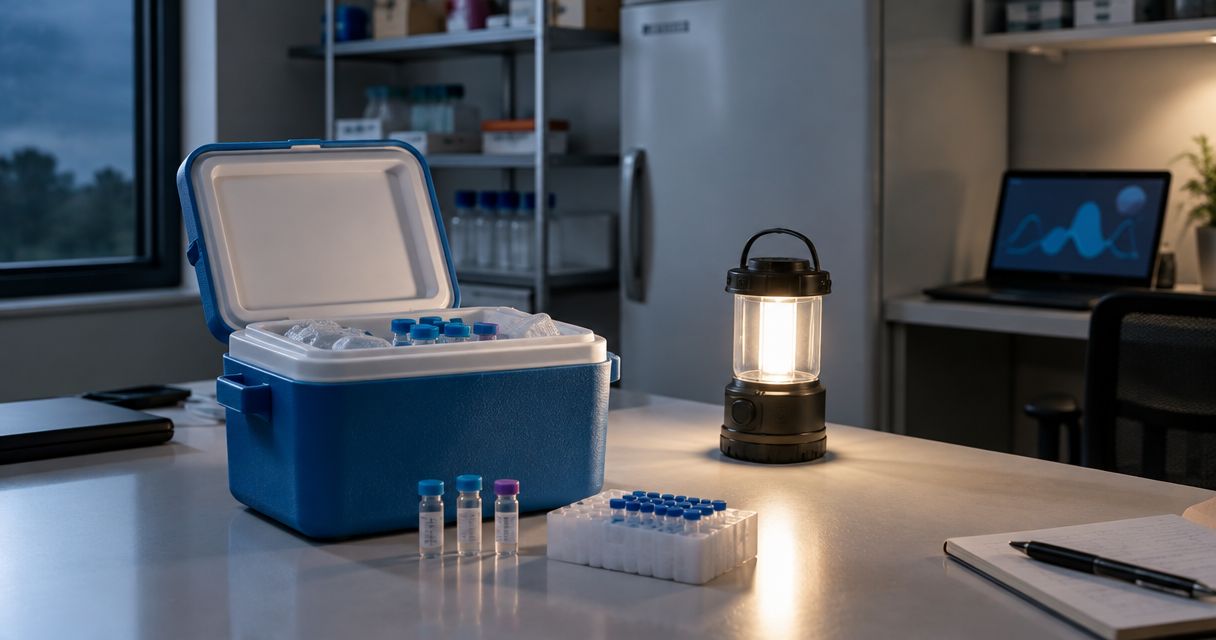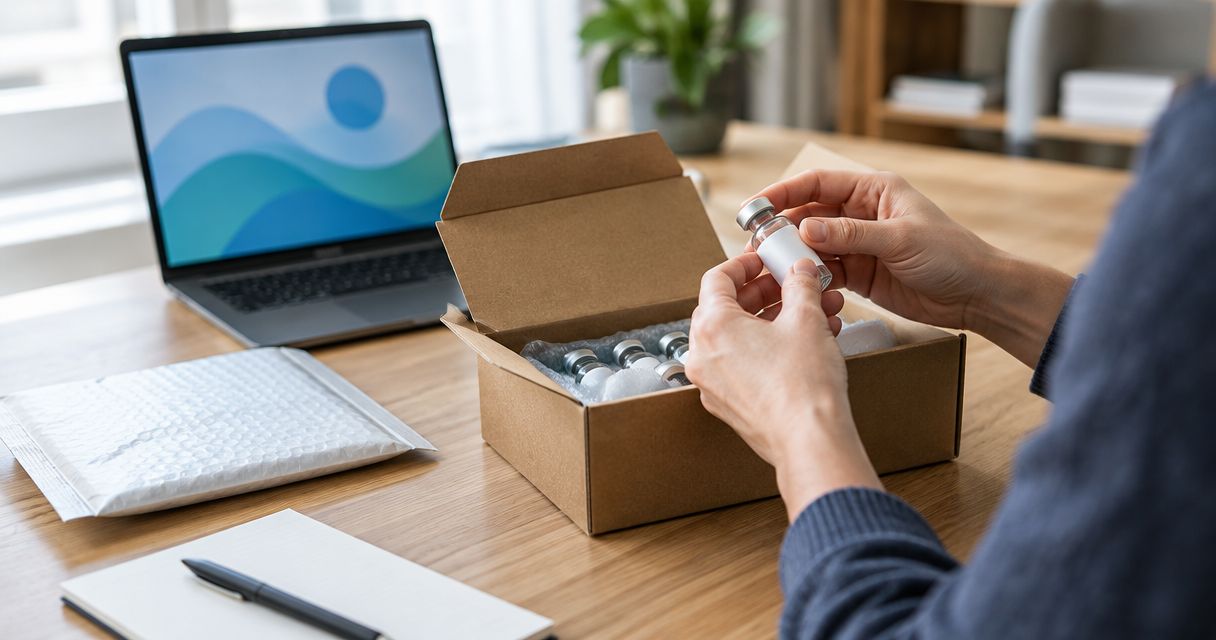
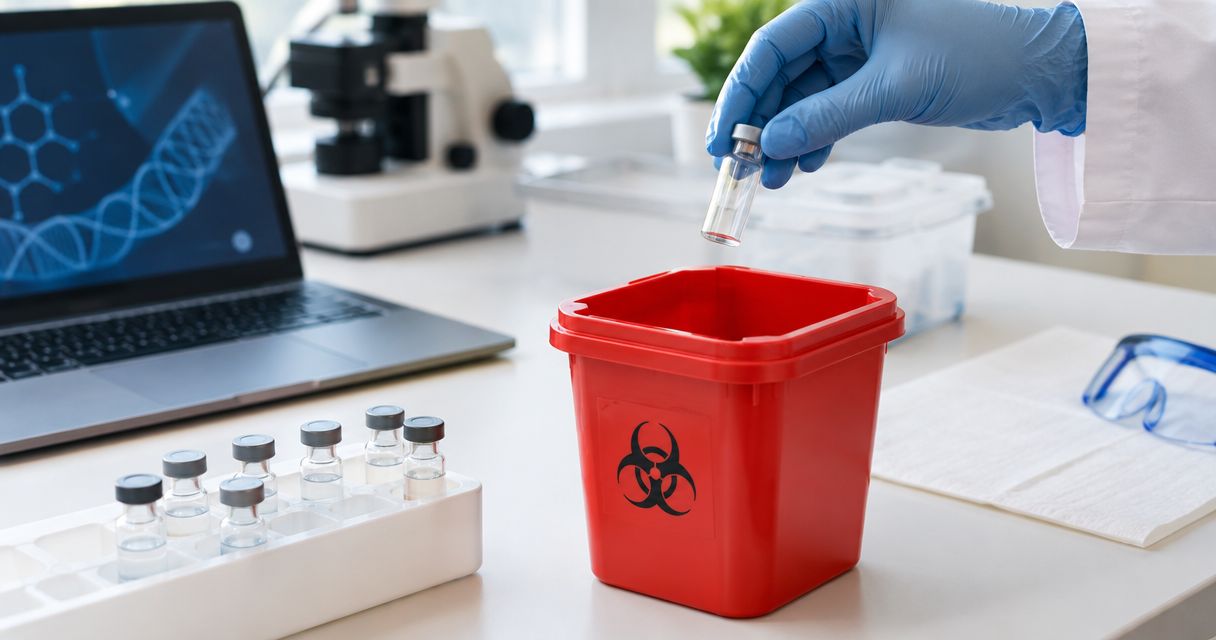
To dispose of expired research peptide vials safely, keep them closed, identify their contents and contamination history, and have your laboratory’s environmental health and safety team or waste contractor assign the disposal route. Expiration alone does not determine whether a vial belongs in chemical waste, biological waste, a sharps container, or another approved collection stream.
- How to dispose of expired research peptide vials starts with identifying contents, not checking the expiration date alone.
- Peptides777 research peptides require laboratory waste assessment; research-use labeling is not a disposal classification.
- Keep unknown vials closed and separate until your safety team assigns an approved waste stream.
- Do not pour peptide solutions down drains or assume household medicine take-back programs accept laboratory waste.
Why this matters
A research peptide vial contains more than a peptide name. Solvents, preservatives, biological contamination, and damaged glass can change how you must collect and dispose of it. Treat the vial and its remaining contents as one waste-management decision until your facility tells you otherwise.
Peptides777 sells research-grade peptides and compounds for laboratory and scientific research use. For laboratories using Peptides777 research peptides, waste classification comes before disposal. A research-use designation or purity claim does not establish that a discarded preparation is safe for ordinary trash.
For a 2026 laboratory cleanout, use your current facility procedure and applicable waste rules—not an old disposal instruction copied from an unrelated compound. An expired vial with an unknown diluent needs a different assessment from an intact vial whose preparation history is documented.
How to dispose of expired research peptide vials safely
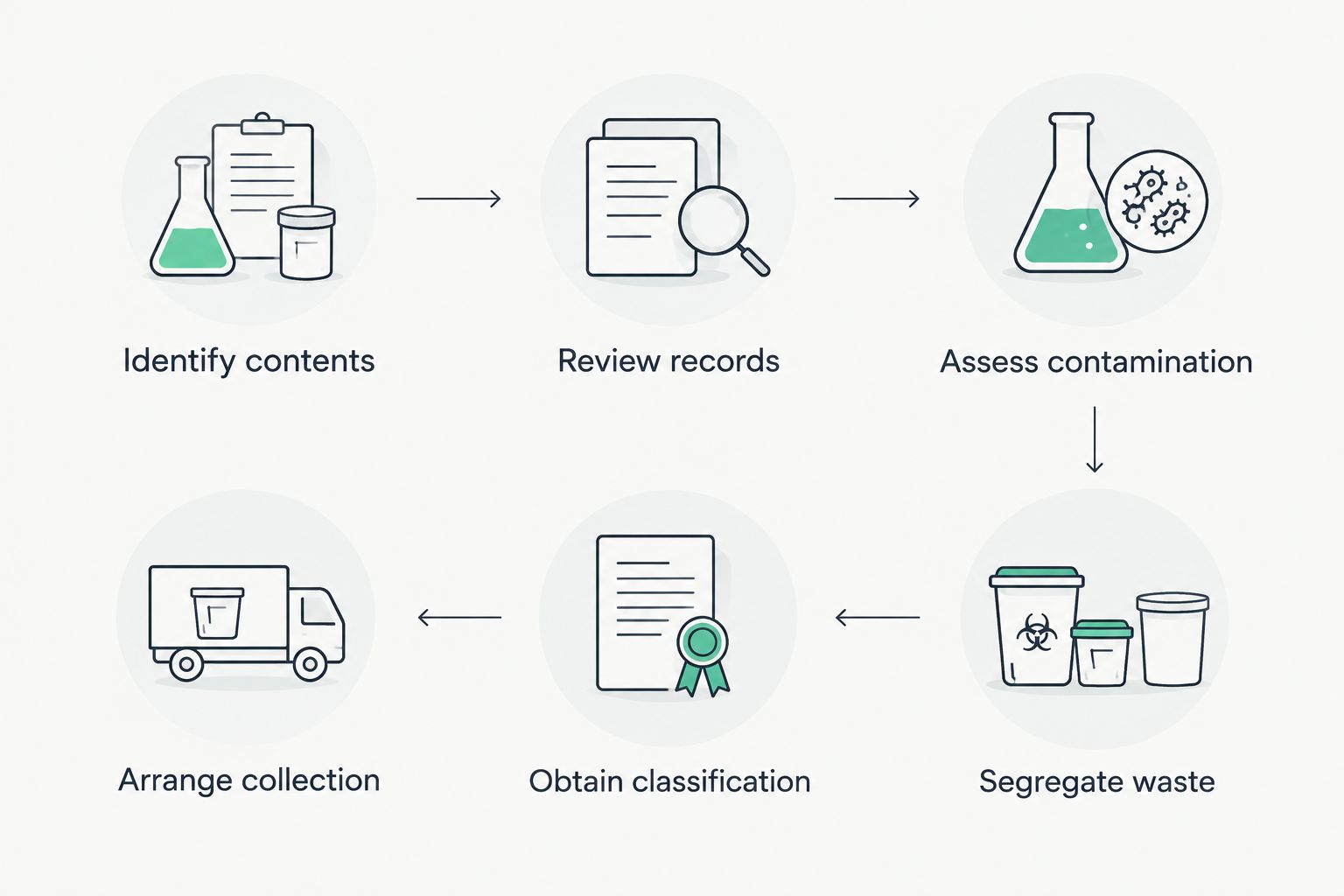
Follow this sequence before anything leaves your laboratory. The objective is to preserve identification, prevent exposure, and hand the waste to the collection stream authorized for its actual contents.
Identify contents
Read the original label and check the inventory or preparation record. Record the compound identity, whether the vial contains dry material or solution, and any known diluent, solvent, preservative, or added reagent.
Keep the original label attached. A replacement waste label should supplement identification rather than hide it. If the label is missing or illegible, mark the contents as unknown under your facility’s procedure; do not infer identity from cap color or storage position.
Review records
Consult the safety data sheet, supplier documentation, and your experiment records. The original product documentation does not describe every mixture you later prepared, so include anything added during laboratory work.
In the United States, the OSHA Hazard Communication Standard, 29 CFR 1910.1200, addresses workplace chemical hazard communication. A safety data sheet supports hazard assessment, but its disposal section is not a substitute for the waste determination required under applicable environmental rules.
Assess contamination
Determine whether the vial contacted biological material, hazardous reagents, or other substances during use. An unused expired vial and a vial used in an experiment do not necessarily have the same waste profile.
Do not open, smell, or sample an unidentified vial to investigate it yourself. Escalate uncertainty to the person responsible for laboratory safety. If the vial is leaking or damaged, restrict access and follow your spill procedure rather than carrying it through the facility.
Segregate waste
Place intact vials in compatible secondary containment according to your facility’s instructions. Keep incompatible or unidentified materials separate until their collection requirements are established.
Do not combine leftover solutions to save space. Mixing waste can create an incompatibility and erase the information needed to classify it. Keep broken glass and exposed needles out of ordinary waste bags; their chemical or biological contamination also matters.
Obtain classification
Ask your environmental health and safety team or qualified waste contractor to confirm the waste stream. Provide the identity, formulation, contamination history, physical condition, and available documentation rather than only the phrase “expired peptides.”
For U.S. facilities, 40 CFR 262.11 sets federal hazardous-waste determination requirements for generators. State requirements can be more stringent, and local sewer rules also apply. Do not treat the absence of a hazard statement as permission to use the sink or ordinary trash.
Arrange collection
Use the container, label, accumulation location, and pickup process specified for the assigned waste stream. Do not improvise a shipping method or mail vials to a supplier without an explicit, authorized arrangement.
Record what was removed and update your inventory after collection. For a 2026 disposal record, retain the identification and collection documentation required by your facility and applicable rules. Removing a vial from inventory should follow actual removal, not merely the decision to discard it.
Which disposal route fits the vial?
Match the collection route to the contents and handling hazards, not to the word “peptide.” The table below compares assessment situations; it does not authorize a waste classification or replace your facility’s instructions.
| Vial situation | Best for | Advantage of this assessment route | Limitation |
|---|---|---|---|
| Intact vial with documented contents | Routine chemical-waste assessment | Known identity supports a specific waste decision | Expiration does not establish whether the waste is hazardous |
| Vial containing a prepared solution | Assessment of the complete formulation | Accounts for diluents and added reagents | The original product label does not describe later additions |
| Vial exposed to biological material | Coordinated biological and chemical review | Addresses contamination alongside chemical hazards | Biological treatment alone does not resolve chemical hazards |
| Broken vial or attached needle | Assessment of physical injury and contamination risks | Addresses puncture hazards during collection | A sharps container does not automatically satisfy chemical-waste requirements |
| Unlabeled or uncertain contents | Unknown-waste assessment | Avoids unsupported assumptions and mixing | Identification and collection require safety-team direction |
Intact, documented vials
An unopened expired vial is easier to assess when its identity and storage history remain documented. Leave the closure intact and provide the product information to your safety team.
The advantage is traceability, not automatic permission for ordinary disposal. A dry powder still requires assessment, and opening it simply to empty the container creates an unnecessary handling step.
Prepared peptide solutions
A prepared solution requires a review of everything in the vial. Include the diluent and any reagents added during the experiment, even when the peptide concentration is low.
The benefit of complete formulation records is a clearer waste decision. The limitation is that a supplier’s information for the original material cannot describe every laboratory preparation. Do not dilute a solution as a substitute for obtaining disposal approval.
Contaminated or damaged vials
Biological contamination and physical damage introduce separate collection concerns. Tell the safety team about both; do not select a container solely because it carries a familiar biohazard or sharps symbol.
Avoid picking up broken glass by hand, including with gloved fingers. Follow your facility’s procedure for tools, protective equipment, and compatible collection containers. A leaking vial requires spill assessment before routine waste handling resumes.
Why peptide vial disposal requirements vary
These factors explain why no single disposal instruction fits every expired research vial:
- Compound identity: The specific substance determines which hazard information and waste rules need review. “Research peptide” is not a regulatory waste category.
- Formulation: Dry material and a solution containing additional chemicals need separate assessments. Include the complete formulation, not just the active compound.
- Contamination history: Contact with biological material or hazardous reagents changes the evaluation. An unused vial does not have the same history as experimental waste.
- Container condition: Intact glass, broken glass, a leaking closure, and an attached needle present different handling concerns.
- Location and facility rules: Federal, state, local, and institutional requirements govern different parts of collection and disposal. Your laboratory’s approved procedure connects those requirements to the waste in front of you.
For a 2026 procedure review, check that the instructions address unknown mixtures and damaged containers as well as unopened stock. A policy that only names the original compound leaves the most difficult disposal decisions unresolved.
Can I put an empty peptide vial in regular trash?
An apparently empty peptide vial is not automatically approved for regular trash. Residue, contamination, and the applicable definition of an empty container determine what happens next.
Do not rinse the vial unless your facility specifically authorizes that step and identifies where the rinsate belongs. Rinsing transfers material into another waste stream; it does not make the disposal question disappear. Likewise, do not place laboratory glass in household recycling without explicit acceptance.
A container that looks clean can still have a relevant use history. Describe that history when requesting a decision rather than reporting only that the vial is empty.
Can I use a pharmacy take-back program for research vials?
Do not assume a pharmacy take-back program accepts laboratory research vials. Programs set acceptance rules, and household medication collection is not a substitute for a laboratory waste assessment.
Before transporting anything, confirm the program accepts the specific material from your type of organization. Explain that it is research material and disclose any chemical or biological contamination. If acceptance is not explicit, use your institution’s waste-management route instead.
Should I bleach or autoclave expired peptide vials?
Do not bleach or autoclave expired peptide vials without an approved procedure for their contents. Neither action is a universal method for making chemical waste suitable for disposal.
Bleach can be incompatible with other chemicals, while heat treatment introduces additional material and equipment considerations. A biological decontamination procedure does not automatically resolve chemical hazards. Keep disposal and decontamination decisions connected, but do not treat them as interchangeable.
What information should accompany a disposal request?
Send a concise description that lets the safety team assess the actual waste. Include the original compound name, physical form, known additions, contamination history, container condition, and approximate remaining quantity when you can determine it without opening the vial.
Attach existing documentation rather than creating a new exposure to obtain better measurements. If the quantity or contents are uncertain, state that directly. Clear uncertainty is more useful than a confident guess.
For Peptides777 research peptides, preserve the original product identification alongside your laboratory’s preparation record. The supplier identifies the starting material; your records explain what happened after receipt. Neither record replaces the other.
FAQ
What's the safest way to dispose of expired research peptide vials in 2026?
Keep the vials closed, identify their contents and contamination history, and obtain an approved waste classification before collection. Follow your facility’s current procedure and applicable federal, state, and local requirements.
Can I pour an expired peptide solution down the sink?
Do not pour an expired peptide solution down the sink without explicit authorization under your facility’s procedure and applicable discharge rules. The full formulation, including added chemicals, needs assessment.
Are expired research peptides automatically hazardous waste?
Expiration alone does not establish whether research peptides are hazardous waste. The waste determination depends on the material, its formulation, contamination, and applicable rules.
Do peptide vials always belong in a sharps container?
Peptide vials do not automatically belong in a sharps container. Broken glass or an attached needle introduces a puncture hazard, but chemical and biological contamination still require an appropriate collection decision.
Can I send expired Peptides777 vials back to the supplier?
Do not send expired Peptides777 vials back without explicit authorization and an approved transport arrangement. Use your laboratory’s waste process unless a specific alternative has been confirmed.
What should I do if the label is missing?
Keep an unlabeled vial closed and request unknown-waste assessment through your safety team. Do not guess the contents, mix it with identified waste, or open it to investigate.
Does high purity make an expired peptide safe for household disposal?
High purity does not establish that an expired peptide is safe for household disposal. Purity describes the material’s composition, not its waste classification, contamination history, or permitted disposal route.
One last thing
The most useful disposal step happens before the vial expires: document every addition when you prepare it. A compound name without a diluent or contamination history leaves the next person with an avoidable unknown.
During your next 2026 inventory review, flag vials whose preparation records are incomplete and request assessment before moving them into routine waste collection. Better records reduce guesswork; they do not replace the required waste decision.