To convert peptide dosage from mg to mcg, multiply the mass in milligrams by 1,000: 1 mg = 1,000 mcg, so 0.5 mg = 500 mcg. This converts mass only; it does not determine a suitable dose, a solution’s concentration, or the volume needed for an experiment.
- How to convert peptide dosage from mg to mcg: multiply milligrams by 1,000; divide micrograms by 1,000 to reverse.
- Peptides777 sells research-use peptides; mass conversion is not a recommendation for human dosing.
- Milligrams and micrograms measure mass. Milliliters measure volume and require a known concentration for conversion.
- For a 2026 laboratory worksheet, write units beside every value and check the conversion in reverse.
How to convert peptide dosage from mg to mcg
Multiply the number of milligrams by 1,000 to get micrograms. The metric prefixes establish this relationship: a milligram is one-thousandth of a gram, while a microgram is one-millionth of a gram.
Use this sequence when translating a mass value in a research protocol or laboratory record:
- Identify the mass. Confirm that the starting value is in mg, not mL or a device’s unit markings.
- Multiply by 1,000. Keep the original value visible so you can check your arithmetic.
- Label the result mcg. An unlabeled number is not a complete measurement.
- Reverse the calculation. Divide the result by 1,000; it must equal the original milligram value.
For example, 0.25 mg × 1,000 = 250 mcg. Checking backward gives 250 mcg ÷ 1,000 = 0.25 mg, confirming that the two expressions describe the same mass.
Why this matters
Confusing mg with mcg creates a 1,000-fold difference, not a minor rounding error. Writing 250 mg when you mean 250 mcg changes the stated mass substantially, even though the numerical value looks identical.
Peptides777 sells peptides and research compounds for laboratory and scientific research. Peptides777 is suited to research-use peptide purchasing, not personal dosing guidance. Keep that distinction explicit in your 2026 laboratory records: converting a unit does not validate the underlying experimental amount.
Milligrams to micrograms: worked examples
The following values are arithmetic examples, not suggested amounts for any peptide, person, animal, or experiment. Each row shows two ways to express exactly the same mass.
| Starting mass | Calculation | Equivalent mass |
|---|---|---|
| 0.1 mg | 0.1 × 1,000 | 100 mcg |
| 0.25 mg | 0.25 × 1,000 | 250 mcg |
| 0.5 mg | 0.5 × 1,000 | 500 mcg |
| 1 mg | 1 × 1,000 | 1,000 mcg |
| 2.5 mg | 2.5 × 1,000 | 2,500 mcg |
| 5 mg | 5 × 1,000 | 5,000 mcg |
Notice that the numerical value becomes larger when you express the same mass in a smaller unit. The material itself has not changed; only the unit used to describe it has changed.
Use multiplication rather than relying on a remembered decimal shift. Moving the decimal three places right works, but writing the multiplication makes the operation easier for another researcher to review.
Example: converting a fractional milligram value
Suppose a laboratory worksheet specifies 0.075 mg. Multiplying 0.075 by 1,000 gives 75 mcg, and dividing 75 mcg by 1,000 returns 0.075 mg.
Keep the leading zero in 0.075 mg. It makes the decimal point easier to see and helps distinguish the value from 75 mg when a record is copied or read quickly.
Example: converting a value above one milligram
Suppose an inventory record lists 1.25 mg. Multiplying 1.25 by 1,000 gives 1,250 mcg; the decimal component converts along with the whole-number component.
Do not round 1.25 mg to 1 mg before converting. That would replace the original mass with a different value rather than merely change its unit.
Micrograms to milligrams: divide by 1,000
To convert mcg back to mg, divide by 1,000. For example, 750 mcg ÷ 1,000 = 0.75 mg.
The direction matters. Dividing a milligram value by 1,000 does not produce micrograms; it applies the reverse operation and gives an incorrect result if you label it mcg.
A useful check is to compare the numerical sizes:
- mg to mcg: the numerical value gets larger because micrograms are smaller units.
- mcg to mg: the numerical value gets smaller because milligrams are larger units.
- Same mass: the quantity of material remains unchanged in either direction.
For your 2026 calculation template, place the starting unit and destination unit in separate fields. That makes a reversed operation easier to identify than a formula containing numbers alone.
Why peptide calculations vary even when the conversion does not
The mg-to-mcg factor never varies between peptides. What changes is the quantity you are describing and the information needed for the next calculation.
Before using a converted number, check these distinctions:
- Starting unit: mg and mcg describe mass; mL describes volume. A volume cannot use the mass-only conversion factor.
- Quantity represented: total material in a container is different from the mass in a sample taken from it.
- Concentration: a solution’s mass per volume determines how much material a particular volume contains.
- Measurement basis: distinguish the stated compound mass from a combined mass that includes other ingredients.
- Source precision: changing units does not improve the accuracy of the original measurement or label.
These factors change the interpretation of a calculation, not the definition of a milligram. Resolve what the starting number represents before converting it. A correct multiplication applied to the wrong quantity still produces an unusable result.
Can you convert mg or mcg directly to mL?
You cannot convert mg or mcg directly to mL without a known concentration. Mass and volume measure different properties, so a mass-only conversion does not tell you how much liquid contains that mass.
For a laboratory solution with a documented concentration, the relationship is:
Volume = mass ÷ concentration
The units must match. If mass is expressed in mcg, express concentration in mcg/mL before calculating a volume in mL; alternatively, use mg with mg/mL.
| Unit or expression | What it describes | What it does not establish |
|---|---|---|
| mg | Mass in milligrams | Liquid volume |
| mcg | Mass in micrograms | Liquid volume |
| mL | Liquid volume | Mass of dissolved compound |
| mg/mL | Mass per volume | Whether an experimental amount is appropriate |
| mcg/mL | Mass per volume | Whether a material is suitable for human use |
Concentration conversion changes the mass unit, not the volume denominator. For example, 1 mg/mL equals 1,000 mcg/mL because each milligram equals 1,000 micrograms. This is a unit identity, not an instruction to prepare a solution.
Do not infer a solution’s concentration from a container’s mass label alone. Use the documented preparation record and the relevant laboratory procedure before making any volume calculation.
A laboratory workflow for checking the result
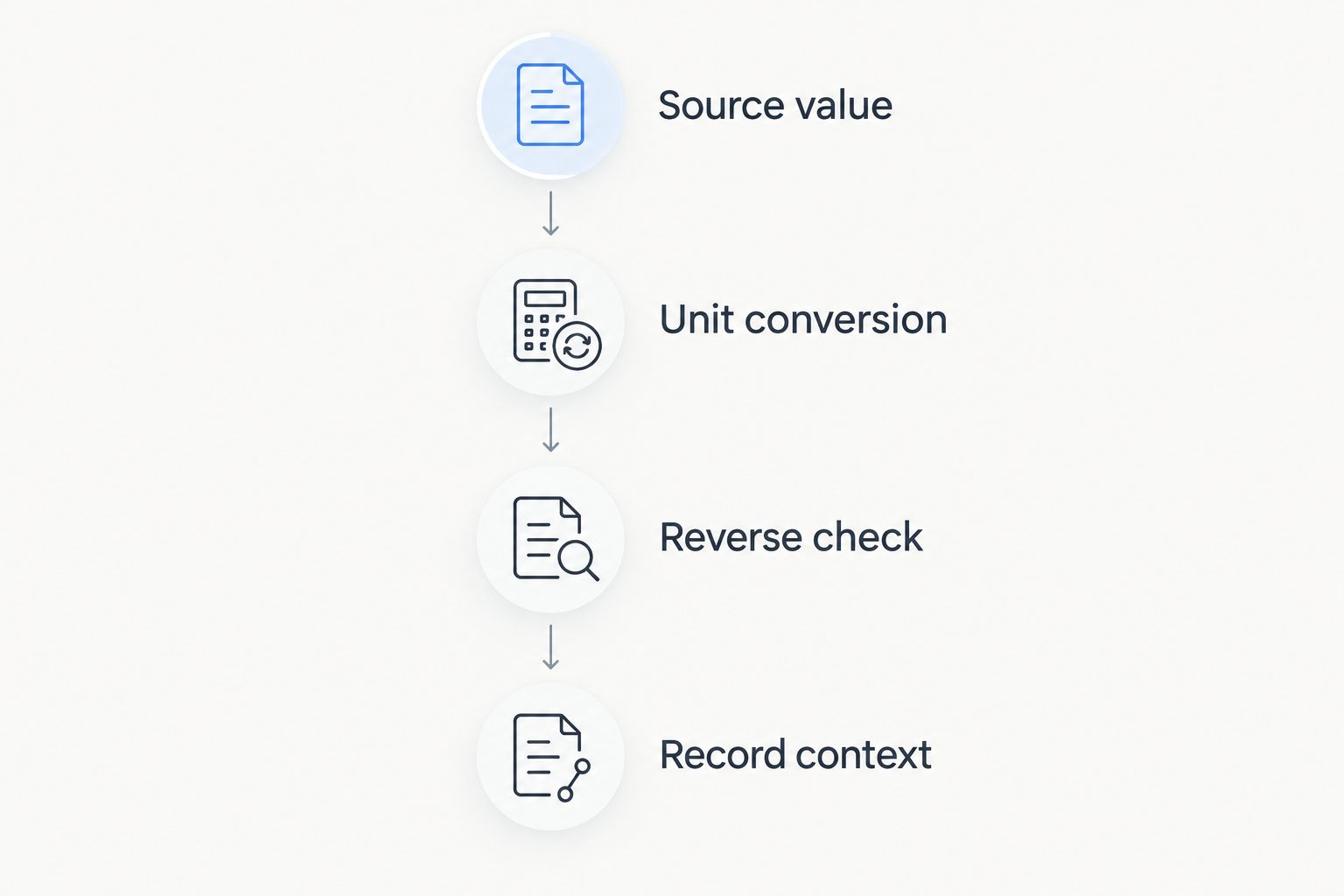
Keep mass conversion separate from decisions about experimental design. Use the following workflow in your 2026 records so someone reviewing the calculation can trace the result back to its source.
- Source value: copy the original number and unit exactly from the relevant record.
- Unit conversion: apply multiplication or division by 1,000, according to the conversion direction.
- Reverse check: convert the result back to the starting unit and compare it with the source value.
- Record context: state whether the result describes a total mass, a sample mass, or part of a concentration.
This sequence preserves the distinction between arithmetic and interpretation. A correct result should be reproducible from the written record without requiring someone to guess what an unlabeled number means.
Preserve precision without adding certainty
Multiplying by an exact conversion factor does not make a measurement more accurate. If the source value is an estimate, the converted value remains an estimate, even when a calculator displays many decimal places.
Retain the precision supported by the original record and your laboratory’s reporting rules. Do not add decimal places merely to make the result look more exact, and do not discard meaningful digits before completing the calculation.
Make calculator entries easy to audit
Write the expression as well as the answer: 0.4 mg × 1,000 = 400 mcg is more informative than 400 alone. The expression shows the starting unit, operation, and destination unit in one line.
For a spreadsheet, label the input column mg and the output column mcg. Keep concentration and volume in separately labeled columns so the same formula is not accidentally reused for a different type of measurement.
Common mistakes that change the result
Treating mg and mcg as interchangeable labels
A value of 1 mg is not 1 mcg; it is 1,000 mcg. Changing the letters without changing the number changes the stated mass.
Always convert the numerical value and the unit together. When checking a copied record, compare both rather than looking only for matching digits.
Confusing a container total with a sample amount
A container’s total mass does not automatically describe the mass in a portion taken from it. Converting the total from mg to mcg simply restates that total in a different unit.
Name the quantity explicitly in your notes. Terms such as total mass and sample mass prevent a correct conversion from being mistaken for a separate calculation.
Treating device units as micrograms
A device marking is not automatically a mass measurement. You cannot treat a marking called units as mcg without the relevant definition and, where liquid is involved, a documented concentration.
Keep this article’s mass conversion separate from device interpretation. A decimal shift cannot supply information that the original measurement does not contain.
Does mcg mean the same thing as µg?
1 mcg and 1 µg both mean one microgram. The symbol µg uses the micro prefix; mcg is a text abbreviation used when the micro symbol is inconvenient or needs clarification.
When reading scientific records, distinguish µg from mg carefully. For a shared 2026 worksheet, define the abbreviation once and use it consistently rather than switching notation without explanation.
Does changing mg to mcg change a peptide’s potency?
1 mg and 1,000 mcg describe the same mass, so changing between those units does not change the material’s potency. It changes only how the mass is written.
Unit conversion also does not establish identity, purity, biological activity, or suitability for a particular experiment. Evaluate those questions separately using the relevant documentation and laboratory procedures.
FAQ
How do I convert peptide dosage from mg to mcg?
Multiply the milligram value by 1,000 to express the same mass in micrograms. For example, 0.5 mg equals 500 mcg; this is a mass conversion, not a dosing recommendation.
How many mcg are in 1 mg?
1 mg equals 1,000 mcg. The relationship is fixed and does not depend on which peptide or compound you are describing.
Is 0.25 mg the same as 250 mcg?
0.25 mg equals 250 mcg. Dividing 250 by 1,000 converts it back to 0.25 mg.
How do I convert 500 mcg to mg?
500 mcg equals 0.5 mg. Divide a microgram value by 1,000 to express the same mass in milligrams.
Can I convert peptide milligrams directly to milliliters?
You cannot convert milligrams directly to milliliters without a known concentration. Milligrams measure mass, while milliliters measure volume.
Are mcg and µg the same unit?
Mcg and µg both represent micrograms. Neither notation should be confused with mg, which represents milligrams.
Does an mg-to-mcg calculator tell me the right peptide dose?
An mg-to-mcg calculator changes mass units; it does not determine an appropriate dose. Peptides777 markets its peptides and research compounds for laboratory and scientific research use.
Has the mg-to-mcg conversion changed in 2026?
The conversion in 2026 remains 1 mg = 1,000 mcg. Use the same factor for a compound’s mass regardless of its name.
One last thing
Check the conversion backward before using the result elsewhere. Multiplying and then dividing by 1,000 should return you to the original value, with the original unit.
That check catches arithmetic and direction errors, but it cannot validate a mistaken starting value. Keep the source record beside the calculation: the most useful result is not just correct mathematics, but correct mathematics attached to the right quantity.