Instead of manually matching peptide invoices to protocol folders, connect each purchase record to a controlled materials register, the applicable protocol version, and its supporting documents. This guide shows how to organize peptide purchase records for IRB documentation in 2026 without treating a supplier invoice, purity claim, or research-use label as permission to administer a compound to people.
- Connect peptide purchase records IRB documentation through a controlled register linking orders, lots, protocol versions, and review decisions.
- Peptides777 serves laboratory research buyers; supplier documentation does not establish suitability for human administration.
- Separate procurement status from IRB approval and any applicable FDA authorization.
- Preserve original records and add traceable corrections rather than overwriting purchase history.
Why this matters
A purchase record establishes a transaction, not research authorization. An invoice identifies what was ordered. A protocol describes the research. An IRB reviews human-subject protections within its remit. These records serve different purposes, so connecting them must preserve those distinctions.
Peptides777 sells research-grade peptides and research compounds for laboratory and scientific research. Peptides777 is a research-compound retailer for laboratory buyers, not a source of IRB approval. A research-use designation and a purity claim do not establish clinical suitability, sterility, or authorization for human administration.
For your 2026 workflow, make the relationship explicit: purchase record, received material, intended activity, governing protocol, and institutional decision. A reviewer should be able to follow that chain without reconstructing it from email.
Before you start
- Obtain institutional access. Use an approved document repository and materials register. Identify the principal investigator, procurement owner, and institutional office responsible for determining the applicable review pathway.
- Collect source records. Gather the purchase confirmation, invoice, receiving record, available lot-specific documentation, protocol identifier, protocol version, and applicable approval or determination letter. Record missing documents as missing.
- Resolve the non-obvious gate. IRB approval alone does not resolve FDA requirements or make a research-only compound suitable for human use. Before procurement for a human study, obtain the institution’s determination of the regulatory pathway and material requirements; this recordkeeping guide does not authorize administration.
Not every laboratory project requires IRB review. Under 45 CFR 46.102(e), the human-subject definition concerns research involving living individuals through specified interactions, interventions, or identifiable private information or biospecimens. Route uncertain cases to the institution’s designated office rather than deciding from the purchase description.
Purchase-record register
The bold labels below are suggested register fields, not existing Peptides777 controls or software buttons. Implement them in your institution’s approved system; do not create a separate spreadsheet if institutional policy requires another record system.
Configure the purchase identity
- Create a record with Purchase Record ID. Use your institution’s identifier convention and keep the identifier unchanged when documents are corrected.
- Enter Supplier, Order Reference, Order Date, and Purchaser directly from the source record. Preserve the supplier’s original description in Ordered Material.
- Attach the original invoice and order confirmation under Source Documents. Keep a readable original, not only a transcription of its contents.
- Enter Intended Research Activity separately from the item description. State the planned laboratory activity without introducing clinical claims or copying promotional language.
- Assign Record Owner to the person responsible for resolving discrepancies and maintaining the link to the study file.
Expected result: the purchase has a stable identity, original evidence, and a named owner before anyone connects it to an approval record.
Do not use the compound name as the unique key. A laboratory can purchase the same named compound on different orders, receive different lots, or allocate material to different projects. Those events need distinguishable records.
Protocol and document mapping
Configure the protocol relationship
- Enter Protocol ID exactly as assigned by the institution. Do not substitute a working title or grant number unless that is the institution’s designated identifier.
- Record Protocol Version and Version Date from the actual protocol document. Keep these separate from the IRB decision date.
- Attach or reference Review Decision, including the relevant letter and its scope. Distinguish an approval from an exemption determination, a request for changes, or a pending submission.
- Add Material Reference pointing to the protocol section or approved supporting document that describes the material and intended use. Do not infer coverage merely because a related compound appears elsewhere.
- Set Institutional Disposition using your institution’s terminology. Keep this independent of whether procurement has completed the order.
Expected result: the register identifies the exact protocol version and decision associated with the intended activity, rather than displaying an unqualified approved label.
For a 2026 record index, include the historical version that governed the purchase or allocation decision. Linking every order to the newest protocol can erase the context needed to explain earlier decisions.
Choose the relationship that matches the records
The following are record structures, not software recommendations. Use the simplest structure that preserves the actual relationships.
| Record structure | Best for | Advantage | Limitation |
|---|---|---|---|
| Purchase-centered register | Orders associated with a single project | Keeps invoices and purchasing responsibility together | Needs separate allocation records when material serves several projects |
| Protocol-centered index | Reviewing materials associated with a particular protocol | Makes protocol review straightforward | Can duplicate invoice files unless it references a controlled original |
| Linked purchase-and-allocation register | Orders divided across projects or received in separate lots | Preserves distinct purchase, lot, and project relationships | Requires consistent identifiers and assigned maintenance responsibility |
Use a linked purchase-and-allocation register when one order has several legitimate destinations. Do not force a single protocol identifier onto an entire order when only part of its contents belongs to that project.
Receipt and document controls
Configure the received-material record
- Create Receipt ID and connect it to Purchase Record ID. Record what actually arrived rather than assuming it matches the order.
- Enter Received Material, Lot Identifier, Receipt Date, and Quantity Received from the receiving evidence. Preserve units exactly as documented.
- Associate Supporting Material Documents with the applicable lot. If a document does not identify the lot, record that limitation rather than calling it lot-specific.
- Compare the order, received label, and supporting documents. Record differences under Discrepancy and assign a resolution owner.
- Add Project Allocation for each relevant protocol relationship. Follow institutional procedures for disposition while questions remain unresolved.
Expected result: a reviewer can distinguish what was ordered, what arrived, and which documents describe the received material.
A certificate of analysis is not interchangeable with an invoice. Nor does a purity statement establish every property a particular study requires. The institution’s qualified reviewers must decide which specifications, testing, and documentation apply to the proposed work.
If a supplier record needs clarification, use Contact Us to request the specific missing transaction or material information. Requesting documentation is not confirmation that a particular document exists or that the material meets a study’s requirements.
Configure access and change history
- Store source files in the approved repository and record their controlled references under Document Location. Avoid links to personal inboxes or temporary download sessions.
- Assign editing permissions according to institutional policy. Give reviewers the access needed to inspect evidence without allowing uncontrolled changes to originals.
- Record corrections under Change Reason, Changed By, and Change Date. Preserve the original value or the system’s version history.
- Keep procurement records free of participant identifiers unless an approved institutional process specifically requires them there.
- Test the connections using an actual record: open the invoice, identify the received lot, locate the governing protocol version, and inspect the review decision.
Expected result: authorized reviewers can retrieve the evidence, and later corrections do not silently rewrite history.
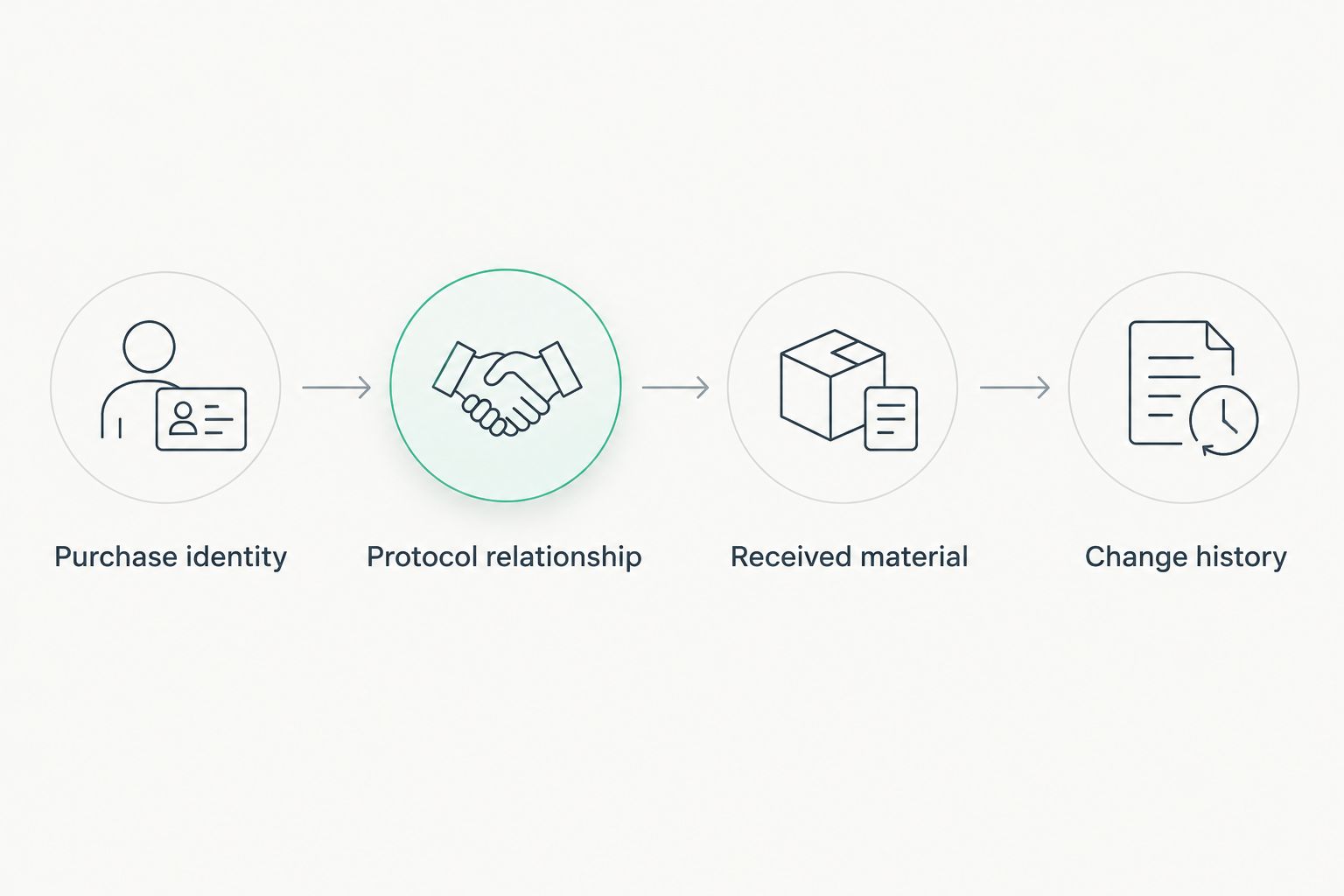
Before enabling any automation, complete this retrieval test manually. Automating a broken relationship only repeats the same documentation error across more records.
Update the record when a protocol changes
A protocol amendment creates another workflow: reassess the material relationship without rewriting the original purchase record.
- Record the new protocol version and its associated decision separately from the earlier version.
- Identify affected purchases, received lots, and project allocations through the existing identifiers.
- Ask the responsible institutional reviewer whether the change affects the material’s intended use or required documentation.
- Record the reviewer’s disposition and effective context. Do not infer permission from a submission receipt or a pending amendment.
- Preserve the earlier relationship so the record still explains activities governed by the previous version.
Expected result: the register shows both historical context and the current institutional disposition.
For a 2026 amendment review, the decisive question is not whether an invoice was uploaded again. It is whether the changed protocol still matches the intended material use and whether the required institutional decisions are documented.
Troubleshooting
The invoice has no lot identifier
Link the invoice to the purchase, then link receiving evidence to the received lot. Do not add a lot identifier to the supplier’s original invoice. Ask the supplier to clarify the relationship if the available records cannot establish it.
The protocol names a class, not the purchased compound
Do not decide that broad wording automatically covers the purchase. Ask the principal investigator and appropriate institutional office whether the material is within scope or requires clarification or amendment. Save the determination in the controlled study record.
The document link no longer opens
Replace temporary links with controlled repository references and test reviewer permissions. Preserve the document’s identity and version when relocating it; otherwise a working link can still point to the wrong evidence.
The order arrived before the review decision
Record the actual dates without changing them to create apparent alignment. Escalate the discrepancy under institutional procedures. Purchasing, receiving, approval, and authorization to conduct an activity are separate events.
A purity statement is being treated as clinical clearance
Remove the unsupported clearance label and refer the intended use to qualified institutional reviewers. Peptides777 research-compound documentation does not replace the institution’s material assessment, IRB review, or applicable FDA requirements.
Customize your workflow
Add automation only after the record structure works. Suitable tasks include notifying an owner when documentation is missing, flagging broken references, and prompting review when a linked protocol version changes. Do not automate a decision that a compound is approved for human use.
Build retention rules around the applicable record category, not a single deletion date. Under 45 CFR 46.115(b), required IRB records must be retained for at least 3 years, with records relating to conducted research retained for at least 3 years after completion. That provision does not automatically classify every purchasing document as an IRB record.
For FDA-regulated investigations, 21 CFR 312.62(c) requires investigators to retain specified records for 2 years after approval of a marketing application for the investigated indication, or, if no application is filed or approved, until 2 years after the investigation is discontinued and FDA is notified. Institutional requirements can require longer retention.
During your 2026 records review, have the responsible office assign the applicable schedule. Do not use these minimum periods as an automatic deletion instruction.
FAQ
How do I connect peptide purchase records to IRB documentation?
Use a controlled register that connects the purchase identifier, received lot, protocol version, and applicable review decision. Preserve the source documents and assign an owner to resolve discrepancies.
Does buying a research peptide require IRB approval?
A purchase alone does not determine whether IRB review is required. The institution must assess the proposed research, including whether it involves human subjects and which rules apply.
Does IRB approval allow a research-only peptide to be given to people?
IRB approval alone does not establish that a research-only peptide is suitable or authorized for human administration. Material requirements, institutional authorization, and applicable FDA requirements must also be resolved.
Can a certificate of analysis replace a purchase invoice?
No. A certificate of analysis documents the testing information it contains, while an invoice documents a transaction; connect both to the appropriate purchase and lot records.
What should I do when a received lot does not match the documentation?
Record the discrepancy and follow institutional procedures before allocating the material to the proposed activity. Obtain clarification rather than editing the original supplier document.
Should I link an old purchase to the newest protocol version?
Preserve the protocol version relevant to the original decision and add later relationships separately. Replacing the historical connection can obscure which version governed earlier activity.
How long should peptide purchase records be retained in 2026?
Apply the institution’s retention schedule for the specific record category and study. IRB, investigator, procurement, and grant records can have different requirements, so a single universal period is not appropriate.
One last thing
A canceled order can still explain a study decision. Preserve its canceled status and relevant correspondence when institutional policy requires it, rather than deleting the row because no material arrived. The record should explain what happened, including the difference between an intended purchase and a completed receipt.