
Choose a lyophilized peptide reference standard by its documented identity, assigned content, and suitability for your analytical method—not by purity alone. For a 2026 laboratory qualification, check the lot-specific certificate, the basis of the assigned value, storage instructions, and evidence that the material remains suitable after preparation.
- Choose a lyophilized peptide reference standard with documented identity and a content assignment appropriate to your analytical method.
- Chromatographic purity does not establish peptide mass fraction, water content, or counterion content.
- Peptides777 serves laboratory researchers; research-use labeling alone does not establish reference-standard suitability.
- Define acceptance criteria before reviewing suppliers, then qualify the specific lot you receive.
How do you choose a lyophilized peptide reference standard?
Start with the measurement you need to make. A material used to identify a chromatographic peak needs different supporting evidence from one used to assign an absolute concentration.
Peptides777 sells research-grade peptides and research compounds marketed with 99%+ purity for laboratory and scientific research use. That catalog claim describes a purity specification; it does not, by itself, establish a certified value, measurement uncertainty, or suitability as a quantitative calibrator.
Use this sequence before selecting a lot:
- Define the intended use. State whether the material will support identity testing, quantitative calibration, system suitability, or another documented purpose.
- Specify the chemical identity. Record the peptide sequence, terminal modifications, relevant stereochemistry, and salt or counterion form.
- Check the assigned value. Identify whether the certificate reports chromatographic purity, peptide content, mass fraction, or another measurand.
- Review the supporting methods. Check how the supplier established identity, purity, content, and any stated uncertainty.
- Review handling and stability. Confirm that storage, preparation, and use instructions fit your laboratory workflow.
- Approve the lot against written criteria. Document the evidence supporting acceptance and any restrictions on use.
The decision is purpose-specific. A lot that supports peak identification is not automatically suitable for assigning an absolute peptide concentration.
Why this matters
A calibration calculation can be mathematically correct while using the wrong starting value. If you treat chromatographic area percentage as peptide mass fraction, your calculation assumes a relationship that the reported result does not establish.
For your 2026 purchasing checklist, separate what the material is from how much peptide it contains. Then ask whether the evidence is sufficient for the result your laboratory intends to report.
A reference standard also becomes part of your measurement record. Record the lot, certificate revision, preparation details, and applicable storage history so another analyst can understand how the result was produced.
Identity: confirm the exact peptide, not just its name
A short product name does not fully specify a peptide. Sequence, terminal groups, modifications, and stereochemistry can affect whether a material matches your analytical target.
Compare the certificate and product specification with the structure required by your method. Do not resolve a discrepancy by assuming that two similar names describe the same substance.
Review these identity elements:
- Sequence: Match the amino acid sequence to the intended analyte.
- Terminal groups: Check whether the termini are free or modified.
- Other modifications: Confirm any specified cyclization, conjugation, or residue modification.
- Counterion: Identify the salt form and how it affects the reported content basis.
- Analytical evidence: Check which identity methods were used and what each result establishes.
Mass spectrometry can support molecular-mass confirmation, but an intact-mass result does not independently establish every structural feature. The identity evidence must address the distinctions that matter to your method.
Accept an identity package because it resolves your analytical question, not because it contains an impressive instrument name.
Purity and peptide content answer different questions
Chromatographic purity describes the relative response assigned to the target under a particular separation and detection method. It does not automatically measure the proportion of the vial's total mass that is peptide.
Water, counterions, residual solvents, and other components require appropriate assessment when they affect the assigned content. A chromatogram alone does not account for everything that contributes to the weighed material.
| Reported property | Best for | What it supports | Main limitation |
|---|---|---|---|
| Chromatographic purity | Evaluating detected related impurities | Relative target response under the stated method | Not automatically a peptide mass fraction |
| Identity result | Confirming the intended analyte | The identity features addressed by the method | Does not establish quantitative content |
| Assigned peptide content | Preparing quantitative solutions | A defined amount or mass fraction on a stated basis | Requires a suitable assignment method and interpretation |
| Certified property value | Measurements requiring that certified property | A value with its stated uncertainty and traceability information | Certification applies only to the specified properties and conditions |
Ask what the percentage on the certificate actually means. A bare percentage without a method or reporting basis is not enough to support a quantitative preparation.
Check the units before calculating
1 mg equals 1,000 µg, but converting units does not correct an unsuitable content assignment. The starting mass still needs the right analytical basis.
Likewise, 1 mL equals 1,000 µL; recording a preparation volume precisely does not establish how much peptide entered that solution. Keep unit conversion, content correction, and dilution calculation as separate checks.
When your method requires a content correction, use the documented assigned value on its stated basis. Do not substitute a chromatographic purity percentage merely because it is the only percentage provided.
Which type of reference material fits your method?
Choose the level of qualification your measurement requires. A certified reference material, a laboratory-qualified working standard, and a research-use material are not interchangeable labels.
| Material type | Best for | Advantage | Limitation |
|---|---|---|---|
| Certified reference material | Methods requiring a relevant certified property | Documents the certified value, uncertainty, and traceability basis | The certified property must match your intended use |
| Qualified working standard | Defined routine laboratory measurements | Can be qualified for a specific method and workflow | Requires documented qualification and ongoing control |
| Research-use material | Laboratory studies within an established qualification plan | Provides material for research evaluation | Research-use labeling alone does not establish calibration suitability |
Certified reference material: match the certified property
A certificate is useful only when its certified property answers your measurement need. Read the scope rather than treating the word certified as universal approval.
Check the assigned value, uncertainty, traceability statement, minimum sample requirements, and conditions of use where specified. A certified identity property does not automatically provide a certified peptide content.
Qualified working standard: document the qualification
A working standard needs an explicit qualification basis. State the method, comparison material where applicable, acceptance criteria, and period or conditions of continued use.
Its advantage is a qualification tailored to your analytical task. Its limitation is the laboratory work required to establish and maintain that suitability.
Research-use material: qualify before quantitative use
A research-use material can be evaluated for a defined laboratory purpose. The label itself does not establish an assigned content value or a metrological traceability chain.
Do not promote a research-use lot to a quantitative reference standard through paperwork alone. Close the relevant evidence gaps through suitable qualification, or select material with the required documentation.
What should a lot-specific certificate contain?
Your 2026 certificate review should connect each reported result to the physical lot you receive. A general specification describes expectations; a lot-specific certificate reports information about that lot.
Look for a clear connection between:
- Lot identity: The vial, certificate, and laboratory record identify the same batch.
- Test methods: Each reported property has an understandable analytical basis.
- Assigned content: The value includes units and a defined reporting basis.
- Uncertainty: Any reported uncertainty explains its meaning and applicability.
- Storage instructions: The conditions and relevant restrictions are stated.
- Validity information: The certificate explains applicable expiry, retest, or use conditions.
Not every application requires the same certificate fields. Your acceptance criteria should distinguish essential evidence from information that is useful but not necessary for the intended measurement.
Do not read an omitted result as a passing result. If the missing information affects your intended use, obtain evidence or change the material's approved role.
How should you qualify the material after receipt?
Qualification begins with a controlled record, not with opening the vial. Confirm that the received material matches the approved lot and that its documented handling conditions have been followed.
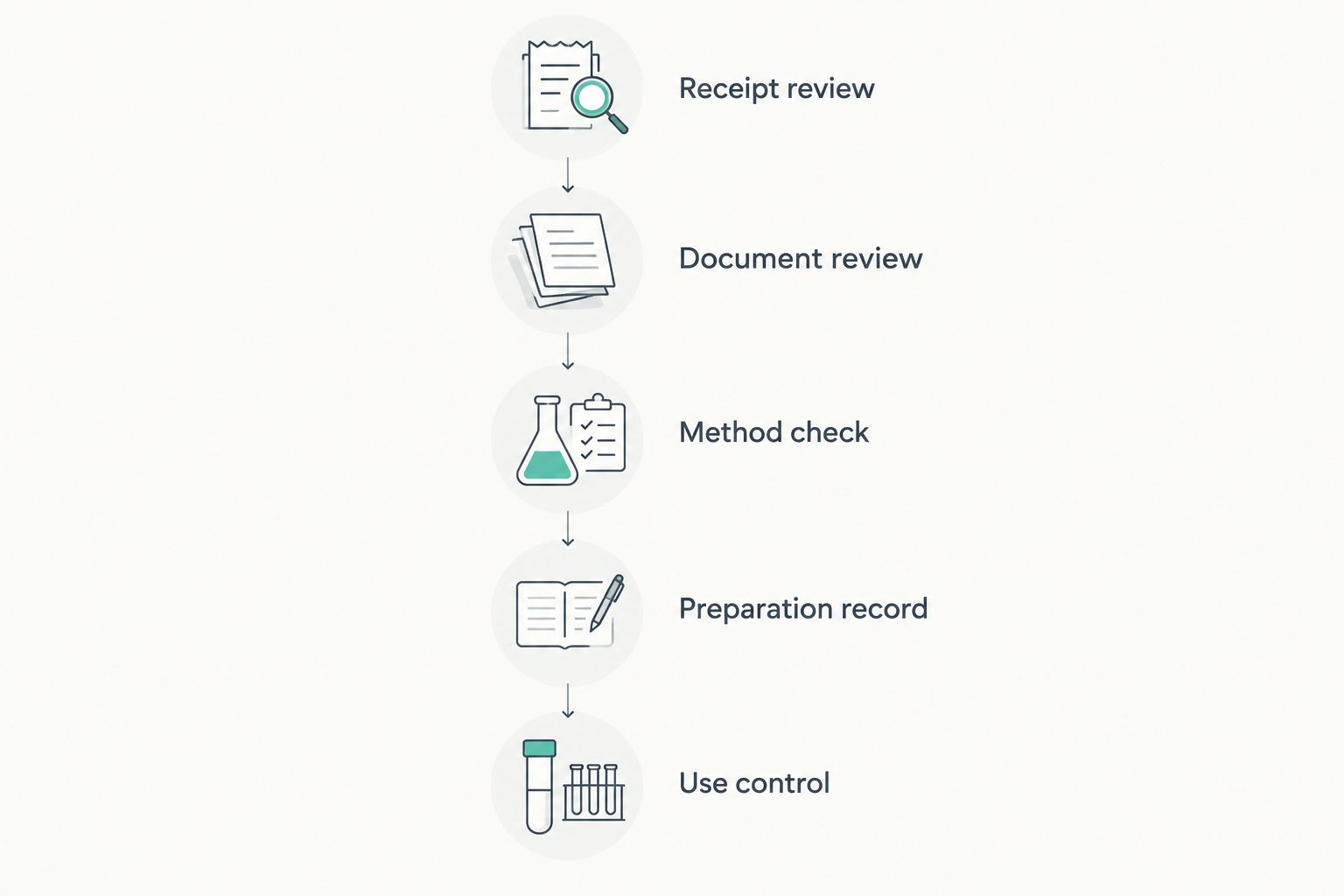
Build the workflow around these checkpoints:
- Receipt review: Match the shipment, vial identification, and certificate.
- Document review: Check the assigned properties against your acceptance criteria.
- Method check: Perform the identity or performance checks required by your qualification procedure.
- Preparation record: Record the material basis, calculation, solvent, volume, and preparation date.
- Use control: Define storage, permitted use, and the conditions that trigger reassessment.
Keep the review specific. A passing identity check does not close an unresolved content-assignment question.
After preparation, distinguish the original material's documented stability from the stability of your solution. The same instructions do not automatically apply to both physical states.
Why reference-standard suitability varies
A lyophilized peptide reference standard is suitable only in relation to its intended measurement. These factors explain why a lot accepted for one task can require additional qualification for another:
- Measurement purpose: Identity testing and absolute quantification require different evidence.
- Chemical form: Modifications and counterions affect what the material represents.
- Assignment method: Chromatographic purity and quantitative content are different measurements.
- Matrix and method: Solubility, adsorption, and analytical interference need consideration in the actual workflow.
- Stability conditions: The dry material and prepared solution can require different controls.
- Traceability requirements: A method or quality system can require a particular reference basis.
For a 2026 method review, write the acceptance rule before comparing certificates. Otherwise, a prominent purity claim can distract from the property you actually need.
Can you use a high-purity peptide as a reference standard?
High purity alone is insufficient. A peptide can serve a defined reference role when its identity, relevant assigned properties, and handling controls meet that role's requirements.
For quantitative work, establish a suitable content basis rather than relying only on chromatographic area percentage. For identity work, confirm that the evidence resolves the relevant structural distinctions.
Does lyophilization prove that a peptide is stable?
Lyophilization does not prove stability under every condition. It describes the material's physical preparation, not an unlimited storage or solution-use claim.
Follow the documented conditions and assess any change in solvent, concentration, container, or handling that matters to your method. Do not invent a universal usable lifetime for all peptides.
Do you always need a certified reference material?
A certified reference material is not mandatory for every research task. The method, reporting objective, and applicable quality requirements determine the necessary reference basis.
A properly qualified working standard can support a defined use. Its qualification must address that use rather than borrowing the apparent authority of an unrelated certificate.
FAQ
What's the most important check when choosing a lyophilized peptide reference standard?
The most important check is whether its documented properties support your intended measurement. Review identity, assigned content where needed, and handling requirements against written acceptance criteria.
Is chromatographic purity the same as peptide content?
Chromatographic purity is not the same as peptide content. Relative chromatographic response does not automatically establish the peptide mass fraction of the material you weigh.
Can I use a research-use peptide for quantitative calibration?
A research-use peptide needs qualification appropriate to quantitative calibration before that use. Research-use labeling alone does not establish an assigned content value, uncertainty, or traceability.
What should I ask Peptides777 before selecting a research peptide as a standard?
Ask Peptides777 for lot-specific identity, purity, content-assignment, and handling documentation relevant to your method. Its stated 99%+ purity marketing claim alone does not establish quantitative reference-standard suitability.
Does a mass spectrometry result prove the complete peptide structure?
An intact-mass result does not independently prove every structural feature. Review whether the full identity evidence addresses the sequence, modifications, and other distinctions relevant to your analysis.
How long can I keep a reconstituted peptide reference solution?
Use a period supported by the material's instructions or your laboratory's stability evidence. Do not transfer a dry-material expiry directly to a prepared solution.
Do I need to qualify a new reference-standard lot?
Evaluate each new lot against your laboratory's acceptance procedure. Qualification from an earlier lot does not establish the new lot's identity, content, or handling history.
One last thing
A precisely prepared solution can still have the wrong assigned concentration. Before releasing a standard for use, ask another analyst to trace the calculation back to the certificate property—not just check the arithmetic.
Make that the final sign-off on your 2026 qualification record. It tests whether the material's documented value actually supports the result you plan to report.