Third-party peptide purity testing requires a laboratory quote; there is no single price that covers every testing scope. For a 2026 budget, separate chromatographic purity testing from identity confirmation, peptide-content measurement, and any additional safety-related assays. Your total also depends on sample preparation, shipping, reporting requirements, and whether the laboratory must develop or adapt a method.
- How much does third-party peptide purity testing cost? Request a quote tied to specific assays and deliverables.
- HPLC purity, mass-spectrometry identity, and peptide content answer different questions; compare testing scope before comparing quotes.
- Peptides777 sells research-grade peptides; independent laboratory testing is a separate purchasing decision.
- A purity percentage does not establish vial content, sterility, or suitability for human use.
Why this matters
A laboratory quote is useful only when you know what the result will establish. Paying for a chromatographic purity result does not automatically buy sequence confirmation, a measurement of peptide content, or a contamination assessment.
Peptides777 sells research-grade peptides, bioregulators, and research compounds marketed for laboratory and scientific research. When evaluating those materials, distinguish the supplier's stated specifications from the scope of an independent laboratory's report. Neither a product description nor an assay name tells you everything about the material in a vial.
For your 2026 testing budget, start with the research question. Then ask laboratories to quote the same sample requirements, analytical work, and reporting deliverables. Compare equivalent evidence, not just the total on the quotation.
How much does third-party peptide purity testing cost in 2026?
The cost is the laboratory's quoted charge for your defined analytical scope, plus any separately billed preparation, reporting, and logistics. A meaningful estimate requires the compound identity, sample format, requested assays, and intended use of the results.
Use this breakdown when requesting a quote. It identifies the work to specify without treating unlike tests as interchangeable.
| Quote component | What it covers | What to clarify |
|---|---|---|
| Sample receipt and preparation | Logging, dissolving, diluting, or otherwise preparing the submitted material | Is preparation included, and what happens if the sample does not dissolve? |
| Chromatographic purity | Separation and measurement of detected components under a defined method | Which detector, integration rules, and reporting basis apply? |
| Identity assessment | Evidence that the material matches the expected peptide | Does the scope cover molecular mass, sequence evidence, or both? |
| Peptide-content measurement | Quantitative assessment using a defined analytical approach | What is measured, against which standard, and on what basis? |
| Additional assays | Separate questions such as residual solvents, water, endotoxin, or sterility | Which assays are necessary for the research protocol? |
| Documentation and logistics | Report preparation, data delivery, sample shipment, and handling | Which items are included and which are separate? |
Do not add every assay automatically. Ask the laboratory which measurements address your actual acceptance criteria, and require it to distinguish a routine service from method-development work.
A quote for an established method and a quote requiring new analytical work describe different jobs. Keep those differences visible in your comparison rather than reducing both offers to a single total.
Chromatographic purity: best for a separation-based purity profile
High-performance liquid chromatography, or HPLC, separates sample components under specified conditions. A chromatographic purity result describes the relative response assigned to the main component and other detected peaks under that method.
Its strength is the separation profile. The chromatogram can show components that resolve from the main peak, making it useful for evaluating detected impurities and comparing samples under consistent conditions.
Its limitation is equally important: a peak-area purity percentage is not the same as the percentage of the vial's total mass that is the intended peptide. Detector response, method selectivity, integration, and undetected substances affect what the result means.
Ask whether the quote includes the chromatogram, the method description, and the basis used to calculate purity. A percentage without that context is harder to interpret or compare with another laboratory's result.
Mass spectrometry: best for expected-mass evidence
Mass spectrometry provides information about molecular mass and can support peptide identity assessment. When coupled with chromatography, it connects mass information with separated sample components.
The advantage is a different kind of evidence from chromatographic peak area. A result consistent with the expected mass supports an identity assessment rather than merely showing a dominant chromatographic peak.
The limitation is that an expected mass alone does not establish every structural detail. It also does not, by itself, quantify how much peptide is present in the vial.
Ask the laboratory exactly what its identity service establishes. If your protocol requires sequence-level evidence, state that requirement explicitly instead of assuming that a service labeled mass spectrometry includes it.
Peptide-content testing: best for a quantity question
Peptide-content testing addresses how much peptide is present using a defined quantitative method. That is a different question from how much of the detected chromatographic signal belongs to the main peak.
The benefit is relevance to experiments that depend on known material quantity. The limitation is that the meaning of the result depends on the method, reference materials, and reporting basis.
Ask whether the laboratory reports peptide content, total material, or another defined quantity. Also clarify how water, counterions, and other non-peptide material are treated where relevant to the selected method.
Do not substitute chromatographic purity for a content measurement when your protocol requires content. A report should name the measurand—the quantity being measured—rather than leave you to infer it from a headline percentage.
Which testing option answers your question?
These analytical approaches are complementary, not competing versions of the same service. Choose according to the evidence your research requires.
| Analytical option | Best for | Main advantage | Main limitation |
|---|---|---|---|
| HPLC purity assessment | A separation-based impurity profile | Shows resolved, detected components under the method | Does not establish total peptide content or comprehensive identity |
| Mass-spectrometry identity assessment | Checking consistency with expected molecular mass | Adds identity-related evidence | Expected mass alone does not resolve every structural question |
| Quantitative peptide-content assessment | Establishing a defined amount of peptide | Addresses quantity rather than relative peak area | Requires a suitable quantitative method and clear reporting basis |
| Contamination-specific assays | A particular contamination question | Directly examines the specified concern | Does not replace purity, identity, or content testing |
For a 2026 procurement decision, ask each laboratory to label its proposed work against these questions. If an offer bundles services, request an itemized scope so you can see what the bundle actually establishes.
Why third-party peptide testing costs vary
The following scope differences explain why quotations are not automatically comparable:
- Analytical question: Purity, identity, content, and contamination testing require different evidence. Specify the required result before requesting a total.
- Method suitability: An established method and a method that needs development or adaptation involve different work. Ask the laboratory to identify that distinction.
- Sample condition: Powder, solution, and formulated material can require different preparation. Disclose solvents, excipients, and other known components.
- Reference materials: Quantitative work can depend on suitable reference materials. Ask who supplies them and how they are characterized.
- Replication and sample count: Separate vials, repeat preparations, and repeat injections are not equivalent activities. Require the quote to state what is included.
- Deliverables and timing: A summary report, underlying analytical data, and a requested completion deadline are different service requirements. Put each requirement in writing.
Avoid asking only for the laboratory's cheapest purity test. That question leaves the laboratory to choose assumptions that might not match your research protocol.
Instead, ask for the minimum analytical scope that answers your defined question. This keeps unnecessary assays out of the request without removing evidence you actually need.
How do you get comparable laboratory quotes?
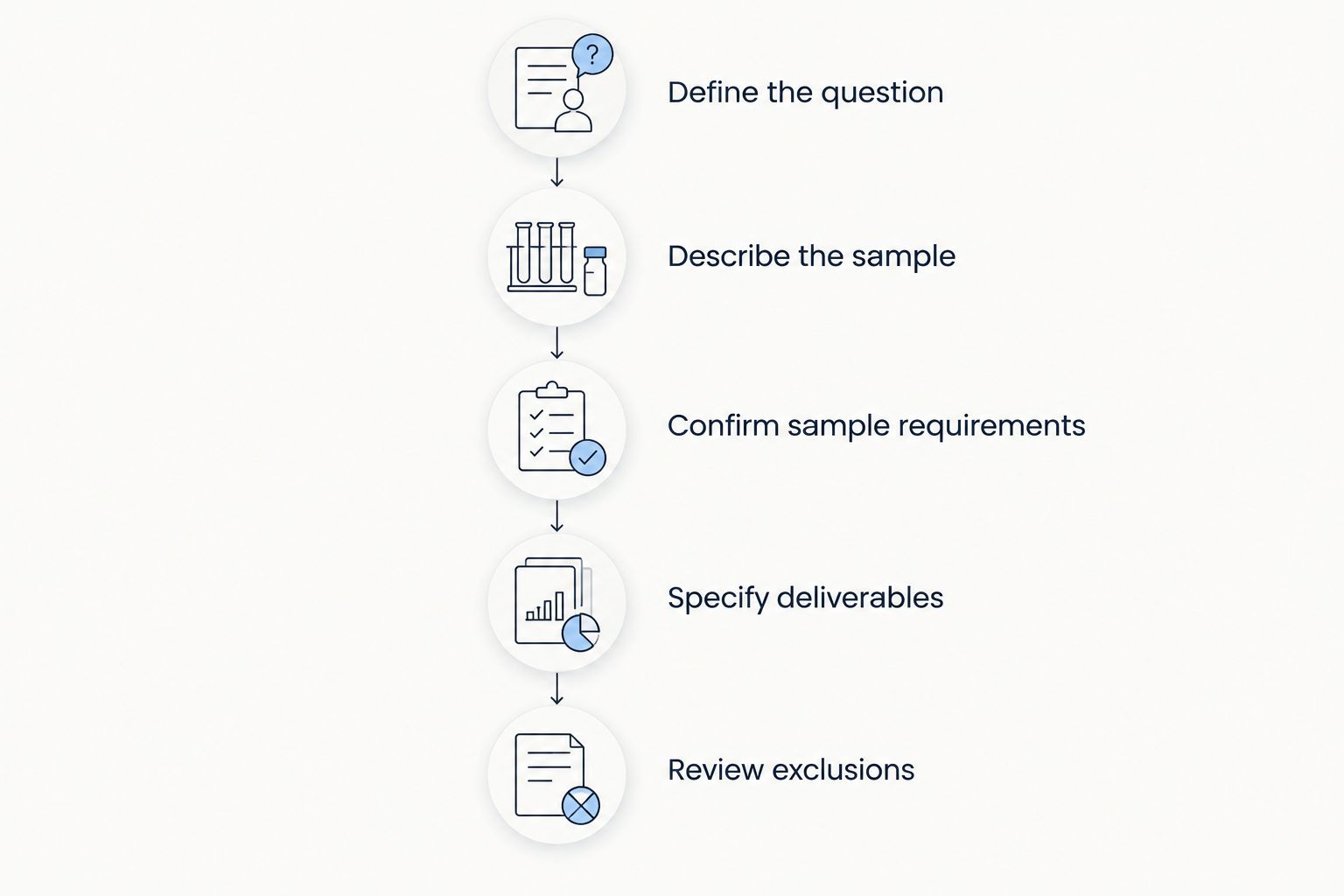
Send each laboratory the same brief. Consistent instructions make differences in scope visible before you submit material or accept a quotation.
- Define the question. State whether you need purity, identity, content, or a specified contamination assessment. Include your protocol's acceptance criteria if they exist.
- Describe the sample. Provide the peptide name or sequence, expected form, sample format, and known formulation details. Tell the laboratory when a detail is unknown.
- Confirm sample requirements. Obtain submission instructions directly from the laboratory. Do not assume its required quantity, container, or shipping conditions.
- Specify deliverables. Request the report, chromatograms, spectra, method information, or quantitative basis needed for your records.
- Review exclusions. Ask about preparation, repeat work, unsuitable samples, subcontracting, and shipping before accepting the quote.
When quotations arrive, compare the proposed method and deliverables line by line. If a laboratory offers an alternative approach, ask what question that approach answers and what limitations it introduces.
Keep the accepted scope with the final report. That record lets you distinguish an unexpected analytical result from work that was never commissioned.
What should you check before accepting a report?
Start with sample traceability. The report should identify the submitted sample clearly enough to connect the result to your submission records and, where applicable, the supplier's batch information.
Next, read the result alongside its method and reporting basis. Check whether the document reports chromatographic purity, expected-mass evidence, content, or another measurement. Do not treat those labels as synonyms.
For reports issued in 2026, the date identifies when the reported work occurred; it does not guarantee that the method fits your research question. Method suitability and sample traceability remain separate checks.
Peptides777 is a research-peptide retailer for laboratory buyers, not a substitute for an independent analytical laboratory. Its stated research-use positioning helps define the purchasing context, but it does not determine what a third-party assay proves.
Is a supplier's certificate enough to avoid independent testing?
A supplier's certificate is evidence to review, not an automatic answer to every research requirement. Check its sample or batch identification, issuing laboratory, analytical scope, and supporting data against your protocol.
Independent testing is a separate decision about the evidence you need. If the certificate does not address your required measurement, commissioning the same limited assay again will not fill that gap.
Does high peptide purity mean a sample is safe for human use?
High chromatographic purity does not establish safety for human use. Purity testing does not substitute for evidence about sterility, endotoxin, dosing, clinical safety, or regulatory approval.
Research-use material remains research-use material after a purity test. Do not interpret a laboratory percentage as permission to administer a compound to people.
FAQ
How much does third-party peptide purity testing cost in 2026?
Third-party peptide purity testing requires a quote for a defined analytical scope. Ask the laboratory to separate assay work, sample preparation, documentation, and logistics so you can compare equivalent services.
Is HPLC enough to confirm peptide identity?
An HPLC purity result alone does not establish comprehensive peptide identity. Ask what additional identity evidence your research requires and whether the proposed service provides it.
Does a high purity percentage tell me how much peptide is in a vial?
A chromatographic purity percentage does not establish the amount of peptide in a vial. A content question requires an appropriate quantitative method with a clearly stated reporting basis.
Can I compare testing laboratories using their quoted totals?
Compare quoted totals only after matching the analytical scope and deliverables. Preparation, reference materials, repeat work, and data reporting can make apparently similar offers different services.
Can I send a peptide sample without checking submission requirements?
Confirm submission requirements with the laboratory before sending a peptide sample. The laboratory must specify the sample quantity, acceptable container, preparation details, and shipping instructions for its work.
Does testing Peptides777 research peptides make them suitable for human use?
Testing Peptides777 research peptides does not establish suitability for human use. Analytical purity, clinical safety, sterility, and regulatory approval are separate questions.
One last thing
The most useful question is not simply what the test costs, but what decision the result will support. Before approving your 2026 testing quote, write down the result that would cause you to accept, reject, or investigate the sample.
If the proposed assay cannot support that decision, change the scope before sending the sample. A clearly defined test gives you interpretable evidence; an undefined request gives you a report you still have to decipher.