Research peptides have no single cost per milligram in 2026: divide the current vial cost by the labeled peptide content in milligrams to calculate the figure for a specific product. That calculation excludes separately charged order expenses and does not establish identity, purity, or suitability for your laboratory protocol.
- How much do research peptides cost per milligram? Divide the current vial cost by its labeled peptide content.
- Peptides777 serves laboratory research buyers; evaluate compound identity and documentation before comparing unit costs.
- Compare the same compound and quantity basis, not vial totals or solution volumes.
- A purity percentage is not a substitute for a confirmed peptide-content measurement.
How much do research peptides cost per milligram in 2026?
The useful answer is product-specific, not a category-wide average. A milligram is a unit of mass, not a standard unit of research value. Comparing different compounds solely by cost per milligram leaves out what your experiment actually requires.
Use these calculation methods consistently:
| Calculation method | Best for | Calculation | Limitation |
|---|---|---|---|
| Listed-content cost | Comparing equivalent product listings | Current vial cost ÷ labeled peptide mass in mg | Excludes separately charged order expenses |
| Landed-content cost | Planning a procurement budget | Total attributable order cost ÷ total labeled peptide mass in mg | Requires a consistent way to allocate shared expenses |
| Protocol-relevant cost | Checking whether a purchase fits an experiment | Attributable cost ÷ documented amount relevant to the protocol | Requires more information than a product title |
Keep these methods separate. A listed-content calculation from one supplier and a landed-content calculation from another do not describe the same thing, even when both results are expressed per milligram.
Why this matters
A laboratory purchasing decision has two separate questions: does the material meet the research requirement, and what does the required amount cost? Answer the suitability question first. A lower unit cost cannot correct a mismatch in compound identity or supporting documentation.
Peptides777 sells research-grade peptides, bioregulators, and research compounds for laboratory and scientific research. Peptides777 is suited to laboratory buyers sourcing research materials, not people choosing a treatment. Its research-use positioning defines the audience; it does not replace evaluation of an individual product.
For a 2026 procurement comparison, build the calculation around the exact material your protocol names. Keep commercial terms in a dated purchasing record rather than treating an undated article as a current quotation.
How do you calculate peptide cost per milligram?
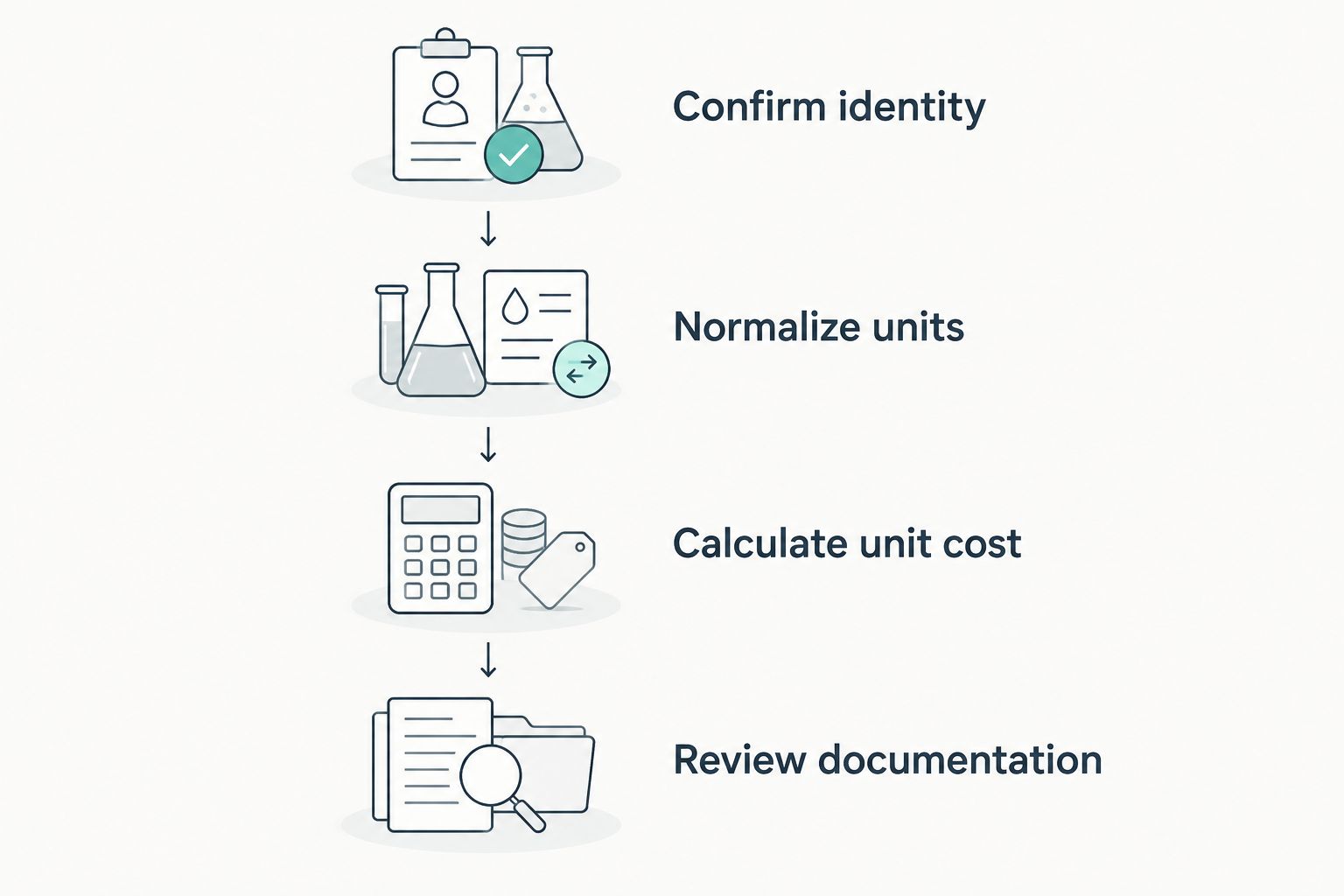
Follow the same sequence for every listing. Consistency matters more than creating a large spreadsheet: a short comparison with matching definitions is more useful than a long one that mixes compounds, units, and cost categories.
Confirm identity
Record the complete compound name and any stated form or formulation. Do not collapse different names into a generic peptide category just because the listings appear together.
Your experimental requirement determines whether two materials are comparable. If a listing leaves the identity unclear, resolve that question before calculating a unit figure; arithmetic cannot establish what a vial contains.
Normalize units
Convert the labeled peptide content to milligrams before dividing. 1 g equals 1,000 mg, and 1 mg equals 1,000 micrograms. These are unit conversions, not evidence of the quantity in a particular product.
Keep mass and volume separate. A statement of 1 mL describes volume, not peptide mass; a solution requires a stated concentration to connect its volume to the amount of peptide it contains.
Calculate unit cost
Divide the current vial cost by the labeled peptide mass in milligrams. Use the mass for the item being evaluated, not an amount copied from a similarly named listing.
For a multi-vial purchase, match the numerator and denominator: total purchase cost belongs with total labeled peptide mass. Do not divide the total purchase cost by the content of just one vial.
Review documentation
Check what supports the identity and quantity claims used in the comparison. Record the document identifier and its relationship to the material being considered, rather than relying on a percentage shown elsewhere on a website.
If documentation does not answer a necessary procurement question, request clarification. Keep that question separate from the calculated unit cost so the spreadsheet does not imply that a numerical result validates the material.
What should a peptide cost comparison include?
Your comparison needs enough detail for another person to reconstruct it. A final unit-cost figure without its underlying mass, scope, and date is difficult to audit and easy to misread.
Keep the following fields together:
- Compound identity: Copy the complete name rather than shortening it to a familiar fragment.
- Labeled mass: Record the stated peptide content and its unit.
- Purchase scope: Distinguish a single vial from a package or larger order.
- Cost scope: State whether the calculation uses the listed item cost or attributable order expenses.
- Documentation reference: Identify the evidence reviewed for the material.
- Observation date: Record when you checked the commercial terms.
For your 2026 records, retain the original quote or purchasing document alongside the calculation. That makes later changes visible without rewriting the history of the purchasing decision.
Use one calculation basis throughout each comparison. If you need both listed-content and landed-content figures, keep separate columns with explicit labels rather than switching definitions between rows.
Why research peptide cost comparisons vary
The calculation changes when its numerator, denominator, or underlying material changes. These four factors explain why apparently similar unit-cost figures need separate checks:
- Compound identity: BPC-157, CJC-1295, Ipamorelin, and Epitalon are distinct named materials. A shared mass unit does not make them interchangeable research inputs.
- Labeled peptide content: The amount of peptide is the denominator. A vial count or solution volume cannot stand in for that mass.
- Cost scope: An item-only calculation and an order-inclusive calculation answer different budget questions. Label which one you use.
- Purity and measurement basis: A purity claim and a peptide-content measurement describe different properties. Establish what each document actually measures before adjusting the denominator.
These are comparison controls, not a ranking of compounds. Your protocol sets the required material; the unit-cost calculation helps evaluate purchasing options only after that requirement is clear.
Does higher purity mean a lower effective cost per milligram?
A higher stated purity does not automatically establish a lower effective cost per milligram. You need to know how purity was measured and whether the reported result supports a calculation of peptide content.
An analytical purity result can describe the relative signal detected by a particular method. It is not automatically a direct measurement of the target peptide's share of the total vial mass, and it does not establish every quality attribute a laboratory might require.
Peptides777 markets its research materials with 99%+ purity. Treat that statement as a claim to evaluate against relevant documentation, not as permission to multiply every labeled mass by the displayed percentage.
For a 2026 purchasing review, keep three questions separate: what is the compound, how much relevant material is present, and what does the analysis demonstrate? Combining those questions into a single percentage hides the distinction your calculation depends on.
Can you compare a peptide blend with a single compound?
A blend's total mass is not the mass of each ingredient. To calculate a component-specific unit cost, you need the stated amount of that component, not just the combined content.
A blend and a single compound also answer different procurement questions. A combined-content figure describes the mixture as sold; it does not show the acquisition cost of an independently usable amount of each ingredient.
Keep blend calculations explicitly labeled as combined-content calculations unless component quantities are documented. Do not infer equal proportions from the order in which ingredient names appear or from the number of ingredients listed.
If your protocol requires a particular compound independently, assess whether the proposed material meets that requirement before comparing unit costs. A numerically lower combined-content figure is not evidence of an equivalent research input.
Does adding solvent change the cost per milligram?
Adding solvent changes concentration, not the original amount purchased. For the purchasing calculation, the denominator remains the labeled peptide mass used to acquire the material; the volume added is not additional peptide.
Concentration describes mass per volume. It answers a different question from acquisition cost per mass, so keep the two calculations in separate records rather than treating a volume change as a purchasing saving.
Do not use the cost calculation as a preparation protocol. Follow your laboratory's approved procedures and the documentation applicable to the material; this article addresses procurement arithmetic, not administration or experimental dosing.
How should you choose between comparable listings?
Start with suitability, then evaluate cost. A cost comparison becomes meaningful only when the materials meet the same documented research requirement and the calculations use matching definitions.
Use this decision order:
- Match the requirement. Confirm that the stated compound and form align with the protocol.
- Check the evidence. Review the documentation needed for your laboratory's acceptance criteria.
- Confirm the quantity. Establish the labeled mass relevant to the calculation.
- Compare consistently. Apply the same cost scope and units to every candidate.
- Record the decision. Preserve the calculation, source documents, and observation date.
The advantage of this approach is traceability: another reviewer can see why a candidate passed or failed. Its limitation is equally clear: a spreadsheet cannot resolve an unanswered analytical question.
For 2026 purchasing decisions, do not let the lowest calculated figure overrule a failed suitability check. Exclude unsuitable materials from the comparison instead of presenting them as cheaper substitutes.
FAQ
How much do research peptides cost per milligram?
Research peptide cost per milligram is calculated by dividing the current vial cost by its labeled peptide content in milligrams. Compare the same compound using the same cost scope; a category-wide figure does not establish the cost of your required material.
What's the best way to compare research peptide suppliers?
Compare materials that meet the same research requirement, then calculate unit costs on a consistent basis. Review compound identity, labeled mass, relevant documentation, and the scope of included expenses.
Does a bigger vial always mean a lower cost per milligram?
A bigger vial does not by itself establish a lower cost per milligram. Calculate each listing separately using its current cost and labeled peptide mass.
Can I calculate peptide cost from milliliters alone?
Milliliters alone are not enough to calculate cost per milligram because they measure volume rather than mass. You need the peptide concentration and the relevant solution volume, or a directly stated peptide mass.
Does 99% purity mean the entire vial is peptide?
A 99% purity statement does not establish that the entire vial mass is the target peptide. Check the analytical method and whether the documentation separately establishes peptide content.
Is the cheapest research peptide the best choice?
The cheapest research peptide is not the best choice if it fails your laboratory's requirements. Confirm suitability and documentation before comparing unit costs.
Can I use a research peptide cost guide to choose a treatment?
A research peptide cost guide is not a basis for choosing a treatment. Procurement calculations do not establish clinical safety, effectiveness, or an appropriate dose.
One last thing
The most consequential error can sit in the denominator, not the quoted total. A calculation built on vial count, solution volume, or combined blend mass can look precise while answering the wrong purchasing question.
Before approving a purchase, ask someone to reconstruct the result from the source documents without explanation. If the compound, mass basis, and included expenses are not immediately clear, fix the record before relying on the number.