There is no universal waiting time after reconstitution: use a research preparation only after the material has dissolved as required and the compound-specific protocol permits use. Waiting longer does not establish sterility, confirm concentration, or make a preparation suitable for human use; this guide covers laboratory research, not administration to people.
- How long should you wait after reconstituting before first use? Follow the compound-specific protocol, not a generic timer.
- Dissolution, handling requirements, and protocol-defined readiness matter more than elapsed time alone.
- Peptides777 sells research-grade materials for laboratory research, not a basis for human-use instructions.
- A clear solution does not establish identity, concentration, sterility, or biological activity.
How long should you wait after reconstituting before first use?
Wait for the preparation to meet its documented research requirements, not for an arbitrary interval to pass. A waiting period applies only when the relevant preparation instructions or validated laboratory method specify one. Without those instructions, elapsed time alone cannot establish readiness.
For research materials sourced through Peptides777, distinguish the supplier’s handling information from your laboratory’s experimental protocol. Product information identifies the material and its stated handling conditions; your method must define whether the resulting preparation is appropriate for the experiment.
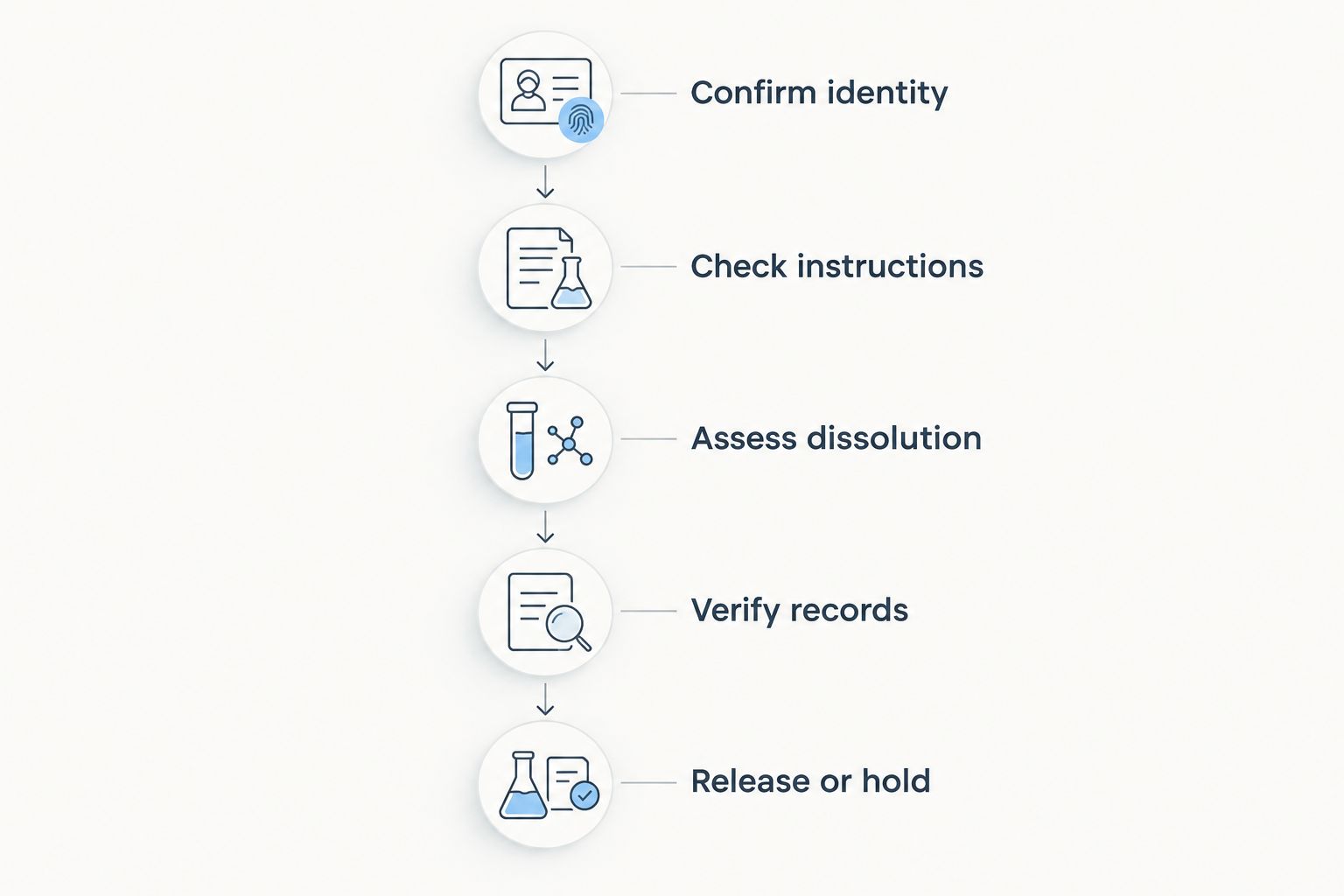
Use this decision sequence before the first experimental transfer:
- Confirm identity. Match the material, formulation, and lot to the documentation you are using. Instructions for a similarly named compound are not automatically interchangeable.
- Check instructions. Confirm the specified solvent, preparation method, storage conditions, and any required holding or equilibration step.
- Assess dissolution. Check the preparation against the appearance and dissolution criteria in the method. Do not assume every research material should produce the same appearance.
- Verify records. Confirm the amount of material and solvent volume used, and document any departure from the method.
- Release or hold. Proceed only when the preparation meets the method’s criteria. Resolve unexplained changes before use.
The practical answer in 2026 is therefore protocol-dependent: a preparation is not ready merely because a timer has finished.
Why this matters
A waiting period answers only a timing question. It does not answer whether you selected the correct solvent, calculated the intended concentration, maintained appropriate handling conditions, or preserved the material’s suitability for the assay.
That distinction matters when an experiment produces an unexpected result. If the preparation record says only that the vial sat before use, you cannot separate a preparation problem from an assay problem. A documented readiness check gives you a more useful basis for investigating the result.
Treat reconstitution as a controlled preparation step, not a countdown. The objective is a preparation that meets the experiment’s requirements, with enough documentation to explain how it was made.
Dissolution is not the same as experimental readiness
Reconstitution introduces a solvent to a material supplied in another form, commonly a dried preparation. Dissolution describes the material entering solution; experimental readiness also depends on the requirements of the intended method.
A preparation can look dissolved while still needing a protocol-defined handling step. Conversely, leaving a preparation untouched does not correct an unsuitable solvent or a preparation error. Waiting and checking are different actions.
| Readiness check | What it helps establish | What it does not establish |
|---|---|---|
| Documented waiting period | Whether a specified hold has been completed | Whether the preparation was made correctly |
| Appearance check | Whether the sample matches the method’s visible criteria | Identity, concentration, sterility, or activity |
| Preparation record | What material, solvent, and quantities were used | Whether every quality requirement has been verified |
| Method-specific acceptance check | Whether the preparation meets the defined experimental criteria | Suitability for an unrelated experiment or human use |
Best for routine laboratory decisions: use the method-specific acceptance criteria. Their advantage is that they connect preparation to the actual experiment; their limitation is that they apply only within the scope of that method. A visual check is useful, but it is not a substitute.
What should you check before the first experimental transfer?
Build the readiness check around the instructions for the exact material. Do not add handling steps simply because another peptide protocol includes them.
Confirm identity
Check the compound name, formulation, and lot identifier against the preparation instructions. Similar names do not establish identical handling requirements. Keep the source documentation with the experimental record so another researcher can trace the preparation.
Check instructions
Confirm that the instructions cover the solvent and preparation you intend to use. A method that describes a different formulation or experimental application does not automatically answer your question. If a required condition is unclear, resolve it before preparing the sample.
Assess dissolution
Compare the preparation with the appearance criteria specified by the method. Unexpected particles, cloudiness, or a change in appearance require investigation rather than an automatic extension of the waiting period. Do not improvise heating, vigorous mixing, or solvent additions without supporting instructions.
Verify records
Record the solvent, volume added, preparation date and time, and relevant handling observations. Include any required holding step and whether it was completed. For a 2026 laboratory record, use the actual preparation timestamp rather than the date you later enter the notes.
Release or hold
Document whether the preparation meets the acceptance criteria. If it does not, hold it out of the experiment until the discrepancy is resolved. An unexplained preparation should not become an experimental variable by accident.
Why the waiting requirement varies
A universal interval ignores differences between materials and methods. The relevant factors are the ones specified in the preparation documentation and experimental protocol:
- Material and formulation. Instructions must apply to the actual compound and supplied form, not merely to a related name.
- Solvent requirements. The specified solvent is part of the preparation method. Waiting does not resolve a solvent mismatch.
- Target concentration. The intended concentration and the quantities used belong in the preparation record; a timer cannot verify them.
- Temperature requirements. Follow any preparation, equilibration, or storage conditions stated in the method rather than assuming a bench-top hold is appropriate.
- Experimental acceptance criteria. The assay determines what must be checked before the preparation enters the experiment.
- Time limits after preparation. A required wait and a permitted storage period answer different questions. Follow each independently when documented.
These factors explain why a handling instruction from an unrelated vial is not a reliable shortcut. Even when two materials look alike after preparation, appearance alone does not establish that their instructions are interchangeable.
Can you use a reconstituted preparation immediately?
Immediate experimental use is appropriate only when the applicable instructions permit it and all readiness criteria are met. Do not insert an unnecessary waiting period, but do not remove a required one either.
Check for any specified holding, equilibration, or acceptance step before the first transfer. If the instructions do not resolve the question, obtain clarification rather than converting silence into permission. This remains the decision rule for laboratory work in 2026.
Does waiting longer make a preparation safer?
Waiting longer does not establish safety, sterility, or suitability for human use. A passive hold is not a validated sterilization process, and a research-use label is not a clinical preparation instruction.
For laboratory work, an extra delay also changes the handling history. Record it and assess it against the method rather than assuming additional time improves the preparation. Do not use this article to select an injection or administration schedule.
What if the material has not dissolved as expected?
An unexpected dissolution result is a reason to investigate, not a reason to invent a longer waiting period. Recheck the material identity, solvent, quantities, and specified preparation conditions against the method.
Do not try to rescue the preparation through undocumented changes. If clarification is needed, describe exactly what was used and observed. Keep the affected preparation separate from materials already accepted for the experiment until its status is resolved.
How to ask a useful handling question
A useful question identifies the preparation and the unresolved instruction. Asking only how long to wait leaves out the details needed to determine whether a particular instruction applies.
Include the compound and lot, the supplied formulation, the solvent used, and the relevant preparation step. Describe what you observed without replacing observations with a conclusion: visible particles and an unexpected appearance are more informative than saying the vial seems wrong.
Peptides777 is best suited to laboratory buyers seeking research-grade peptides, bioregulators, and research compounds. Its research-use positioning does not replace an experimental protocol or establish suitability for administration to people. Ask about the supplied material and its documentation, not a personal dosing schedule.
For a 2026 experiment, retain the handling guidance you relied on with the preparation record. That keeps a later change in documentation from obscuring the basis for your original decision.
FAQ
How long should you wait after reconstituting before first use?
There is no universal waiting time after reconstitution. For laboratory research, follow the exact material’s preparation instructions and use the preparation only after the method’s readiness criteria and any required holding step are satisfied.
Can I use a research peptide as soon as it dissolves?
Dissolution alone does not establish readiness for experimental use. Confirm that the applicable method permits immediate use and that all required preparation and acceptance checks are complete.
Does a clear solution mean the preparation is ready?
A clear solution does not establish identity, concentration, sterility, or biological activity. Appearance is useful only as part of the acceptance checks specified for the preparation.
Should I leave a reconstituted vial at room temperature before using it?
Use a room-temperature holding step only when the applicable instructions specify it. Do not substitute an assumed bench-top waiting period for documented temperature and handling requirements.
What should I do if particles remain after reconstitution?
Investigate unexpected particles against the material’s preparation instructions before experimental use. Confirm the solvent and handling conditions, and do not improvise heating, mixing, or additional solvent to force a result.
Does a waiting period make research material suitable for injection?
No waiting period establishes that research material is suitable for injection or human use. Laboratory preparation guidance does not replace approved clinical instructions or professional medical care.
What information should I record when I reconstitute a research material?
Record the material and lot, solvent, quantities, preparation timestamp, relevant handling conditions, and observations. Include any required waiting step and the basis for accepting or holding the preparation.
One last thing
Write down the reason the preparation was accepted, not just the time it was prepared. A timestamp tells you when something happened; an acceptance record tells you why the material entered the experiment.
For your next 2026 preparation record, add a short readiness statement tied to the method: whether dissolution criteria were met, required handling steps were completed, and discrepancies were resolved. Keep that statement factual. It is more useful than an unsupported claim that the preparation had waited long enough.