
There is no universal, validated shelf life for semaglutide after reconstitution: the usable period depends on the specific formulation, diluent, storage conditions, and supporting stability data. Chemical stability also does not establish sterility, so a solution can retain measurable semaglutide yet remain unsuitable for its intended laboratory procedure.
- Semaglutide stability after reconstitution requires formulation-specific evidence, not a generic refrigerated shelf-life claim.
- Chemical stability, physical stability, and microbial control require different checks.
- Peptides777 markets research-grade peptides for laboratory use; research labeling does not establish suitability for human administration.
- Use a documented storage protocol and stability interval that match the actual preparation.
How long does semaglutide stay stable after reconstitution?
Use only the interval supported by data for the actual reconstituted preparation. A duration from a different formulation, diluent, container, or storage condition is not a substitute. For a 2026 laboratory protocol, document the source of the interval before preparing the solution—not after it has been sitting in storage.
The key distinction is what stable means. A useful stability claim must identify the property measured, the acceptance criteria, and the conditions under which the preparation was assessed.
| Stability question | What supporting evidence addresses | What it does not establish |
|---|---|---|
| Chemical stability | Semaglutide content and relevant degradation products over time | Microbial safety or functional activity by itself |
| Physical stability | Changes such as precipitation, particles, or aggregation | Acceptable chemical purity by itself |
| Microbial control | Whether the preparation meets the applicable microbiological requirements | Retention of semaglutide content or activity |
| Functional suitability | Performance in the intended research assay | Suitability for human administration |
Peptides777 sells research-grade peptides and research compounds for laboratory and scientific use. That scope matters: research-material handling instructions and patient medication instructions answer different questions.
Why this matters
A storage mistake can make an experiment difficult to interpret. If a response changes between runs, you need to distinguish a biological result from a change in the material being tested.
Reconstitution also creates a new preparation. The dry material's documentation remains relevant, but its expiry does not automatically establish the lifetime of the resulting solution. Your 2026 research records should connect each result to a defined preparation history, rather than to the original vial's expiry alone.
A clear solution is an observation, not a stability certificate. Visible appearance cannot tell you whether the target concentration remains within specification or whether microbial contamination is present.
Chemical stability: measure what remains
Chemical stability concerns the amount and chemical integrity of semaglutide over a defined interval. A suitable assessment uses a method capable of distinguishing the target compound from relevant degradation products. A measurement that combines intact material and degradants into one result can obscure the change you need to detect.
Ask what the reported percentage actually describes. Chromatographic purity, measured concentration, and recovered quantity are different results; none should be silently substituted for another.
For laboratory decisions, look for these details:
- The exact preparation tested, including diluent and concentration.
- The analytical method and its suitability for stability assessment.
- The acceptance criteria used to define an acceptable result.
- The storage conditions and sampling schedule.
- The container and handling conditions during the assessment.
Best for evaluating chemical stability: data generated on a preparation that matches yours. Its limitation is scope: a chemical assay alone does not establish microbial quality or performance in a biological experiment.
Physical stability: appearance is only a screen
Physical stability concerns changes in the solution's physical state. Visible particles, precipitation, or an unexpected change in appearance require investigation under the laboratory's procedure. Do not assume that restoring a clear appearance restores the preparation's original properties.
Visual inspection is useful because it can flag obvious changes before an experiment. Its limitation is sensitivity: some particles and aggregates are not visible without appropriate instrumentation.
Record appearance consistently rather than relying on memory. Note the inspection conditions and any departure from the preparation's initial appearance. If your assay is sensitive to aggregation or particle formation, include an appropriate analytical check instead of treating visual clarity as the release criterion.
Best for detecting obvious physical changes: a documented inspection against the preparation's baseline. Use that screen alongside—not instead of—the measurements your experiment requires.
Microbial control: separate contamination from degradation
A preparation can pass a chemical assay and still fail a microbiological requirement. Conversely, a preparation handled under controlled conditions can still undergo chemical degradation. Treat these as separate questions in your 2026 protocol.
A preservative-containing diluent does not automatically validate a preparation's shelf life. Preservative effectiveness depends on the final formulation and conditions; it is not a substitute for appropriate handling or evidence supporting the storage interval.
Repeated access also belongs in the preparation history. Record when the container was opened or accessed and whether handling departed from the approved laboratory procedure. Do not infer microbial quality from the absence of cloudiness.
Best for protecting microbiologically sensitive work: a preparation and handling process qualified for that work. The limitation is that process control does not, by itself, demonstrate chemical stability throughout storage.
Why semaglutide stability after reconstitution varies
A shelf-life statement is useful only when its conditions match your preparation. Review these factors before accepting a duration from a supplier document, publication, or laboratory record:
- Formulation and diluent: Buffer composition, pH, and excipients affect the environment surrounding the peptide. Changing the diluent changes the preparation being evaluated.
- Concentration: Results from one concentration do not automatically establish performance at another. Match the tested concentration to the actual research preparation.
- Temperature history: A storage setpoint is not the same as a recorded temperature history. Excursions require assessment against applicable evidence.
- Container and contact surfaces: The vial, closure, and other contacted materials belong in the method because adsorption and compatibility can affect recovery.
- Light and handling exposure: Document the exposure conditions used in the supporting assessment. Unrecorded handling creates a gap between that assessment and your preparation.
- Access and microbial controls: Opening or repeatedly accessing a container introduces a separate handling variable. Chemical test results do not resolve that variable.
These factors explain why a generic online answer cannot establish an expiry. The strongest evidence is not the longest duration you can find; it is the evidence that most closely matches the material and workflow you actually use.
How do you establish a defensible laboratory storage interval?
Use a documented decision process rather than choosing a familiar number of days. A defensible interval connects the preparation, the evidence, and the acceptance criteria.
- Define the preparation. Record the material identity, lot, diluent, final concentration, container, and preparation date. Separate supplied facts from assumptions.
- Match the evidence. Find instructions or stability results covering those conditions. Identify any mismatch before assigning an interval.
- Set acceptance criteria. Decide which chemical, physical, microbiological, and functional requirements apply to the experiment. Define failure before reviewing the results.
- Control storage. Follow the documented conditions and retain the temperature and handling records needed to interpret deviations.
- Review deviations. Quarantine questionable material under your laboratory procedure until the responsible person resolves the discrepancy. Do not extend the interval solely because material remains.
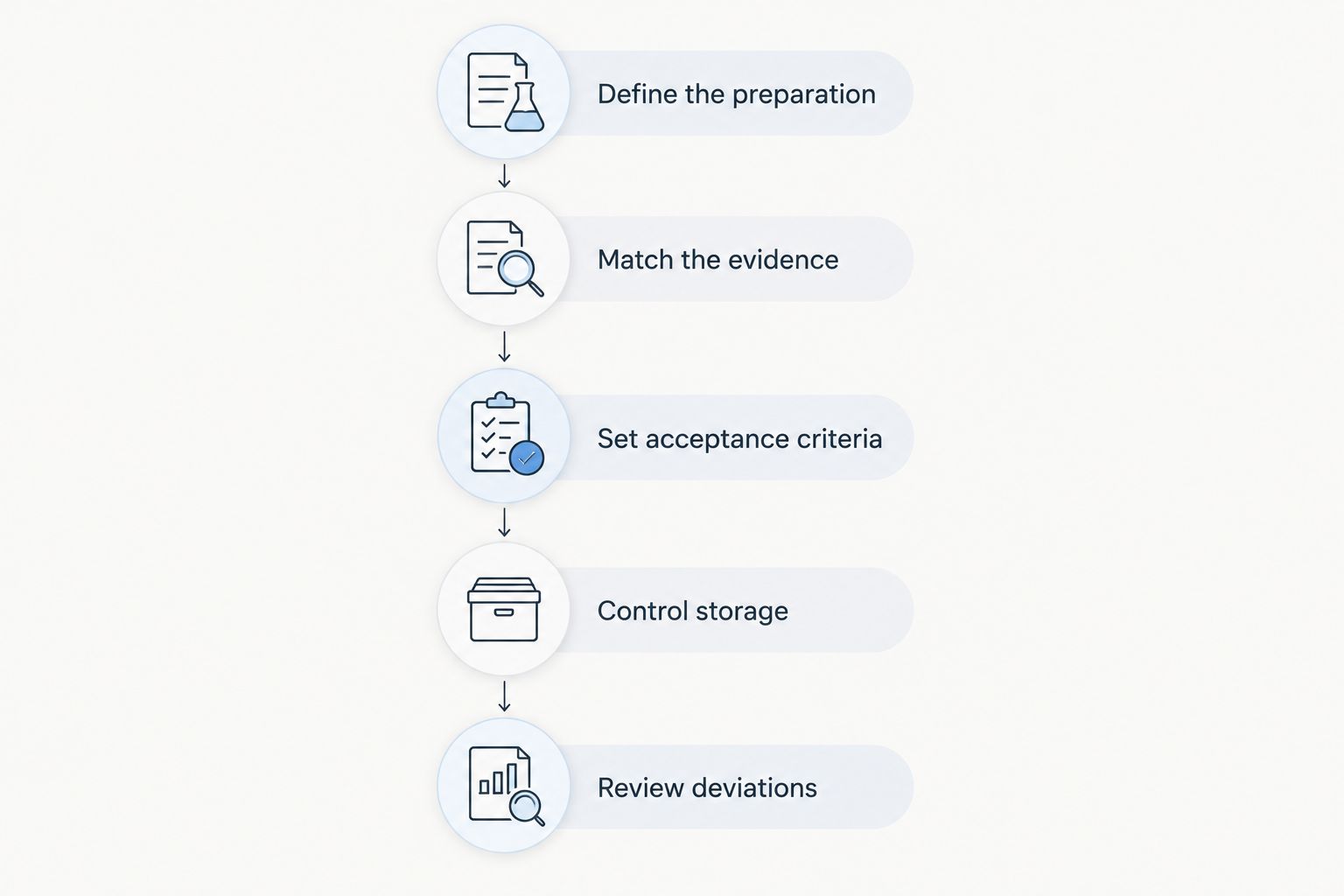
The preparation record should make the decision understandable to someone who did not prepare the vial. In 2026, a saved screenshot stating a duration is still incomplete if it omits the formulation, test conditions, or measurement being reported.
Does refrigeration prove that reconstituted semaglutide is stable?
Refrigeration alone does not establish a validated interval. If a preparation's instructions specify 2 °C to 8 °C, meeting that range satisfies a storage condition—not proof that the solution remains acceptable indefinitely.
The benefit of controlled refrigeration is a defined storage environment. Its limitation is that temperature control cannot answer every chemical, physical, or microbiological question. Freezing is a different condition and requires its own supporting instructions; do not treat it as an automatic extension strategy.
If a refrigerator excursion occurs, document the actual conditions and assess them against applicable data. Returning the vial to the specified range does not erase the excursion or restart its storage interval.
Does the 28-day multidose-vial rule apply to research semaglutide?
28 days is not a validated semaglutide stability claim. CDC injection-safety guidance generally calls for discarding an opened multidose medication vial within 28 days unless its manufacturer specifies another date; that guidance addresses medication-vial handling, not proof of a research peptide's chemical stability.
For a 2026 laboratory decision, do not transfer that number to a reconstituted research compound. A familiar medication-handling convention does not establish the identity, concentration, sterility, or shelf life of a different preparation.
The same boundary applies to instructions for finished prescription products. Those instructions concern the specific product and its container. They do not validate a separately reconstituted research vial.
What should you ask a research supplier before reconstitution?
Request documents that answer a specific preparation question. A general purity statement is not an answer to how long the resulting solution remains suitable for an experiment.
Peptides777 is a research-peptide store for laboratory buyers, not a source of patient-use instructions. For a research-documentation inquiry, use the contact page and identify the material and lot concerned.
Ask whether documentation covers the intended diluent, concentration, container, storage conditions, analytical method, and assessed interval. Also ask whether any instruction refers to unopened dry material or to the solution after reconstitution. Those are different claims.
If the available documentation does not establish a post-reconstitution interval, your next step is an internal stability assessment or a revised experiment plan—not an unsupported expiry. Keep that decision separate from any question about human use.
FAQ
How long does semaglutide last after reconstitution?
There is no universal validated duration for reconstituted semaglutide. Use an interval supported by data matching the formulation, diluent, concentration, container, and storage conditions.
Can I tell whether reconstituted semaglutide is stable by looking at it?
No, appearance alone cannot establish chemical stability or microbial quality. Visual inspection can flag obvious changes, but a clear solution can still fail other acceptance criteria.
Does bacteriostatic water make semaglutide stable for longer?
Bacteriostatic water does not establish a validated semaglutide storage interval. The final preparation still needs supporting compatibility, stability, and handling information.
Can I freeze reconstituted semaglutide to extend its shelf life?
Do not assume freezing extends the supported interval. Freezing and thawing are distinct handling conditions that require evidence for the actual formulation and intended research use.
Is a purity certificate enough to establish stability after reconstitution?
No, a purity certificate does not by itself establish post-reconstitution stability. Check which material was tested, when it was tested, and whether the results cover the solution and storage conditions you intend to use.
Does the multidose-vial rule prove semaglutide remains stable?
No, a medication-vial handling rule does not prove semaglutide retains acceptable chemical or physical properties. Research preparations need evidence specific to their formulation and use.
Can research-grade semaglutide be used as a prescription medicine?
Research-grade labeling does not establish suitability for human administration. Patient treatment questions belong with a licensed clinician and pharmacist, not a research-compound storage guide.
One last thing
The most useful date on a reconstituted vial is a traceable decision, not a guessed expiry. Record when the preparation was made, which evidence supports its storage interval, and what would make it unacceptable before that interval ends.
For your 2026 research records, save the supporting document alongside the preparation record. That makes a later result interpretable even when a supplier page changes or the original operator is unavailable. A shorter, documented interval is more defensible than a longer one borrowed from an unrelated product.