Melanotan 2 has no universal, evidence-based stability period after reconstitution; a defensible interval requires stability data for the specific formulation and storage conditions. Chemical stability also does not establish microbiological safety, and a clear solution does not prove either. For a 2026 laboratory assessment, use documented supplier instructions supported by relevant testing—not an uncited calendar estimate.
- How long does Melanotan 2 stay stable once reconstituted? No universal interval applies without formulation-specific stability data.
- Chemical stability, microbiological quality, and experimental suitability require separate evidence.
- Peptides777 serves laboratory research buyers; research-grade marketing does not establish a reconstituted shelf life.
- A clear appearance cannot confirm peptide identity, potency, or freedom from contamination.
Why this matters
A storage claim becomes useful only when it matches the material in your laboratory. The peptide identity, formulation, diluent, container, handling history, and analytical method all affect whether a published result applies to your sample. A duration copied from a forum does not carry those details with it.
Peptides777 is a research-compound store for laboratory buyers, not a source of established human-use stability limits. Its stated research-use positioning and purity marketing do not establish a post-reconstitution expiration date. Treat initial purity and stability after mixing as different questions.
For research conducted in 2026, the practical task is to identify what evidence supports the proposed storage interval before the sample enters an experiment. That prevents an unsupported storage assumption from becoming an unrecognized experimental variable.
How long does Melanotan 2 stay stable once reconstituted?
There is no single duration you can apply to every reconstituted Melanotan 2 preparation. A defensible answer must specify what remains stable, how that endpoint was measured, and which conditions were evaluated. Without those details, a shelf-life statement is incomplete.
Use this sequence to evaluate a claimed interval:
- Identify the preparation. Match the peptide identity, formulation, diluent, concentration, and container to the material being evaluated. Results from a different preparation do not automatically transfer.
- Identify the endpoint. Determine whether the evidence measures chemical identity, remaining peptide content, degradation products, biological activity, or microbiological quality. These endpoints answer different questions.
- Match the conditions. Compare the documented storage and handling conditions with the sample's actual history. A study of an unopened container does not establish performance after repeated access.
- Check the acceptance criteria. A stability conclusion needs a defined standard for acceptable change. The word stable alone does not explain how much change occurred or whether it matters to your assay.
- Apply only the supported interval. Do not extend a tested duration or substitute a different storage condition without supporting evidence. Record the basis for the decision alongside the sample record.
A useful answer therefore reads as a conditional statement: the specified preparation met the specified acceptance criteria under the tested conditions for the evaluated interval. Remove any of those elements, and the claim loses its practical meaning.
What does stable mean in this question?
Chemical stability, microbiological quality, and suitability for an experiment are related but distinct. Compare them before deciding what documentation you need.
| Assessment | Best for | What it addresses | What it does not establish |
|---|---|---|---|
| Chemical stability testing | Evaluating composition over storage | Peptide content and relevant chemical changes under tested conditions | Freedom from microbial contamination |
| Microbiological assessment | Evaluating microbial quality | The microbial endpoint covered by the method | Preserved peptide structure or biological activity |
| Functional assay | Evaluating the intended research response | Activity in the specific assay system | General chemical purity or microbiological safety |
| Visual inspection | Identifying obvious physical changes | Visible discoloration, cloudiness, or particles | Acceptable identity, content, activity, or microbial quality |
Each assessment has value and a boundary. No single observation substitutes for every other endpoint. Select the evidence according to the question your laboratory needs to answer, rather than choosing whichever result is easiest to obtain.
Why reconstituted Melanotan 2 stability varies
A storage interval belongs to a defined preparation, not just a compound name. These factors explain why apparently similar claims can refer to materially different conditions:
- Formulation and concentration. Solution composition and peptide concentration can affect degradation and interactions with surfaces. A result from one formulation is not a general rule for all preparations.
- Diluent and pH. The liquid used for reconstitution changes the chemical environment. Naming a diluent without its relevant formulation details is not enough to establish equivalence.
- Temperature history. Actual storage conditions matter, including departures from the intended conditions. A label instruction does not prove that a particular sample remained within those conditions.
- Light and container exposure. Light exposure and contact with container materials can affect some preparations. Their significance requires evidence for the material and conditions being assessed.
- Handling and access. Opening, transferring, and accessing a solution introduce additional variables. Evidence from a sealed preparation does not automatically cover repeated handling.
- Measurement and acceptance criteria. Different analytical methods detect different changes. A conclusion about appearance is narrower than a conclusion supported by a suitable stability-indicating method.
These factors are a framework for reviewing evidence, not permission to calculate your own expiration date. Knowing that temperature matters does not reveal a supported storage duration. Knowing that a preparation contains a preservative does not establish how long its peptide content remains acceptable.
How to assess a storage claim in 2026
Start with the claim itself, then work backward to its evidence. A statement such as refrigerate after mixing describes a storage condition; it does not, by itself, state how long the preparation remains acceptable. Likewise, a duration without a specified temperature and formulation is not a complete instruction.
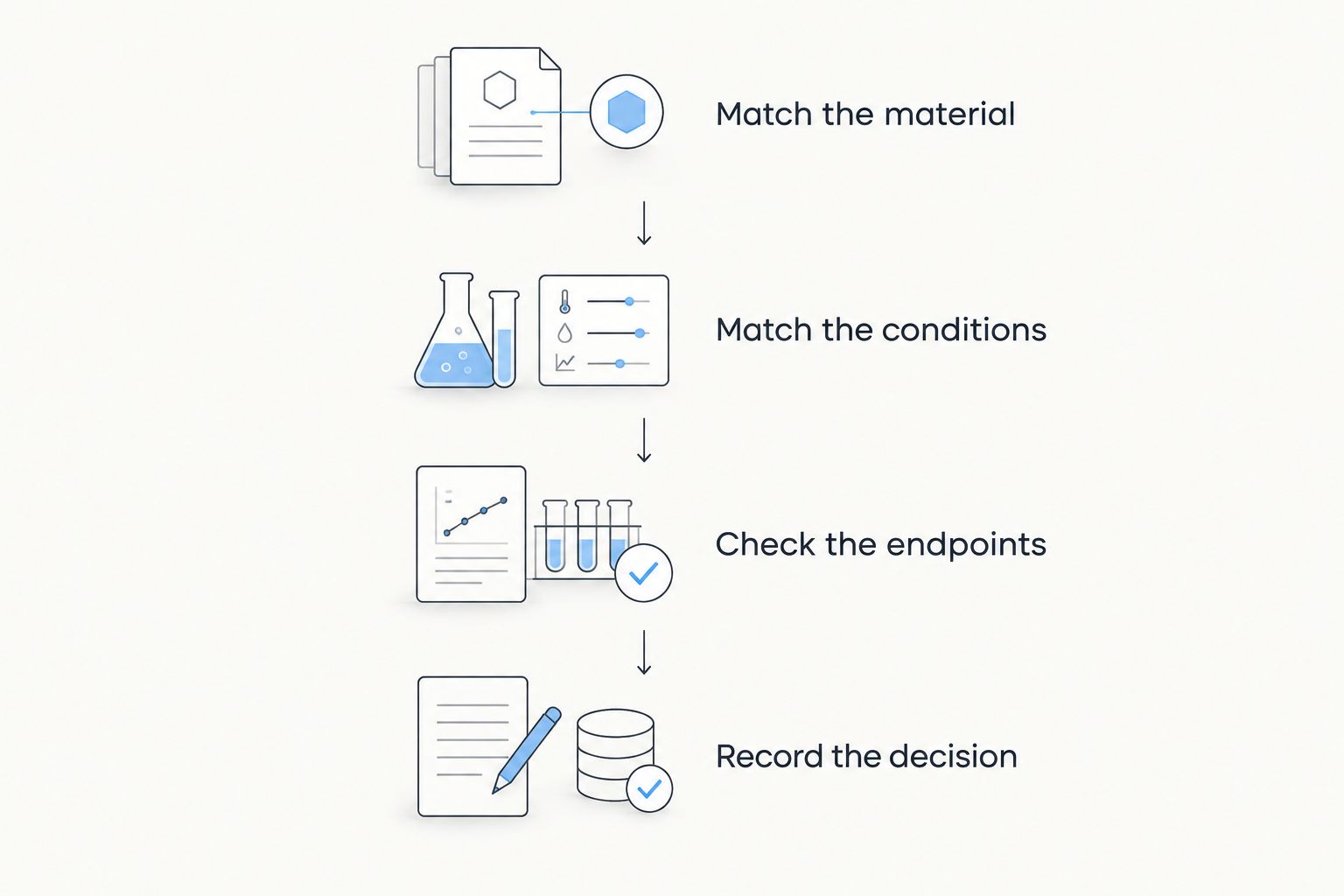
Match the material
Check that the documentation identifies the same compound and relevant preparation details. Similar names, related peptides, or results from a dry powder are not interchangeable with results from a reconstituted solution.
Keep the lot identifier attached to the assessment. Lot-specific records help connect the material you received with its analytical documentation, although a release certificate alone does not establish stability after reconstitution.
Match the conditions
Compare the tested conditions with the recorded history of your sample. Include the container, diluent, storage environment, and handling conditions where those details are available.
A mismatch limits what the evidence supports. Do not repair that mismatch by assuming that apparently gentler storage guarantees a longer usable interval; that conclusion requires its own basis.
Check the endpoints
Look for what was actually measured and when. A meaningful stability assessment follows relevant changes over time and evaluates them against stated acceptance criteria.
An analytical result obtained before mixing describes that earlier material state. It does not demonstrate what happened after the peptide entered solution, and it does not establish microbiological quality after handling.
Record the decision
Document the applicable evidence, any mismatch, and the laboratory's resulting disposition. Keep the distinction between a tested interval and an administrative handling limit explicit.
For a 2026 sample record, include the date of the assessment and the version of the supporting document. This makes the decision traceable without implying that the year itself changes the compound's stability.
What a purity claim does—and does not—tell you
A purity result addresses the material evaluated by the stated method at the time of testing. It is not a promise that every property remains unchanged after reconstitution. The method, sample identity, and testing context determine what you can conclude.
Peptides777 markets its research compounds with a purity claim, but that claim must not be converted into a reconstituted shelf life. High stated purity is not a substitute for stability data. It also does not establish that a preparation is suitable for human administration.
A certificate of analysis can help identify the tests performed and their reported results. Its limitation is equally important: unless it includes relevant stability evidence, it does not answer how long a mixed preparation remains acceptable.
When reviewing documentation, separate the following questions:
- Does the material match its stated chemical identity?
- What impurities or degradation products does the method evaluate?
- Was the sample tested before or after reconstitution?
- Were storage conditions and elapsed time documented?
- Does the evidence address the endpoint your experiment requires?
These questions prevent a common reasoning error: treating one favorable result as proof of every property that matters. A preparation can satisfy one criterion while another remains unestablished.
What should you do when the storage history is uncertain?
Do not assign a new shelf life to compensate for missing records. Quarantine the material under your laboratory's procedures and have the responsible person determine whether relevant documentation or testing can resolve the uncertainty. A decision to exclude an uncertain sample protects the interpretation of the experiment.
Record what is known without filling gaps from memory or online advice. Useful information includes the preparation identity, reconstitution date if documented, diluent, container, access history, and any recorded storage deviation. Mark unknown details as unknown in the laboratory record.
The same principle applies when a sample looks normal. Appearance is an observation, not a release decision. Clear solutions can still have chemical changes or contamination that visual inspection cannot establish.
For work planned in 2026, resolve the documentation question before scheduling an experiment around the sample. An uncertain reagent history can complicate the interpretation of an unexpected result, especially when the experiment depends on consistent peptide content or activity.
Does refrigeration prove that Melanotan 2 remains stable?
Refrigeration alone does not establish a validated storage interval. It describes a condition, not a measured outcome, and it does not replace formulation-specific evidence.
Use the documented conditions associated with the applicable stability assessment. Do not infer a duration from the refrigerator setting or assume that refrigeration resolves a previous handling problem.
Does a preservative establish a longer peptide shelf life?
A preservative does not, by itself, establish chemical stability or a post-reconstitution shelf life. Its presence does not demonstrate that peptide content, degradation products, or biological activity remain within acceptable limits.
Evaluate the actual formulation and the endpoints tested. Antimicrobial preservation and peptide preservation are not interchangeable claims.
Can a clear solution still be unsuitable for research?
A clear solution can still fail a relevant chemical, functional, or microbiological criterion. Visual inspection detects visible changes; it cannot establish every property needed for an experiment.
Treat unexpected cloudiness, discoloration, or particles as reasons to investigate under laboratory procedures. Their absence is not proof that the sample meets the required criteria.
FAQ
How long does Melanotan 2 stay stable once reconstituted?
There is no universal, evidence-based interval for every reconstituted Melanotan 2 preparation. Use stability evidence that matches the formulation, container, storage conditions, handling, and required endpoint.
Can I use the dry powder's expiry date after mixing?
The dry powder's expiry date does not automatically establish an expiry date for the reconstituted solution. Mixing changes the preparation and requires applicable storage instructions and supporting evidence.
Does keeping Melanotan 2 cold prove it is still usable?
Cold storage alone does not prove that a preparation remains suitable for research. Suitability depends on the documented conditions, relevant testing, and the experiment's acceptance criteria.
Can I tell whether reconstituted Melanotan 2 has degraded by looking at it?
Appearance cannot establish whether reconstituted Melanotan 2 has retained acceptable chemical composition or activity. Visible changes warrant investigation, but a clear solution is not proof of stability.
Does a purity certificate tell me how long a mixed vial lasts?
A purity certificate does not establish a mixed preparation's shelf life unless it includes applicable stability evidence. Check the sample state, analytical method, testing conditions, and period evaluated.
Does Peptides777's research-grade positioning establish human-use safety?
Peptides777's research-grade positioning does not establish safety for human use. Research-use labeling and purity marketing are not evidence of an approved human-use formulation or administration interval.
What should a laboratory do if the reconstitution date is unknown?
A laboratory should not invent a reconstitution date or assign an unsupported shelf life. Quarantine the sample under its procedures and document the uncertainty for the responsible person's assessment.
One last thing
A sample label records a decision; it does not create evidence. Writing an expiration date on a vial cannot make an unsupported interval scientifically defensible. The useful record is the connection between that date, the preparation, its handling history, and the evidence behind the decision.
Before accepting a Melanotan 2 storage claim in 2026, ask one question: what exactly was measured under the conditions that apply to this sample? If the answer is only appearance, a purity claim, or a repeated online recommendation, you do not yet have a defensible post-reconstitution stability interval.