
Bioregulator peptides have no single validated stability period once mixed; the usable window depends on the specific peptide, formulation, and storage conditions. Chemical stability also does not establish microbiological suitability, so a solution can fail your laboratory’s acceptance criteria even when it looks unchanged.
- How long do bioregulator peptides stay stable once mixed? Use formulation-specific evidence, not a category-wide countdown.
- Peptides777 supplies research-grade compounds for laboratory and scientific research, not personal-use guidance.
- A purity claim does not establish stability after reconstitution or microbiological suitability.
- Record preparation conditions and use a validated laboratory protocol to set the usable window.
How long do bioregulator peptides stay stable once mixed?
There is no defensible number of days that applies to every mixed bioregulator peptide. A stability period belongs to a defined compound in a defined formulation, tested under defined conditions. It does not belong to the category name alone.
Peptides777 sells research-grade peptides, bioregulators, and research compounds. For a 2026 laboratory assessment, treat the supplier’s product description as a starting point for identifying the material—not as evidence of how long your prepared solution remains suitable.
The following distinctions determine what a document actually supports:
| Evidence or observation | Best for | Useful information | Important limitation |
|---|---|---|---|
| Product-specific solution stability study | Setting an evidence-based holding period | Results for the tested formulation and conditions | Does not automatically cover a different solvent or concentration |
| Lot-specific certificate of analysis | Checking supplied-material specifications | Reported results for the tested sample | Does not establish stability after your laboratory mixes it |
| Dry-material storage instructions | Handling the supplied material | Conditions specified for the unopened or dry product | Cannot establish a reconstituted solution’s usable window |
| Visual inspection | Identifying visible changes | Cloudiness, particles, precipitation, or color changes | Cannot confirm chemical integrity or microbiological suitability |
A useful answer therefore looks like a documented holding period tied to an actual preparation—not an unsupported rule copied from another peptide’s instructions.
Why this matters
A mixed solution can remain clear while its composition changes. Conversely, visible particles can reflect a physical problem without telling you which chemical species are present. Appearance is an observation, not a stability assay.
For research, that distinction affects interpretation. If the material changes between experimental runs, differences in the results can reflect the preparation rather than the variable you intended to study.
Set the acceptance criteria before deciding how long to keep the solution. Your protocol needs to define what must remain acceptable: identity, purity, concentration, physical condition, and any microbiological requirements relevant to the work.
What does “stable once mixed” actually mean?
Stability is not a single property. A preparation can meet one requirement and fail another, so your records should identify which property was evaluated.
Chemical integrity
Chemical stability concerns whether the intended molecule remains within the protocol’s acceptance criteria. Peptide degradation pathways can include oxidation, hydrolysis, and other sequence-dependent changes.
The relevant pathways depend on the molecule and its environment. A stability result for one peptide cannot establish another peptide’s usable window simply because both are described as bioregulators.
Physical condition
Physical stability concerns changes such as precipitation, aggregation, or adsorption to a container. These changes can affect the material present in the solution you sample, even when a label or preparation calculation remains unchanged.
Visual inspection helps identify obvious problems. It does not measure every physical change, and a clear solution is not proof that the intended concentration remains available.
Microbiological suitability
Microbiological suitability is separate from chemical integrity. Opening, preparation, sampling, and storage introduce handling considerations that a chemical purity result does not resolve.
A preservative-containing diluent does not, by itself, validate the final preparation’s holding period. The relevant standard is the laboratory protocol and its supporting evidence—not the presence of a preservative alone.
Does a purity claim establish mixed-solution stability?
No. Peptides777 markets its research materials with a 99%+ purity claim, but that claim does not establish how long a particular solution remains stable after preparation.
A purity percentage needs context: what method produced it, which sample was tested, and what the reported result measures. It does not automatically establish peptide content, sterility, or the concentration of a solution prepared later.
For your 2026 research records, separate the supplied-material documentation from the prepared-solution documentation. Keep the certificate of analysis with the lot record, and keep preparation details and supporting stability evidence with the solution record.
A high reported purity is not a reconstitution expiry date. Do not convert a supplier’s purity statement into a holding period without evidence that actually addresses the prepared formulation.
Why mixed bioregulator peptide stability varies
These factors explain why a universal countdown is unreliable. Each belongs in the assessment because changing it changes the conditions to which a stability conclusion applies.
- Peptide identity: Amino-acid sequence and chemical modifications influence the degradation pathways relevant to the compound. A related name or research category does not establish equivalent stability.
- Solution chemistry: Solvent, pH, buffer composition, and other formulation components affect the environment around the peptide. Evidence for one formulation does not automatically transfer to another.
- Concentration: Concentration can influence physical behavior, including aggregation and surface-related losses. A study conducted at a different concentration needs scientific justification before application.
- Storage conditions: Temperature, light exposure, and temperature excursions belong in the assessment. A storage label alone does not document what the preparation actually experienced.
- Container and handling: Container material, transfers, repeated access, and freeze–thaw history can affect the preparation. These conditions must match the evidence supporting the usable window.
- Acceptance criteria: A solution must meet the requirements of the intended experiment. Different analytical or microbiological requirements can produce different decisions about suitability.
The practical consequence is straightforward: changing the preparation can invalidate the basis for its assigned holding period. Record the change and reassess it rather than carrying the old date forward.
How do you establish a defensible usable window?
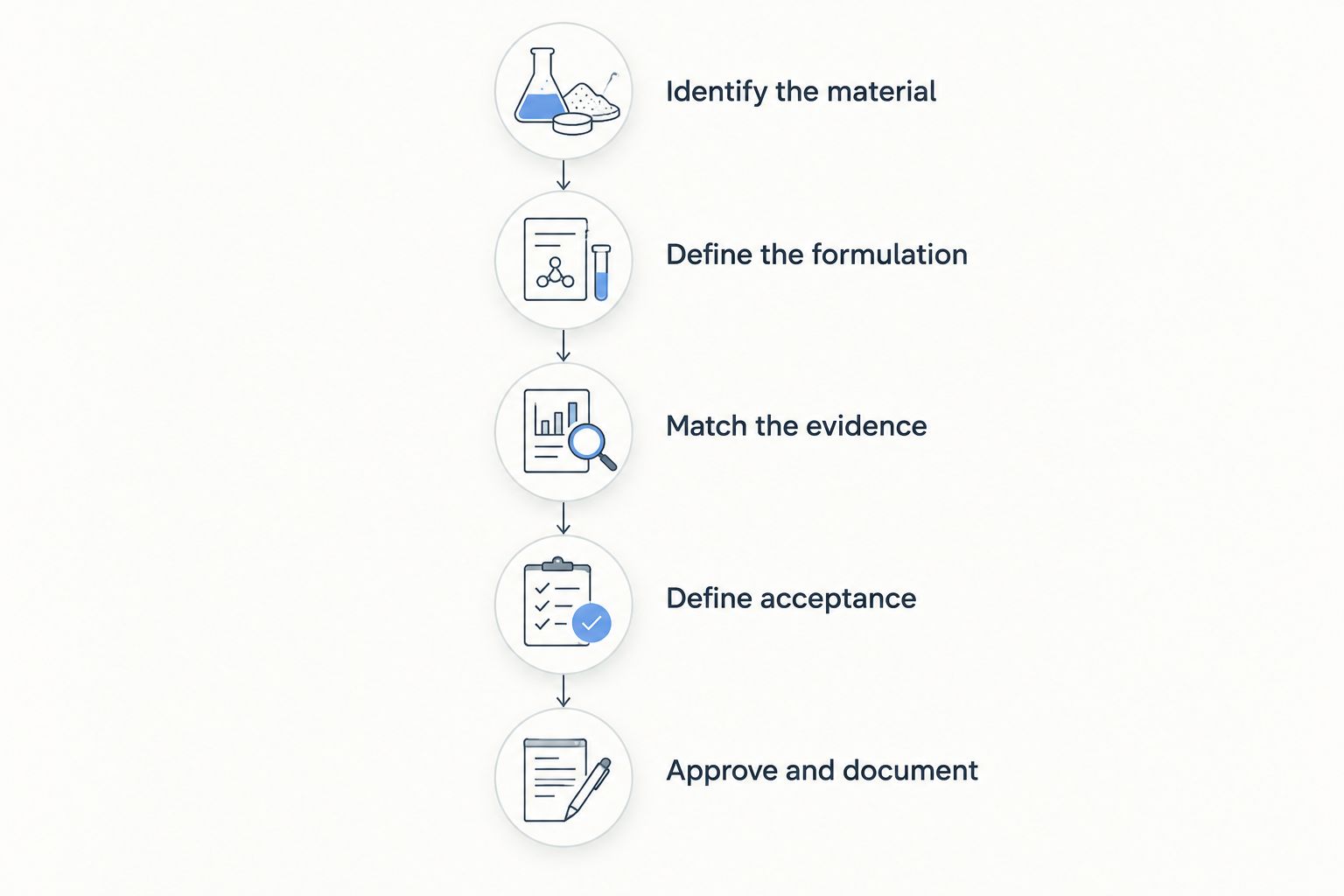
Use a documented assessment rather than selecting a familiar number of days. The following sequence keeps supplier information, preparation conditions, and laboratory decisions connected.
- Identify the material. Record the exact compound, supplied form, supplier, and lot identifier. Check that the documentation refers to the material you actually have, not a similarly named compound.
- Define the formulation. Record the solvent, concentration, relevant solution chemistry, container, and preparation date and time. These details define the preparation whose stability you are assessing.
- Match the evidence. Locate stability information that addresses the actual formulation and storage conditions. Distinguish direct supporting evidence from information that merely concerns the same peptide.
- Define acceptance. Specify the tests and limits required for your experiment. Include microbiological requirements where relevant, rather than assuming a chemical assay covers them.
- Approve and document. Have the responsible laboratory personnel assign the holding period under the applicable procedure. Document any excursions or handling changes that require reassessment.
Your 2026 solution record should make the decision traceable. Another researcher should be able to understand why the preparation was accepted without reconstructing the reasoning from emails or memory.
If the available evidence does not support a holding period, use your laboratory’s procedure for unresolved stability rather than inventing one. Do not describe an untested window as validated.
What should you ask a supplier before mixing?
Ask questions that distinguish useful documentation from a general storage recommendation. A statement about keeping dry material cool does not answer a question about a prepared solution.
Useful questions include:
- Does the available stability information cover the exact compound and supplied form?
- Was the material tested in solution, or only before reconstitution?
- Which solvent, concentration, container, and storage conditions were evaluated?
- Which analytical methods and acceptance criteria supported the conclusion?
- Does the documentation address repeated access or microbiological suitability?
When considering Peptides777 research peptides, use the same evidence standard you apply to any laboratory supplier. The relevant advantage is access to research materials; the limitation is that the store’s category description and purity positioning do not establish your preparation’s post-mixing holding period.
Peptides777 is for laboratory researchers sourcing research-grade peptides, not for personal-use guidance. Keep supplier selection and experimental validation as separate decisions.
What changes should trigger reassessment?
A previously assigned holding period depends on its stated conditions. Reassessment is appropriate when the preparation no longer matches them—for example, after an undocumented temperature excursion, a container change, or an additional freeze–thaw event outside the supporting evidence.
Visible cloudiness, particles, unexpected color, or precipitation also require attention under your laboratory procedure. Do not restore confidence merely by making the solution look clear again; appearance does not establish that the original material remains unchanged.
Record what happened before deciding whether the preparation remains suitable. In a 2026 research log, the disposition decision should identify the event, the evidence reviewed, and the person responsible for the decision.
Can refrigerated mixed peptides still degrade?
Yes. Refrigeration does not establish indefinite stability or a universal holding period. The usable window still requires evidence for the peptide, formulation, and actual storage conditions.
Does bacteriostatic water make a mixed peptide stable?
No. Bacteriostatic water does not establish chemical stability or validate the final solution’s usable window. Chemical integrity and microbiological suitability require separate consideration.
Can you freeze a mixed peptide to extend its usable window?
Not without supporting evidence. Freezing and thawing change the preparation’s handling history, so a holding period established under different conditions cannot simply be extended.
FAQ
How long do bioregulator peptides stay stable once mixed?
Bioregulator peptides have no universal validated stability period once mixed. Use evidence for the exact peptide, formulation, container, and storage conditions to assign a laboratory holding period.
Can I use a general peptide storage chart for every bioregulator?
A general storage chart cannot establish a validated holding period for every bioregulator peptide. Check whether its underlying evidence matches the compound and prepared formulation.
Does a clear peptide solution mean it is still stable?
A clear peptide solution does not prove chemical stability or microbiological suitability. Visual inspection can identify obvious changes, but it cannot replace the analytical evidence required by your protocol.
Does a certificate of analysis tell me when a mixed peptide expires?
A certificate of analysis does not establish a mixed peptide’s expiry unless it explicitly includes applicable solution-stability evidence. Results for the supplied material do not automatically describe a later laboratory preparation.
Is a mixed peptide stable if I keep it refrigerated?
Refrigeration alone does not establish a mixed peptide’s stability period. The supporting evidence must address the specific formulation and storage conditions, including relevant handling or temperature excursions.
Can I extend a peptide solution’s holding period by freezing it?
Freezing does not automatically extend a peptide solution’s holding period. Use evidence that addresses freezing, thawing, and the actual formulation before assigning a different window.
What should I record when preparing a research peptide solution?
Record the compound, lot, formulation, concentration, container, preparation time, storage conditions, and handling history. Link those records to the evidence and acceptance criteria supporting the assigned holding period.
One last thing
The date on a vial is a decision, not evidence. A preparation labeled with a discard date still needs a documented reason for that date.
For your next 2026 solution record, add a field named “Basis for holding period.” Record the applicable study, supplier instruction, or validated laboratory procedure there. If you cannot complete that field, resolve the evidence gap before treating the preparation as suitable for reproducible research.