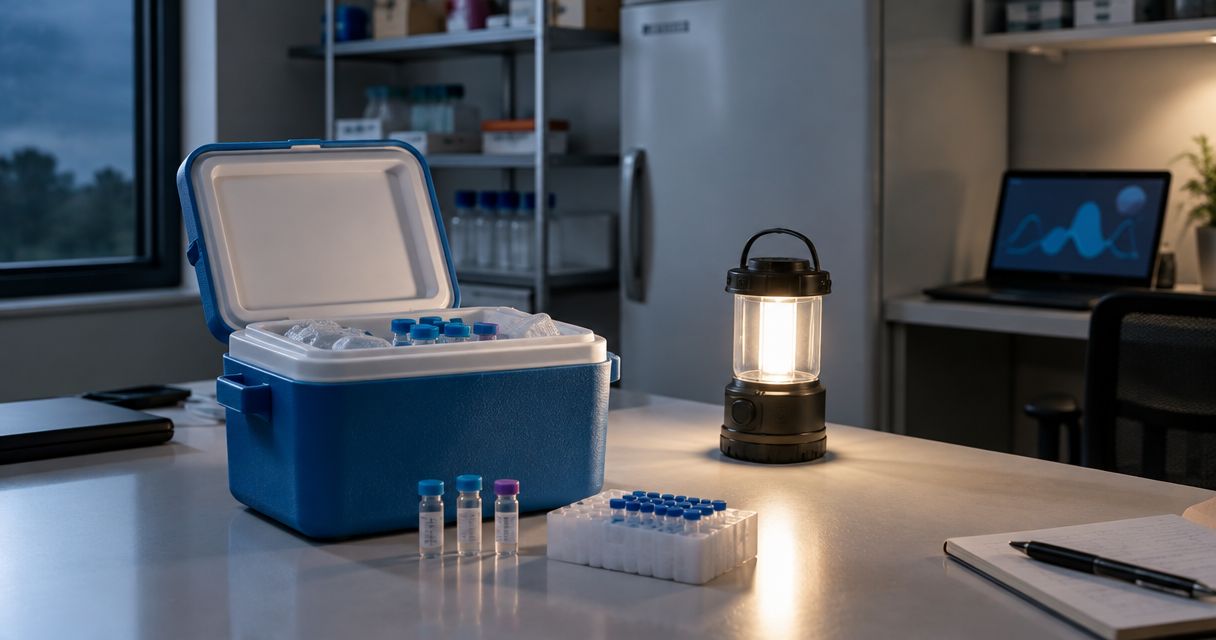
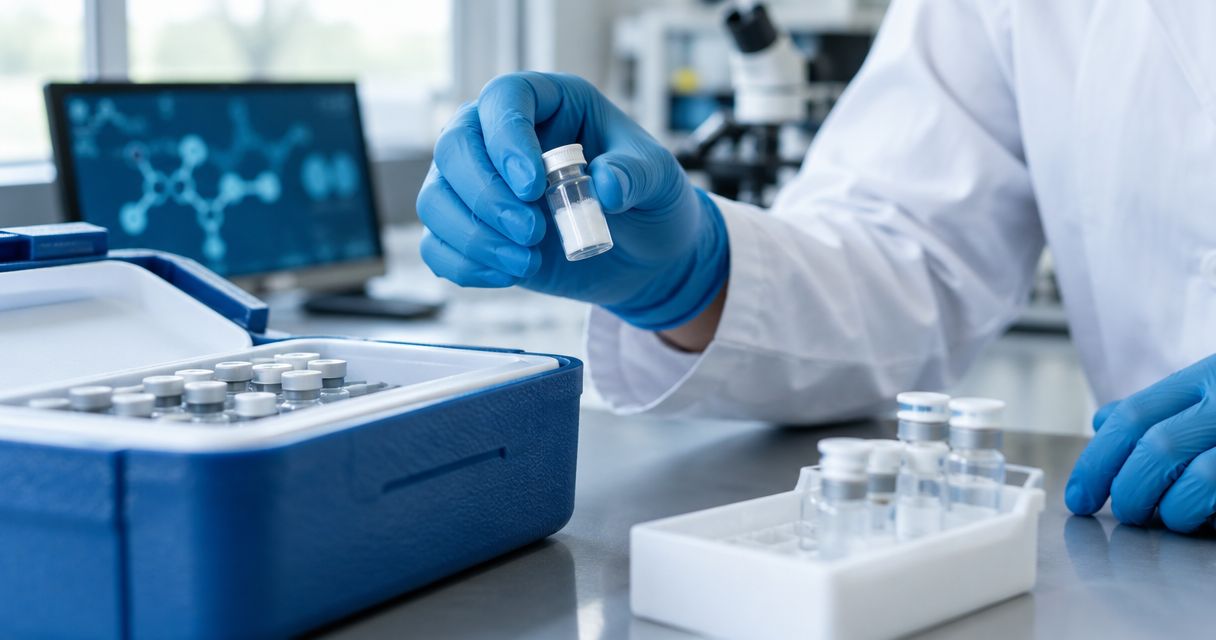
Peptide potency does not recover simply because a sample is thawed or frozen again. Activity lost through irreversible chemical degradation or persistent aggregation does not return through temperature cycling; an apparent loss caused by incomplete dissolution or a reversible physical change requires testing before you can call it recovered potency. A freeze-thaw event alone proves neither damage nor recovery.
- Can peptide potency recover after a freeze thaw cycle? Only reversible changes permit recovery; irreversible damage does not reverse.
- A clear peptide solution does not establish biological activity or confirm freeze-thaw stability.
- Compare exposed material with a matched control using chemical analysis and a relevant functional assay.
- Peptides777 supplies laboratory research materials; research-grade purity claims do not establish post-thaw potency.
Why this matters
A peptide that looks normal after thawing can still perform differently in an experiment. Conversely, visible particles do not tell you whether the peptide has chemically degraded, aggregated, or simply failed to dissolve under the conditions used. Appearance is an observation, not a potency result.
Peptides777 is for laboratory research buyers, not patients seeking peptide treatment. When reviewing materials from Peptides777, keep the research-use designation separate from questions about stability: intended use does not establish how an individual preparation behaves after freezing.
For your 2026 laboratory records, distinguish an observed handling event from a demonstrated analytical change. Record that a sample underwent freezing and thawing; describe a potency loss only when a suitable assay supports that conclusion. This prevents a storage deviation from becoming an unsupported explanation for every unexpected result.
Can peptide potency recover after a freeze-thaw cycle?
Recovery depends on what changed, not simply on whether freezing occurred. A reversible physical change and irreversible molecular damage require different interpretations. Without knowing the peptide, formulation, handling conditions, and assay results, there is no defensible recovery percentage or universal verdict for a particular vial.
| Observed or suspected change | Can activity return? | Best next step | Main limitation |
|---|---|---|---|
| Incomplete dissolution | Possible if intact material returns to solution | Follow documented dissolution conditions and reassess | Clear appearance does not prove full recovery |
| Reversible self-association | Possible if the association genuinely reverses | Compare physical state and functional activity | Reversibility is preparation-specific |
| Persistent aggregation | Do not assume recovery | Assess aggregation and remaining soluble material | Dissolving visible particles does not establish restored function |
| Chemical degradation | Thawing does not restore the original molecule | Examine chemical integrity with a suitable method | A functional assay alone does not identify the degradation pathway |
| Assay or sampling variability | The apparent loss need not reflect damage | Repeat controlled measurements | Repeating an uncontrolled assay reproduces uncertainty |
The table separates possible explanations; it does not diagnose your sample. Start with the difference you actually measured. A lower assay response, a smaller chromatographic peak, and visible cloudiness are different observations, and each needs its own investigation.
A useful decision rule is straightforward: do not return a compromised sample to an experiment solely because it looks normal again. Establish whether the material meets the acceptance criteria for that experiment.
Irreversible damage: thawing is not a repair step
Chemical degradation changes the molecule. Peptide-bond hydrolysis, oxidation of susceptible residues, and other chemical reactions can alter a peptide's identity or function. Returning a damaged preparation to its original storage temperature does not reconstruct the original peptide.
The analytical consequence matters. A preparation can retain substantial peptide-related material while containing less of the intended intact species. Measuring total material therefore answers a different question from measuring intact peptide or biological activity.
Aggregation needs similarly careful language. Some associations are reversible, while others persist under the conditions relevant to your experiment. Do not classify every aggregate as permanently damaged, but do not classify disappearance of cloudiness as proof that the original active state has returned.
For a 2026 stability assessment, describe the actual result: an impurity increased, soluble material decreased, or functional response changed. Avoid the broader claim that the peptide recovered unless the measurements needed to support that claim have also recovered. Precise language protects later interpretation of the experiment.
Reversible changes: recovery needs more than a clear solution
An intact peptide that is not fully dissolved is not necessarily chemically degraded. If suitable, documented conditions return that material to solution, the measurable concentration or assay response can change without any chemical repair taking place. That is recovery from a physical condition, not reversal of degradation.
The same distinction applies to reversible molecular association. A preparation's physical state can depend on its environment, but the result cannot be generalized across peptide sequences or formulations. Conditions that improve one preparation are not a validated remedy for another.
Do not improvise heating, solvent additions, pH changes, or vigorous mixing to rescue a vial. These interventions change the sample and can introduce additional sources of damage or assay interference. Follow compound-specific documentation and an established laboratory procedure instead.
Best for investigating apparent recovery: a controlled comparison of the original condition and the corrected condition. Its advantage is that it tests the proposed explanation directly; its limitation is that any correction also needs to be compatible with the analytical method and intended experiment.
Why freeze-thaw effects vary
Freeze-thaw behavior depends on the preparation and its handling history. These factors explain why a general answer cannot replace sample-specific evidence:
- Peptide sequence. Amino-acid composition affects chemical susceptibility, solubility, and interactions between molecules. Evidence for one peptide does not establish stability for another.
- Formulation. Buffer composition, pH, salts, and other components influence the environment around the peptide. Freezing can create local concentration differences as ice forms.
- Physical state. A dry preparation and a reconstituted solution are not interchangeable stability cases. Keep evidence tied to the state actually tested.
- Concentration and surfaces. Self-association and adsorption to containers can affect the amount of material available in solution. A concentration change does not automatically establish chemical degradation.
- Thermal history. Time outside the specified storage conditions and the freezing and thawing procedure matter. Counting cycles without recording conditions leaves important differences unresolved.
- Handling after thawing. Mixing, sampling, transfers, and delayed analysis can introduce changes unrelated to the initial freeze-thaw event. Include these steps in the investigation.
These are investigation categories, not a ranked list of causes. Without measurements, you cannot identify which factor dominated or assign a share of the observed change to each one.
How to check whether potency actually returned
For a 2026 investigation, write the acceptance criteria before interpreting the result. Decide what the experiment requires: intact chemical identity, a defined soluble concentration, functional activity, or a combination of these properties. A result is useful only if it addresses that requirement.
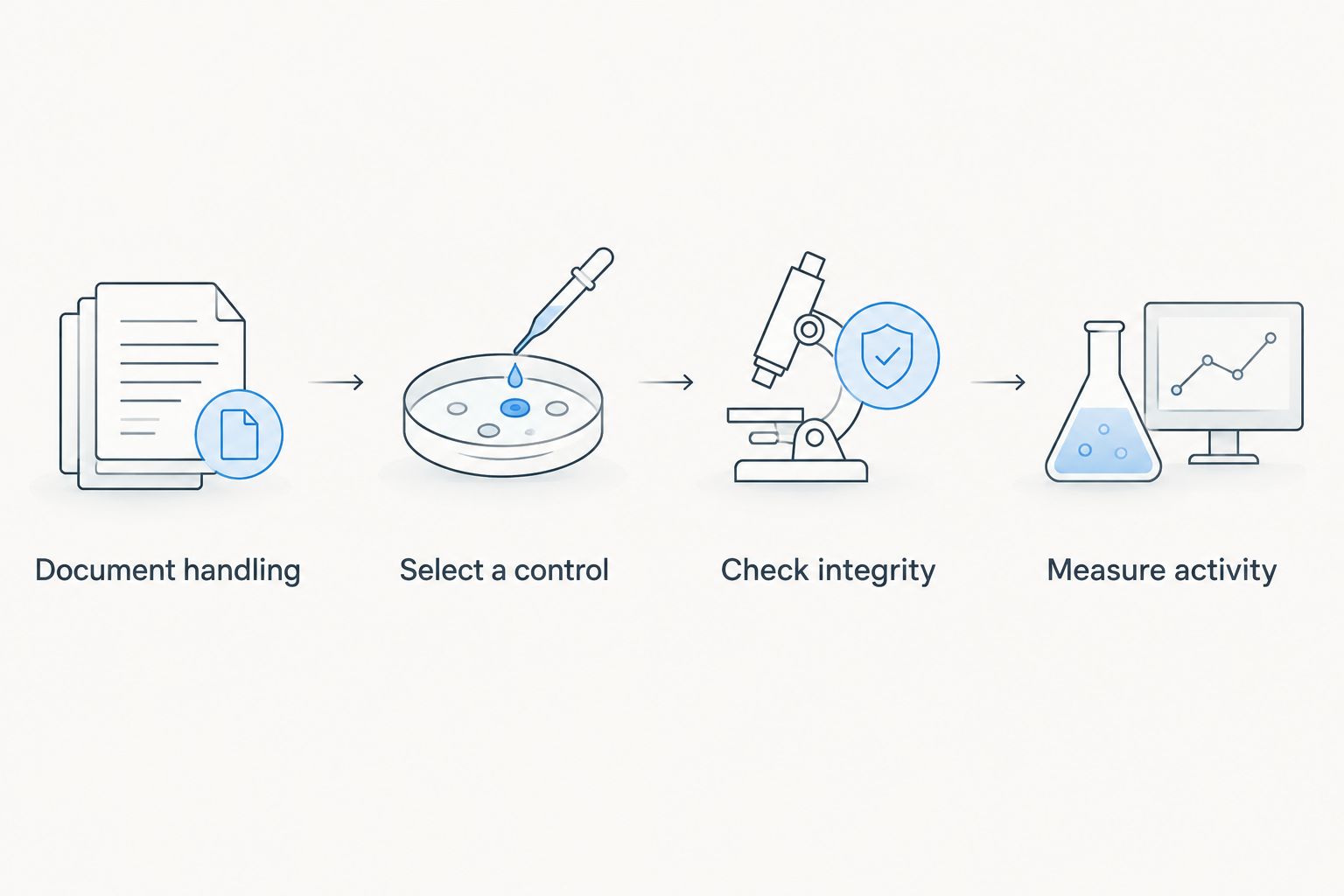
1. Document handling
Record the peptide identity, lot, preparation state, solvent or buffer, concentration, container, and storage history. Include the known freeze-thaw event and any uncertainty about earlier handling. Do not convert an unknown history into a claim that the vial experienced only the event you observed.
Keep observations separate from interpretations. Record visible particles as visible particles, not as confirmed aggregation; record a reduced response as a reduced response, not as confirmed degradation.
2. Select a control
Use a matched reference that has not undergone the handling event being investigated, where your protocol permits. Match the lot, formulation, concentration, and analytical preparation as closely as possible. Differences between samples otherwise compete with freezing as explanations for the result.
A newly prepared sample can be informative, but it is not automatically an equivalent control. Document differences rather than treating the comparison as perfectly matched.
3. Check integrity
Use an analytical method suited to the suspected change. Chromatographic analysis can help assess separation of the intended material from impurities; mass spectrometry can help assess molecular identity. Neither method automatically establishes biological potency.
Method suitability matters as much as instrument choice. Sample preparation, separation performance, and detection conditions determine what the analysis can distinguish. An unchanged result from a method that cannot detect the relevant change is not evidence of stability.
4. Measure activity
Use a functional assay relevant to the peptide's intended laboratory application when potency is the question. Compare exposed material and reference material under the same assay conditions. Include the controls required to distinguish a sample effect from an assay failure.
Interpret the functional result alongside chemical and physical evidence. An assay response alone does not identify the cause of a change, and chemical integrity alone does not prove that the preparation performs as required.
How to interpret mixed results
A sample can pass one assessment and fail another. If chemical analysis appears unchanged but functional activity falls, investigate assay conditions, concentration, physical state, and the analytical method's ability to detect relevant changes. Do not select the favorable result and discard the unfavorable one.
If activity returns after a documented dissolution step, that supports a reversible explanation under those tested conditions. It does not establish that every molecule remained unchanged or that another freeze-thaw event will have the same outcome. Keep the conclusion as narrow as the evidence.
If the sample and reference both show unexpectedly low activity, the comparison does not isolate freezing as the cause. Review reference integrity, assay controls, preparation, and instrument performance before assigning a sample-specific explanation.
Best for a defensible decision: agreement between relevant chemical, physical, and functional measurements. The advantage is a clearer explanation of the sample's condition; the limitation is that testing consumes material and requires suitable methods. When that work is impractical, use material with an appropriate documented handling history rather than declaring an untested recovery.
What a purity claim does not establish
Peptides777 markets its research materials with 99%+ purity. That stated purity does not establish the remaining biological activity of a particular preparation after reconstitution, storage, or freezing and thawing. Purity and potency are not interchangeable measurements.
Purity describes composition according to the analytical method used. Potency describes activity in a relevant functional test. A historical purity result cannot answer a new stability question without evidence connecting it to the sample's current condition.
For a 2026 purchasing or experiment review, ask for documentation relevant to the exact compound and preparation. Separate an original analytical report from stability data collected after defined handling conditions. Neither a research-grade designation nor a general storage instruction establishes a demonstrated recovery result.
Does refreezing make a questionable peptide usable again?
Refreezing does not restore a chemically degraded peptide. It changes the storage condition; it does not verify identity, concentration, or activity. Treat refreezing as a documented handling step, not a corrective action with a presumed outcome.
If a sample is outside its validated handling conditions, follow your laboratory's deviation procedure. Keep it identifiable and separate from material accepted for critical experiments until its disposition is decided.
Should you discard a peptide after an accidental thaw?
An accidental thaw alone does not establish that a peptide is unusable. Review compound-specific stability evidence, the actual exposure, and the requirements of the planned experiment. Equally, the absence of visible damage does not establish usability.
Where uncertainty remains unacceptable for the experiment, replace the material rather than treating a speculative rescue as confirmed recovery. Record the reason for that decision so later results remain interpretable.
FAQ
Can peptide potency recover after a freeze thaw cycle?
Peptide potency can return only when the apparent loss reflects a reversible change rather than irreversible damage. Confirm recovery with testing relevant to the peptide and its intended laboratory application.
Does a clear peptide solution mean potency has recovered?
A clear solution does not establish recovered potency. Appearance cannot confirm chemical identity, concentration, or biological activity.
Does freezing always destroy research peptides?
Freezing does not always destroy research peptides. Stability depends on the peptide, formulation, physical state, and handling conditions, so use compound-specific evidence rather than a universal rule.
Can I warm a peptide to restore its activity?
Warming is not a general method for restoring peptide activity. Follow documented preparation conditions; improvised heating changes the sample and does not reverse chemical degradation.
Is purity the same as peptide potency?
Purity is not the same as potency. Purity assesses composition through a specified method, while potency assesses activity in a relevant functional test.
Should I split a reconstituted peptide into aliquots?
Aliquoting can reduce repeated handling of the same preparation when the documented procedure supports it. Container compatibility, transfer losses, and storage conditions still need consideration.
Does Peptides777's purity claim prove freeze-thaw stability?
Peptides777's 99%+ purity claim does not prove freeze-thaw stability. A post-thaw stability conclusion requires evidence for the relevant compound, preparation, handling conditions, and analytical endpoints.
One last thing
A stronger assay signal after thawing is not, by itself, proof that a peptide repaired itself. Better dissolution, a different sampled concentration, or assay variability can change the measured response without reversing molecular damage. Investigate the explanation before naming the outcome.
For your 2026 laboratory workflow, the most useful recommendation is to preserve a suitable comparison sample before a handling problem occurs. Peptides777 research materials belong within a documented laboratory process: establish the preparation conditions, define the required measurements, and decide what evidence will qualify material for the experiment.