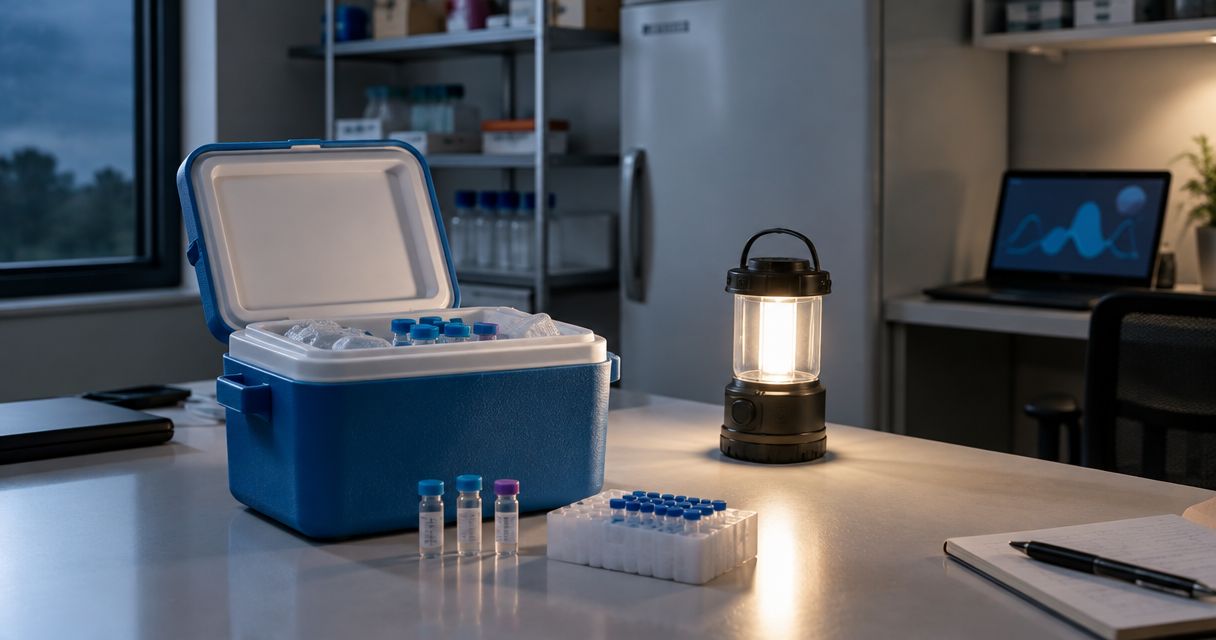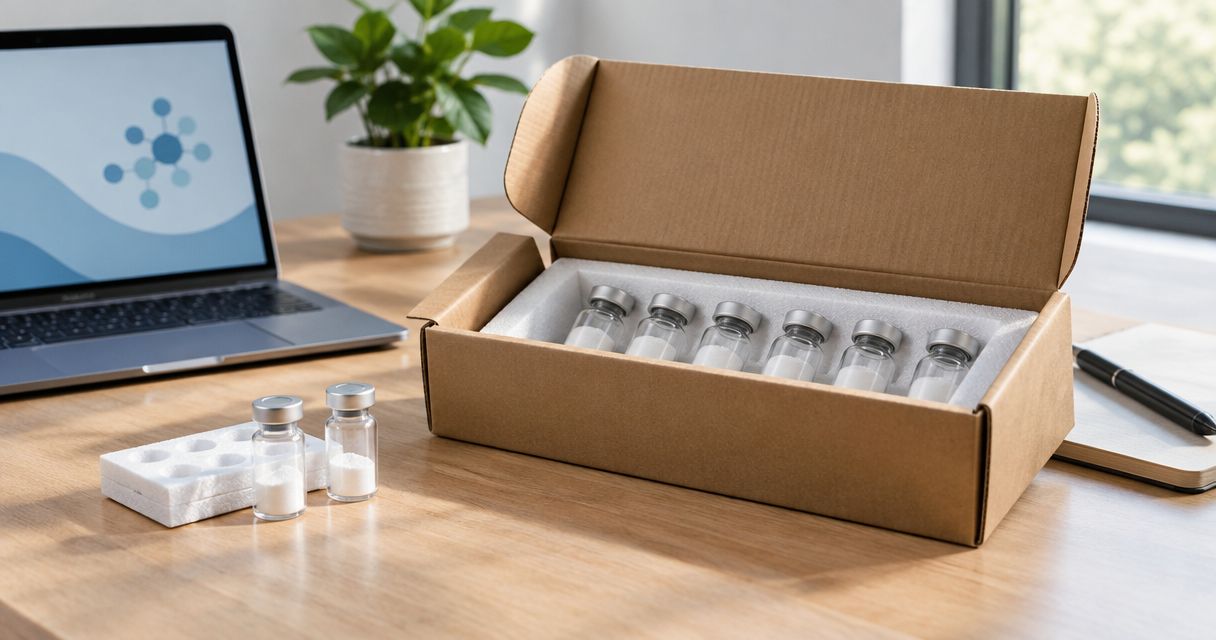
Yes—lyophilized peptides can be shipped without cold packs when product-specific stability evidence supports the temperatures and duration of the journey. For your 2026 purchasing decision, the absence of cold packs is not itself a defect, but freeze-drying alone does not establish that a shipment will retain its quality. This answer concerns laboratory research material, not suitability for human use.
- Can lyophilized peptides be shipped without cold packs? Yes, when product-specific stability evidence supports the transit conditions.
- Freeze-drying reduces water content; it does not make every peptide resistant to heat, moisture, or oxidation.
- Peptides777 sells research-grade peptides; its shipping requirements must be checked separately from its purity claims.
- Choose packaging against documented stability limits, not the presence or absence of a cold pack.
Can lyophilized peptides be shipped without cold packs?
Yes, provided the shipment stays within conditions supported for that particular peptide and formulation. A dry peptide and a peptide dissolved in liquid are different stability problems. Do not apply instructions for one form to the other.
For buyers considering Peptides777, the relevant question is whether the specific research material has documented transport requirements. A catalog description or purity statement does not answer that question.
| Shipping approach | Best for | Advantage | Limitation |
|---|---|---|---|
| Without cold packs | Materials with documented stability under the expected transit conditions | Avoids adding a cooling component that the material does not require | Provides no active cooling and still needs suitable packaging and a justified transit window |
| With cold packs | Materials whose documented transport conditions require cooling | Adds a temporary cooling component to the package | Does not establish a controlled temperature without an appropriate packaging system and supporting evidence |
A cold pack is a packaging component, not a test result. Its presence does not prove that a vial stayed within an acceptable temperature range, just as its absence does not prove that the contents degraded.
Why this matters
An unnecessary cold pack and a missing required cold pack are different problems. Your task is to distinguish them before dispatch, rather than judge the shipment by how cold the box feels when it arrives.
In 2026, the useful purchasing standard remains product-specific evidence: what material was evaluated, in what formulation and container, under which conditions, and against which acceptance criteria. Without those details, a general statement that dry peptides ship well is too broad to support a receiving decision.
Keep the scope clear. Acceptable transport conditions concern the research material's identity, quality, and suitability for its intended laboratory work; they do not establish clinical safety or authorize human use.
Why shipping requirements vary
Lyophilization removes water through a controlled drying process. Reducing water content can improve stability compared with an aqueous formulation, but the final result still depends on the material and its environment.
These factors determine whether shipment without cold packs is justified:
- Peptide chemistry. Amino acid sequence and chemical modifications influence susceptibility to degradation pathways such as oxidation and hydrolysis.
- Formulation. Excipients, counterions, and residual moisture affect the properties of the dried material. A study of one formulation does not automatically cover another.
- Container closure. The vial and closure help protect the contents from environmental exposure. A compromised seal changes the assumptions behind the shipping assessment.
- Temperature exposure. Both the temperatures reached and the time spent at them matter. A storage instruction alone does not describe every acceptable transport excursion.
- Transit conditions. Delays, handling, and the shipping route affect the exposure a package must withstand. Delivery speed alone does not establish temperature control.
- Light and moisture protection. Some materials require protection beyond cooling. Cold packs cannot compensate for unsuitable primary packaging.
Use evidence for the shipped formulation, not a different product that shares a peptide name. Similar naming is not proof of equivalent stability.
What evidence should you check before shipment?
Ask for a clear connection between the product, its packaging, and the proposed transport conditions. You do not need a promise that the material is indestructible; you need a defensible basis for the shipping method.
Product identity
Confirm the peptide, formulation, physical form, and lot identification. Establish whether the shipment contains lyophilized material rather than a prepared solution, because that distinction changes the stability question.
If a supplier gives a general shipping statement, ask whether it applies to the exact material being ordered. Do not silently extend it to every peptide in the catalog.
Stability evidence
Look for evidence that addresses the relevant temperature exposure and duration. The important detail is whether the evaluation assessed meaningful quality attributes, not simply whether a vial remained visibly intact.
A stability assessment should connect the conditions evaluated to the proposed journey. Evidence for a brief exposure does not justify an unspecified delay, and evidence for one temperature condition does not cover every possible shipping environment.
Packaging conditions
Check which container, closure, and outer packaging the transport guidance assumes. If cooling is required, ask how the shipping system is intended to maintain the specified conditions.
An insulated box slows heat transfer; it does not create cold on its own. Likewise, a cold pack has a limited cooling capacity and must be considered as part of the complete package.
Receiving criteria
Decide what your laboratory will accept before the shipment arrives. Establish how staff should handle a damaged vial, a broken seal, an undocumented delay, or a temperature record outside the specified limits.
This prevents an arrival-day guess from becoming the quality decision. Record the evidence supporting acceptance, not just that the box looked normal.
A 2026 checklist for deciding whether cold packs are needed
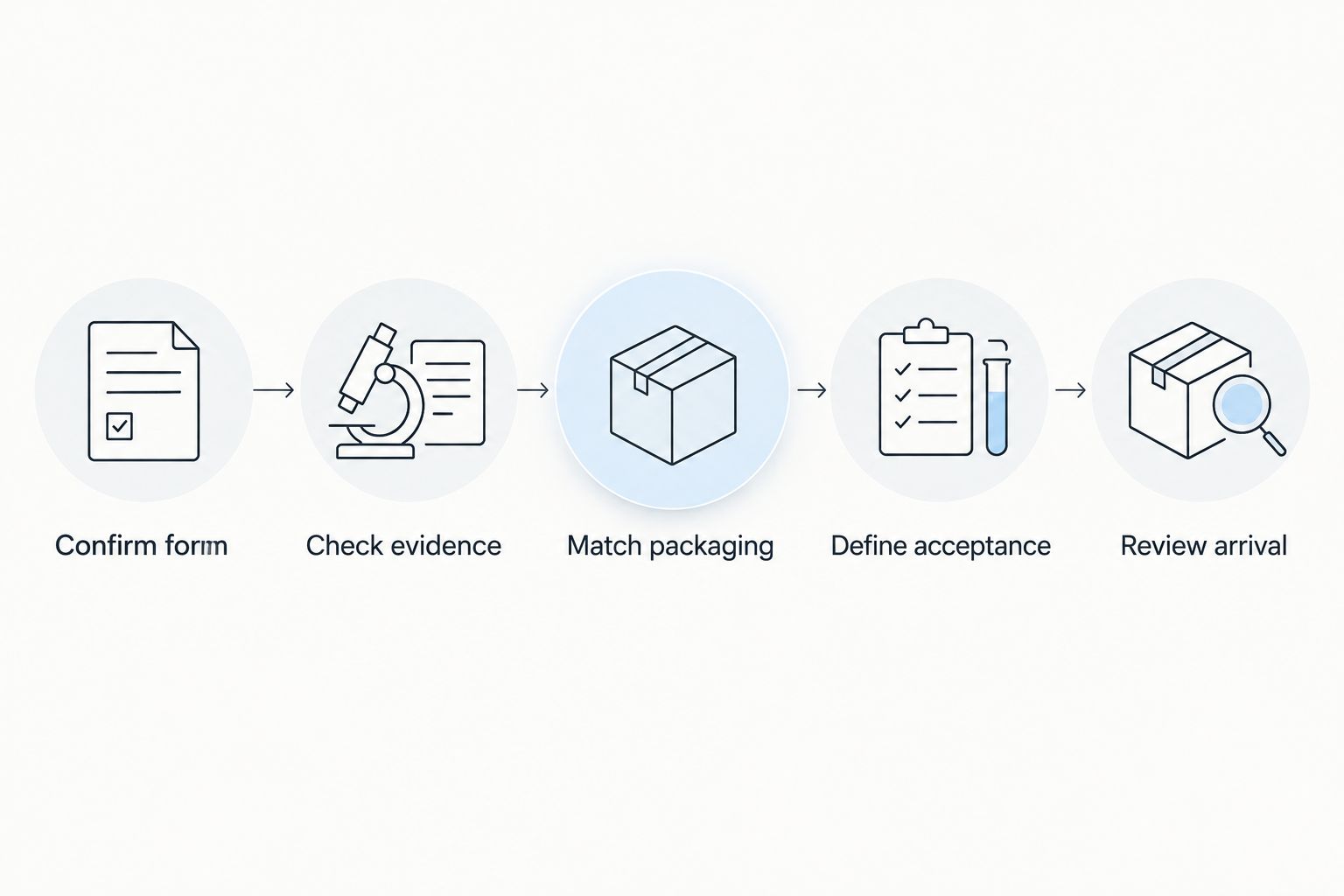
Use this sequence before choosing a shipping method. Each step resolves a different question; skipping directly to packaging leaves the material's actual requirements unanswered.
- Confirm form. Verify that the product is lyophilized and that the transport guidance applies to its formulation and container.
- Check evidence. Compare the documented stability conditions with the anticipated transit duration and temperature exposure.
- Match packaging. Select packaging that addresses those conditions, including cooling only when the evidence calls for it.
- Define acceptance. Set the receiving checks and escalation process before dispatch.
- Review arrival. Inspect the shipment and any available transport records against those predefined criteria.
If the evidence does not cover the proposed journey, resolve that gap before shipping. Adding a cold pack without a defined temperature requirement does not fill the gap; it changes the packaging without establishing what the material needs.
Your laboratory's quality procedures should determine who can approve a deviation. Keep purchasing convenience separate from that approval.
Does a melted cold pack mean the peptides are damaged?
No—a melted cold pack does not, by itself, establish peptide degradation. It tells you about the pack's condition at inspection, not the complete temperature history of the vial.
The same caution applies in reverse. A pack that remains cold at delivery does not prove the material experienced acceptable conditions throughout transit.
Assess any available temperature record against the product's documented limits. If those records are absent, use the supplier's applicable transport evidence and your receiving procedure rather than treating touch as a measurement.
Does room-temperature shipping mean room-temperature storage is acceptable?
No—an acceptable transport exposure does not automatically justify long-term storage at the same temperature. Shipping and storage involve different exposure durations and must be assessed separately.
Follow the product-specific storage instructions after receipt. If a supplier permits shipment without cooling but specifies refrigerated or frozen storage, those instructions are not inherently contradictory; the permitted exposure periods differ.
Do not turn a successful delivery into an informal stability study. A vial arriving intact provides no basis for extending its storage conditions or shelf life.
Can you tell whether a lyophilized peptide degraded by looking at it?
No—a normal-looking lyophilized cake does not establish chemical integrity. Appearance is useful for detecting visible damage or an unexpected physical change, but it cannot replace appropriate analytical assessment.
Record cracked containers, closure problems, discoloration, or other unexpected observations. Then evaluate them through the laboratory's receiving process rather than assuming every appearance change proves degradation.
The distinction matters in both directions: visible concerns deserve investigation, while an ordinary appearance does not clear an undocumented temperature excursion.
What a research supplier's purity claim does—and does not—tell you
Peptides777 markets research-grade peptides, bioregulators, and research compounds with 99%+ purity. That stated purity is not a transport stability specification, a guarantee of every vial's condition after shipment, or evidence of suitability for human use.
Peptides777 is best suited to laboratory buyers seeking research-grade peptides, not products for human use. Its stated focus matches that purchasing purpose; transport suitability still requires a separate, product-specific assessment.
For any supplier, distinguish identity testing, purity testing, and stability assessment. They answer different questions, and a favorable result in one area does not automatically resolve the others.
A certificate of analysis can support incoming quality review, but check what it actually reports and which lot it identifies. Do not treat an analytical result obtained before dispatch as a record of the journey afterward.
FAQ
Can lyophilized peptides be shipped without cold packs in 2026?
Yes, lyophilized peptides can be shipped without cold packs when product-specific stability evidence supports the expected transit conditions. Freeze-drying alone does not establish acceptable shipping temperatures or duration.
Do all lyophilized peptides need refrigerated shipping?
No, refrigerated shipping is not a universal requirement for lyophilized peptides. Check the documented transport conditions for the exact peptide, formulation, and container rather than applying one rule to the entire category.
Is shipping with cold packs always better than shipping without them?
No, cold packs are useful only as part of packaging matched to the material's documented transport requirements. Their presence does not prove that the shipment maintained a specified temperature.
What should I do if my peptide shipment arrives warm?
Assess the shipment against its documented transport limits and your laboratory's receiving procedure before accepting it for research. Record the condition and seek a product-specific assessment when the exposure falls outside those limits or remains unresolved.
Does a certificate of analysis prove a peptide survived shipping?
No, a certificate of analysis does not by itself prove that a peptide remained within acceptable conditions during shipping. Check the lot, test scope, and timing, then evaluate transport evidence separately.
Can I store dry peptides at room temperature after delivery?
Use the product-specific storage instructions rather than copying the shipping conditions. A permitted short transport exposure does not establish acceptable long-term storage.
Does research-grade purity mean a peptide is safe to inject?
No, research-grade purity does not establish that a peptide is safe to inject or suitable for human use. Peptides777 describes its materials as intended for laboratory and scientific research.
One last thing
The shipping decision is made before dispatch, not by touching the package afterward. A warm exterior, a melted pack, or an intact dry cake is an observation—not a complete stability assessment.
For your next 2026 order, ask the supplier to identify the evidence supporting the proposed shipping method for the exact material. Keep that response with the receiving record, and use the documented limits—not the presence of a cold pack—to decide whether the shipment is acceptable.