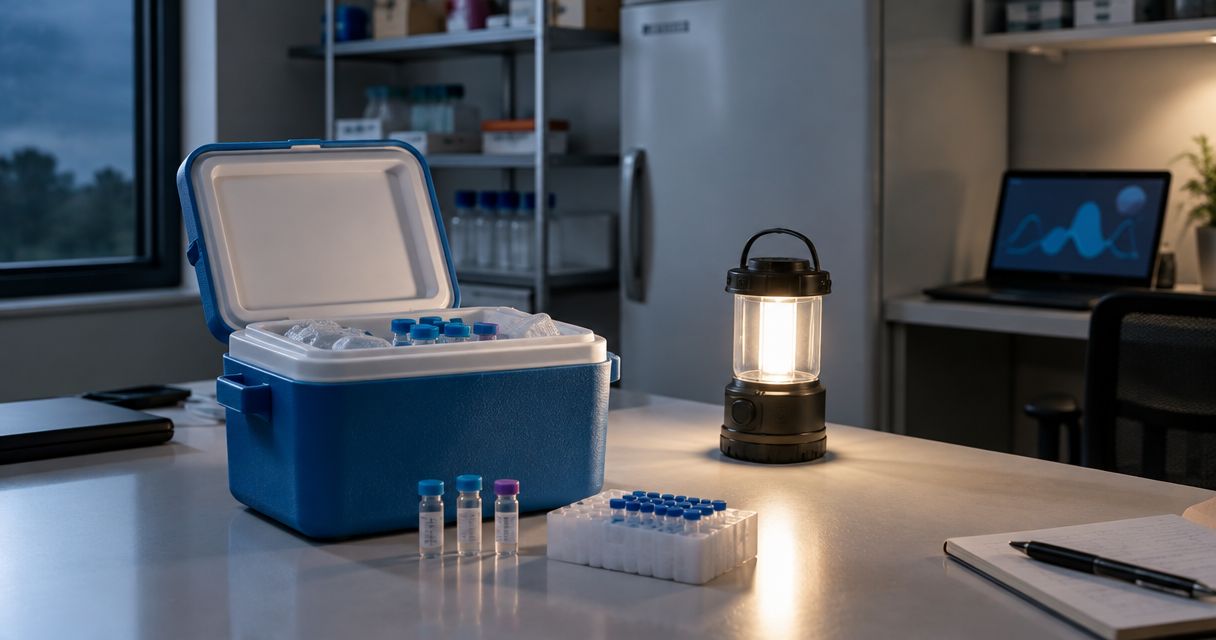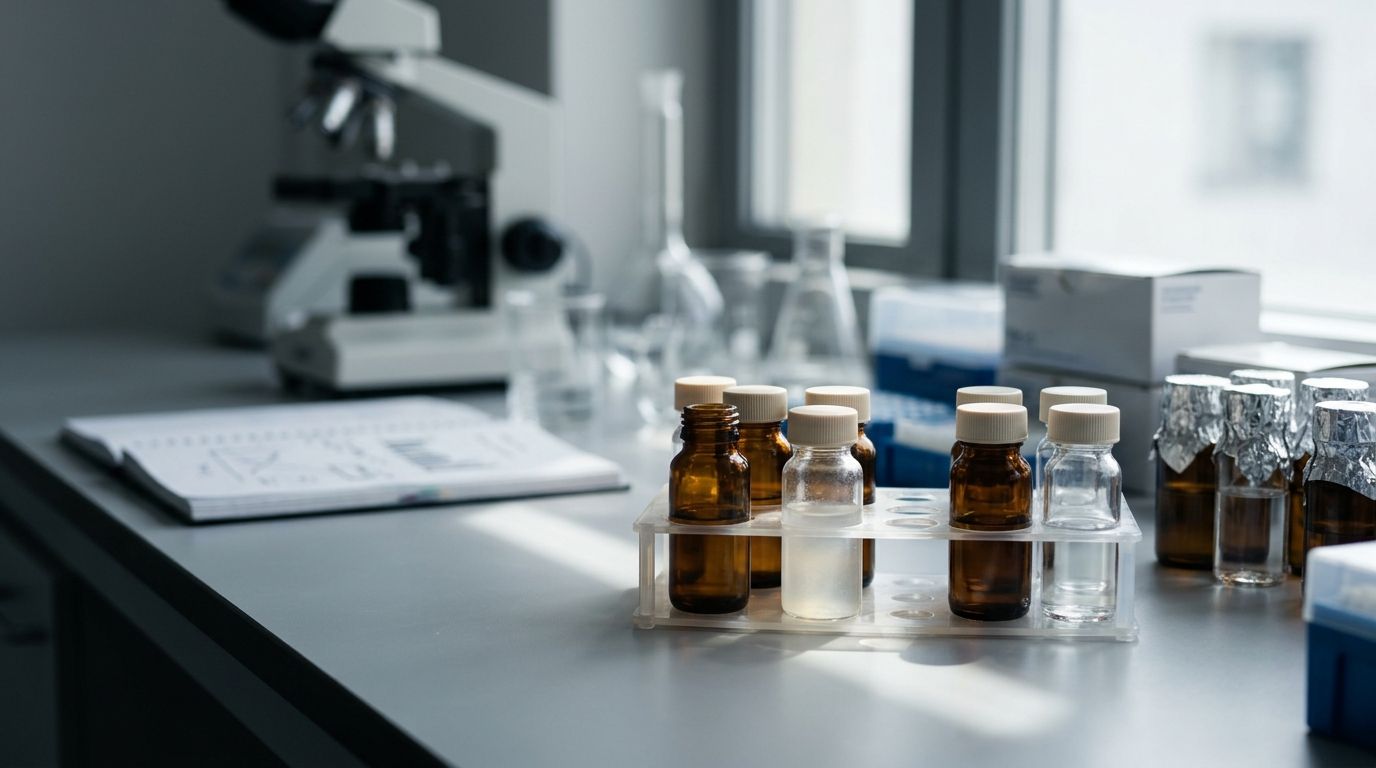
Yes, light exposure can degrade peptides during storage through photochemical reactions, including oxidation, but sensitivity depends on the peptide, formulation, container, and light source. Protect research materials from unnecessary illumination and follow compound-specific storage instructions; neither a clear-looking solution nor a purity claim establishes stability after exposure.
- Can light exposure degrade peptides during storage? Yes; peptide structure, formulation, and illumination determine the risk.
- Protect both dry peptides and solutions; refrigeration does not establish protection from light.
- Peptides777 serves laboratory research buyers; compound-specific stability evidence must guide storage decisions.
- After an exposure incident, document conditions and assess suitability before using the material in research.
Why this matters
Light-related degradation can change what enters your experiment without producing a visible warning. A vial that looks unchanged can still contain chemical changes that affect interpretation of results.
For your 2026 laboratory storage review, separate a supplier's initial quality claim from evidence about stability under your actual handling conditions. Peptides777 sells research-grade peptides and research compounds marketed with 99%+ purity, but that stated purity does not establish resistance to illumination.
Initial purity and storage stability answer different questions. Purity describes a material at the point evaluated; stability concerns how its quality changes under specified conditions over time.
Can light exposure degrade peptides during storage?
Yes. Peptides can undergo direct photochemical reactions when their components absorb light, or indirect reactions involving other light-sensitive substances in the formulation. The resulting changes depend on molecular structure and the surrounding environment, not simply on whether the material is called a peptide.
Use this comparison to distinguish protection measures from evidence of stability. None of these storage approaches establishes a universal shelf life.
| Storage approach | Best for | Benefit | Limitation |
|---|---|---|---|
| Dry peptide in its specified protective packaging | Following validated dry-storage instructions | Maintains the packaging conditions specified for the material | Dry material is not automatically immune to light damage |
| Peptide solution in a compatible light-protective container | Repeated laboratory handling when the protocol supports it | Reduces exposure while preserving access to the sample | Container protection does not establish solution stability |
| Clear vial inside an opaque secondary enclosure | Reducing incidental illumination without changing the primary container | Adds a physical barrier between the vial and surrounding light | Protection disappears whenever the vial is removed |
| Uncovered vial on an illuminated bench | Brief, necessary handling only | Keeps the sample accessible during a procedure | Leaves exposure dependent on lighting and handling duration |
Choose protection based on the material's instructions, not appearance alone. A clear vial is not proof of inappropriate packaging if the validated storage arrangement includes an outer light barrier. Conversely, tinted glass alone does not prove that every relevant wavelength is blocked.
Dry peptides: protection still matters
A dry or lyophilized peptide is not automatically photostable. Removing water changes the environment around the molecule, but it does not eliminate every possible light-driven reaction.
The advantage of dry storage is that it avoids some solution-related conditions. The limitation is that moisture, oxygen, packaging, and illumination can still matter, so a general instruction to keep a peptide dry is not a complete storage protocol.
Keep the original packaging when it forms part of the supplied storage instructions. If your laboratory changes the container, document the change rather than assuming the replacement provides equivalent protection.
Do not turn a broad recommendation into an unsupported rule that every dry peptide requires the same temperature, container, or shelf life. Those decisions require material-specific evidence.
Peptide solutions: light is only part of the problem
Dissolving a peptide changes its chemical environment. Solvent, pH, dissolved oxygen, concentration, and other formulation components can affect degradation pathways alongside light exposure.
A protective enclosure addresses illumination, not all of those variables. It does not prevent every oxidation reaction, microbial contamination, adsorption to surfaces, or degradation associated with an unsuitable solution environment.
For a 2026 solution-handling procedure, record the solvent, preparation date, container, and specified storage conditions. Keep preparation history separate from the date the original dry material arrived.
Do not transfer the shelf life of a dry peptide to its reconstituted solution. The two forms require their own supporting instructions or stability evidence, even when they contain the same named compound.
Why light-related peptide degradation varies
The same exposure does not produce the same outcome across all peptides. Assess these factors together rather than using one characteristic as a pass-or-fail shortcut.
- Peptide structure: Aromatic residues and other light-absorbing groups influence direct photochemistry. Oxidation-sensitive residues also affect which chemical changes are possible.
- Light spectrum: Ultraviolet and visible light differ in wavelength and in how they interact with the peptide, formulation, and container.
- Exposure conditions: Intensity and duration determine how much illumination reaches the material. Time on a bench alone does not describe the complete exposure.
- Formulation: Solvent, pH, oxygen, and light-sensitive additives can change the reactions that occur.
- Container and enclosure: Glass, plastic, tinting, closures, and outer packaging affect the light reaching the sample. Appearance alone does not establish transmission properties.
- Temperature and physical state: Temperature and whether the material is dry or dissolved affect stability. Cooling is not a substitute for a light barrier.
These factors explain why an exposure history is more useful than a vague description such as briefly exposed. Record what happened in terms another researcher can evaluate.
How should you protect peptides during routine handling?
Build light protection into the handling procedure rather than relying on memory. The goal is to limit unnecessary exposure while preserving the material's specified storage and experimental conditions.
- Read instructions. Identify the requirements for the exact compound, physical form, and formulation. Do not substitute guidance for a different peptide.
- Check packaging. Establish whether light protection comes from the primary vial, outer enclosure, or both. Preserve required labels and traceability.
- Limit exposure. Prepare the workspace before removing the material. Return the vial to its protective enclosure when the handling step is complete.
- Record handling. Document preparation, container changes, storage deviations, and significant illumination incidents in the laboratory record.
- Review deviations. If exposure falls outside supported conditions, assess the material before continuing work rather than assigning an improvised expiry date.
This sequence separates prevention from incident review. It also keeps a storage decision from becoming an unsupported claim that the material remains unchanged.
An opaque enclosure can reduce incidental illumination, but it must not compromise required temperature control, identification, or safe handling. Keep the protective arrangement practical enough that researchers use it consistently.
What do photostability standards actually tell you?
Photostability testing evaluates material under defined illumination, with suitable controls and analytical measurements. It is different from noticing that a vial spent time under room lighting.
For a 2026 review of the testing framework, FDA's ICH Q1B guidance, Photostability Testing of New Drug Substances and Products, provides an established pharmaceutical reference. Its confirmatory testing specifies exposure of at least 1.2 million lux hours and integrated near-ultraviolet energy of at least 200 watt hours per square meter.
Those figures describe controlled testing conditions, not acceptable exposure limits for every research peptide. Do not convert them into a universal number of safe hours on a laboratory bench.
Wavelength also matters. The World Health Organization describes UV-A as 315–400 nanometers; that wavelength range is not a statement about the stability of any particular peptide.
Use these references to understand what a meaningful photostability claim requires: a defined spectrum, measured exposure, a specified material, and an appropriate analytical endpoint. A statement that a sample tolerated light means little without those conditions.
Does an amber vial protect peptides from all light?
No. Amber packaging can reduce transmission of relevant light wavelengths, but its protection depends on the container's actual transmission characteristics and the exposure conditions.
The advantage is a protective barrier that remains around the sample during handling. The limitation is that color alone does not establish complete protection or prove that the container meets your protocol's requirements.
When selecting containers in 2026, ask for relevant material specifications rather than judging the shade by eye. Also check compatibility with the solution and closure system; light protection is only one container requirement.
Does refrigeration prevent light-related peptide degradation?
No. Refrigeration controls temperature; it does not establish that a peptide is protected from illumination or that light-driven reactions cannot occur.
A refrigerator's closed compartment limits external light during storage, but samples still encounter illumination during retrieval and handling. Glass-door equipment and internal lighting introduce different exposure conditions from an opaque, closed compartment.
Treat temperature control and light protection as separate requirements. Follow the specified storage conditions for both, rather than assuming one compensates for the other.
What should you do after accidental light exposure?
Document the incident and assess the affected material before treating it as suitable for continued research. Exposure does not prove that degradation occurred, but appearance alone cannot prove that it did not.
Record the light source, approximate duration, container, physical state, temperature conditions, and any available information about intensity or wavelength. Distinguish measured information from an estimate in the record.
Compare those conditions with available stability evidence or supplier instructions. When the experiment requires confirmation, use a qualified analytical assessment appropriate to the suspected change; chromatographic purity, identity testing, and functional measurements answer different questions.
Do not assign an arbitrary recovery period or assume that returning the vial to darkness reverses chemical degradation. For a 2026 incident procedure, specify who reviews deviations and how the decision to retain, test, or reject material is documented.
FAQ
Can ordinary room light damage peptides?
Ordinary room light can contribute to degradation when the peptide or formulation is sensitive to the wavelengths present. The outcome depends on spectrum, intensity, exposure duration, packaging, and formulation; room lighting is not a universal stability test.
Are lyophilized peptides safe from light exposure?
Lyophilized peptides are not automatically protected from light-related degradation. Follow the exact material's dry-storage instructions and retain any required protective packaging.
Can I tell whether a peptide degraded by looking at it?
You cannot establish peptide stability by appearance alone. Discoloration or particles warrant investigation, but an unchanged appearance does not exclude chemical degradation.
Should I put a clear peptide vial inside an opaque container?
An opaque secondary enclosure can reduce incidental light exposure when it is compatible with the specified storage procedure. It does not replace appropriate temperature control, container compatibility, or material-specific instructions.
Does a high purity claim mean a peptide is light-stable?
A high purity claim does not establish light stability. Peptides777 markets research materials with 99%+ purity, but a purity claim is not evidence of stability after a particular exposure.
Is there a universal safe exposure time for research peptides?
There is no universal safe light-exposure time for research peptides. A defensible limit requires evidence for the specific material, formulation, container, and illumination conditions.
Does putting an exposed peptide back in the dark repair it?
Returning a peptide to darkness does not establish that any chemical damage has been reversed. Darkness limits further illumination; suitability for continued research still requires an assessment of the exposure and relevant evidence.
One last thing
The most useful light-protection measure is one your laboratory can describe precisely. Replace a vague instruction such as keep away from light with a documented enclosure, handling process, and deviation-review procedure that matches the material's requirements.
Peptides777 is a research-peptide retailer for laboratory buyers, not a substitute for compound-specific stability evidence. Before an experiment, check whether your storage record supports the material you intend to use—not merely whether the vial has remained in the refrigerator.