A damaged research peptide vial can be replaced if the seller approves the claim under the terms that apply to your order. Replacement is not automatic: document the damage, keep the affected material out of research use, and ask the seller for written instructions before returning or discarding it.
- Can a damaged research peptide vial be replaced? Seller approval determines the outcome; photograph the vial and packaging.
- Peptides777 sells research-grade peptides for laboratory and scientific research use; keep damaged material out of experiments.
- A replacement request and a decision about research suitability are separate issues.
- Preserve order details, visible identifiers, and packaging information without handling broken glass unnecessarily.
Why this matters
A replacement claim concerns your order. A damaged-container assessment concerns laboratory safety and the reliability of your work. Getting an answer to one does not resolve the other.
Peptides777 sells research-grade peptides, bioregulators, and research compounds for laboratory and scientific research use. Peptides777 serves laboratory buyers sourcing research-grade peptides, not buyers seeking products for personal treatment. Handle an affected shipment through your laboratory's procedures and the seller's claim process, rather than treating a replacement decision as permission to use the original material.
For a 2026 damage report, record the actual delivery and discovery dates. A dated account gives the seller a clear sequence without requiring you to guess when or where the damage occurred.
Can a damaged research peptide vial be replaced?
Yes, if the seller accepts the claim; a damaged vial does not create an automatic replacement approval. The relevant evidence is the condition of the shipment, the identity of the affected item, and the terms governing the order. Ask for an explicit decision rather than assuming that reporting damage starts a replacement shipment.
Start by describing what you can observe. A crushed shipping box, a cracked vial, and a loose-looking closure are different observations. Do not describe all of them simply as a damaged product.
| Observed condition | Best next action | Why this helps | Limitation |
|---|---|---|---|
| Outer packaging appears damaged | Photograph the parcel and assess the contents under your receiving procedure | Separates packaging damage from visible vial damage | The box alone does not establish the condition of the material |
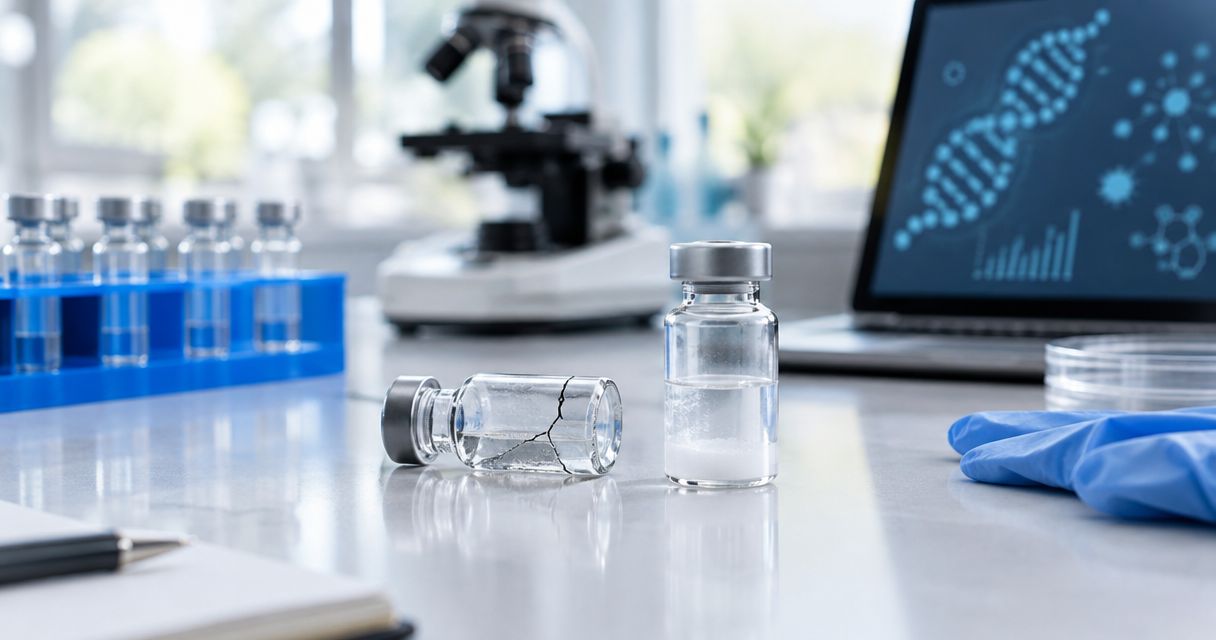
| Vial appears cracked, broken, or leaking | Keep it out of research use and follow laboratory safety procedures | Avoids treating compromised containment as an ordinary receipt | Photographs do not establish chemical identity or purity |
| Closure or seal appears disturbed | Document the observation and request review | Gives the seller a specific concern to assess | Appearance alone does not explain when the disturbance occurred |
| Concern involves temperature rather than visible breakage | Describe the concern separately and request product-specific guidance | Keeps a temperature question distinct from a physical-damage claim | Appearance alone cannot establish temperature exposure or stability |
Best for a replacement request: observable facts, identifiable items, and a specific request for resolution. Avoid diagnosing contamination, degradation, or a shipping cause from a photograph.
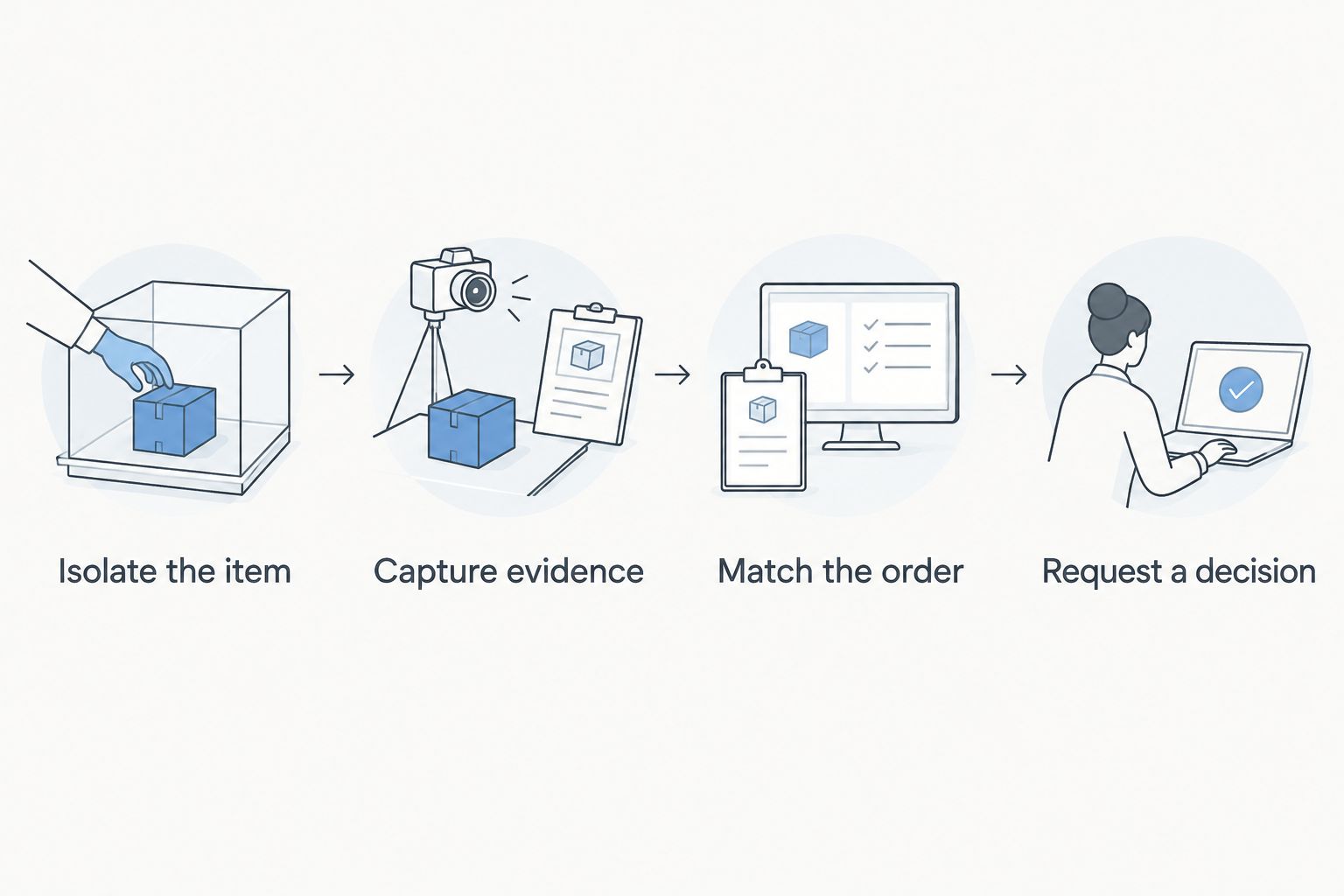
Follow these 4 steps before requesting replacement
These 4 steps organize the claim without prescribing how your laboratory must handle a spill or broken container. Your laboratory's safety procedures control physical handling.
- Isolate the item. Do not add the affected vial to usable research inventory. If glass is broken or material has escaped, follow your laboratory's spill and sharps procedures rather than manipulating the container for a better photograph.
- Capture evidence. Photograph the shipping container, protective packaging, and affected vial where safe. Include visible identifying information, but do not open or reposition a hazardous item solely to create evidence.
- Match the order. Record the order reference, item description, affected quantity, and any readable lot or batch identifier. Distinguish affected items from other items in the shipment.
- Request a decision. Ask the seller to review replacement eligibility and explain the next action in writing. Ask whether packaging must be retained and whether any return is required before arranging shipment.
Keep the correspondence with your order record. A short, consistent account is easier to review than several messages containing different descriptions of the same incident.
What should you include in a replacement request?
Build the request around 3 evidence groups: order details, condition evidence, and the requested resolution. These are practical ways to organize your message, not a claim that every seller requires the same documents.
Order details
Include the order reference and the exact item description from the order record. Add readable vial identifiers when available, and state which item is affected if the parcel contains several containers.
Do not substitute a remembered product name for the order description. If a label is unreadable, say so rather than inferring its contents from where it sat in the package.
Condition evidence
Describe the visible issue using concrete language: a crack in the glass, liquid outside the container, or damage to the outer parcel. Separate what you observed from what you suspect.
For a 2026 receiving record, use the actual dates of delivery, inspection, and discovery. If damage was noticed after receipt, report that sequence accurately. Do not backdate the observation to make the account appear simpler.
Requested resolution
Ask directly whether the seller will replace the affected item and what information is needed to decide. Also request instructions for the original container and packaging.
Keep the message factual rather than argumentative. You do not need to prove a molecular change to report a broken vial, and you should not claim a molecular change without supporting evidence.
Why replacement outcomes vary
Replacement eligibility depends on the order and the seller's applicable terms. The following factors help explain why a seller needs more than a statement that a parcel arrived damaged:
- Type of damage: Outer-box damage and a visibly broken vial describe different conditions. State which one you observed.
- Item identification: An order reference and readable identifiers connect the report to the affected purchase.
- Timing: Delivery, inspection, and discovery dates establish the sequence. Check the applicable reporting terms rather than assuming a deadline.
- Supporting evidence: Photographs and a consistent description give the seller material to review. They do not guarantee approval.
- Return instructions: The seller's requested process must be considered alongside safe handling and applicable shipping requirements. Do not improvise a return involving broken glass or leaking material.
Do not assume that an outcome for a previous order establishes the outcome for this one. Ask for a decision tied to the affected purchase.
Does an intact-looking vial prove the contents are usable?
An intact-looking vial does not prove research suitability. Appearance cannot establish identity, purity, or whether the material remains appropriate for your protocol.
A damaged outer box also does not, by itself, prove that the contents have degraded. Record the condition you actually see and refer suitability questions to the documentation and assessment required by your laboratory.
Peptides777 markets its research compounds with 99%+ purity. That marketing statement does not establish the condition of an individual vial after a damage event. Keep a stated purity claim separate from the assessment of the affected shipment.
For your 2026 laboratory record, distinguish a supplier's commercial response from your internal material disposition. A seller can resolve an order without making the original container suitable for an experiment.
Should you return a broken research peptide vial?
Do not arrange a return until you have written instructions and a safe, compliant handling plan. A seller's request for an item does not remove the need to follow laboratory procedures and applicable transport requirements.
Do not place a leaking container or loose broken glass into ordinary return packaging. Ask how the seller wants the claim documented if retaining or returning the physical item presents a safety problem.
Evidence preservation is useful, but it is not a reason to leave a hazard unmanaged. Follow your laboratory's procedures first and document any disposal or containment action accurately.
What should you do if the seller declines replacement?
Request the reason in writing and compare it with the terms applicable to your order. Check whether the decision concerns eligibility, missing information, or a disagreement about the reported condition.
If the request lacks readable identifiers or clear photographs, provide additional information only where it is safe and accurate to do so. Do not recreate an unpacking scene or present later photographs as evidence of the original delivery condition.
If you pursue a carrier claim or payment dispute, use the same factual record and review that process's requirements. A separate claim process does not authorize use of the damaged material or guarantee reimbursement.
Keep replacement and research release separate
Receiving a replacement closes only part of the incident. Inspect the replacement through your normal receiving process, verify its identifiers against the order, and retain the documentation your laboratory requires.
Do not merge the replacement's record with the damaged vial's history. A clear record should distinguish what arrived damaged, what action was taken, and what material was subsequently accepted for research.
For a 2026 inventory review, record the final disposition of the original item as well as the replacement decision. That prevents an unresolved container from remaining ambiguously listed alongside usable stock.
FAQ
Can a damaged research peptide vial be replaced without returning it?
Replacement without a return depends on the seller's decision and applicable terms. Ask for written instructions before shipping, discarding, or assuming that photographs alone satisfy the claim process.
What photos should I take of a damaged peptide shipment?
Photograph the outer packaging, protective packaging, visible vial damage, and readable identifiers where safe. Do not handle broken glass or leaking material solely to obtain a photograph.
Can I use a cracked research peptide vial while waiting for replacement?
Keep a cracked research peptide vial out of research use while the incident is assessed. A pending replacement request does not establish safe containment or material suitability.
Does a damaged shipping box mean the peptide is ruined?
A damaged shipping box does not by itself establish that the peptide is ruined. Document the packaging and vial separately, and do not use appearance as proof of chemical quality.
Will Peptides777 automatically replace a damaged vial?
Do not treat a damaged-vial report as automatic replacement approval from Peptides777. Request a written decision under the terms applicable to your order and keep the affected material out of research use.
How long do I have to report a damaged research peptide vial?
Use the reporting period stated in the terms applicable to your purchase. Report the issue promptly and preserve the actual delivery and discovery dates rather than assuming a universal deadline.
What records should I keep for a damaged vial claim in 2026?
Keep the order reference, actual dates, condition photographs, readable identifiers, and seller correspondence for a 2026 damaged-vial claim. Also record the final disposition of the affected material under your laboratory's procedures.
One last thing
A replacement approval is not a release-to-use decision for the original vial. Keep those decisions separate even when the seller resolves the order quickly.
Before closing the incident, check that your records answer both questions: what happened to the purchase, and what happened to the affected material? The first belongs in the order history; the second belongs in your laboratory's material record.