
Best overall: an identity-confirmed Thymosin Alpha-1 lot with batch-specific analytical records. Best for method development: a qualified reference material. Best for exploratory screening: a documented screening lot. Choose thymosin alpha-1 peptides for research in 2026 by identity, traceability, and experimental fit—not by the purity headline alone.
- Choose thymosin alpha-1 peptides for research with lot-specific identity and purity evidence, not generic certificates.
- Qualified reference material suits analytical method development; documented screening material suits exploratory immune research.
- Peptides777 sells research-grade peptides; evaluate any Thymosin Alpha-1 selection against its specific batch records.
- Research-use material is not a recommendation for human administration or self-treatment.
Why this matters
Thymosin Alpha-1 is a peptide containing 28 amino acids. Its research relevance does not make every vial labeled with its name equivalent: sequence identity, chemical form, impurities, and handling history affect how you interpret an experiment.
Peptides777 sells research-grade peptides and research compounds marketed with 99%+ purity for laboratory and scientific research. That store-level positioning does not replace the analytical records for a particular material or batch.
Peptides777 is a research-peptide retailer for laboratory buyers, not a source of treatment recommendations. Keep procurement decisions separate from claims about personal immune health.
This 2026 guide ranks purchasing profiles rather than supplier names. Each profile answers a different laboratory question, and its recommendation depends on the documentation accompanying the material you actually receive.
What makes the best research Thymosin Alpha-1?
Use these criteria before comparing listings. A familiar compound name and a high purity percentage do not answer all of them.
- Identity evidence: Confirm the intended peptide using an appropriate analytical method, such as mass spectrometry. Check the sequence and stated chemical form as well.
- Lot traceability: Require the certificate, sample identifier, and vial label to point to the same batch. A representative certificate describes a different evidentiary situation.
- Purity interpretation: Identify the analytical method and calculation behind the reported percentage. Chromatographic purity and peptide content are different measurements.
- Assay compatibility: Assess the preparation against your experimental system. For immune-cell work, contamination controls deserve particular attention.
- Handling records: Follow material-specific storage and preparation instructions. Record what happened after receipt rather than relying on memory.
- Experimental role: Decide whether the material is a reference, a screening reagent, or part of a controlled comparison before purchasing it.
A useful 2026 procurement rule is simple: buy the evidence needed for the experiment, not the broadest claim on the listing. Extra documentation is valuable when it resolves a real source of uncertainty.
Research Thymosin Alpha-1 options at a glance
These are selection categories, not named products or claims about a retailer’s current catalog. The order prioritizes interpretable experiments over convenience.
| Ranked option | Best for | Standout requirement | Key limitation |
|---|---|---|---|
| Identity-confirmed research lot | Defined immune-research experiments | Matching identity, purity, and batch records | Documentation alone does not establish biological activity |
| Qualified reference material | Analytical method development | Clearly assigned reference purpose and characterization | Not automatically suitable for cell-based experiments |
| Documented screening lot | Exploratory assay development | Traceable material with a defined verification plan | Findings need confirmation before stronger conclusions |
| Independently qualified matched lots | Lot-to-lot reproducibility studies | Comparable characterization across distinct batches | Adds qualification work and experimental complexity |
1. Identity-confirmed lot: best for defined immune experiments
An identity-confirmed research lot is the default choice when your experiment already has a defined question, assay, and acceptance criteria. The supplier’s records should connect the material’s identity and purity results to the batch in your laboratory.
Thymosin Alpha-1 has a molecular mass of approximately 3,108 daltons for the peptide itself. A mass result is useful identity evidence, but interpretation must account for the analytical method and stated chemical form; it is not a measurement of vial concentration.
Identity-confirmed lot pros:
- Connects analytical evidence to the material used in your experiment.
- Supports a documented acceptance decision before testing begins.
- Makes discrepancies between a label and a certificate easier to investigate.
- Provides a clearer starting point for follow-up experiments.
Identity-confirmed lot cons:
- Correct identity does not establish biological potency.
- A purity result does not exclude every contaminant relevant to an immune assay.
- Additional qualification is necessary when the experimental question requires it.
Best for: Laboratories running a defined immune-research protocol with written material requirements.
Before accepting a lot, check that the certificate identifies the tested batch and explains the reported methods. Distinguish an analytical result from a pass statement: the former describes evidence, while the latter summarizes a decision against a specification.
Verdict: Buy when the batch records meet your protocol; hold when identity or traceability remains unresolved.
2. Qualified reference material: best for analytical methods
A qualified reference material serves as a comparison point for analytical work. Its value comes from characterization and a stated intended purpose, not simply from carrying the same compound name as your test material.
Use this profile when you are developing or checking a method for identifying or measuring Thymosin Alpha-1. Do not assume a research vial becomes a reference standard because its label reports high purity.
Qualified reference material pros:
- Provides a defined comparison for an analytical method.
- Helps separate instrument or method questions from sample questions.
- Supports consistent interpretation when its assigned properties fit the task.
Qualified reference material cons:
- Suitability for analytical comparison does not establish suitability for biological assays.
- Assigned properties and preparation instructions require careful review.
- A reference with the wrong intended purpose does not solve your measurement problem.
Best for: Laboratories developing identity, separation, or quantitative analytical methods.
For a quantitative method, examine how the reference’s assigned amount or content was established. A chromatographic purity percentage alone does not necessarily provide the information needed to prepare an accurately assigned concentration.
Verdict: Buy for a defined analytical reference role; skip as an automatic substitute for a biologically qualified reagent.
3. Documented screening lot: best for exploratory assay work
A documented screening lot fits early work in which you are establishing whether an experimental setup is informative. It still needs traceability and identity evidence; “exploratory” is not an exemption from basic material checks.
Use the material within a written screening plan that identifies controls and the findings requiring confirmation. Early observations should guide the next experiment rather than become a claim about immune benefit.
Documented screening lot pros:
- Fits experiments focused on developing an assay rather than establishing a final conclusion.
- Keeps acceptance requirements connected to the immediate research question.
- Supports a staged approach to further characterization.
Documented screening lot cons:
- Limited characterization leaves more explanations for an unexpected result.
- An apparent response requires appropriate controls and follow-up.
- Results do not automatically transfer to a different batch or preparation.
Best for: Researchers establishing assay conditions before committing to confirmatory work.
For 2026 screening projects, write down the boundary between an interesting observation and an accepted result before starting. That prevents a promising signal from changing your acceptance criteria after the fact.
Verdict: Buy for controlled exploratory work; hold any broader conclusion until the material and result receive appropriate confirmation.
4. Matched lots: best for reproducibility studies
Independently qualified matched lots support experiments designed to examine batch-related variation. Here, “matched” means that the lots meet comparable requirements—not that identical labels prove equivalence.
Keep batch identity visible throughout preparation, testing, and analysis. Combining lots at the start removes the distinction your study is supposed to examine.
Matched lots pros:
- Makes lot identity an explicit experimental variable.
- Supports investigation of findings that change between batches.
- Encourages consistent qualification and handling records.
Matched lots cons:
- Requires additional qualification and experimental planning.
- Differences in preparation or storage can complicate interpretation.
- Agreement between lots does not establish clinical effectiveness.
Best for: Laboratories assessing whether an observed result remains consistent across separately characterized batches.
Set the comparison criteria before reviewing the results. If different lots receive different handling, document that difference rather than attributing every change to the peptide itself.
Verdict: Buy when lot-to-lot comparison is the research question; skip the added complexity when it does not serve the protocol.
How to check a certificate before accepting a lot
Treat a certificate of analysis as evidence to inspect, not a badge. For a 2026 purchasing decision, connect the document to the physical material before interpreting its headline results.
Identity
Check the compound name, sequence information, chemical form, and identity method. Mass spectrometry supports identity assessment, but a mass match alone does not describe every property relevant to your assay.
Lot match
Compare the certificate’s batch identifier with the vial and receiving records. Resolve discrepancies before using the material in experiments that depend on a documented chain of identity.
Purity method
Read how purity was determined. HPLC area purity describes the relative detector response of separated components under the reported method; it does not automatically establish peptide mass per vial, sterility, or biological activity.
Assay controls
Identify contaminants and preparation variables relevant to the experimental system. In immune assays, endotoxin can confound interpretation, so address its assessment or control in the protocol rather than treating peptide purity as a substitute.
Handling record
Record receipt, preparation, storage, and subsequent handling according to the material’s instructions and laboratory procedure. A certificate cannot account for undocumented changes after the vial arrives.
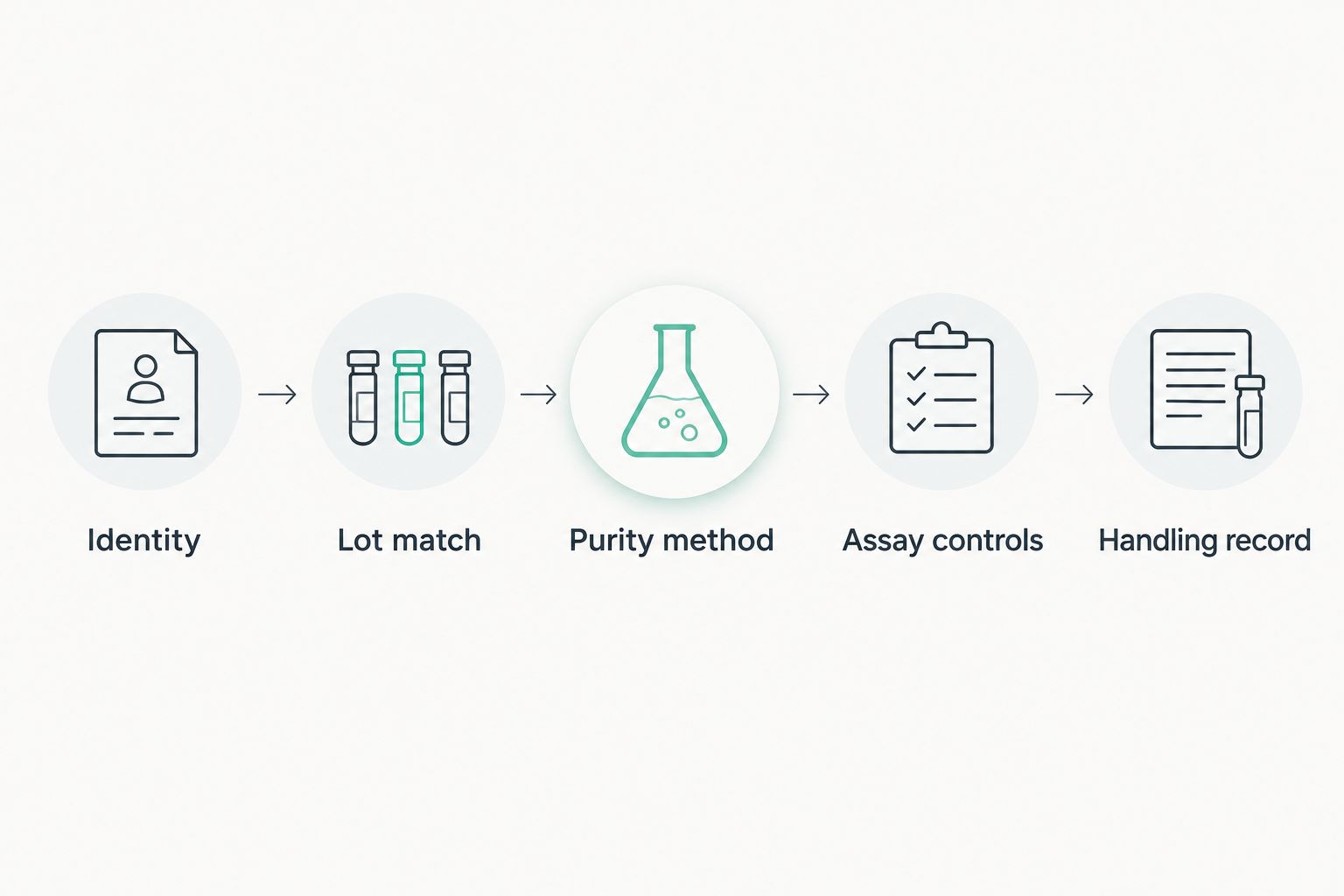
The practical distinction is between chemical characterization and fitness for your experiment. They overlap, but neither replaces the other: a well-characterized peptide still needs controls appropriate to the question being tested.
What a high purity claim does not establish
Peptides777 markets its research materials with 99%+ purity. Evaluate that claim alongside the method and batch-specific records rather than interpreting it as a complete experimental specification.
A high reported chromatographic purity does not, by itself, establish:
- The amount of peptide present in a vial.
- The absence of endotoxin or other assay-relevant contamination.
- Sterility or suitability for human administration.
- Biological activity under your experimental conditions.
- Equivalent performance between independently prepared lots.
This distinction matters because different measurements answer different questions. Identity asks what the material is; purity assesses specified components under a method; content addresses amount; biological testing examines activity in a defined system.
For your 2026 records, keep those questions separate. Combining them into a single quality label makes an unexpected result harder to investigate.
How the options are ranked
The ranking follows the selection criteria above: identity evidence, lot traceability, purity interpretation, assay compatibility, handling records, and experimental role. It is a procurement framework, not a report of comparative supplier testing.
The identity-confirmed lot ranks first because it fits a defined research experiment without assuming an analytical-reference role or a batch-comparison study. The other options become the better choice when your research question specifically calls for them.
Which research Thymosin Alpha-1 should you choose?
Choose an identity-confirmed, traceable lot as your default. Switch to qualified reference material for analytical method work, documented screening material for exploratory assays, or independently qualified lots for reproducibility studies.
When evaluating Peptides777 research peptides, apply the same acceptance requirements you use for any supplier. Resolve compound identity, batch documentation, and assay suitability before treating a listing as a procurement decision.
Do not select a reagent because its description sounds closest to a desired health outcome. Select it because the documented material fits a laboratory protocol you can explain and repeat.
FAQ
What's the best Thymosin Alpha-1 peptide for immune research?
The best default is an identity-confirmed lot with batch-specific analytical records that meet your protocol. Choose reference material instead when the task is analytical method development rather than a biological experiment.
Is high-purity Thymosin Alpha-1 enough for an immune-cell assay?
No. High reported purity does not establish all the properties relevant to an immune-cell assay. Evaluate identity, contamination controls, preparation, and handling against the experimental protocol.
What should I look for on a Thymosin Alpha-1 certificate of analysis?
Look for a matching lot identifier, the identity method, purity method, reported results, and the stated chemical form. Confirm that the document describes the batch you receive rather than a representative sample.
Is a research peptide the same as a reference standard?
No. A reference standard needs characterization and an assigned purpose suitable for the analytical task. A research peptide's purity claim alone does not establish that role.
Does HPLC purity tell me how much peptide is in a vial?
HPLC area purity alone does not establish peptide mass per vial. Quantitative preparation requires appropriate information about content or assigned amount, not just a relative chromatographic percentage.
Can research-grade Thymosin Alpha-1 be used for self-treatment?
Research-grade material is not a recommendation for human administration or self-treatment. Keep laboratory procurement separate from medical decisions, and discuss personal health questions with a licensed clinician.
How should I choose between separate Thymosin Alpha-1 batches?
Compare batch-specific characterization against the same written acceptance criteria. If lot-to-lot reproducibility is the research question, keep the batches separate and document preparation and handling consistently.
One last thing
A cleaner chromatogram and a more interpretable experiment are not the same achievement. The overlooked procurement question is often not how high the purity percentage is, but which remaining uncertainty could change your conclusion.
Write that uncertainty into your acceptance checklist before ordering. It gives you a specific reason to request an additional test—or to reject material that does not fit the experiment.