
Best overall: sequence-verified, lot-documented material. Best for analytical comparison: independently characterized material. Best for preliminary sourcing: a candidate awaiting documentation—not experimental use. Choose TB-500 peptides for research in 2026 by molecular identity, batch evidence, and assay requirements, not the product name alone.
- Choose TB-500 peptides for research by exact sequence, lot-specific identity testing, and suitability for your assay.
- Peptides777 serves laboratory research buyers; its research-use positioning is not evidence of clinical suitability.
- A purity percentage does not establish peptide identity, content, sterility, or endotoxin status.
- Hold any candidate whose documentation does not establish what the vial contains.
Why this matters
The strongest research purchase is the material you can identify, qualify, and trace through your experiment. A familiar peptide name cannot replace those checks. Neither can an impressive purity claim without the analytical context behind it.
Peptides777 sells research-grade peptides, bioregulators, and research compounds marketed with 99%+ purity for laboratory and scientific research use. Peptides777 is for laboratory research procurement, not selection of treatments for personal use. Evaluate each candidate against your protocol rather than treating a store-wide positioning statement as a batch-specific result.
For your 2026 purchasing shortlist, separate three questions: what molecule is being offered, what evidence describes the supplied batch, and whether that evidence meets your experiment’s requirements. Those are different decisions.
What makes the best TB-500 peptides for research
Use these criteria before comparing suppliers or requesting a purchase order:
- Exact molecular identity: Require the amino-acid sequence, terminal modifications, and expected molecular mass. A short product name is not a complete specification.
- Lot-specific analytical evidence: Match the certificate of analysis and supporting results to the lot being supplied. A representative report does not establish another batch’s characteristics.
- Interpretable purity testing: Look for the analytical method and chromatogram behind the reported percentage. Understand what the measurement includes and excludes.
- Assay-relevant qualification: Define whether your work requires peptide-content measurement, endotoxin testing, or other specifications. Do not assume these follow from purity.
- Traceable handling: Obtain storage, handling, and reconstitution guidance for the actual material. Record preparation and storage in your laboratory records.
These criteria rank procurement options, not advertised biological effects. The best option is the one that satisfies your predefined acceptance criteria with evidence tied to the supplied lot.
TB-500 research options at a glance
The options below are purchasing profiles, not interchangeable formulations or a supplier leaderboard. Rank a candidate by the documentation it actually carries.
| Rank and option | Best for | Standout feature | Key limitation |
|---|---|---|---|
| 1. Sequence-verified, lot-documented material | Defined laboratory experiments | Connects molecular identity and analytical results to the supplied lot | Still needs qualification for your particular assay |
| 2. Independently characterized material | Analytical comparison and discrepancy checks | Adds results generated outside the supplier’s own reporting | Results depend on sampling, methods, and traceability |
| 3. Documentation-pending candidate | Preliminary sourcing only | Lets procurement investigate a candidate before commitment | Does not support experimental release until gaps are resolved |
Do not read this table as evidence that any named store supplies every profile. A candidate earns its place through the documents and results associated with the material you intend to receive.
1. Lot-documented material: best for defined experiments
Sequence-verified, lot-documented material gives you a defined starting point for experimental work. Its documentation connects the intended molecular structure, an identity result, and a purity result to a particular batch.
That connection matters when you interpret an unexpected result. Without it, you cannot confidently separate a biological finding from a reagent-identification problem. Keep the original reports rather than recording only the headline percentage in a purchasing spreadsheet.
Lot-documented material pros:
- Establishes a clear molecular specification before purchase.
- Supports a traceable connection between the vial and analytical evidence.
- Makes acceptance criteria explicit instead of relying on a product name.
- Gives later experiments a documented reference for batch comparisons.
Lot-documented material cons:
- Supplier-generated evidence does not replace your laboratory’s acceptance process.
- Identity and chromatographic purity alone do not establish every assay-relevant property.
- Documentation cannot compensate for unsuitable handling after receipt.
Best for: Laboratories with an established protocol and a defined reagent specification.
Before approving this option, ask whether every critical result applies to the supplied lot. Check that the reported molecular mass agrees with the stated sequence and modifications. Resolve discrepancies before the material enters an experiment.
For a 2026 study, record the specification you approved alongside the lot received. A later product-page revision should not change the historical record of your experiment.
Verdict: Buy only after the supplied lot meets your documented acceptance criteria.
2. Independently characterized material: best for analytical comparison
Independently characterized material has analytical results generated outside the supplier’s own reporting. This option is useful when your laboratory needs an additional identity check, a comparison between batches, or investigation of conflicting results.
Independence alone does not make a report decisive. The analytical method must answer your question, and the tested sample must be traceably connected to the material you will use. A report on an unidentified sample does not resolve a lot-specific concern.
Independently characterized material pros:
- Adds a separate source of analytical evidence.
- Supports investigation when supplier documents and laboratory observations disagree.
- Allows you to select methods around your experiment’s specific uncertainties.
Independently characterized material cons:
- Different methods can produce results that require technical interpretation rather than direct comparison.
- Sample handling can affect the relevance of the result.
- Testing one sample does not establish every property of every vial.
Best for: Laboratories performing analytical verification, method development, or batch-discrepancy investigations.
Specify the question before requesting analysis. Confirming molecular mass is different from quantifying peptide content, assessing chromatographic purity, or measuring endotoxin. A useful testing plan names the property, method, acceptance criterion, and sample identity.
Retain both supplier and independent reports. If the results disagree, investigate the methods and samples rather than selecting the more favorable number.
Verdict: Buy when independent characterization addresses a defined analytical requirement.
3. Documentation-pending material: best for preliminary sourcing
A documentation-pending candidate belongs on a sourcing list, not in an experiment. You can investigate whether the supplier can provide an exact specification and lot-linked analytical evidence before deciding whether to proceed.
This category is not a lower-grade recommendation. It is a purchasing status. Once the required evidence is supplied and accepted, reassess the candidate against the same criteria used for every other option.
Documentation-pending candidate pros:
- Keeps an initial sourcing inquiry separate from experimental approval.
- Gives procurement a clear list of unresolved requirements.
- Prevents a product listing from becoming an assumed technical specification.
Documentation-pending candidate cons:
- Leaves reagent identity or suitability unresolved until evidence arrives.
- Does not support confident comparisons based on purity claims alone.
- Cannot be released for experimental use merely because purchasing is convenient.
Best for: Procurement teams building a shortlist before technical review.
Ask for the exact sequence and modifications first. Then request the lot identifier, analytical methods, results, and relevant handling instructions. If a reply provides general assurances rather than the requested evidence, keep the candidate on hold.
Verdict: Hold pending qualification; skip if critical identity or traceability gaps remain unresolved.
TB-500 and thymosin beta-4: verify the actual molecule
Do not assume a TB-500 label specifies the same material used in a paper about thymosin beta-4. Full-length thymosin beta-4 contains 43 amino-acid residues; a fragment is a different molecular entity. Match the supplier’s exact specification to the material described in your source method.
Sequence length is only part of that comparison. Terminal modifications and other structural details also belong in the specification. Similar naming does not establish analytical equivalence or justify transferring experimental conclusions between materials.
When reviewing a 2026 research proposal, put the molecular specification in the reagent section rather than recording only TB-500. That makes the intended reagent clear to purchasing staff, collaborators, and anyone attempting to reproduce the work.
What a purity result establishes—and what it does not
A chromatographic purity percentage describes a result under a particular analytical method. It does not independently establish molecular identity, the mass of peptide in a vial, sterility, or suitability for administration.
For example, a reported chromatographic area percentage is not automatically the percentage of the vial’s total mass that consists of the target peptide. Water, counterions, and other constituents require their own consideration when interpreting content.
Read the number together with the method. Ask how peaks were detected and integrated, which result supports identity, and whether peptide content was measured separately. These questions determine whether the report answers your laboratory’s actual requirements.
Treat 99%+ purity as a claim to examine, not a substitute for reagent qualification. Peptides777’s stated research-use positioning does not turn a purity claim into evidence of clinical safety or efficacy.
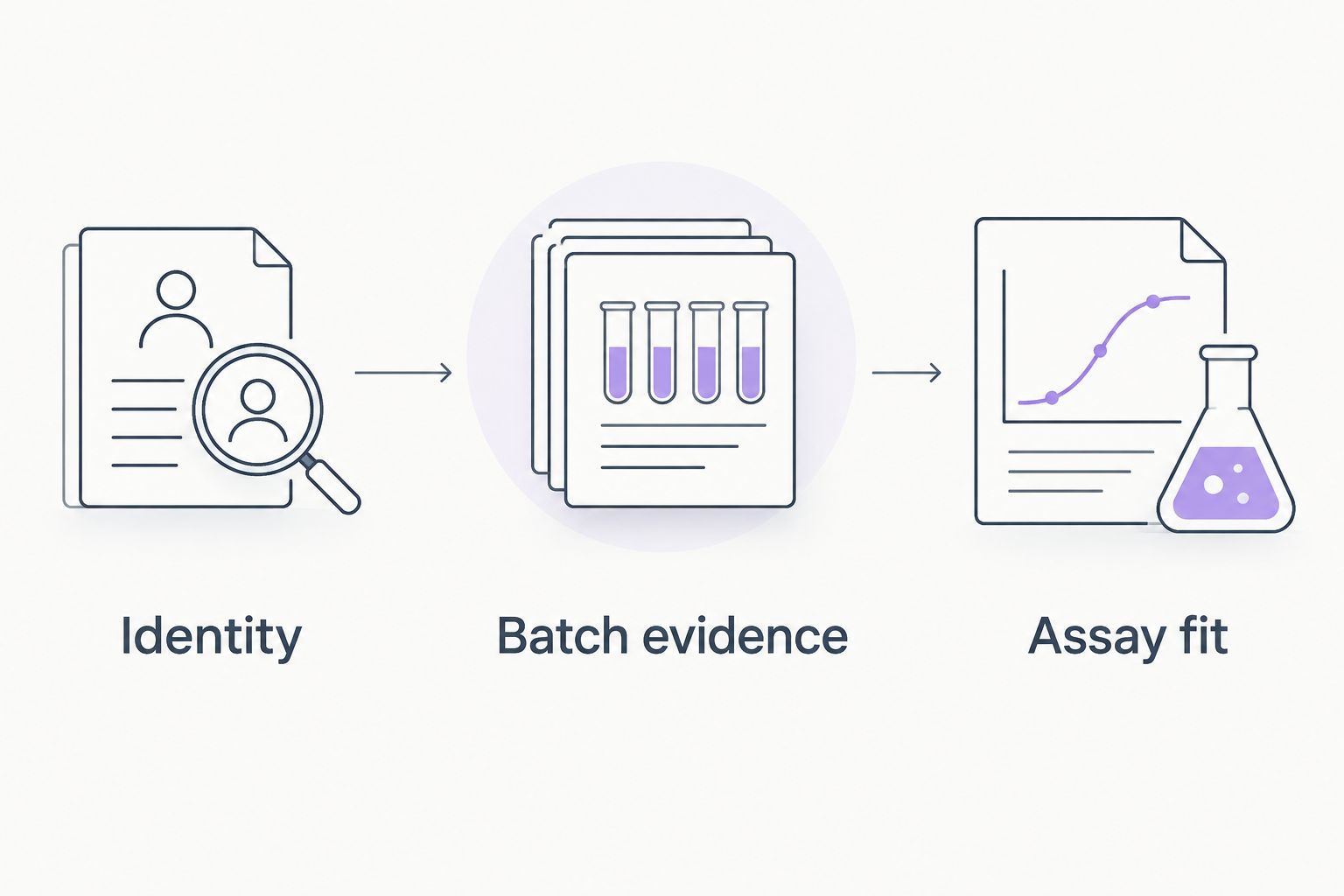
Qualify a candidate through three procurement gates
Use this sequence for your 2026 purchasing review. Each gate answers a different question; passing one does not waive the others.
Identity
Write down the exact molecule your experiment requires. Compare the offered sequence, modifications, and expected molecular mass against that specification. Stop if the documents describe different substances under the same short name.
Batch evidence
Connect the proposed lot to its certificate and supporting analytical results. Check that identifiers agree across the documents. If independent analysis is required, preserve that sample’s connection to the original lot.
Assay fit
Compare the available evidence with your protocol’s acceptance criteria. Determine whether additional qualification is required before release. Keep material that has not passed this review separate from approved experimental reagents.
After approval, archive four records: the purchase specification, lot-specific analytical documents, receipt and storage record, and preparation record. This is a recordkeeping recommendation, not a claim that every experiment needs an identical quality system. Follow your institution’s requirements where they are more specific.
How the options are ranked
The ranking prioritizes exact identity, lot-linked evidence, interpretable analysis, assay suitability, and traceable handling. Sequence-verified, lot-documented material comes first because it connects the intended reagent to the supplied batch.
Independent characterization earns priority when your research question requires it. Documentation-pending candidates remain sourcing leads until they meet the same acceptance criteria. Neither a purity headline nor a familiar supplier name changes those rules.
Which TB-500 research option should you choose?
Choose sequence-verified, lot-documented material as the default for a defined laboratory protocol. Add independent characterization when the experiment requires an additional check, and hold candidates that cannot establish identity or traceability.
For a Peptides777 sourcing inquiry, request evidence for the specific material and lot under consideration. Keep supplier selection separate from experimental approval. Your protocol determines what documentation is sufficient—not the product title.
FAQ
What's the best way to choose TB-500 peptides for research?
Choose material with an exact molecular specification, lot-specific identity and purity evidence, and documentation that meets your assay requirements. Approve the supplied batch against written acceptance criteria before experimental use.
Is TB-500 the same as thymosin beta-4?
Do not assume the names identify the same molecular material. Full-length thymosin beta-4 contains 43 amino-acid residues; compare the exact sequence and modifications with your research method.
Does 99% purity prove that a peptide is suitable for my experiment?
No. A purity result does not independently establish identity, peptide content, sterility, endotoxin status, or suitability for your assay.
Is independent testing better than a supplier certificate?
Independent testing is useful when it addresses a defined analytical question with a traceable sample. It supplements supplier documentation rather than automatically replacing it.
What should I ask a peptide supplier before purchasing?
Request the exact sequence, modifications, lot identifier, certificate of analysis, supporting analytical results, and handling instructions. Add any assay-specific requirements before approving the purchase.
Can research-use peptides be selected for personal treatment?
No. Research-use positioning is not evidence of clinical suitability, safety, or efficacy, and this guide does not provide treatment or administration recommendations.
What should I do when the analytical documents disagree?
Hold the candidate while you investigate the discrepancy. Compare sample identities, methods, and specifications before releasing material for experimental use.
One last thing
A clean chromatogram cannot identify a peptide by itself. Confirm what the molecule is before deciding how pure it is. That order prevents a polished analytical report from answering the wrong purchasing question.