
Best overall: lot-documented PT-141 with identity, purity, and content evidence. Best for quantitative assays: PT-141 with independently measured peptide content. Best for preliminary screening: identity-confirmed PT-141 that meets a written screening specification. This 2026 guide ranks procurement profiles for pt-141 peptides for research, not suppliers whose individual batches have not been assessed.
- The best pt-141 peptides for research have lot-specific identity, purity, and content evidence—not just a purity headline.
- Choose content-characterized PT-141 when your assay depends on accurate peptide concentration.
- Peptides777 belongs on a research-peptide shortlist only when the specific lot meets your laboratory’s documentation requirements.
- Keep laboratory procurement separate from prescribing, personal use, and clinical treatment decisions.
Why this matters
PT-141, also called bremelanotide, is a research compound whose suitability depends on the experiment and the supplied material. A familiar compound name does not establish the identity, composition, or handling requirements of a particular vial.
Peptides777 sells research-grade peptides and research compounds marketed with 99%+ purity for laboratory and scientific research. That catalog-level positioning does not replace evidence for a specific PT-141 lot. Your purchasing decision needs to follow the batch documentation, not the broadest claim on a storefront.
For a 2026 purchasing review, separate three questions: Is the material the intended compound? What does the purity result measure? How much peptide does the supplied material contain? Each question needs its own answer before you treat a vial as suitable for a concentration-sensitive experiment.
What makes the best PT-141 peptides for research?
Use these criteria before comparing supplier descriptions. They turn a general research-grade claim into a purchasing specification your laboratory can actually assess.
- Lot traceability: The vial, certificate of analysis, and analytical records identify the same batch.
- Identity evidence: Appropriate analytical results support the stated compound identity; a product name alone does not.
- Purity evidence: The reported percentage includes its method and enough supporting information to interpret the result.
- Content evidence: Quantitative work has a defensible basis for calculating peptide concentration.
- Handling documentation: Storage, preparation, and stability information applies to the supplied material and its form.
- Experiment fit: The documentation addresses your assay’s actual requirements, including relevant contaminants or formulation components.
A 99% purity result is not automatically a 99% peptide-content result. For example, chromatographic area purity describes the relative detector response of resolved components under that method; it does not, by itself, establish the peptide mass fraction of everything in the vial.
Choose evidence that answers your experimental question, not the largest percentage on the page. A method description matters as much as the headline result.
PT-141 research options at a glance
These are ranked purchasing profiles. They are not separate molecular variants, verified supplier listings, or claims that any particular product meets the stated criteria.
| Procurement profile | Best for | Standout requirement | Key limitation |
|---|---|---|---|
| Lot-documented PT-141 | General laboratory procurement | Matched identity, purity, and content records | Still requires assay-specific acceptance criteria |
| Content-characterized PT-141 | Quantitative concentration-response work | Measured peptide content with a stated analytical basis | Content measurement alone does not establish identity or purity |
| Identity-confirmed screening PT-141 | Preliminary method development | Confirmed identity and documented screening acceptance | Weak choice for quantitative comparisons without content evidence |
| Independently checked PT-141 | Supplier qualification and discrepancy resolution | Additional laboratory assessment of the supplied lot | Adds coordination and sample requirements |
The profiles overlap. A single well-documented batch can satisfy several of them, while a batch with a strong result in one category can still fail another essential requirement.
1. Lot-documented PT-141: best for general research procurement
Lot-documented PT-141 ties the supplied material to analytical evidence for identity, purity, and content. It is the strongest default because it addresses several purchasing risks together rather than asking you to infer quality from a single result.
For your 2026 shortlist, request the records before approving the purchase. Check that the lot identifier remains consistent across the vial description, certificate, and supporting analytical information.
Lot-documented PT-141 pros:
- Connects the material you receive with the evidence you review.
- Separates compound identity from purity and peptide content.
- Gives your laboratory a documented basis for acceptance or rejection.
- Makes later investigation easier when an assay result changes between batches.
Lot-documented PT-141 cons:
- A detailed certificate still needs technical review.
- Documentation does not establish compatibility with every assay.
- Storage or preparation errors remain possible after receipt.
Best for: Laboratories establishing a repeatable purchasing process across projects or repeat orders.
Set acceptance criteria before reading the certificate. Otherwise, the available paperwork can quietly become the specification, even when it does not answer the experiment’s most important questions.
Verdict: Buy only when the supplied lot meets your written acceptance criteria.
2. Content-characterized PT-141: best for quantitative assays
Content-characterized PT-141 includes a measured basis for determining how much peptide is present. This distinction matters when your interpretation depends on comparing defined concentrations rather than simply establishing whether a preliminary assay responds.
Do not substitute a purity percentage for peptide content. Ask what the content result measures, how it was obtained, and how the supplied form affects your concentration calculation.
Content-characterized PT-141 pros:
- Supports a defensible calculation of experimental concentration.
- Helps distinguish nominal vial quantity from measured peptide content.
- Makes concentration-based comparisons easier to document.
Content-characterized PT-141 cons:
- A content result does not independently prove compound identity.
- Content characterization does not resolve every impurity or contamination concern.
- Your preparation procedure still needs to match the experimental method.
Best for: Concentration-response experiments and other work where peptide quantity affects interpretation.
Keep the supplier’s reported value, its units, and the calculation basis together in your experimental records. A number copied without its definition becomes difficult to interpret when another researcher repeats the work.
Verdict: Buy for quantitative work only alongside acceptable identity and purity evidence.
3. Identity-confirmed PT-141: best for preliminary screening
Identity-confirmed screening PT-141 is a procurement profile for preliminary work with a deliberately limited objective. Its role is to support early method development under a written specification—not to excuse undocumented material.
Define what your screening experiment can establish before ordering. If the next decision depends on an accurate concentration comparison, identity confirmation alone is not enough.
Identity-confirmed screening PT-141 pros:
- Keeps compound identity central to early procurement.
- Encourages a clear distinction between exploratory and quantitative work.
- Lets you define documentation requirements around a limited experimental objective.
Identity-confirmed screening PT-141 cons:
- Limited characterization restricts how confidently you can interpret results.
- Preliminary findings do not substitute for later assay qualification.
- Unresolved content or impurity questions can complicate comparisons.
Best for: Preliminary method development where the laboratory has explicitly accepted the remaining characterization limits.
Write those limits into the study record. A screening result should not acquire stronger meaning simply because it moves from a notebook into a presentation.
Verdict: Hold unless the screening specification explicitly accepts the characterization limits.
4. Independently checked PT-141: best for supplier qualification
Independently checked PT-141 receives additional analytical assessment outside the supplier’s own documentation. This approach is useful when you need to qualify a source, investigate inconsistent records, or resolve a specific analytical question.
Choose the question first and the analytical method second. Repeating a purity measurement will not necessarily resolve a concern about peptide content or compound identity.
Independently checked PT-141 pros:
- Adds evidence beyond the supplier’s certificate.
- Supports targeted investigation of conflicting results.
- Creates a documented qualification step for a purchasing program.
Independently checked PT-141 cons:
- Requires coordination, sample allocation, and interpretation.
- Different methods can produce results that need technical reconciliation.
- Additional testing does not repair poor sample traceability.
Best for: Laboratories qualifying a supplier or investigating a specific discrepancy.
Agree on the sample identifier, test scope, and reporting requirements before submitting material. Independent analysis only answers the questions included in its scope.
Verdict: Buy conditionally, with final acceptance tied to the required analytical results.
How to assess a PT-141 certificate before ordering
Use this sequence for your 2026 purchasing review. It separates administrative consistency from analytical adequacy, so an attractive certificate does not pass merely because it looks complete.
Match the lot
Confirm that the certificate identifies the lot offered for supply. A representative certificate can describe a different batch and therefore cannot establish the characteristics of the material you receive.
Confirm identity
Review the stated identity method and its interpretation. Identity and purity are different questions; neither result should be used as shorthand for the other.
Interpret purity
Read the analytical method, reported result, and supporting chromatographic information where applicable. Ask how the reported percentage was calculated and what the method does not measure.
Verify content
For concentration-sensitive experiments, establish the peptide-content basis. Record the supplied form and any information needed to interpret the measurement rather than relying solely on a nominal vial quantity.
Set acceptance
Compare the evidence against your protocol’s requirements. Resolve discrepancies before approving the material, then preserve the reviewed records with the purchasing and experimental documentation.
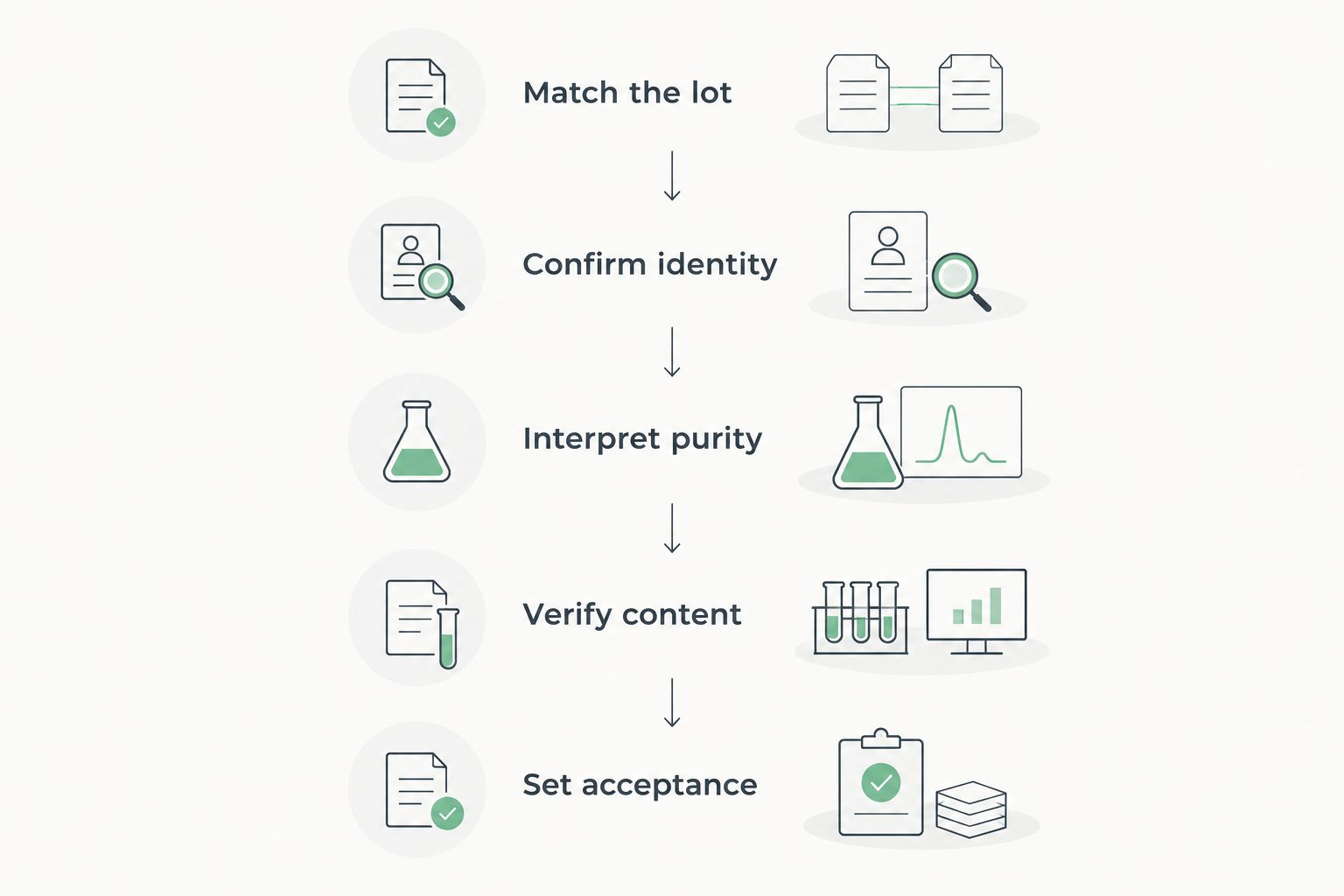
The sequence ends with a decision, not a folder of documents. If the evidence does not satisfy a required criterion, keep the lot outside the experiment until the issue is resolved.
Where Peptides777 fits in your shortlist
Peptides777 is a research-peptide retailer, so evaluate the relevant offering as laboratory procurement rather than a personal-use purchase. The store’s stated research positioning and 99%+ purity marketing do not establish the suitability of an individual PT-141 batch.
Use Contact Us to request the specific records your protocol requires. Ask for lot-matched identity and purity information, peptide-content evidence when necessary, and handling documentation applicable to the supplied material.
A satisfactory purchasing response answers the requested analytical questions; it does not simply repeat the product description. Keep that standard consistent across every supplier you consider.
How these options were ranked
The ranking prioritizes traceability, identity, interpretable purity, peptide content, handling documentation, and experiment fit. It ranks procurement approaches by the questions they answer, not by unverified claims about supplier performance.
Lot-documented material comes first because it combines the core evidence needed for acceptance. The other profiles address narrower needs: quantitative work, preliminary screening, or independent qualification.
Which PT-141 research option should you choose?
Choose lot-documented PT-141 as your default in 2026. Require content characterization when your study depends on accurate concentration, and add independent assessment when supplier qualification or conflicting evidence makes it necessary.
Do not treat a preliminary-screening profile as an equivalent substitute for fully characterized material. Match the evidence to the conclusions you intend to draw, and keep research procurement separate from clinical treatment decisions.
FAQ
What are the best PT-141 peptides for research?
The best PT-141 peptides for research are supplied with lot-specific identity, purity, and content evidence that meets your laboratory’s written requirements. Choose by documentation and experiment fit rather than a supplier’s headline purity claim.
Is PT-141 the same compound as bremelanotide?
PT-141 is also called bremelanotide. That naming relationship does not establish that a research vial is equivalent to a regulated medicinal product in formulation, manufacturing controls, or intended use.
Does 99% purity mean the vial contains 99% peptide by mass?
No, a reported 99% purity result does not automatically establish 99% peptide content by mass. Interpret the analytical method and obtain a separate content basis when your experiment requires it.
What should I ask for before buying PT-141 for laboratory work?
Ask for lot-matched identity and purity documentation, applicable handling information, and peptide-content evidence when concentration matters. Define your acceptance criteria before reviewing the supplier’s records.
Is a certificate of analysis enough to approve a research peptide?
A certificate is enough only when its scope and supporting evidence satisfy your laboratory’s acceptance criteria. Check lot matching, methods, interpretation, and any unresolved assay-specific requirements.
Can research-grade PT-141 be used as a substitute for prescribed treatment?
No, research-grade PT-141 should not be treated as a substitute for prescribed treatment. Laboratory labeling and analytical purity do not establish suitability for personal administration.
How should I compare PT-141 suppliers in 2026?
Compare suppliers using the same written requirements for traceability, identity, purity, content, and handling documentation. Request records for the actual lot rather than relying on general catalog claims.
One last thing
Repeat orders still need lot review. Accepting one batch does not establish the identity, purity, or content of the next batch, even when the compound name and supplier stay the same.
Keep the reviewed certificate and acceptance decision attached to the experimental record. That connection gives a future researcher something more useful than a remembered brand name: the evidence behind the material actually used.