
Best overall: lot-documented, single-compound Hexarelin. Best for analytical comparison: qualified Hexarelin reference material. Best for combination experiments: separately characterized research compounds. Choose hexarelin peptides for research in 2026 by identity, batch documentation, and experimental fit—not a purity headline alone.
- Choose hexarelin peptides for research with lot-specific identity and purity documentation, not an unsupported percentage.
- Single-compound Hexarelin is the default for experiments that need an interpretable compound-specific result.
- Qualified Hexarelin reference material serves analytical comparison; it does not replace biological assay controls.
- Peptides777 sells research peptides for laboratory use; assess each candidate against your protocol before ordering.
Why this matters
Hexarelin is a synthetic peptide containing six amino acid residues and is studied as a growth hormone secretagogue receptor agonist. Its experimental role does not make research material suitable for personal use. This guide addresses laboratory procurement, not treatment, dosing, or self-administration.
Peptides777 sells research-grade peptides, bioregulators, and research compounds. Peptides777 is a research-peptide sourcing option for laboratory buyers, not a source of products for human use. That distinction belongs at the start of your purchasing decision, before formulation or assay design.
For a 2026 procurement decision, separate the compound's identity from the evidence attached to the material. A familiar peptide name identifies the intended substance; it does not establish what a particular vial contains or whether its documentation supports your experiment.
What makes the best Hexarelin peptides for research?
Use these criteria before comparing suppliers or selecting a material format:
- Identity evidence: Look for analytical evidence addressing whether the material matches Hexarelin, rather than treating a product label as confirmation.
- Lot traceability: Match the certificate of analysis, container label, and purchasing record to the same batch identifier.
- Purity method: Read what the reported percentage measures, including the analytical method and its reporting basis.
- Quantity basis: Distinguish nominal vial content from measured peptide content. A chromatographic purity result is not a concentration measurement.
- Handling documentation: Require instructions relevant to the supplied material, your solvent system, and the planned experiment.
- Experimental fit: Choose single-compound material, reference material, or a combination-study approach according to the question being tested.
Keep identity and purity as 2 separate analytical questions. Mass spectrometry can support molecular identity, while chromatography can characterize the measured component profile; neither result alone establishes every property relevant to an assay.
A research peptide described as highly pure is not automatically sterile, endotoxin-controlled, or suitable for clinical use. Those are separate attributes requiring separate evidence.
Hexarelin research options at a glance
These rankings compare procurement approaches, not named supplier products. Each approach serves a different experimental purpose.
| Rank and option | Best for | Standout feature | Key limitation |
|---|---|---|---|
| 1. Lot-documented, single-compound Hexarelin | Compound-specific biological experiments | Keeps the intended test compound separate from other active compounds | Still requires assay controls and fit-for-purpose qualification |
| 2. Qualified Hexarelin reference material | Analytical method comparison | Provides a documented comparator for a defined analytical purpose | Reference status does not establish suitability for every biological assay |
| 3. Separately characterized research compounds | Planned combination experiments involving Hexarelin | Allows individual compounds and their combination to be evaluated separately | Adds experimental conditions and interpretation requirements |
The default in 2026 is single-compound Hexarelin with traceable documentation. Choose another approach only when the experimental objective specifically requires it.
1. Single-compound Hexarelin: best for compound-specific assays
Single-compound Hexarelin is the clearest starting point when your experiment asks what Hexarelin does within a defined model. Keeping other active compounds out of the test material removes a source of ambiguity, although it does not remove the need for vehicle controls, assay validation, or material qualification.
Review the lot-specific analytical record before committing the material to an experiment. Match the stated identity, batch identifier, and analytical results rather than relying on a general quality statement across a supplier's catalog.
Single-compound Hexarelin pros:
- Supports a direct comparison between the intended compound and the relevant controls.
- Avoids introducing another active compound through a premixed formulation.
- Allows procurement records to connect the tested material with its analytical documentation.
- Provides a straightforward starting point for subsequent combination studies.
Single-compound Hexarelin cons:
- A single-compound label does not prove identity, content, or freedom from contaminants.
- Documentation alone does not establish compatibility with your biological model.
- Preparation and handling can introduce variation after the material reaches your laboratory.
Best for: Researchers running experiments intended to isolate Hexarelin-specific effects.
Before selecting material, ask whether your protocol needs evidence beyond routine identity and purity characterization. Cell-based work, for example, can require additional attention to contamination and vehicle effects. Define those requirements in the protocol rather than assuming the supplier's standard documents cover them.
Verdict: Buy lot-documented single-compound Hexarelin when its analytical evidence and handling requirements meet your protocol.
2. Qualified Hexarelin reference material: best for analytical comparison
Qualified Hexarelin reference material serves as a comparator for a stated analytical purpose. Its value comes from the documented properties relevant to that purpose, not merely from carrying the words reference material.
For a 2026 method-development project, check what has actually been assigned or characterized. Identity confirmation, purity assessment, and quantitative calibration are different tasks; a material qualified for one task is not automatically qualified for all of them.
Qualified Hexarelin reference material pros:
- Supports comparison against a material with a defined analytical role.
- Helps separate questions about the test sample from questions about method performance.
- Provides a basis for documenting why a particular comparator was selected.
Qualified Hexarelin reference material cons:
- A reference material without an appropriate assigned content value does not establish quantitative accuracy by itself.
- Analytical suitability does not establish sterility or suitability for biological experiments.
- Handling or preparation errors can compromise the comparison despite appropriate source documentation.
Best for: Analytical laboratories comparing identity, developing methods, or evaluating samples against a defined comparator.
Read the accompanying documentation for the intended use, assigned properties, uncertainty where applicable, and handling conditions. Do not substitute an ordinary research vial for a qualified comparator solely because both labels name Hexarelin.
Verdict: Buy qualified Hexarelin reference material for the analytical purpose its documentation supports; skip unsupported reference claims.
3. Separate research compounds: best for combination experiments
Separately characterized compounds are the stronger starting point when your research question concerns Hexarelin alongside another compound. Keeping the components separate allows you to establish individual-compound conditions before evaluating their combination.
A premixed preparation ties its components together before the experiment begins. That format does not, by itself, reveal which component accounts for an observed response or whether the combination behaves differently from either component alone.
Separate research compounds pros:
- Allow individual compounds and the combination to have distinct experimental conditions.
- Preserve separate documentation for each material.
- Let the protocol define the combination rather than accepting a fixed mixture as the experimental design.
Separate research compounds cons:
- Require additional preparation and recordkeeping.
- Introduce more handling steps and opportunities for preparation error.
- Need a design that accounts for vehicle compatibility and the interpretation of combined effects.
Best for: Laboratories with a defined combination hypothesis and the controls needed to evaluate it.
Write the comparison plan before selecting the materials. If your central question concerns Hexarelin alone, a combination adds complexity without answering that question more directly. If the central question concerns an interaction, individual-compound controls become part of interpreting the result.
Verdict: Buy separately characterized compounds for a planned combination study; skip mixtures as a shortcut to compound-specific conclusions.
Read a Hexarelin certificate before accepting the lot
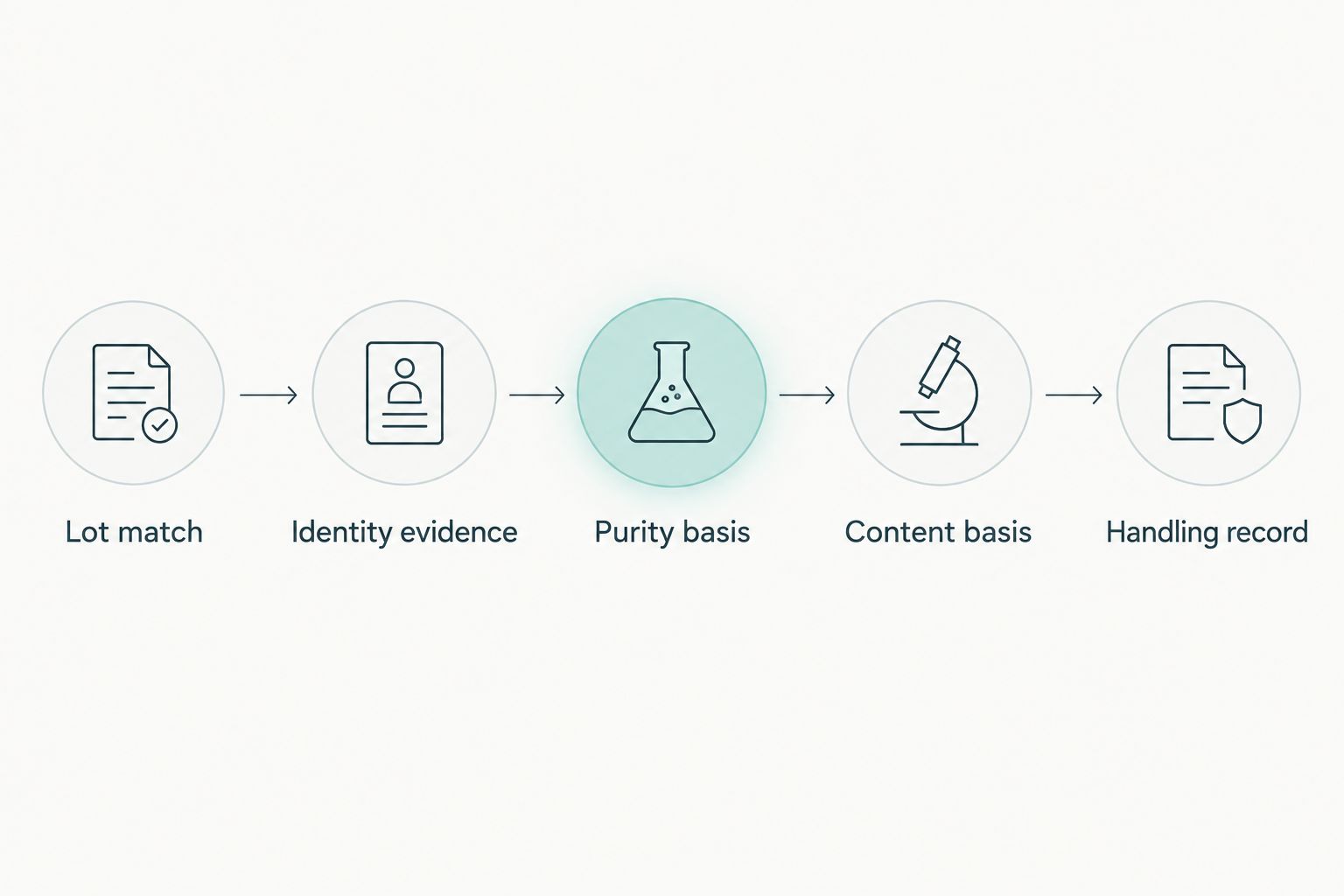
Use this sequence when reviewing hexarelin peptides for research. It turns a supplier document into a procurement check rather than a decorative attachment.
Lot match
Require 1 matching lot identifier across the container and its analytical documentation. A certificate for a different batch does not characterize the vial you will test. Keep the purchasing record with the lot record so a later experiment remains traceable.
Identity evidence
Check whether the evidence addresses the claimed molecular identity. A chromatogram alone does not establish the peptide sequence, and a matching mass alone does not exclude every possible impurity or structural alternative.
Purity basis
Read the method behind the percentage. Chromatographic area percentage describes the relative measured signal under specified conditions; it is not automatically the fraction of the vial's total mass that is active peptide.
Content basis
Identify what the stated quantity represents. Residual water, counterions, and other constituents matter when converting nominal material mass into an experimental concentration. Use an appropriate content determination when the protocol requires quantitative accuracy.
Handling record
Follow the documented handling conditions and record preparation details. Do not transfer a storage or preparation rule from an unrelated peptide simply because both materials arrive in similar containers.
In 2026, keep this review attached to the actual lot decision. A supplier's general quality description and a batch-specific analytical record answer different questions; the latter connects evidence to the material entering your experiment.
How to assess Peptides777 for research-peptide sourcing
Peptides777 markets research-grade peptides with 99%+ purity for laboratory and scientific research use. Treat that statement as a reason to examine the supporting analytical documentation, not as proof of every quality attribute your protocol requires.
For any candidate material, ask for the lot-specific identity and purity evidence, the quantity basis, and the relevant handling information. Keep supplier selection separate from experimental approval: a purchasing decision does not establish that the material meets every requirement of your study.
The practical limitation is the research-use scope. Do not interpret a research-grade description or purity claim as evidence of clinical suitability, human safety, or a treatment benefit.
Check documentation before selecting material
Ask about lot-specific identity, purity methods, quantity basis, and handling documentation.
How these options were ranked
The ranking prioritizes interpretable experiments, traceable materials, and documentation matched to the intended use. Single-compound material ranks first for compound-specific work; reference material serves analytical comparison; separate compounds serve combination experiments.
This is a purpose-based buying framework, not a claim that one supplier's Hexarelin outperforms another. Choose the evidence package that answers your experimental question, not the most emphatic product description.
Which Hexarelin research option should you choose?
For most compound-specific protocols, start with lot-documented, single-compound Hexarelin. Select qualified reference material when your primary task is analytical comparison, and select separate compounds when your protocol explicitly investigates a combination.
For your 2026 purchasing specification, write down the intended use, required analytical evidence, quantity basis, and acceptance criteria before reviewing candidates. That order prevents an attractive listing from becoming the basis of the protocol.
FAQ
What's the best Hexarelin format for a compound-specific experiment?
Lot-documented, single-compound Hexarelin is the default for compound-specific experiments. It avoids adding another active compound, but you still need appropriate controls and material qualification.
Does 99% purity mean a Hexarelin vial is sterile?
No. A purity result does not establish sterility, endotoxin status, or clinical suitability; those properties require separate evidence.
Is a Hexarelin certificate of analysis enough to approve a purchase?
A certificate supports a purchase only when it matches the lot and addresses your acceptance criteria. Review identity, purity method, quantity basis, and handling information rather than accepting the document's title alone.
Is Hexarelin reference material better than ordinary research material?
Qualified Hexarelin reference material is better suited to the analytical purpose documented for it. That does not make it the best choice for every biological experiment or establish human-use suitability.
Should I choose a Hexarelin blend for combination research?
Separately characterized compounds give you more control over a combination study's design. They allow individual-compound conditions to be compared with the combination instead of relying on a premixed preparation alone.
Can research-grade Hexarelin be used for personal treatment?
Research-grade Hexarelin is not a basis for personal treatment. Laboratory-use labeling and analytical purity do not establish safety or suitability for human administration.
What should I ask Peptides777 before choosing research peptides?
Ask Peptides777 for documentation relevant to the candidate material and your protocol. Prioritize lot-specific identity evidence, the purity method, the stated quantity basis, and handling instructions.
One last thing
A highly pure sample and an accurately prepared concentration are different achievements. Even a strong chromatographic result does not tell you how much peptide reached your final assay solution. Carry the content basis, preparation record, and lot identifier into the experiment—not just the purity percentage.