

Best overall: batch-characterized DSIP reference material. Best for formulation control: lyophilized DSIP with validated handling instructions. Best for an established assay: a characterized DSIP solution with a compatible vehicle. Choose DSIP peptides for sleep research by identity, batch documentation, and experimental fit—not by promises about better sleep.
- For DSIP peptides for sleep research, prioritize batch-specific identity and purity evidence over sleep-related marketing.
- Batch-characterized DSIP reference material is the default choice when a documented comparator is the main requirement.
- Choose lyophilized DSIP for formulation control; choose prepared solutions only when vehicle compatibility is established.
- Peptides777 sells research-use compounds; evaluate any DSIP candidate separately from store-wide purity claims.
Why this matters
DSIP stands for delta sleep-inducing peptide, a peptide containing 9 amino acids. Its name does not establish that a particular preparation improves sleep, reproduces a published result, or belongs in a human treatment protocol.
Peptides777 is best considered a research-compound sourcing option, not a source of sleep-treatment recommendations. The store markets research-grade compounds with 99%+ purity, but that general positioning does not replace documentation for the exact material and lot you intend to study.
For a 2026 purchasing decision, separate two questions: Is this the material your protocol requires, and can your experiment measure the proposed effect? A well-characterized peptide cannot rescue an unsuitable study design. An appropriate endpoint cannot compensate for uncertain material identity.
What makes the best DSIP peptides for sleep research
Use these criteria before comparing formats or suppliers:
- Identity evidence: The documentation should support the peptide's identity, not merely display its name on a label. Mass spectrometry and chromatographic analysis answer different analytical questions.
- Batch traceability: Match the certificate of analysis, container label, and purchase record to the same lot. A representative certificate does not characterize every batch.
- Purity interpretation: Read the analytical method and reported result together. Chromatographic purity, peptide content, and biological activity are different properties.
- Protocol compatibility: Specify the required form, vehicle, concentration basis, and handling conditions before choosing material.
- Handling documentation: Require preparation, storage, and stability information appropriate to the actual formulation. Do not transfer instructions between unrelated peptides.
- Research boundaries: Keep procurement and experimental planning separate from personal sleep use. Research-use labeling does not establish clinical suitability.
The best DSIP material is the material whose identity, composition, and handling fit the experiment you can actually run. A high percentage on a product page answers only part of that question.
DSIP research options at a glance
These are procurement profiles, not interchangeable grades or named commercial products. A lyophilized preparation or a prepared solution can also be batch-characterized; the ranking below assigns each profile a different purchasing priority.
| Research option | Best for | Standout requirement | Key limitation |
|---|---|---|---|
| Batch-characterized DSIP reference material | A documented experimental comparator | Lot-specific identity and characterization records | Characterization does not establish biological activity |
| Lyophilized DSIP | Methods requiring formulation control | Validated reconstitution and handling instructions | Preparation introduces additional variables |
| Characterized DSIP solution | An established assay with a defined vehicle | Documented concentration, vehicle, and stability | Less flexibility to change formulation |
For this 2026 comparison, “best” means the closest match to a defined laboratory requirement. It does not mean strongest sleep effect, clinical effectiveness, or suitability for self-administration.
1. Batch-characterized DSIP: best for a documented comparator
Batch-characterized DSIP reference material puts analytical documentation ahead of convenience. The purchasing objective is a traceable comparator with identity and composition records that your laboratory can evaluate.
Use this profile when your experiment depends on explaining exactly what material entered the assay. Treat “reference material” as a documentation requirement, not an automatic claim of certification or metrological traceability.
Batch-characterized DSIP pros
- Lot-specific records connect analytical results to the material used.
- Identity testing helps distinguish peptide identification from a purity claim.
- A documented comparator supports clearer methods reporting and investigation of unexpected results.
Batch-characterized DSIP cons
- Analytical characterization alone does not demonstrate activity in your experimental model.
- Different analytical methods characterize different attributes; one result does not describe the entire preparation.
- Additional application-specific checks remain necessary when the experiment has requirements beyond the supplied characterization.
Best for: Laboratories prioritizing a documented comparator over preparation convenience.
Before selecting this option, compare the stated peptide identity with your protocol and inspect the actual lot record. Ask whether the reported purity describes chromatographic peak area, whether peptide content is reported separately, and whether other relevant attributes are characterized.
Do not interpret “reference” as permission to skip controls. Your assay still needs an appropriate comparison condition and a defined measurement plan.
Verdict: Buy when the batch characterization matches the comparator specification; skip materials supported only by a generic certificate.
2. Lyophilized DSIP: best for formulation control
Lyophilized DSIP is supplied as freeze-dried material rather than an already prepared solution. Its main purchasing advantage is the opportunity to prepare a formulation that fits a validated laboratory method.
This option belongs in a workflow with documented preparation procedures. Physical appearance cannot establish identity, purity, peptide quantity, or successful reconstitution.
Lyophilized DSIP pros
- Lets the laboratory select a compatible vehicle within validated preparation instructions.
- Supports preparation around a protocol-defined concentration rather than an unsuitable supplied concentration.
- Allows formulation decisions to remain part of the laboratory's controlled method.
Lyophilized DSIP cons
- Reconstitution adds handling steps and opportunities for preparation error.
- The stated mass does not, by itself, explain peptide content or every component present.
- Storage and stability assumptions must be checked for both the supplied material and the prepared solution.
Best for: Method development where formulation control is a defined requirement.
Choose this profile because your method needs that control, not because dry material is automatically purer or more effective. A freeze-dried appearance is a physical form, not a quality grade.
Record the preparation conditions and the material's history after reconstitution. If your study compares treatment conditions, preparation differences should not become an untracked explanation for the result.
Verdict: Buy when formulation control is necessary and handling instructions support your method; hold when preparation conditions remain undefined.
3. Characterized DSIP solution: best for an established assay
A characterized DSIP solution arrives in a specified vehicle at a stated concentration. Its strongest use case is an existing assay whose requirements already match that formulation.
Convenience is useful only after compatibility is established. The vehicle, concentration basis, storage history, and documented stability all belong in the selection decision.
Characterized DSIP solution pros
- Removes the initial reconstitution step from the laboratory workflow.
- Provides a defined starting formulation when concentration and vehicle are documented.
- Fits established methods that already specify a matching solution format.
Characterized DSIP solution cons
- The supplied vehicle limits formulation flexibility.
- Dilution changes peptide concentration but does not remove vehicle components.
- A concentration statement does not establish stability throughout transport, storage, and experimental use.
Best for: Laboratories running an established assay with verified formulation compatibility.
Inspect the complete formulation rather than the peptide name alone. A vehicle-only control helps distinguish effects associated with the formulation from effects associated with the peptide-containing condition.
Do not choose a solution simply to avoid planning. If the assay requires a different vehicle, selecting the matching material is more defensible than improvising around an incompatible formulation.
Verdict: Buy when the documented solution matches the established assay; skip when vehicle composition or stability is unclear.
How to check a DSIP candidate before ordering
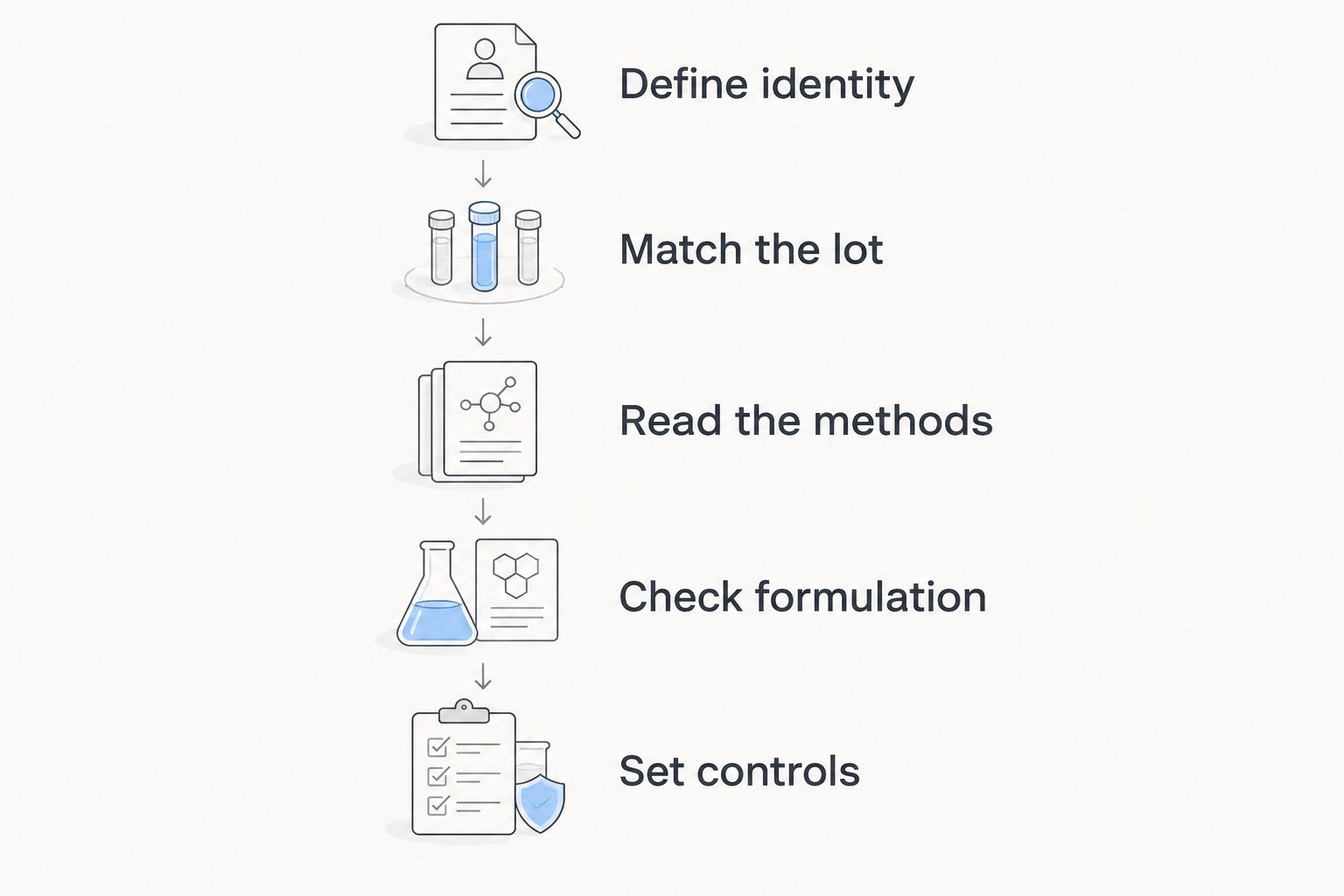
Use this sequence for a 2026 procurement review. Resolve each requirement before treating the next one as settled.
- Define identity. Write down the peptide identity and any required form. Similar names are not a substitute for matching the material specification.
- Match the lot. Confirm that the certificate and container refer to the same batch. Keep those records with the experiment.
- Read the methods. Examine what the identity and purity methods actually measure. A percentage without its analytical context is incomplete.
- Check formulation. Compare vehicle, concentration basis, and handling instructions with the protocol. Resolve incompatibilities before ordering.
- Set controls. Specify the comparison conditions and endpoints before exposure. Do not decide what counts as success after seeing the result.
Keep the purchase record, certificate, preparation record, and experimental identifier connected. Traceability is most useful when an unexpected finding requires you to distinguish a material problem from a preparation or measurement problem.
What a purity claim does—and does not—tell you
Peptides777 markets its research compounds with 99%+ purity. Evaluate that statement at the product and batch level rather than treating it as a complete specification for DSIP.
Chromatographic purity commonly describes the relative contribution of detected peaks under a particular method. It is not automatically the percentage of the container's mass that consists of the target peptide, and it does not establish sterility, endotoxin status, or biological potency.
Ask for 2 complementary analytical methods—such as mass spectrometry for identity and chromatography for separation—when those methods fit your material specification. This is a purchasing criterion, not proof that every preparation requires the same testing panel.
For your 2026 methods file, distinguish these statements:
- Identity: Evidence supports which peptide is present.
- Purity: A stated analytical method characterizes detected impurities or components.
- Content: A measurement describes how much target peptide is present.
- Activity: An appropriate experiment evaluates a biological response.
Do not convert an analytical purity result into a claim about sleep performance. Those are different questions requiring different evidence.
How the options are ranked
This ranking prioritizes identity evidence, traceability, protocol compatibility, and handling requirements. Batch-characterized material takes the default position because a documented comparator is a clear starting requirement; dry material and prepared solutions take narrower slots based on workflow needs.
The ranking does not compare clinical outcomes or claim that a physical format produces stronger effects. For a 2026 study, your protocol determines the winning specification—not the position of a format in a buying guide.
Which DSIP research option should you choose?
Choose batch-characterized DSIP when you need a defensible default comparator. Choose lyophilized material when formulation control is part of the method, and choose a prepared solution only when the established assay matches its documented composition.
Peptides777 belongs in a research-use sourcing review, with any candidate assessed against the same batch and protocol requirements. Keep the decision tied to records you can retain and conditions you can reproduce.
If no candidate satisfies the specification, postpone selection rather than relaxing the specification to match a listing. A convenient purchase is not a substitute for an interpretable experiment.
FAQ
What's the best DSIP peptide for sleep research?
Batch-characterized DSIP is the default choice when a documented experimental comparator is the main requirement. The final selection must match the protocol's identity, formulation, handling, and analytical requirements.
Is lyophilized DSIP better than a prepared solution?
Neither format is universally better. Lyophilized DSIP suits methods requiring formulation control, while a prepared solution suits an established assay with matching vehicle and concentration requirements.
Does 99% purity mean DSIP is effective for sleep?
No. An analytical purity result does not establish a sleep effect, clinical benefit, or suitability for human use; those questions require separate evidence.
What should I check on a DSIP certificate of analysis?
Check that the lot identifier matches the container and that the certificate states the analytical methods and results. Distinguish identity, chromatographic purity, peptide content, and any application-specific testing rather than treating them as equivalent.
Can I use research-grade DSIP to treat insomnia?
Research-grade DSIP is not a basis for self-treating insomnia. Research-use material should remain within appropriate laboratory work, and personal sleep concerns belong with a qualified healthcare professional.
How should a laboratory store DSIP?
Follow validated instructions for the exact material and formulation. Do not assume that dry material and a reconstituted solution share the same storage conditions or stability.
What matters more than the DSIP product name?
The batch specification and its fit with the experiment matter more than the product name. Identity evidence, formulation compatibility, traceability, and appropriate controls determine whether the material supports interpretable work.
One last thing
A vehicle control can matter more than a second product comparison. If two preparations introduce different vehicles, comparing their experimental results does not isolate peptide-related differences.
Before your next 2026 purchase, write the control condition beside the material specification. That small planning step keeps the buying decision connected to the question the experiment is supposed to answer.